
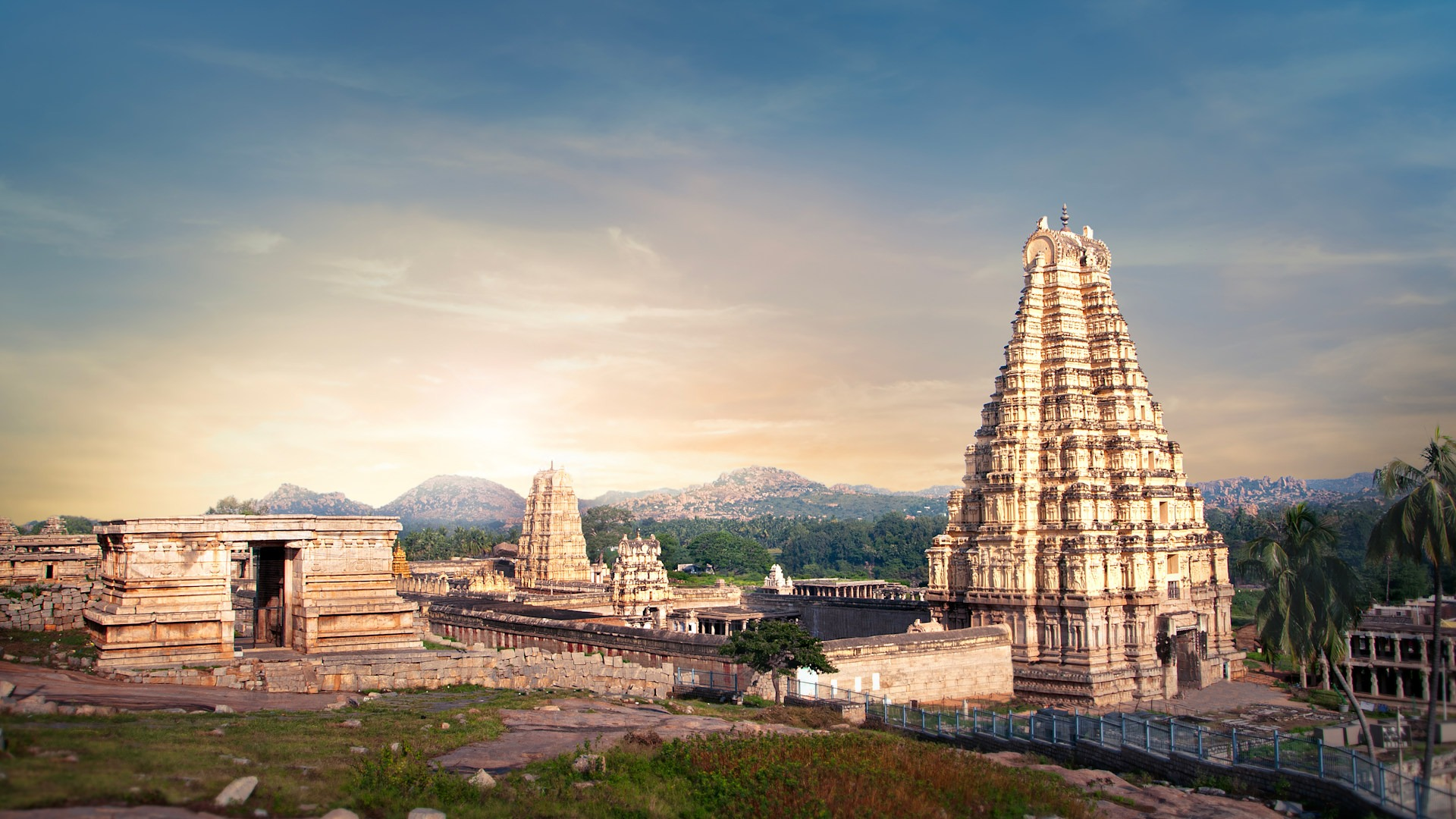
South India operates as one of the most production-capable regions in Asia. Four distinct film industries — Tollywood in Hyderabad, Kollywood in Chennai, Sandalwood in Bengaluru, and Mollywood in Kerala — run in parallel, each with its own crews, studio infrastructure, and location networks. For international productions, co-productions, and OTT commissions, this density translates into practical advantages: multiple production bases within a single timezone, regionally specialised crew pools, and a combined incentive landscape that is among the strongest on the subcontinent.
The region spans a geographic range few comparable production hubs in Asia can match. Within a single itinerary, a production can move from the Arabian Sea coastline of Kerala to the Deccan plateau architecture of Hyderabad, from the temple corridors of Tamil Nadu to the hill-station forests of Coorg and Ooty. What makes South India exceptional is not visual diversity alone but operational depth — the infrastructure to support large-format features, mid-budget OTT series, and ad film productions simultaneously across cities.
Why South India Works for International Productions
For an international production, choosing a shooting region involves more than scenery. It involves assessing crew availability, permit speed, studio infrastructure, post-production pipelines, and the reliability of the production services network. South India passes each of these tests — and does so across four separate production economies, not one. That structural breadth is what separates it from single-city production bases like Mumbai or narrower markets like Sri Lanka or Thailand, which lack the internal redundancy to absorb schedule disruptions without significant impact.
The four states that anchor South India’s production ecosystem — Telangana, Tamil Nadu, Karnataka, and Kerala — each operate independent film industries with their own government film bodies, incentive schemes, and infrastructure investments. In 2025 and 2026, all four have either passed or are actively implementing formal film policies. For productions planning multi-location shoots, this policy convergence matters: clearance frameworks are moving toward more uniform processes, and state-level film offices are increasingly equipped to handle foreign production enquiries directly rather than routing them through central government channels.

Four industries, one production corridor
The scale of South India’s combined industry is consistently underestimated. Tollywood alone produces over 200 features annually, making Hyderabad one of the highest-output film cities in the world by volume. Kollywood operates at comparable output, with Tamil-language productions feeding both domestic audiences and diaspora markets in Southeast Asia, the Gulf, and North America. Bengaluru’s Sandalwood industry has traditionally operated at smaller scale, but its VFX and post-production infrastructure now serves productions from across the country and internationally. Kerala’s Mollywood is the smallest of the four by volume but is arguably the most internationally regarded for narrative quality, with films regularly progressing through international festival circuits and securing global streaming distribution.
For a line producer coordinating a South India shoot, this means access to crew and talent at every production scale. A 400-person feature production can be crewed from Hyderabad and Chennai without difficulty. A 60-person OTT series shooting on location in Kerala can draw on experienced local teams who have worked on international briefs at comparable scale. The talent pipeline is self-replenishing because all four industries maintain active productions year-round, ensuring crew skills remain current and practised.
Competitive cost structure and national incentives
South India is generally 25–35% more cost-competitive than Mumbai for equivalent production days, particularly for location shoots, crew day rates, and equipment hire. Hyderabad and Chennai offer the strongest cost-to-output ratios for large-format shooting, while Bengaluru carries a modest premium for post-production services that is consistently offset by the quality and speed of its technical workflows. Kerala operates at moderate rates with a cost profile better suited to mid-budget and independent productions than to large-scale studio features.
At the national level, the 40% cash rebate for foreign productions — capped at ₹30 crore per project — applies to qualifying shoots anywhere in India, including all South India locations. State-level schemes add layered benefits on top: Karnataka offers up to ₹1 crore for qualifying co-productions, Tamil Nadu has a progressive rebate structure for productions registered under its film development policy, and Telangana maintains an infrastructure grant scheme for international productions using its purpose-built studio facilities. These incentives can be stacked in specific configurations, making South India financially competitive against established Southeast Asian incentive destinations such as Thailand and Malaysia.

City and State Production Profiles
Each of South India’s major production cities operates differently — in crew culture, infrastructure type, and the kinds of productions it handles most efficiently. Understanding those differences is essential for a line producer allocating shooting schedules, sourcing crew, and structuring a multi-city itinerary. The profiles below cover what each city offers in 2025–2026, where its strengths are concentrated, and what production types each serves best.
Productions that treat South India as a single undifferentiated production zone tend to under-utilise the region’s depth. The more productive approach is to map specific production requirements — studio space, location type, crew specialisation, post-production pipeline — to the city best equipped to deliver them, and to plan the shooting schedule around that allocation from the outset.
Hyderabad — Tollywood scale and studio infrastructure
Hyderabad is the undisputed heavyweight of South India’s production infrastructure. The city hosts Ramoji Film City, the largest integrated film studio complex in the world by area, alongside a constellation of facilities — Annapurna Studios, Prasad Labs, and newer purpose-built stages in the outer ring road zone — that give Hyderabad an indoor shooting capacity no other Indian city matches. For controlled-environment productions, large-format action shoots, and period features requiring extensive set construction, Hyderabad is the default base.

Crew depth in Hyderabad is exceptional across every department. Cinematography, production design, stunt coordination, and VFX supervision are all consistently available at international standard. The city’s crew pool has been shaped by decades of large-budget Telugu features, several of which — RRR, Baahubali, Pushpa — have crossed into global theatrical distribution. That track record means Hyderabad crews are experienced working to international delivery specifications, including multi-camera rigs, drone operations at scale, and complex wire and stunt choreography. International productions arriving in Hyderabad for the first time consistently report that the below-the-line talent density exceeds expectations.
Hyderabad also offers direct international air connectivity via Rajiv Gandhi International Airport — a significant logistics advantage for equipment-heavy shoots arriving from Europe, North America, or the Gulf. The outer ring road infrastructure handles large convoy movement efficiently between studio and location zones. Full detail on studio booking, unit base logistics, and crew sourcing for Telangana-based productions is covered in our line producer Hyderabad guide.
Studio and post-production infrastructure
Ramoji Film City alone has over 50 outdoor sets, 47 production floors, and a full-service hotel and accommodation wing for cast and crew — making it operationally self-contained for long-format shoots. Beyond Ramoji, Annapurna Studios handles premium post-production including colour grading, Dolby sound mixing, and digital intermediary workflows at standards accepted by major international distributors. Prasad Labs remains one of the busiest processing and post facilities in South India, with established pipelines for DCP delivery and streaming master preparation. Productions based in Hyderabad have access to end-to-end workflows from first shoot day through to deliverable, without routing post work through Mumbai or internationally.
Chennai — Kollywood and multilingual production base
Chennai’s production ecosystem is built around Kollywood and its extended supply chain of studios, equipment vendors, and experienced crew. The city’s studio belt — anchored by AVM Studios, Vijaya Studios, and facilities developed in the Sholinganallur corridor — handles a significant proportion of Tamil-language production and, in recent years, has absorbed increasing volumes of Hindi, Telugu, and Malayalam shoots relocating for cost or logistics reasons. For multilingual OTT series that need to shoot across multiple language versions simultaneously, Chennai offers a practical operational base.

Tamil Nadu’s broader geography adds considerably to Chennai’s value as a production hub. Locations within a three-hour radius include the temple architecture of Madurai and Thanjavur, the hill-station environments of Ooty and Kodaikanal, the distinctive coastal profile of Rameswaram and Kanyakumari, and the Chettinad heritage zone — one of the most architecturally distinctive environments in South Asia for period and visual productions. This location range, combined with Chennai’s crew and equipment base, makes Tamil Nadu one of the most versatile production states in South India. Detailed production logistics and incentive access for Tamil Nadu shoots are available through our line producer Tamil Nadu team.
Crew depth and multilingual capabilities
Chennai’s crew market is deep in traditional film production skills. Line producers here have long experience managing large-cast shoots, coordinating local union relationships, and handling permit applications across the Tamil Nadu Film Commission. Arri, RED, and Sony cinema package hire is reliably available through established equipment vendors. Rigging, lighting, and transport logistics are well-developed for both studio and location-based production. For international co-productions requiring multilingual cast management, Chennai’s production services infrastructure is particularly experienced — the city has handled multilingual shoots for major South Asian broadcasters for over two decades, and that institutional knowledge is reflected in how efficiently the city’s production community manages cross-language production days. Full city-level production logistics are covered in the line producer Chennai guide.
Bengaluru — VFX, post-production and OTT infrastructure
Bengaluru’s identity in the South India production ecosystem is distinct from Hyderabad and Chennai. Rather than volume film production, the city’s strength lies in post-production depth, technology-enabled workflows, and OTT servicing infrastructure. Its base of VFX studios, AI-assisted editing facilities, and motion capture labs — concentrated in the Whitefield and Electronic City corridors — has made Bengaluru the preferred post-production destination for productions that require sophisticated visual effects work delivered on international streaming timelines. This specialisation has deepened as global OTT platforms have increased their investment in South Asian content.

Karnataka’s film policy underpins this specialisation. The state formally recognises cinema as an industry and provides production incentives of up to ₹1 crore for Kannada and qualifying co-produced films, alongside indirect benefits through its technology sector incentive framework. For OTT productions planning to shoot in Karnataka and post in Bengaluru, the combination of location variety and post-production infrastructure creates a seamless pipeline. Karnataka’s Sandalwood industry operates at moderate volume but with rising international attention — particularly following the global success of the KGF franchise, shot primarily in Karnataka and post-produced in Bengaluru. Our line producer Bengaluru guide covers the full Karnataka production landscape, crew market, and current incentive conditions.
Post-production depth and technology ecosystem
Bengaluru’s post-production cluster is the most technologically advanced in South India. Studios in the city offer real-time rendering workflows, game-engine-based virtual production pre-visualisation, AI-assisted colour grading, and immersive audio mixing in Dolby Atmos certified facilities. Several major streaming platforms — including Amazon Prime Video and Netflix — have production servicing agreements with Bengaluru-based post houses that facilitate fast-turnaround finishing for streaming delivery. For productions integrating high volumes of VFX — architectural augmentation, period environment extensions, or creature work — Bengaluru provides access to experienced VFX supervision at rates below comparable facilities in Mumbai.

Kerala and Kochi — natural locations and script-first crews
Kerala operates differently from every other production state in South India. Its strength is not studio infrastructure or volume output, but a combination of geographic distinctiveness and a crew culture shaped by Mollywood’s internationally recognised narrative tradition. The state’s 2025 draft film policy formally classifies cinema as an industry, introducing clearer permitting frameworks, production support mechanisms, and a 20% green-production incentive for shoots meeting environmental compliance criteria. That last point matters operationally: many of Kerala’s most compelling locations — backwaters, rainforest interiors, hill-station environments — sit inside or adjacent to ecologically protected zones, and Kerala’s permit process is increasingly structured to facilitate access within defined limits rather than blocking it.

The depth of Kerala’s natural location range is unmatched in South India. Within the state, a production can access the Arabian Sea coastline and fishing harbour environments of Thiruvananthapuram and Kovalam, the backwater networks of Alleppey and Kumarakom, the tea estate and rainforest elevations of Munnar, the colonial port architecture of Fort Kochi, and the tribal and forest environments of Wayanad. This geographic concentration allows significant location variety within a compact shooting schedule — an advantage that location-intensive productions consistently cite. International productions requiring visual distinctiveness, particularly high-end travel brand content, nature documentary work, and OTT dramas requiring specific tropical geography, consistently gravitate to Kerala. The line producer Kerala page covers state-wide production logistics, location access, and incentive structures.
Kochi as the operational hub
Within Kerala, Kochi functions as the production operations centre. The city has the strongest logistics infrastructure in the state — international air access via Cochin International Airport, established equipment vendors, a concentration of production service companies experienced with international briefs, and proximity to the Fort Kochi heritage zone, which doubles as a production-ready location. For Kerala-based shoots requiring both location diversity and logistical efficiency, Kochi is the natural base of operations. Our line producer Kochi team coordinates permit applications, union liaison, and equipment logistics for productions operating out of Kochi as their primary base across the state.
Locations, Crew and Logistics
The city profiles above establish where production infrastructure is concentrated across South India. But the region’s location value extends well beyond the urban limits of Hyderabad, Chennai, Bengaluru, and Kochi. Understanding the broader location geography — and the crew and logistics networks that support remote shooting — is critical for productions planning multi-location schedules or single-location shoots in secondary environments. South India’s transition from city to wilderness happens quickly, and the secondary location range is as commercially valuable as the primary production hubs.
Productions planning remote location work in South India benefit from understanding the logistics chain before the schedule is locked. Crew transport, equipment convoy routing, catering and unit base setup in non-urban locations, and communication infrastructure in forest and hill zones all require advance planning. Line producers with cross-state South India experience can identify these requirements early and build them into the production budget before they become schedule risks on location.
Filming environments — coast, hills and heritage
South India’s location range spans four broad environment types that appear consistently in international production briefs. The coastline stretches from the eastern Andhra shore through Tamil Nadu’s Bay of Bengal frontage and around the southern tip to Kerala’s Arabian Sea coast — over 2,500 kilometres of varied beach, harbour, fishing village, and sea-facing heritage architecture. Andhra Pradesh’s eastern districts, particularly the Visakhapatnam coastal zone, offer wide-format arid vistas and port infrastructure useful for naval and industrial production sequences. The Western Ghats, running through Kerala, Karnataka, and Tamil Nadu, provide high-altitude forest, tea and coffee plantation environments, waterfalls, and tribal heritage zones. The temple belt of Tamil Nadu, spanning Madurai, Thanjavur, Kanchipuram, and Rameswaram, concentrates some of the most architecturally distinctive religious heritage environments in Asia. Offshore, the Andaman & Nicobar Islands, reached by air from Chennai, extend that coastal range into a tropical-island register the mainland cannot match. Northward up the west coast, productions basing a South India schedule sometimes add a Goa leg for its beaches and Portuguese-era heritage, where the cost of filming in Goa follows the Mumbai import model, run through the same network by our line producers in Goa.
Karnataka’s Coorg region — accessible within four hours of Bengaluru — exemplifies the region’s location depth. The district combines coffee and spice plantation interiors, colonial-era estate architecture, paddy terraces, and the Brahmagiri mountain range. Productions requiring rainforest environments without the permitting complexity of core Kerala forest zones frequently use Coorg as an accessible and logistically manageable alternative. The Hampi boulder landscape in northern Karnataka, a UNESCO World Heritage Site, offers a visually unique environment for period and fantasy productions. Ooty and Kodaikanal in Tamil Nadu, both established hill stations with well-developed location access protocols, provide temperate European-substitute environments within the South India location brief — particularly useful for productions that need cool-climate visuals without European below-the-line costs.
Karnataka and Tamil Nadu Heritage: Location Range Beyond the Coast

Andhra Pradesh is an emerging secondary location of growing commercial interest. Visakhapatnam combines beach, port, and hill environments within a compact geography, and the state’s coastline offers long-stretch beach access that is increasingly difficult to secure in more established location markets. The state’s film body has been proactive in inviting international production enquiries, and permit processes for Andhra Pradesh locations are generally straightforward for foreign productions operating through an India-registered production entity.
Crew capabilities and production services
South India’s crew market is exceptionally deep by Asian production standards, and its depth is distributed rather than centralised. Each city maintains its own primary crew ecosystem with distinct specialisations — a structure that benefits productions significantly once understood, because it allows department-level crew sourcing from the city best equipped to supply it rather than defaulting to whatever is closest to the shoot location.

Hyderabad leads for large-format cinematography, high-stakes stunt coordination, and production design at feature scale. Chennai’s strength is in multilingual production management, long-form scheduling, and union relationship management for large-cast productions. Bengaluru’s crew pool is orientated toward post-production, VFX supervision, and technology-enabled workflows. Kochi provides specialist local teams experienced in ecological location management, scouting under conservation constraints, and permit navigation for Kerala’s more complex access environments. These pools can be combined for multi-city productions, with department heads sourced from one city and on-the-ground location teams drawn from another, without the friction this would cause in less developed production markets.
Hyderabad Crew: Large-Format Cinematography and Stunt Coordination
The region’s equipment supply chain has expanded significantly in 2024–2025. Arri and RED rental packages are available in Hyderabad, Chennai, and Bengaluru at rates competitive with Mumbai. Drone operations, crane and jib systems, and underwater housing rigs are accessible through established vendors in all four production cities. Lighting and grip — historically the most difficult equipment category outside Mumbai — has improved substantially in Hyderabad and Bengaluru, driven by investment from large-budget Telugu and OTT productions. For productions sourcing specialist equipment for remote Kerala or Andhra Pradesh locations, advance planning of three to four weeks is recommended to ensure availability.
Production logistics — travel management, unit base coordination, freight handling, and accommodation contracting — are handled by well-established production services companies in all four cities. International productions working in South India for the first time typically benefit from engaging a line producer with cross-state experience, as permit systems, union relationships, and state film commission processes vary considerably between Telangana, Tamil Nadu, Karnataka, and Kerala. A local partner with established relationships across multiple state film commissions can compress permit timelines significantly and identify location substitutions before schedule disruption occurs.
Incentives, Permits and Clearance Framework
South India’s incentive landscape in 2025–2026 combines national rebate eligibility with state-level schemes that vary in structure, cap, and qualifying conditions. For productions planning their financing structure, understanding the overlay of national and state incentives — and the permit requirements attached to accessing them — is important early in pre-production. The framework described below applies to the current policy cycle; individual state conditions should be verified directly with the relevant film commission before finalising, as scheme parameters are subject to revision within each budgetary period.
The distinction between incentive eligibility and permit access is important. Some state schemes require a production to be formally registered with the state film body before shooting commences — not as a condition of filming, but as a condition of incentive disbursement. Productions that arrive in-state without having initiated this registration process may film successfully but miss the window for incentive application. A line producer familiar with each state’s administrative requirements can initiate the necessary registrations during pre-production, ensuring eligibility is secured before the first shoot day.
State rebate structures and national overlays
The national 40% rebate for foreign productions applies to qualifying shoots across all South Indian states, with a per-project cap of ₹30 crore. Qualifying conditions include a minimum India-based spend threshold and the use of India-registered production entities for the shoot. State incentives layer on top of this national structure, though the interaction between state and national benefits varies by configuration and requires verification per project.

Telangana operates an infrastructure grant scheme for international productions using its purpose-built studio facilities, with a separate track for productions generating significant state-based below-the-line employment. Tamil Nadu’s rebate scheme, revised in 2024, introduced a progressive structure with higher percentages available to productions using Tamil Nadu as a primary shooting base rather than a secondary location. Karnataka’s ₹1 crore co-production incentive is available to productions with a qualifying Karnataka creative or financial partner. Kerala’s 20% green-production incentive applies to shoots meeting environmental compliance criteria — relevant for productions working in ecologically sensitive zones, which include some of the state’s most visually distinctive locations.
A consolidated overview of current state-level structures across all four states is available in the South India Film Incentives Guide: download the South India Film Incentives Guide 2025.
Permit coordination and clearance timelines
Permit timelines in South India vary significantly by state and location type. For studio-based production in Hyderabad or Chennai, shooting can typically commence within three to five business days of a formal location agreement with the studio facility — no separate government permit is required for controlled-environment shooting. For location shooting in public spaces, heritage sites, or government-managed environments, permits are issued through state film commissions, with typical turnarounds of seven to fourteen days for standard locations and three to six weeks for protected heritage or forest zone permits.
Kerala’s permit framework has improved following the 2025 draft film policy. The state now operates a single-window interface through the Kerala Film Development Corporation for foreign production permits, reducing the need for multiple departmental applications. Tamil Nadu’s film commission has invested in a digital permit tracking system that allows production managers to monitor application status in real time. Telangana’s film commission operates a dedicated international production desk staffed specifically for foreign production enquiries, with the capacity to pre-clear locations before a production team arrives in-country — a significant operational advantage for productions doing advance location surveys.
Kerala and Karnataka Permit Frameworks: Recent Policy Changes
Heritage site permits — covering the Archaeological Survey of India jurisdiction — require separate applications regardless of state and typically have lead times of four to eight weeks. Productions planning to shoot at major temples, palace complexes, or UNESCO-listed sites should initiate permit applications at least six weeks before the scheduled shoot date and engage a line producer experienced in ASI permit processes, which operate through a different administrative channel from state film commissions.
Pre-Production Planning for South India Shoots
Effective pre-production for a South India shoot begins with a clear allocation of production functions across cities. Because each city has distinct strengths — studio work in Hyderabad, multilingual crew management in Chennai, post-production in Bengaluru, location-intensive shooting in Kerala — productions that plan city allocation early achieve significantly better outcomes than those treating South India as a single production zone. The most common planning error is assuming that crew, equipment, and logistics from one city can be efficiently transferred to support a shoot in another at short notice. That assumption works in Mumbai, where supply is concentrated. In South India, the supply is distributed — and accessing it efficiently requires advance allocation.
Budget planning for South India should account for the regional cost differential between cities. Hyderabad and Chennai carry higher below-the-line day rates than Kerala or interior Karnataka, reflecting their larger crew markets and higher studio-sector competition for talent. Equipment costs follow a similar pattern — highest in Hyderabad, moderate in Chennai and Bengaluru, more competitive in Kerala for equivalent package specifications. Accommodation and unit base logistics are generally efficient across the region, with established production-friendly hotel chains in all four cities and well-developed remote accommodation solutions in Kochi, Coorg, and the Kerala hill stations.
Budget Planning: Regional Cost Differentials and Incentive Stacking
Schedule construction for multi-state South India shoots benefits from building buffer days between state transitions. The combination of crew changeovers, equipment convoy moves, and permit handoffs between state jurisdictions creates logistical complexity that schedule optimisation tools alone cannot account for. Experienced line producers working in South India typically recommend one non-shooting transition day per state crossing for shoots moving between three or more states. This buffer consistently saves production time overall by preventing the schedule compression that comes from underestimating inter-state logistics.
For productions combining multiple South Indian states in a single shoot, consolidated line production management — with a senior line producer coordinating across sub-units in each state — is the most operationally efficient structure. This approach consolidates permit management, equipment logistics, and crew contracting under a unified brief while retaining the local expertise of city-specific teams. Our line production coordination team provides this consolidated management structure from pre-production planning through final delivery.
