
Bengaluru is the production base for Karnataka’s Kannada film industry, “Sandalwood”, and the working gateway to the rest of the state, from the city’s IT corridors and colonial cores to the Western Ghats, the coast and the Hampi ruins a few hours out. A line producer in Bengaluru is the person who turns that range into a shootable schedule: securing permissions, assembling crew and studios, and holding a single permitting relationship across the city and the state so a unit is not rebuilt at every location.
This page sets out what a line producer and a film fixer actually handle here, the authorities and realistic timelines involved, where productions shoot in and around the city, and how to engage the right partner. For a feature, series or ad film that runs beyond Karnataka, the same team coordinates the way line producers in India run multi-city schedules across states, with Bengaluru as the southern base.
What a Line Producer Actually Handles Here
The line producer is the operational backbone of a shoot. While the director works on story and the actors on performance, the line producer makes the days physically possible: breaking the script down location by location, budgeting against real Bengaluru costs, and running the approvals in parallel so nothing waits on a single desk. On a city shoot that means BBMP permissions for civic spaces, Bengaluru Traffic Police coordination for road use, studio bookings, crew sourcing from the Kannada feature and ad pools, and equipment hire, all timed against a call sheet that assumes the city’s traffic, not a map’s distances.
A film fixer works one layer down, at ground level, and the distinction matters when you hire. The line producer plans, budgets and holds the approvals; the fixer executes and adapts on location, handling local access and introductions, vendor and community coordination, and the real-time problem-solving that keeps a street shoot or a residential-layout setup from stalling over a misunderstanding. On a small commercial or documentary crew a film fixer in Bengaluru may be all a production needs; on a feature the two roles run together, the fixer clearing the ground the line producer has scheduled.

Bengaluru as a Base for the Whole of Karnataka
What makes the city commercially useful is not only what sits inside it but the base it gives you for the state. Unlike a legacy film city built around one studio lot, Bengaluru works as a hybrid: a deep crew market, studio capacity, and a short drive to landscapes that would otherwise need separate units. Studio work anchors on Sree Kanteerava Studios, the state-owned facility in Nandini Layout running since 1966 with indoor stages and outdoor sets, and on Innovative Film City at Bidadi, which offers controlled environments and set-build capacity on the city’s edge.
Crew, Studios and Equipment
Camera, grip, lighting and generator hire are all available locally, though large-format packages, specialist lenses and technocranes still travel up from Chennai or Hyderabad on bigger shoots, which a line producer factors into the kit list early. It is a natural southern node for line production in South India, close enough to Kerala, Tamil Nadu and the coast to fold neighbouring states into one plan.
The work the city actually feeds is broad: national and international advertising, OTT originals, corporate and technology content, and Kannada features. That mix makes the freelance crew market deep in some departments and thin in others, and a line producer knows the difference, strong local depth in camera, lighting, production design and post, against the specialist, an underwater unit, a large-scale art department, a particular gaffer, who is better brought in from Mumbai or Hyderabad and budgeted for from the start.
The city’s real advantage to a production is talent and cost rather than cash. Bengaluru’s technology sector has built one of India’s deepest VFX, motion-capture and post-production talent pools, now routinely used on Kannada features and pan-India OTT work, and its large English-speaking crew base is a day-to-day asset for international units. On incentives the picture is thinner: Karnataka’s own support is limited to a modest subsidy for Kannada-language films, so a visiting production plans around the national incentive for films shot in India rather than a Bengaluru-specific rebate. The regional detail is set out in our South India film incentives guide.
The Karnataka Corridor
Most productions that base in Bengaluru shoot well beyond it, and the line producer plans transport, accommodation and call sheets with regional logic rather than city limits. The corridor within a day’s reach runs to Mysuru for palaces and heritage, Ramanagara for the open rock country made famous by Sholay, and out to the Western Ghats and coast. Coffee estates and mist sit around Coorg and Chikkamagaluru, worked through our line producer in Coorg; the beaches run up the coast through Gokarna and Udupi. Held as day-trips or short redeployments from one base, that range is what lets a schedule stack varied locations without rebuilding the crew each time.

Where Productions Shoot in and Around the City
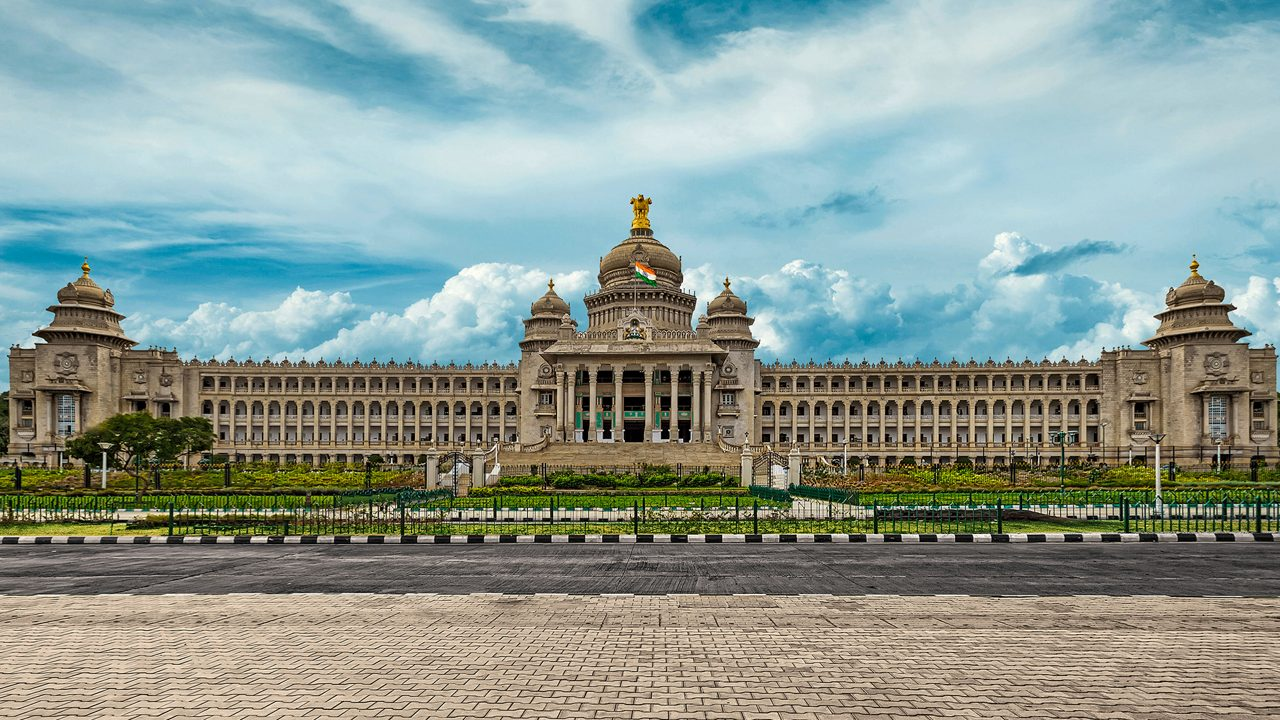
Filmmakers often picture only glass towers and tech parks, but the city’s strength is how quickly a unit can move between registers in a single schedule. Central Bengaluru holds colonial-era buildings, wide roads and administrative architecture that stand in for government, corporate and newsroom settings, though those cores carry tighter controls and usually shoot on weekends or in the early morning. Whitefield and the Outer Ring Road supply glass skylines and private campuses that double for international cities, and because many of those campuses are privately held, permissions there are often simpler than on public roads. The Vidhana Soudha and its administrative precinct give the definitive government facade, though the building itself is tightly controlled and usually shot from public vantage points, while UB City and the central business district carry corporate scenes and the Metro’s elevated corridors supply the city’s contemporary, on-the-move texture.

Despite its growth the city keeps green pockets, lakes and parks that carry romantic sequences and morning montages without a location move, though some are permit-restricted and a fixer will usually have a visually similar private estate on hand as backup. Cubbon Park and Lalbagh anchor the central green cover, and the lakes at Ulsoor and Sankey Tank carry reflective, early-morning material.
Within a Few Hours of the City
The bigger prize is proximity: within a few hours a production reaches rugged terrain around Ramanagara for action and rural stand-ins, and hill and forest-edge roads for atmospheric scenes. Nandi Hills, about sixty kilometres north, is the standard pre-dawn hill location, and the Bannerghatta forest edge gives controlled greenery closer in, most of it on time-bound access windows that a line producer covers with early call times, lean crews and a weather day. The heritage draw runs to Hampi, Badami and Pattadakal, where the ruins sit under Archaeological Survey control and a shoot turns on ASI filming permits for Hampi and Badami secured well ahead of the dates.

Filming Permissions and Approvals
Permissions here are a structural part of the schedule, not a formality, and they rarely run through a single desk. For feature films, television and web series the starting point is India Cine Hub, the Ministry of Information and Broadcasting’s national portal, which states that once complete documents are submitted a shooting permission normally takes no more than three weeks to process; contentious or sensitive locations can run longer. A line producer submits early and runs the local approvals in parallel rather than in sequence, because the city-level permissions are where a schedule actually lives or dies.
The Authorities Involved
On the ground the authorities a film fixer coordinates typically include:
- BBMP (Bruhat Bengaluru Mahanagara Palike), for civic spaces, roads and public areas
- Bengaluru Traffic Police, for any shoot that uses or affects road movement
- Karnataka Film Chamber of Commerce, for industry coordination and local liaison
- Deputy Conservator of Forests, for forest, wildlife and eco-sensitive zones
- District administrations, for shoots that extend outside the city into the state
- Private property owners, for studios, campuses and residential layouts

The Approval Workflow
The process is predictable enough to plan against. A line producer breaks the script down location by location, then works the approvals as a sequence that can overlap:
- Script and location breakdown, mapping every setup to the desk that clears it
- India Cine Hub application for features, television and web series
- Local civic and police approvals for the specific streets, spaces and hours
- Special-category permissions, such as forest, heritage or district clearances
- Property agreements and on-ground confirmations before dates are locked
Rules, Restrictions and Last-Minute Changes
The written rules are clear; execution turns on interpretation, timing and coordination. In public spaces crowd interaction is regulated, blocking access needs consent, and noise is monitored, which is why so much city work runs at dawn. Some areas restrict heavy lighting rigs, drones and large generators, pushing line producers toward smaller mobile units, battery lighting and indoor substitutes, and many locations permit filming only within set hours, so night work needs special coordination and extended hours are rarely granted. Heritage structures and religious spaces ask for more still: content-sensitivity checks, minimal-footprint crews, and a fixer who can build the local trust that turns a permission into actual cooperation.
Even with paperwork in order, approvals occasionally shift for a political event, a public-safety advisory or a weather alert, and residents sometimes object despite a valid permit. This is where local depth pays for itself: the line producer activates an alternate location, reschedules scenes and adjusts the shot list, while the fixer mediates on the ground and explains timelines before a standoff forms. First-time teams tend to underestimate approval timelines, apply too late, and assume a permission guarantees access, and it is precisely those errors that a seasoned local partner is hired to prevent.
On-Ground Execution: Traffic, Weather and Studios
Once permissions are locked, the job becomes execution, and Bengaluru’s traffic is the most visible challenge and the most predictable when handled well. Distances that look short on a map vary dramatically by hour, so line producers group location-heavy days geographically, avoid cross-city moves at peak, and build real buffers into the call sheet, often preferring early-morning and late-night blocks to protect shooting time and reduce crew fatigue. Rather than force a fixed order, experienced units design fluid day plans, holding dialogue interiors as the flexible material that can absorb a delay while exterior and crowd scenes take the clean hours.

Weather planning is never optional. The climate is moderate, but sudden rain and overcast skies are common, so line producers prioritise weather-sensitive exteriors early, keep indoor alternatives ready, and adjust the shot list in real time to avoid losing a full day. Studios earn their place for exactly these reasons, and most Bengaluru productions run a hybrid: establishing shots and exteriors on location, performance-heavy scenes and pickups on a controlled stage where sound and schedule are certain. On long regional shoots the same discipline extends to the road, splitting travel and shoot days and rotating crew so productivity holds across an extended calendar. Underneath all of it sits daily burn control, tightening the schedule and scaling crew to the scene rather than the day.

Hiring a Line Producer or Fixer in Bengaluru
For a production new to the city, engaging an external producer without local support tends to cost more than it saves, through permission delays, inefficient location choices and schedule compression. A good local partner earns its fee in ways a quote never shows: existing relationships with the authorities and property owners, location intelligence, honest budgets, and the anticipation of risk before it lands. The city’s production economy is younger and thinner than Mumbai’s or Hyderabad’s, so a company here is worth what it can import and coordinate, the crew, kit and access it pulls together at short notice, more than any standing back-lot.
Choosing well is what decides whether a shoot feels manageable or chaotic, and our vendor-evaluation checklist for selecting a line producer lays out the questions worth asking. In practice, look for a partner who has handled similar-scale projects, works regularly across Karnataka rather than only the city, is candid about traffic and travel time, and can explain how they handle last-minute changes; references from past projects tell you more than a rate card. Be wary of anyone who underplays the logistics, promises unrealistic timelines, lacks strong local contacts, or avoids the subject of contingency. Experienced film fixers in Bengaluru and line producers treat transparency as part of the job, and it is worth more than the lowest quote.
Before locations are locked, confirm the fundamentals:
- All approvals received in writing, with copies shared to the relevant departments
- On-ground contacts briefed, and travel times checked at actual shoot hours
- Access restrictions understood, with backup locations confirmed, not assumed
- Budget carrying real flexibility for weather, reschedules and contingency

Common Questions Producers Ask
How long do filming permissions take in Bengaluru?
For features, television and web series the national India Cine Hub permission normally clears within three weeks of complete documents, though contested or sensitive locations can take longer. Local civic and police approvals move faster but still need lead time, so a line producer files the national application first and runs the city-level clearances alongside it rather than after. A realistic planning figure is three to four weeks from a locked location list to a shoot-ready permission set.
Do I need both a line producer and a film fixer?
It depends on scale. A small commercial, a documentary or a two-day shoot is often covered by a film fixer alone, handling access, local coordination and on-ground problems. A feature, series or multi-location schedule needs a line producer to plan, budget and hold the approvals, usually with a fixer working under them on location. The two are not interchangeable: one owns the plan, the other clears the ground it runs on.
When is the best time of year to shoot in Bengaluru?
The climate is moderate year-round, but the June-to-September monsoon brings unpredictable rain that complicates exteriors, so the October-to-February window is the most reliable for outdoor work, with clearer light and comfortable temperatures. The summer months from March to May stay workable and are warmer without being extreme. Weather-sensitive scenes are scheduled early in any window regardless, with indoor alternatives held in reserve.
Is filming in Bengaluru cheaper than Mumbai?
Crew, location and studio costs generally run lower than Mumbai or Hyderabad, and the city’s talent depth keeps day rates competitive. The saving narrows on specialist equipment that travels in, and on anything that fights the traffic, where lost hours cost more than the line item suggests. The real economy comes from tight scheduling and local access rather than a headline rate, which is why an experienced local partner usually pays for itself.
Can you fly drones for aerial filming in Bengaluru?
Drone work is possible but tightly regulated. Aerial shoots need clearance under the national DGCA framework alongside local permissions, and large parts of the city sit within controlled airspace around Kempegowda International Airport, where flying is restricted or barred outright. A line producer confirms the airspace category for each location early, because a shot that is routine on the outskirts may be impossible over the central business district.
Why Work With a Local Bengaluru Partner
Bengaluru is not the easiest city to film in, but it is one of the most rewarding when it is handled by someone who knows it. The difference between a schedule that holds and one that slips comes down to local relationships, with BBMP, the traffic police, the forest department and location owners, and to the judgment that only comes from having run shoots here before. A local partner gives a visiting production a single point of accountability, permit expertise, a Karnataka-wide crew and location network, realistic budgets, and the problem-solving that keeps a day moving when the city throws up the unexpected.
For a feature, series, ad film or OTT project in Bengaluru or anywhere in Karnataka, that is the partner to engage first, before the locations are locked and the calendar is set. Brought in early, they shape the schedule around how the city actually works; brought in late, they can only manage the consequences of a plan built without it.
