
Hyderabad is the capital of Telangana and one of the largest film production centres in India, home to the high-output Telugu industry and to Ramoji Film City, the biggest studio complex in the world. Over the last decade it has also become a pan-India production base, the place where some of the country’s largest features have been mounted because the city can build, crew and shoot at a scale few other locations can match. Hyderabad film production combines large-scale studio work at Ramoji with local crew, city locations and Telangana logistics. A line producer in Hyderabad helps a production harness that scale, pairing the studio capacity and crew depth with the Nizami-era heritage locations and the permit and incentive processes that come with shooting in Telangana.
This guide covers why Hyderabad carries so much production weight, what a line producer manages here, how permissions and the Telangana incentive landscape work, the city’s locations and the corridor it feeds, and where film fixers fit alongside a full line-production model.

Why Hyderabad Is a Film Production Hub
Hyderabad’s strength is that it offers infrastructure, crew and locations in one place. A project can build standing sets, hire complete departments, shoot heritage and modern looks within the city, and finish in local post houses, all without leaving the metro. For a producer, that means Hyderabad can carry an entire schedule rather than a handful of days, which is why it sits alongside Mumbai and Chennai as a primary base in Indian production.
Ramoji Film City and the Studio Base
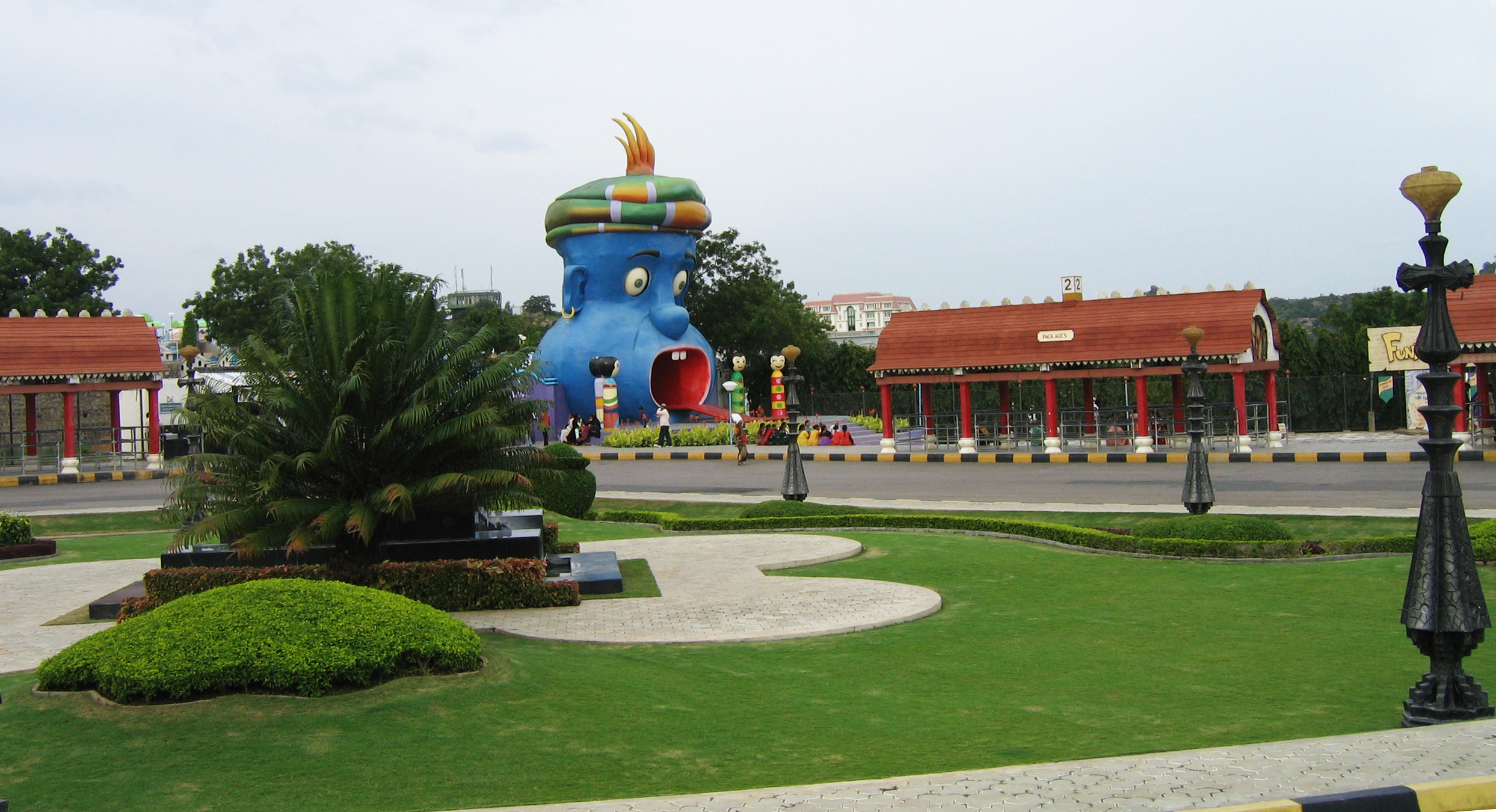
Ramoji Film City, established in 1996 on the city’s outskirts, is the defining asset. Spread across roughly 1,666 acres, it holds the Guinness record as the largest film studio complex in the world, with dozens of sound stages and permanent standing sets that range from railway stations and temples to streetscapes and gardens. It handles hundreds of productions a year across multiple languages, and it is the kind of facility where a unit can shoot an airport, a palace and a foreign street within the same gate, under full production control. Large pan-India features have been built there precisely because of that combination of scale and control.
Shooting at Ramoji is run more like operating inside a secure production town than booking a single stage. The complex provides sound stages, an enormous spread of permanent exterior sets, on-site accommodation and unit support, and the whole environment is controlled, which reduces the public-access and crowd-management constraints that come with city locations. For a sequence that needs a built world, that control is worth as much as the look itself.
The city’s studio history runs deeper than Ramoji alone. Annapurna Studios in Banjara Hills, founded by the Akkineni family, pairs stages with a working film school, and Hyderabad’s older studio and lab base supports the wider Telugu industry. The practical point for a schedule is the rare degree of backlot control: a line producer can lock a large, secure, weather-independent environment for the most demanding sequences and build the rest of the plan around it.

Telugu Crew Depth and Pan-India Reach
Behind the studios is a deep, experienced crew base. The Telugu film industry is one of the highest-output in the country, which sustains full departments of camera, lighting, art, costume, stunts and post talent that a production can scale up or replace without flying people in. That depth now serves projects in every language, as Hyderabad has become a regular base for Hindi and pan-India films drawn by the combination of studio capacity and skilled local crews.
The back end is equally strong. Hyderabad’s post-production, visual effects and finishing houses operate at scale, so a project can shoot and complete in the same city. For a line producer, this end-to-end capability shortens turnarounds and removes the handoff risk that comes with shooting in one place and finishing in another.
That reach is why Hyderabad increasingly competes for projects that have no Telugu connection at all. A Hindi feature, a streaming series or an international commercial can crew up here, use the studio capacity, and tap the same post pipeline as part of a wider line producer India plan, which is a large part of why the city’s share of national production has grown rather than stayed regional.
What a Line Producer Manages in Hyderabad
A line producer in Hyderabad owns the execution layer of the shoot: the studio and backlot bookings, the crew and equipment, the permits, and the budget and schedule that tie them together. In a city built around large studio operations, much of the value is in sequencing, holding an expensive facility only for the window it is needed and keeping every other element ready around it.

Studio and Backlot Booking
Booking at Ramoji or another major facility is more than reserving a floor. It involves the stage, the standing sets, accommodation and unit support that the complex provides, often as a package, and it has to be locked early against a busy production calendar. A line producer negotiates the build period, the shoot window and the strike, and sequences them so the facility is not sitting idle waiting on a cast date or a permit elsewhere. Getting that booking discipline right is one of the largest single levers on a Hyderabad budget.
It also shapes the rest of the schedule. Because a major facility is expensive and in demand, the line producer plans cast availability, location days and second-unit work around the studio window rather than the other way round, so the build is shot out efficiently and the floor is released on time rather than held over at cost.
Crew, Equipment and Budget Control
Equipment is rarely the constraint in Hyderabad. Camera, grip and lighting houses are well stocked, and for international units the Hyderabad Inland Container Depot (ICD) is the authorised ATA Carnet facility for temporary equipment import and customs clearance. The line producer consolidates vendors so the production runs through a coherent set of suppliers rather than a scatter of one-off rentals, scales crew to the format, and confirms key technicians against their other commitments in a busy market.
Local hiring also matters for cost and goodwill. Sourcing support staff, transport and catering through established Hyderabad suppliers is both cheaper and smoother than importing everything, and it keeps day-to-day coordination and problem-solving in local hands. Deciding what to source locally and what to bring in is a judgement the line producer makes early.
All of this rolls into the budget and schedule, which is where the role is ultimately measured. The line producer prices studio, crew, equipment and permissions against current rates, builds in the contingency a high-demand environment needs, and protects the plan once the shoot is underway and changes begin to land. In a city where a single facility booking can dominate the budget, that financial control is the difference between a schedule that holds and one that bleeds.
Filming Permits in Hyderabad: GHMC, Police and Heritage
Permissions in Hyderabad run on several tracks: civic approvals for public spaces, police clearance for traffic and crowds, central clearance for projects with a foreign element, and heritage permissions for protected monuments. They sit with different authorities and have to be pursued in parallel, mapped to each location at the recce stage rather than chased one at a time.
GHMC, Police and Traffic Approvals
For locations under GHMC control, the Greater Hyderabad Municipal Corporation clears roads, public spaces and municipal property, while the police commissionerate with jurisdiction over the location clears setups that affect traffic or draw crowds. A shoot in the old city, on a busy arterial road or around the Hussain Sagar promenade needs both the civic permission and the police sign-off, along with a traffic-management plan the police will hold the production to. These approvals reward lead time and proper documentation, and they punish units that turn up expecting to negotiate access on the day.
The old city around Charminar is the clearest example. Its lanes are narrow and busy, equipment access is limited, and any sizeable setup affects both traffic and daily life, so the police attach conditions on timing and footprint that have to be built into the call sheet from the start. A unit that plans the day around those conditions keeps the location; one that does not tends to lose shooting hours on the spot.
For international units, the cross-cutting requirements of film visas, equipment import and central clearance sit on top of the local permits, and our India filming compliance checklist sets out how those layers fit together. A line producer runs all of them in parallel so the shoot dates hold.

Central Clearance, State and Heritage Sites
Feature films, television and web series, and reality projects with foreign cast or crew route through the India Cine Hub single window run by the Ministry of Information and Broadcasting, which issues the national shooting permission and supports film visas and temporary equipment import. Documentaries, foreign audio-visual commercials and music videos fall outside the ICH application route. They require Ministry of External Affairs clearance before the applicable state, municipal, police and location permissions are completed; the correct visa category should be confirmed for each crew member with the relevant Indian mission.
Heritage is the distinct track. Charminar and Golconda Fort are centrally protected monuments under the Archaeological Survey of India and need its structured permission, with conditions on access, equipment and proximity; the Qutb Shahi tombs sit under Telangana’s state heritage administration and are cleared through it. Privately held heritage such as the Chowmahalla and Falaknuma palaces is cleared with the estate directly. Each of these carries its own lead time and has to be opened well before the shoot, since a monument cannot be improvised onto the schedule late.
The privately held palaces add a commercial layer on top of the heritage one. Access, rates and conditions at a property like Falaknuma are negotiated directly with the operator, and a working location agreement has to coexist with the building’s other commitments. Pinning those terms down early, rather than assuming availability, is part of what a line producer carries on a heritage-heavy Hyderabad shoot.

Telangana Film Incentives and Permit Calendar
Telangana’s published production support is concentrated in AVGC and related investment rather than a general live-action cash rebate. International productions should assess national incentive eligibility separately and confirm any state facilitation against the current format and production brief. The wider regional context is set out in our guide to South India filming incentives.
What Telangana Offers
Telangana’s published state support is oriented mainly toward animation, visual effects and gaming (AVGC) and related investment, with reimbursement provisions for qualifying work incurred in the state; it is not a general live-action cash rebate. For an international or pan-India live-action project, the more reliable levers are the central India Cine Hub facilitation and the operational savings of Ramoji’s scale. The wider picture of film rebates in India sets these measures in context, and a line producer scopes which of them actually apply to a given project.
For a fuller breakdown of the schemes across the southern states, our South India film incentives guide sets out the current structures and qualifying conditions, with a statewise reference for how Telangana compares with its neighbours. Reading the incentive against the actual production plan, rather than the headline rate, is what turns a scheme into a real saving.
Documentation and Timing
Whatever support a project qualifies for depends on documentation that starts on day one of the shoot, not paperwork reconstructed afterwards. Spend records, local-vendor invoices, crew engagement and the central and state permissions all have to align, and a gap in that trail is the usual reason a claim fails. The same discipline carries the permit calendar: the studio booking, the central clearance, the heritage approvals and the city permissions each have their own lead time, and a line producer maps them onto a single timeline so the shoot dates are realistic rather than aspirational.
This is also where local knowledge pays for itself. Incentive terms and the bodies that administer them change over time, so a line producer who tracks the current Telangana position can tell a producer at the budgeting stage what is realistically claimable and what is not, rather than building a number into the plan that the paperwork will not support later.
Hyderabad’s Locations and Corridor
Hyderabad supplies a wide on-screen palette and a launch point for the wider region. On its own the city offers heritage, palace, lake and modern looks; as a base it opens the rest of Telangana and the neighbouring states, which is why most schedules treat it as a hub rather than a single location.
City and Heritage Looks
The Nizami-era heritage is the city’s signature: Charminar and the old city bazaars, Golconda Fort, the Qutb Shahi tombs, and the grand interiors of the Chowmahalla and Falaknuma palaces give period and royal settings that are hard to match elsewhere. Against that, the Hussain Sagar lake and Tank Bund supply central waterfront frames, while HITEC City and the financial district provide glass-and-steel corporate backdrops for contemporary stories. The advantage of the city looks is that they come with the full crew and permit machinery already in place, so a Hyderabad location is usually quicker to mount than the same look in a less-resourced town.
The contrast within a short radius is part of the appeal. A schedule can move from a four-hundred-year-old fort to a glass tower at Durgam Cheruvu to a lakeside promenade inside the same day, which gives a production real range without long transfers, provided the permissions for each are lined up in advance.

Ramoji Backlots and Telangana Inserts
Beyond the city, the Ramoji backlots cover looks a production would otherwise have to travel for, from foreign streetscapes to temple complexes, all under one roof. The wider state adds genuine heritage and landscape: the Kakatiya-era Ramappa temple in Mulugu, a UNESCO World Heritage site, the fort city of Warangal, and the lakes and forests around Pocharam and Nagarjuna Sagar. Run as outbound legs from Hyderabad, these connect the city to the broader line production in South India corridor, with crew and equipment dispatched from the metro and topped up locally.
Each outbound destination carries its own permission character, from ASI rules at the heritage sites to forest clearances around the reserves, so the corridor plan is as much about sequencing approvals as moving trucks. Pinning that down in prep is what lets a multi-location Telangana schedule run without dead days between legs.

Hiring a Line Production Company in Hyderabad
Hyderabad is one of India’s most established studio markets, anchored by Ramoji Film City, the largest integrated film complex in the world, alongside Annapurna Studios and a Telugu industry that shoots at volume year-round. A line production company in Hyderabad plugs a visiting production into that ecosystem: standing sets and backlots, a large local crew and equipment base, and the Telangana permissions that govern city and studio shoots.
The reason to engage a company rather than a lone fixer is the scale of what Hyderabad can mount. Ramoji alone can hold multiple units and department-built sets, and coordinating that with local crew contracts, transport and the permit chain is a budget-and-compliance job, not a location-access one. For a feature or a series building sets in the city, the company carries the whole below-the-line operation from prep to wrap.
Film Fixers and Line Producers in Hyderabad
Productions often ask whether they need a full line producer or just a fixer in Hyderabad. Both have a place, but they do different jobs, and on a studio-led shoot in a city this scale the distinction is sharp.

Where Film Fixers in Hyderabad Fit
Film fixers in Hyderabad are valuable for the on-ground work: scouting and securing specific locations, arranging local permissions, sourcing vendors and solving day-to-day problems during a shoot. For a small unit, a documentary or a contained advertising job, a capable film fixer in Hyderabad who knows the city can be enough, and they often work alongside a line producer as the local execution arm. Used that way, a fixer is a force multiplier rather than a substitute, moving fast on specific asks while the line producer keeps the budget and the whole picture in view.
Experienced fixers in the city bring documented filing history and location knowledge a visiting producer cannot build from scratch, and a good line producer works through them rather than around them. The point is not fixer or line producer; it is the right combination for the size and risk of the project.
On a Hyderabad shoot, that combination usually means a line producer holding the studio booking, the budget and the compliance, with experienced fixers handling the location-level detail underneath. It is a model built for a city where a single facility decision can shape the whole production, and it is why the role is defined here by accountability rather than errands.
What a fixer typically does not carry is the contractual and financial accountability for the whole shoot, the studio contracts, the central and heritage permissions and the budget. On a larger or longer project, and especially one built around a major facility booking, that gap matters, and it is the line producer who fills it. The reliable model on a serious Hyderabad shoot is a line producer holding overall accountability, with film fixers working under that umbrella on local tasks.
Engaging a Line Producer in Hyderabad
Hyderabad rewards early engagement. The studios, the heritage permissions and the civic approvals all reward lead time, so the right moment to bring in a line producer is at the planning stage, before dates are fixed, so that facility availability, permission timelines and incentive documentation shape the schedule instead of colliding with it. A budget built here should reflect that a major studio booking can dominate the costs, and that the gain is reliability and scale, the ability to mount ambitious work under full control.
For producers comparing options across the country, that combination of the world’s largest studio complex, deep crew, strong heritage and disciplined execution is what keeps Hyderabad on the shortlist for work that needs scale rather than a single location.
For a feature, series, OTT show or commercial shooting in Hyderabad or running across Telangana from a Hyderabad base, a single accountable line producer across studios, crew, permissions and incentives is what keeps the production moving and the budget intact. That capability is part of our wider film production services across India, with Hyderabad as one of the strongest execution centres in the country.
