
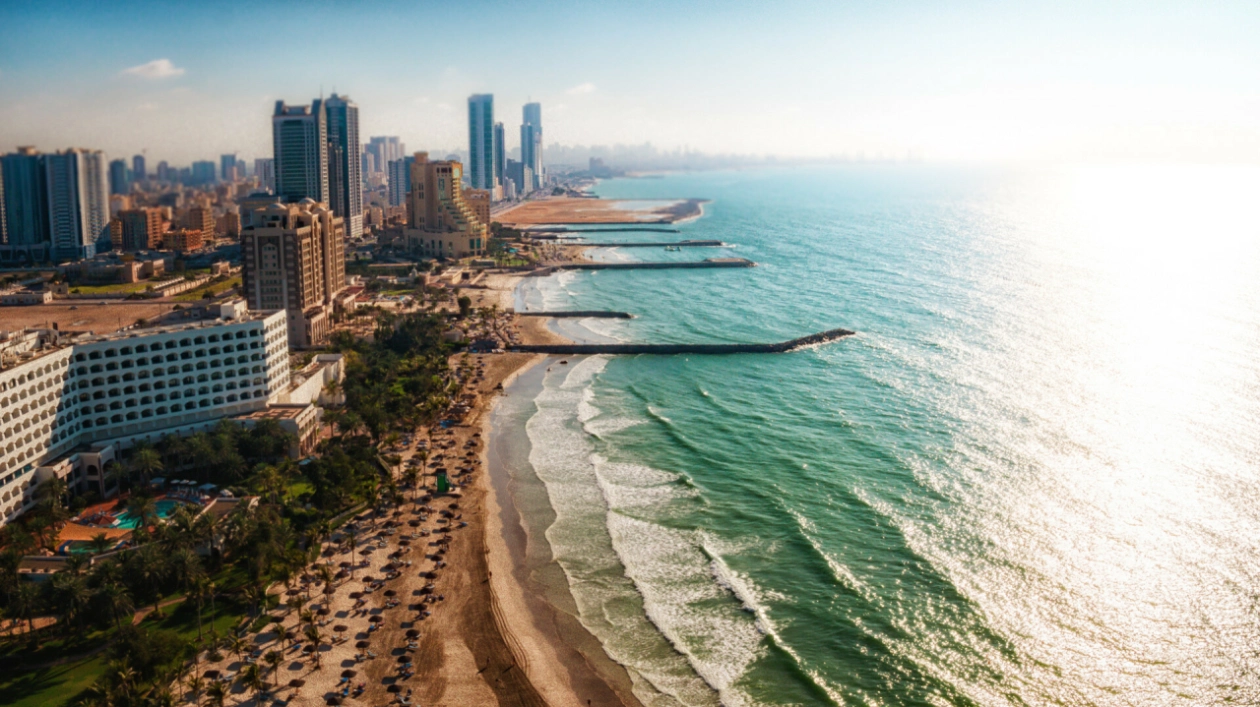
A line producer Ajman brief is almost always a cost and logistics decision rather than a scale one. Ajman is the smallest of the seven emirates, about thirty minutes north of Dubai, and it works best as an efficient, lower-cost base for a shoot rather than as a standalone production centre. The UAE’s primary production hub is Dubai, covered in our line producer Dubai guide; Ajman sits under it as a cost-efficient location and crewing base, drawing on the same regional pool. This page sets out what Ajman actually offers a production: its locations, how permits work on the ground, where the crew and kit come from, and where the real savings are.
Why Productions Choose Ajman
The case for Ajman is practical. Permits, location access and accommodation cost less than in Dubai, the emirate is far less congested, and a unit can hold a beach, a heritage site or a quiet street without the crowd management and road-closure load that a central Dubai shoot carries. For commercials, music videos, intimate drama and the second-unit or pickup days of a larger production, that combination often makes Ajman the more sensible base.
What Ajman does not have is a deep standing production industry of its own. There is no large local crew base or major studio inside the emirate, so the saving is operational, not an incentive: Ajman is cheaper and simpler to shoot in, but the crew, equipment and specialist vendors are brought in from Dubai and Sharjah. The common mistake is to assume Ajman’s lower costs come from production incentives or rebates. They do not: the savings come from simpler execution, lower accommodation costs and easier logistics.
Where Ajman Saves, and What It Suits
The saving shows up in three places. Location access and the permit itself are lighter than the equivalent in central Dubai; hotel and accommodation rates in Ajman run below the Dubai marina and downtown belts; and because the emirate is quiet, a shoot needs less spend on crowd control, security and road management to hold a public location. For a tightly budgeted commercial, branded film or independent drama, those three lines together can move the day rate meaningfully without changing the look on screen.
Ajman suits some formats better than others. Commercials, music videos, fashion and stills, social and branded content, independent drama, and the pickup or second-unit days of a larger UAE production are where it earns its place. A large-scale feature that needs deep local crew, major stage space or a long permit chain is still better anchored in Dubai, with Ajman used for specific days inside that plan.
Filming Locations in Ajman
Ajman’s location range is compact but genuinely varied for its size. The Corniche and the open public beaches give clean sand, calm water and an uncluttered coastline that is easy to control for a shoot. Inland and along the creek, the older town carries the texture a period or cultural story needs, and the dhow-building yards on the creek remain a working maritime backdrop.
Beaches, the Corniche and the Modern Face
Set against that, Ajman also offers a clean modern face. The newer waterfront developments, City Centre Ajman and the China Mall give contemporary commercial and retail backdrops, while the emirate’s resort hotels, among them Ajman Saray, Fairmont Ajman, Bahi Ajman Palace and the Oberoi Beach Resort, Al Zorah, double as controlled interior, pool and beach locations that are far easier to lock than their Dubai equivalents.
Residential villa districts cover the domestic interiors and suburban exteriors that a commercial or drama often needs without heavy dressing, and the relatively low traffic means a street can be held with a smaller footprint than in Dubai.
That control is part of the appeal. With lighter traffic and smaller crowds, a unit can lock a beach, a stretch of Corniche or an old-town lane faster and with fewer marshals than the equivalent in Dubai, which shortens turnaround between setups and protects the schedule on a tight day. For stills and short-form content in particular, that speed of access often matters more than the depth of the location list.
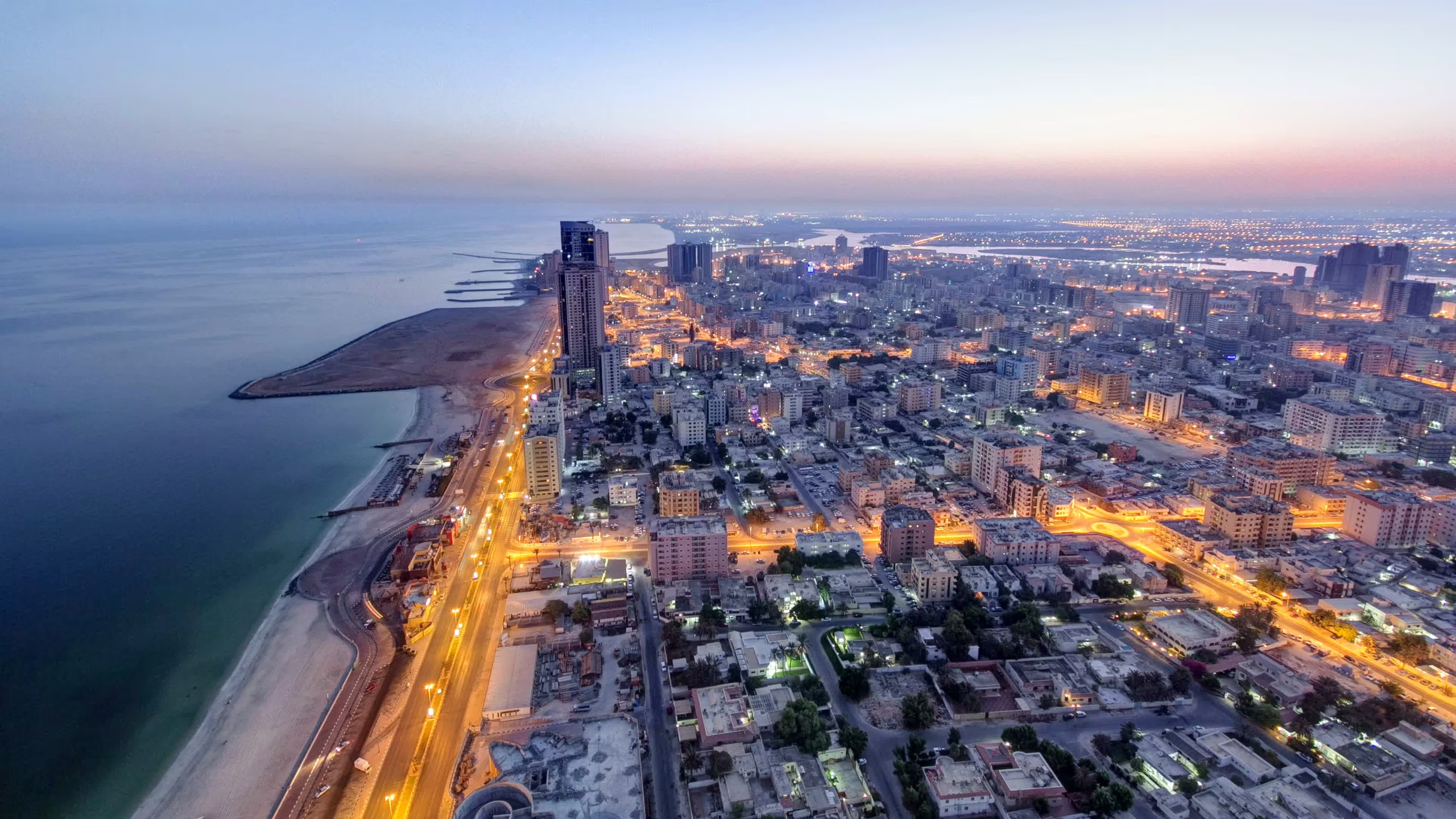
For most jobs the working radius is small. The Corniche, the public beaches, the old town and the creek sit within a few minutes of each other, City Centre Ajman and the main hotels are a short drive, and Al Zorah is on the northern edge of the city, so a unit can cover several distinct looks in a day without long company moves. The inland exclaves at Masfout and Manama are the exception, an hour or more out, and are scheduled as their own block rather than mixed into a city day.

Ajman Museum, Al Zorah and the Inland Exclaves
Ajman Museum, set in an eighteenth-century fort, is the emirate’s strongest heritage location, with watchtowers, courtyards and traditional interiors. Al Zorah, on the northern edge of the city, adds mangrove channels, tidal lagoons and resident flamingos, a natural-water environment that is rare this close to Dubai. Further out, Ajman’s inland exclaves of Manama and Masfout bring agricultural plains and low mountain terrain, which widens the palette beyond the coast for a production willing to travel an hour for them.

Al Zorah rewards a closer look for natural and lifestyle work: its protected mangroves are reached by boardwalk and kayak channel, the lagoon draws flamingos and migratory birds, and the marina and golf course sit alongside for a controlled resort environment.
Masfout, Ajman’s mountain exclave in the Hajar range near Hatta, brings a hilltop fort, terraced farms and dam reservoirs, while Manama, the second exclave, offers flat agricultural country. Together they let a single Ajman-based production reach coast, wetland, city and mountain without leaving the emirate’s jurisdiction, which keeps the permitting under one authority rather than splitting it across several.
Ajman for Commercials, Stills and Short-Form
The formats that fit Ajman best are the ones that value speed and cost over scale. Commercials, fashion and product stills, music videos, social and branded content, and lifestyle and travel pieces all benefit from quick permits, easy lockups and a backdrop list that runs from beach and resort to fort and mangrove within a short drive. The resort hotels give controlled, photogenic interiors and pool-and-beach setups for fashion and hospitality brands, while Al Zorah suits wellness, outdoor and lifestyle work that needs natural water and greenery without the crowding of a Dubai beach.
Longer-form work uses Ajman more selectively. A regional series or feature will usually base in Dubai for crew depth and stage space and bring specific days to Ajman for a beach, a heritage exterior or a cost-sensitive block of coverage. Either way the planning question is the same: which days genuinely benefit from Ajman’s lower cost, and how cleanly can the crew and equipment move in for them without losing the saving to travel and downtime. Typical Ajman schedules run comfortably as one- to three-day shoots, with Dubai used for any specialist facilities and Ajman for the location days.
Permits and On-Ground Authorities
Each emirate runs its own filming permissions, and Ajman is no exception. A shoot clears its permit through the relevant Ajman government department, with Ajman Police handling anything that touches roads, public order or crowds, and the Ajman Media City Free Zone covering the licensing side for media companies that base there. As across the UAE, many approvals come from private parties rather than government: resort operators, malls and developers maintain their own filming permissions for their sites, secured alongside the municipal and police sign-offs. In practice the process is lighter and quicker than a central Dubai permit, which is part of the cost case, but it still rewards lead time and a clean application rather than turning up expecting access on the day.
A few conditions are worth planning for. Drone work, any filming near government or security-sensitive sites, and shoots that involve weapons, stunts or large setups draw additional clearances and a longer lead time, and a beach or Corniche shoot that affects public access needs its window agreed in advance. None of this is heavy by regional standards, but it has to sit in the schedule from the recce rather than be chased on the day.
For an international production, the practical route is to run the Ajman permit through a local production service provider who files it correctly and coordinates the police and municipal sign-offs in parallel. That is the part a line producer owns: mapping each location to the authority that controls it, building the lead times into the schedule, and keeping the approvals moving so the shoot dates hold.
How the Ajman Permit Runs
In sequence, an Ajman permit runs roughly as follows:
- Submit the filming application to the relevant Ajman authority with the script or treatment, locations, dates and crew details.
- Secure location-owner or developer consent for private and resort sites, and the municipal no-objection certificate for public spaces.
- Clear Ajman Police sign-off for anything affecting roads, traffic, public order or security, with a traffic-management plan where it is needed.
- Lodge separate approvals for drone operation, weapons, stunts or any government-adjacent location, allowing the extra lead time these carry.

Accommodation and Production Base in Ajman
Basing a unit in Ajman is one of the clearest cost levers the emirate offers. Hotel and serviced-apartment rates sit below the Dubai Marina and Downtown belts, so a production can house cast and crew close to the locations at a materially lower nightly cost and still keep Dubai’s crew base within a half-hour drive. For a multi-day shoot, that accommodation saving alone often offsets the cost of moving crew in from Dubai each day.
Timing matters as much as base. The comfortable shooting window across the UAE runs roughly from October to April, when daytime heat is manageable and exterior days hold their schedule; the May-to-September summer pushes exterior work into early mornings and evenings and raises the load on cast, crew and equipment. An Ajman schedule is built around that window the same way any Gulf shoot is, with the cooler months booked early because they are in demand across the region.
Crew, Equipment and the Dubai and Sharjah Corridor
Because Ajman has no large standing crew base, the unit is assembled from the wider region. Most productions therefore crew the job as a Dubai, Sharjah and Ajman corridor rather than treating Ajman as an isolated market. Camera, grip, lighting, art and technical crew, along with equipment rental and specialist vendors, come from Dubai and neighbouring Sharjah, both within roughly half an hour. Ajman borders Sharjah directly and sits a short drive from Dubai, so the crew and kit travel in for the shoot day and the production bases its accommodation in Ajman at a lower rate.
What the Production Hires Locally
What does come from within the emirate and from neighbouring Sharjah is the support layer: transport and drivers, catering, security, location marshals, junior crew and extras are sourced locally at a lower rate than Dubai. The heads of department, specialist technicians and the camera, grip and lighting packages travel from Dubai, where the equipment houses and the senior crew pool sit. Drawing that line between what is hired locally and what is brought in is the single biggest call on an Ajman crew budget, and getting it wrong in either direction either inflates the cost or leaves the unit short on the day.
On the technical side, Ajman itself carries limited rental stock, so camera bodies and lenses, lighting and grip trucks, generators and specialist rigging come up from the Dubai and Sharjah houses, which between them hold most of the region’s professional inventory. For a standard commercial or drama package that is a straightforward day rate plus transport; for anything needing high-end or scarce kit, the booking is made early against the Dubai houses’ wider demand. The line producer prices that movement into the budget rather than assuming a local availability that is not there.

Deciding what to source locally and what to bring from Dubai is one of the larger levers on an Ajman budget. Light-footprint shoots can run almost entirely on a Dubai crew making the short trip; larger setups need that movement planned carefully so call times, equipment trucks and accommodation line up rather than the unit losing hours to the daily commute.
Choosing Between Ajman, Dubai and Sharjah
Choosing between the emirates is a practical call. Dubai brings the skyline, the deepest crew and the heaviest permit and cost load; Sharjah offers strong heritage and museum locations at a middle cost; Ajman comes in lowest for permits, access and accommodation, but with the least local crew of the three. Most regional shoots use a blend, and the line producer’s job is to place each scene in the emirate that delivers it most cheaply for the same result on screen, then route the crew and kit between them efficiently.
Ajman in a Multi-Emirate Shoot
Ajman’s clearest strength is how easily it combines with its neighbours. A schedule can take in Ajman, Sharjah and Dubai within a single base, and Abu Dhabi within a longer day, so a production picks each emirate for what it does best: Dubai for skyline and infrastructure, Sharjah and Ajman for heritage and lower-cost coverage, and Abu Dhabi for its desert and institutional locations, covered in our line producer Abu Dhabi guide. Run from one production office, this cross-emirate approach keeps the budget under a single line of control rather than splitting it across separate units. Working that corridor means budgeting against UAE crew rates and permit routes rather than one emirate’s numbers.
The mechanics of that cross-emirate schedule are where the savings are kept or lost. Each emirate’s permit runs on its own timeline, so the applications are filed in parallel from the recce; the crew and trucks are routed to cut dead mileage between Ajman, Sharjah and Dubai; and the unit base is fixed where accommodation is cheapest, usually Ajman, with day trips out to the others. Run this way, a three-emirate shoot reads on screen as one larger production while costing closer to the lowest-cost base.
The Line Producer’s Role in Ajman
On an Ajman shoot the line producer is the single point of control across a job whose pieces sit in different places: the locations are in Ajman, the permits run through Ajman’s authorities, and the crew and kit come from Dubai and Sharjah. As film fixers in Ajman who run these shoots rather than describe them from outside, we hold the permit applications, assemble the crew from the regional pool, book accommodation at the local rate, and schedule the Dubai and Sharjah movement so nothing stalls a shooting day.
The result a production should expect from Ajman is a lower effective cost for the same coverage, achieved through execution rather than through any incentive. In practice that means a recce that prices each option honestly, a permit plan filed early with the right Ajman authorities, a crew list split cleanly between local hires and Dubai imports, and a base and schedule built around the cheapest viable setup, so the budget a production approves is the budget it actually runs to. Whether Ajman forms the entire shoot or one stop in a wider UAE schedule, we budget the production as one operation so locations, permits, crew and equipment stay under a single line of control.
