

Remake rights in India govern the legal process by which an existing work — a film, novel, short story, stage play, or format — is acquired for adaptation into a new production. The rights in question are not simple permissions. They span adaptation, translation, dramatisation, and in most cases the right to create derivative works including sequels and spin-offs. Each element must be secured separately, from the original author’s literary rights through to any prior screen adaptations that may sit in a different chain of ownership entirely. Our remake rights agent India practice covers deal structure, option agreement negotiation and IP validation. For the transactional layer — how remake rights professionals India manage cascade obligations from option through to OTT delivery — the operational detail is covered separately.
Celluloid Pact works on adaptation rights acquisition across the Indian market and in Southeast Asia, including projects entering the Netflix India and Netflix Southeast Asia production pipeline. The logistics of remake rights acquisition — chain of title verification, option structuring, adaptation fee negotiation, and moral rights management — are deal-stage decisions that affect whether a project can be packaged, financed, and cleared for release. This page sets out the legal and commercial framework that governs that process.
Rights work extends beyond remakes to wider clearance — including music and clip licensing India and E&O for OTT delivery. The underlying intellectual property rights in film production sit beneath all of it.
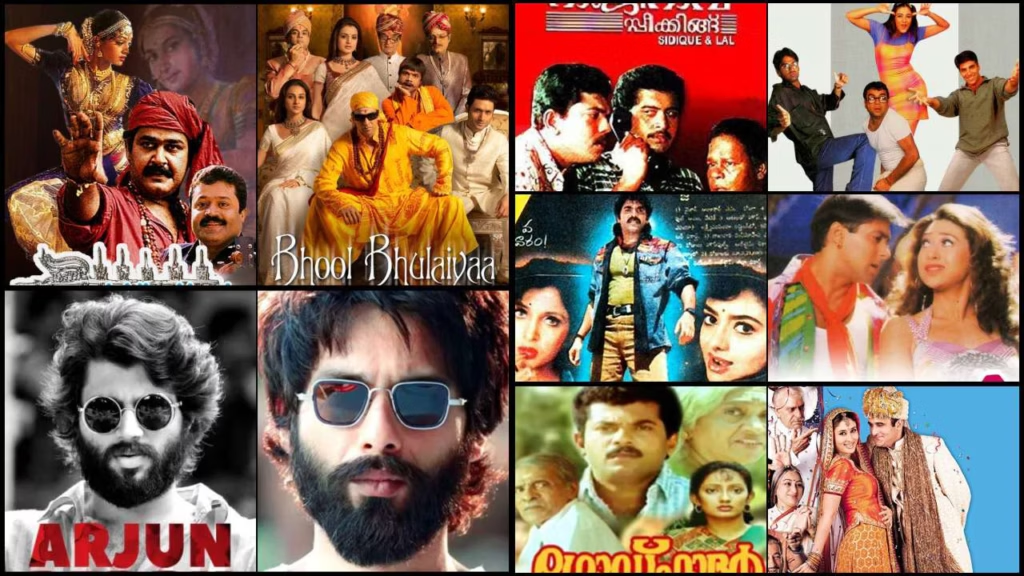
Legal Foundation of Remake Rights in India
The legal basis for remake rights India sits primarily within the Copyright Act 1957, as amended through 2012. The Act defines copyright as including the exclusive right to make adaptations and translations of a work — meaning that acquiring the right to remake a film requires a specific contractual grant of the adaptation right, not just a licence to screen or distribute. This distinction matters: a broad licensing agreement that fails to mention adaptation explicitly will not support a remake, regardless of what the parties intended.
Adaptation Rights Under the Copyright Act
Section 14 of the Copyright Act specifies that copyright in a literary or dramatic work includes the right to make any cinematograph film or sound recording in respect of the work. This is the statutory basis for adaptation licensing. The adaptation right is treated as a distinct bundle from reproduction and communication rights — a producer who wants to remake a film from a novel must obtain the adaptation right specifically, and that right must be expressly stated in the agreement.
Global producers approaching Indian source material — novels, short stories, OTT originals — frequently underestimate the granularity required in rights documentation. The question of how to buy movie rights in India operationally depends first on identifying every layer of rights required for the intended adaptation and ensuring each is addressed in the acquisition agreement. An agreement that grants “all rights” without itemising them will face challenge at the clearance stage.
Where a project draws on novels, OTT originals or existing screenplays, the underlying story and screenplay layers are optioned and cleared separately rather than as a single block. The dedicated workflow for film adaptations and script licensing sets out how each layer is itemised and verified before the adaptation agreement is executed.
The Copyright (Amendment) Act 2012 introduced an important provision for authors working under employment contracts or commissioner agreements: authors of literary and musical works in film retain rights to exploit the work in any medium other than the film itself. A composer or screenwriter who contributed to an original film retains rights in their contribution outside of the cinematographic context — a producer acquiring remake rights must assess whether any contributors to the original retain residual rights that could affect the remake.
Cinematographic Film and Underlying Works
A cinematographic film carries its own copyright under Section 13 of the Act, separate from the underlying literary or dramatic work on which it is based. This creates a layered ownership structure. A remake of a film involves two separate sets of rights: the rights in the underlying work (novel, play, original screenplay) and the rights in the prior screen adaptation itself. In many cases these are held by different parties.
The Drishyam franchise illustrates the problem at scale. The original Malayalam film created a cinematographic copyright owned by the Malayalam producer. Each subsequent official remake — Tamil, Telugu, Kannada, Bollywood, and the Ajay Devgn-led Hindi versions — created a separate cinematographic copyright in that language version. A producer acquiring rights to make a new version in any language must identify which version forms the basis for the remake, whether any existing adaptation licences in that language are still in force, and whether the original Malayalam rights have been further assigned or licensed since the initial acquisition.
Informal remake culture in the Indian film industry — particularly prevalent before 2015 — means that many prior screen adaptations were made without documented rights agreements. This does not extinguish the underlying copyright, but it creates significant ambiguity around which rights have previously been exploited and whether any informal arrangements might constitute enforceable licences.

Language, Territory and Platform Segmentation
Indian adaptation rights are routinely segmented along three axes: language, territory, and platform. A single underlying property may have been separately licensed for Tamil theatrical release, Hindi OTT rights, and English-language international adaptation through entirely separate agreements with different parties. Each segment carries its own exclusivity provisions, term, and reversion conditions.
Before any new acquisition proceeds, the rights holder must map every existing licence against the rights being sought. A Tamil theatrical licence with a five-year exclusivity window effectively prevents any Tamil theatrical remake during that period — even if the original rights holder is willing to grant a new licence. The exclusivity runs with the licence, not with the rights holder’s current intention.
Platform segmentation has become significantly more granular since 2020. OTT rights are now commonly split between SVOD, AVOD, TVOD, and broadcast — each treated as a separate exploitation window. An adaptation licence that grants “OTT rights” without specifying which OTT categories are included will not resolve the ambiguity in a platform negotiation. Rights agreements from before 2015 routinely failed to address digital and streaming exploitation at all, creating gaps that must be addressed through supplemental documentation before those rights can be included in a financing package.

Chain of Title — Verification and Reversion Risk
Chain of title is the documentary record that traces copyright ownership from the original author through every subsequent assignment, licence, and transfer to the current rights holder. A clean chain of title — unbroken, documented in writing, and consistent with the rights being offered — is a prerequisite for any serious financing or platform conversation. The chain of title is not something that can be reconstructed retrospectively after a deal is agreed. It must exist before the acquisition is presented to investors or platforms.
Author Ownership and Assignment Requirements
Under Section 19 of the Copyright Act, copyright assignment must be in writing and signed by the assignor or their duly authorised agent. Oral assignments are not enforceable. This requirement creates a straightforward documentation standard — but in practice, large volumes of Indian entertainment rights history predate consistent documentation, and informal arrangements were treated as binding by industry convention even when legally they were not.
Section 19(6) provides that if an assignee fails to exercise the assigned rights within a period of one year from the date of assignment, the assignment in respect of such rights is deemed to have lapsed. This reversion provision means that option agreements must have clear exercise provisions and production milestones — a dormant assignment does not preserve rights indefinitely. The assignee who acquires rights and then fails to develop the project within the statutory window may find the rights have reverted to the author, regardless of what the contract states.
A reference international remake agreement template — covering option structure, adaptation rights grant, chain of title representations, moral rights acknowledgements, and reversion conditions — is available for download: REMAKE-AGREEMENT International Format (PDF). The document reflects current market practice in cross-border Indian adaptation transactions.

Reversion Risk in Dormant Catalogues
Large volumes of Indian content — particularly from the 1980s and 1990s — sit in ambiguous ownership following deaths, family estate partitions, and informal oral assignments that were never reduced to writing. A rights holder who actively claims ownership of a catalogue title may be doing so in good faith while a separate branch of the original author’s family holds a documented assignment that predates the current claim.
Dormant catalogue titles require a rights audit that covers the full assignment history, succession documentation following the original author’s death, any court orders affecting ownership, and a record of every licence granted since the original assignment. This audit cannot be abbreviated on the grounds that the current rights holder has a long-standing market relationship. A clean market reputation is not equivalent to a verified title history, and producers who have relied on reputation rather than documentation have faced title challenges at the worst possible moment — after production investment has been made.
Properties that were the subject of disputes — even disputes resolved privately — carry additional risk. A private settlement agreement that resolved an ownership dispute but was never registered or formally acknowledged by all parties leaves residual ambiguity that can be revisited by successors or assigns of any party to the original dispute.
Documentary Continuity for Investors and Platforms
Financing institutions and streaming platforms now require chain of title documents as a condition of participation, not as a post-closing formality. An unbroken documentary chain from original author through each subsequent assignment — with written agreements at each step, properly executed and consistent with the rights described in the current acquisition — is a financing prerequisite. The documentation standard has risen substantially since 2019, driven by platform commissioning teams that have encountered title problems in already-produced content.
Gaps in chain of title that could have been negotiated around at the option stage frequently become absolute blockers at the closing stage. A missing assignment document between an original author’s estate and a subsequent producer who then licensed the property — a gap that looks manageable during initial due diligence — may require litigation or a negotiated settlement with the estate to close, neither of which can be resolved on a production timeline.
Rights counsel should be instructed to produce a chain of title memorandum — a formal written opinion confirming the current rights holder’s authority to grant the rights being acquired — before any adaptation agreement is signed. This document becomes part of the title package delivered to financiers and should be updated whenever ownership changes or new licences are granted.

India’s Remake Market — Commercial Logic and the Rights History Problem
The Commercial Case for Proven Stories
India’s film market operates on a risk calculus that favours the already-tested. A story that performed at the box office in Malayalam becomes a candidate for Hindi production. A Korean thriller with documented theatrical returns across three Asian markets arrives in Mumbai development meetings backed by comparative data rather than creative instinct. The reasoning is commercially coherent — in an industry where most films fail to recover production costs, a proven narrative structure reduces the largest single unknown in the acquisition decision. This is the foundation on which Bollywood remake rights in India operates: risk quantified by prior performance, not creative ambition.
The preference for adaptation over origination is not a character flaw. It is a financing decision made under box office conditions that punish novelty and reward familiarity. What the logic does not automatically produce is any serious examination of whether the title being pursued comes with a clean rights history. The commercial safety of a proven story and the legal cleanliness of the rights to that story are separate questions — and the Indian acquisition market has historically treated them as the same question, or skipped the second one entirely.
When Hindi Originals Become Acquisition Targets
The same logic applies to commercially proven Hindi originals. The track record assembled by award-winning low budget Bollywood films — Newton’s documented 6× box office multiple, Lunchbox’s international sales and Japanese theatrical run, Andhadhun’s remake licensing across multiple territories — provides comparable acquisition data within the domestic market. A small Hindi production that exits through OTT, accumulates awards, and triggers remake conversations is not a speculative acquisition target; it is a documented return pattern with a clean production provenance. These films are increasingly entering the pipeline not as remakes of proven foreign material, but as the proven Indian source material that foreign producers now seek to acquire — a reversal that has made Bollywood remake rights in India an emerging acquisition category in its own right.
Regional Remake Corridors and Rights Informality
South Indian content has fed this pipeline for decades. Drishyam, Sadma, Ghajini, Vikram Vedha — all moved from regional-language originals into Hindi productions through corridors that varied substantially in how formally the rights transfer was documented. The Korean corridor has added a new dimension to the same dynamic: proven story, commercial data, abbreviated due diligence. The difference is that Korean licensing intermediaries now operate with standardised approval clauses and backend participation requirements that cannot be informally navigated. The documentation discipline that the Indian market deferred for four decades is arriving as an import condition.
Pre-1985 Adaptations and Undocumented Source Rights
Literary Source Adaptations and Historical Documentation Gaps
Masoom (1983), directed by Shekhar Kapur, is one of Indian cinema’s more instructive examples of an undocumented source acquisition. The film is based on Man, Woman and Child (1980), a novel by Erich Segal — the American author and Harvard professor whose earlier work Love Story (1970) had made him one of the most commercially recognised novelists in English publishing. Segal was not an obscure regional figure. His 1980 novel was published by a major American house under active copyright, in a jurisdiction where adaptation rights were routinely negotiated and documented.
Documentation Gaps and the Rights Assumption Problem
Whether the producers of Masoom formally licensed adaptation rights from Segal’s publisher is not on public record. Segal died in 2010. His literary estate now controls the novel’s rights, alongside the separate copyright in the 1983 cinematographic work held by the film’s producers. A studio wishing to develop a contemporary remake of Masoom — or a production that draws substantially on the same source material — faces a layered title question with two distinct chains of ownership that may never have been formally connected. The 1983 film’s relationship to the underlying American novel is now the problem of whoever wants to develop next from that material.
This is not a historical exception. It is the operating condition of a large proportion of Indian commercial cinema produced between 1970 and the early 1990s — an era when adaptation rights were acquired informally, documented loosely, or treated as a production afterthought in an environment where enforcement was unlikely. Every catalogue title from that period carries a variant of the same question, and the answer matters the moment a streaming platform’s legal team begins their commissioning due diligence.

Acquiring Rights to Classic Titles — Sadma and the Layered Remake
The Sadma case illustrates how contemporary acquisition works when the subject is a 40-year-old film with its own adaptation history sitting underneath it. Ad-filmmaker Lloyd Baptista recently acquired Hindi remake rights to Sadma (1983) directly from director-producer Raj Sippy — a straightforward transaction in form, and a considerably more layered one on examination.
The Sadma–Moondram Pirai Adaptation Chain
Sadma (1983) was itself a Hindi remake of the Tamil film Moondram Pirai (1982), directed by K. Balachander. Both productions starred Kamal Haasan and Sridevi. A remake of Sadma today requires a title audit that works backwards through both layers: the documented rights to the 1983 Hindi production, addressable through Raj Sippy or his successors, and the separate question of whether the Hindi production held formally documented rights to the 1982 Tamil original — and whether those underlying rights are structurally relevant to the new adaptation. A remake of a remake is not a two-party transaction. It is a rights archaeology exercise in which the acquiring party must establish not just current ownership but documented acquisition at each layer of the adaptation chain.
That is the standard the South-to-Hindi remake corridor has historically not required of itself, and the standard that OTT platform commissioning now imposes. The title package that was commercially adequate in 1983 — oral agreement, industry relationship, assumed permission — is no longer adequate for a financing conversation in 2025. This gap between historical practice and current documentation standards is where most classic-title remake deals are won or lost, not in the creative development room.
Licensing Structure and Fee Architecture
The commercial structure of a remake rights India transaction typically involves two stages: an option agreement that grants exclusivity during development, and an acquisition or assignment agreement that completes the rights transfer on exercise of the option. The distinction between the two stages — and the relationship between the option fee, the acquisition fee, and any backend participation — determines the economic outcome for both parties and the risk allocation during development.
Assignment vs Licence
An assignment transfers copyright ownership — or a defined portion of it — from the rights holder to the acquirer. Once made, the assignment cannot be unilaterally reversed. The acquirer becomes the owner of the assigned rights and can exploit or further assign them without returning to the original rights holder, subject to any conditions written into the agreement. Most major Indian studio acquisitions are structured as assignments — the studio acquires full ownership of the adaptation rights in the specified territory and language basket.
A licence, by contrast, grants permission to exercise specific rights for a defined term, territory, and purpose — without transferring ownership. The rights revert automatically at the end of the licence term or upon breach of any of its conditions. Licences are the more common structure for independent producers and for first-time adaptation transactions, where the original rights holder is unwilling to permanently part with ownership but is prepared to permit a specific production.
Exclusive licences function operationally like assignments during their term — no one else can exercise the licensed rights — but they do not transfer ownership, and the reversion conditions must be carefully documented. A producer who holds an exclusive licence to remake a property in Hindi theatrical does not own the Hindi theatrical adaptation right; they hold permission to exercise it, permission that expires when the licence term ends or when production milestones are not met.
Fee Models and Revenue Participation
The option fee — typically 10–15% of the anticipated acquisition or assignment fee — secures exclusivity during the development period, commonly 12 to 24 months. The option fee is paid to the rights holder regardless of whether the option is exercised. It compensates the rights holder for taking the property off the market during development. If the option is not exercised within the agreed period, the rights revert to the rights holder without further obligation.
The acquisition fee is paid on exercise of the option — the point at which the producer has decided to move forward with production and completes the rights purchase. Acquisition fees in the Indian market vary substantially by property type: a proven hit film commands a significantly higher acquisition fee than an unpublished novel or an unproduced stage play. Benchmarks by property type, and the revenue participation structures that rights holders are currently accepting, are set out on the remake rights fees page, which covers Indian market rate structures by territory and rights category.
Backend Royalty and Revenue Participation
Backend royalty provisions have become significantly more common in Indian adaptation transactions since 2019. A percentage of net revenues from the adaptation — rather than a flat acquisition fee — appeals to rights holders whose properties have genuine commercial potential and who prefer to participate in the upside rather than accept a fixed sum at the point of maximum uncertainty. The royalty percentage varies: proven Korean IP licensed to Indian producers typically attracts a backend participation of 3–7% of net revenues. Indian literary works acquired for OTT adaptation may carry lower backend expectations. The structure of any net revenue definition in the agreement matters substantially — a royalty on contractually defined “net revenues” that excludes most revenue streams has limited value.

Creative Modification Governance and Moral Rights
Acquiring adaptation rights does not grant the producer unlimited freedom to modify the source material. Rights holders — particularly in the Korean IP market, among Turkish screenwriters offering Turkish film remakes, and among Indian literary authors — routinely retain approval or consultation rights over script modifications. The extent to which the adaptation can depart from the source property, and the legal consequences of departing beyond the agreed threshold, are among the most consequential provisions in any remake rights agreement.
Script Deviation and Cultural Adaptation Risk
Original rights holders frequently impose script approval or at minimum consultation rights as part of the adaptation licence. These provisions are particularly common in Korean IP transactions, where the original creators and their licensing intermediaries have maintained visible creative control as a condition of granting rights to Indian producers. The scope of permitted modification — and what constitutes a breach of the modification provision — must be defined in the agreement, not left to subsequent negotiation.
Cultural Adaptation and the Modification Threshold
Cultural adaptation risk operates in the opposite direction. A plot that functions within Korean social and cultural context — the relationship dynamics, institutional structures, and dramatic logic that make the original compelling — may require structural modification to work in a North Indian theatrical context without alienating the intended audience. The detailed process of negotiating creative modifications in film remakes involves identifying which elements of the source property are essential to the IP (and therefore protected by the modification provisions) and which are culturally contingent (and therefore available for adaptation without risk).
The legal question of whether a modification so substantial that it produces a materially different work constitutes a new work — potentially free of the original licence — or a derivative work — still governed by it — is not definitively resolved in Indian law. Producers who have argued that their adaptation is sufficiently original to stand independently have found the claim difficult to sustain where the plot structure, character relationships, and dramatic arc closely follow the source. The safe approach is to treat all narrative material drawn from the source property as within the scope of the adaptation licence, regardless of how extensively it has been modified.
Moral Rights Under Section 57
Section 57 of the Copyright Act grants authors two categories of moral rights that survive assignment and cannot be waived: the right to claim authorship of the work, and the right to restrain or claim damages for any distortion, mutilation, modification, or other act in relation to the work that is prejudicial to their honour or reputation. Moral rights under Indian law are perpetual and inalienable — they cannot be contracted away, regardless of what the assignment agreement states.
A screenwriter who has assigned adaptation rights to a producer retains the right to object to modifications that damage their reputation. The assignment does not extinguish that right. An agreement that purports to transfer moral rights or require their waiver is ineffective to that extent — and the exposure runs indefinitely, not just during production.
Acquisition agreements should address moral rights not by attempting to waive them — which is not legally possible — but by documenting the agreed scope of adaptation that both parties have acknowledged, establishing a process for author consultation on material script modifications, and recording the author’s acknowledgement that the adaptation as described falls within acceptable parameters. This documentation does not extinguish the moral rights; it provides evidence that the author was consulted and did not object at the time of acquisition. That evidence matters substantially if a dispute arises after production.

Cross-Border Licensing, Korean IP and Platform Controls
Cross-border remake rights transactions have increased substantially in volume since 2018. The primary corridors are Korean-to-Indian, regional Indian-language-to-Hindi, and Indian-to-Southeast-Asian. Each corridor has distinct market conventions, licensing structures, and platform control provisions. Treating cross-border acquisition as a simple extension of domestic rights management is the most common error in international adaptation transactions.
Multi-Language Exploitation Architecture
Indian remakes are frequently structured for multi-language simultaneous or sequential release. The Telugu-Hindi, Malayalam-Hindi, and Tamil-Hindi corridors each represent separate exploitation windows — and an adaptation licence granted for Hindi theatrical does not automatically cover Telugu theatrical release even where both versions are produced from the same script. Each language must be addressed as a separate grant in the acquisition agreement.
Simultaneous Release and Platform-by-Platform Addressing
The strategic and commercial logic of multi-language adaptation rights acquisition, and the specific rights structuring used for Asian and US-focused stories, is covered in detail on the rights, adaptations and remakes for Asia and USA-focused stories page. International co-production agreements add further complexity: an Indian-Korean co-production requires language grants across Korean, Hindi, Tamil, and English, combined with separate platform grants for streaming rights in each territory. Without explicit language-by-language and platform-by-platform addressing, the rights structure will contain gaps that surface during clearance.
Rights holders granting multi-language licences must also address whether the licence covers simultaneous or sequential release, whether one language version’s release triggers any exclusivity window that delays another, and whether the backend participation provisions apply per-version or to aggregate revenues across all language versions. These questions are not resolved by silence. The default position — each language treated as a separate and independent licence — is typically not what either party intends, but it is what an ambiguous agreement will be interpreted to mean.

Netflix, OTT Platforms and South East Asia Adaptation Rights
Major streaming platforms — including Netflix India — do not typically acquire adaptation rights directly. They commission a production partner who holds the underlying rights and delivers a completed work under a licensing or output deal. The rights holder relationship is therefore between the original IP owner and the production company, not between the original IP owner and the platform. Celluloid Pact works on adaptation rights acquisition for projects entering the Netflix India and Netflix Southeast Asia production pipeline, managing the chain of title, option structuring, and rights documentation that sits upstream of the platform commissioning conversation.
Southeast Asia — Where OTT Adaptation Differs
In Southeast Asia, the adaptation rights market differs from the Indian theatrical model in several important respects. Indonesian, Thai, Vietnamese, and Filipino productions operate on shorter option windows — typically 12 months rather than the 18–24 months common in Indian markets — with platform-specific exclusivity provisions that split SVOD, AVOD, and theatrical rights at the point of acquisition rather than later. A rights holder in India licensing Southeast Asian adaptation rights must segment the grant explicitly: Southeast Asian theatrical, Southeast Asian SVOD, and Southeast Asian AVOD are treated as separate windows, each of which may be held by a different platform partner.
Platform Title Standards and the Commissioning Shift
The OTT commissioning model has shifted documentation standards across both markets. Platforms that previously accepted incomplete title documentation at commissioning now require cleared title — chain of title memorandum, all underlying rights agreements, and a written legal opinion — before or concurrent with the licensing agreement. A project that cannot demonstrate a complete rights trace will not receive a platform deal, regardless of the creative package or the strength of the production partner. This has moved rights clearance from a closing condition to a pre-commissioning deliverable.

Korean IP and the India Remake Pipeline
Korean IP has become the most consistently acquired foreign source for Indian remakes in the 2020s. The Korean source industry operates through established IP licensing intermediaries — organisations that represent content creators and maintain standardised licensing terms — and the volume of deals has raised the price of proven Korean titles substantially over the five years to 2025. Indian producers working this corridor benefit from a dedicated Korean film agency in India to navigate licensing channels and bridge the negotiation gap, and from a Korea content aggregator India service to turn an open brief into a qualified shortlist before any approach is made. A Korean IP title with documented theatrical success, existing Hindi or Tamil fan awareness, and a clear narrative fit for Indian cultural context now commands acquisition fees and backend participation provisions that reflect competitive bidding, not individual negotiation.
Licence Terms and Standard Korean Acquisition Structure
Standard Korean adaptation licences to Indian producers currently include: defined territory (India theatrical combined with India OTT, typically excluding Southeast Asian rights which are licensed separately through Korean intermediaries), defined language basket (Hindi, Tamil, and Telugu listed as separate grants with separate fees), approval rights over script modifications beyond a defined threshold, and backend royalty in the range of 3–7% of net revenues. The approval rights provisions are more stringent in Korean transactions than in most Indian-to-Indian language remake agreements — Korean licensors have become progressively more protective of creative integrity as the Indian remake market has grown.
The commercial success patterns of Korean-origin Indian remakes, and the acquisition and box office data across the major transactions in this corridor, are analysed on the Indian remakes of Korean movies page. The data shows both the commercial case for Korean IP acquisition and the modification risk profile — the remakes that have performed most consistently are those where the cultural adaptation has preserved the core dramatic engine of the Korean original while effectively localising its social context.

IP Monetisation and Long-Term Franchise Control
The commercial value of a successful adaptation extends well beyond the initial film. Sequels, spin-offs, character licensing, and platform outputs can generate revenues that dwarf the original acquisition cost — but only if the rights structure at the point of initial acquisition anticipates and addresses franchise control. The producers who have built durable franchise positions in the Indian market have done so because their initial acquisition agreements secured remake rights India in the broadest possible terms: sequel rights, spin-off rights, character rights, and the right to develop derivative works without returning to the original licensor.
Sequels, Spin-Offs and Character Rights
A remake rights agreement that is silent on sequel rights creates a gap that permanently limits franchise value. If the original adaptation licence does not expressly grant the right to produce sequels, the producer must return to the original rights holder for each subsequent film — at whatever price the market supports at that point. The original rights holder, knowing the franchise has established market value, will price sequel rights accordingly.
Character rights under Indian law are not separately codified in the manner familiar from US copyright practice. Characters with sufficient distinctiveness — developed over multiple works, commercially associated with a specific franchise — may receive protection as part of the underlying literary or dramatic work. The practical protection for character rights in an Indian adaptation transaction comes from the scope of the adaptation grant: an assignment that covers “all derivative works” in the specified territory provides broader franchise protection than one limited to “one cinematographic film based on the underlying work.”
Maddock Films’ retention of intellectual property rights to the Stree franchise — securing sequel, spin-off, and character rights across all future derivative works from the point of the original acquisition — has become the model that major Indian studios seek to replicate in new acquisition agreements. The franchise value of the Stree universe (Stree, Munjya, Stree 2, and the extended Maddock horror-comedy shared universe) was made possible by rights documentation at the initial acquisition stage that did not limit the producer to a single film.
Investor, Studio and Platform Risk Allocation
Investors and streaming platforms have become significantly more granular about how remake rights are verified and represented in financing documents. A representation that “all necessary rights have been obtained” is no longer sufficient for a serious financing close. Financiers require specific schedules listing each element of the underlying work, each prior screen adaptation, the rights granted, the rights expressly not granted, any outstanding approvals required from rights holders or regulatory bodies, and the chain of title documentation supporting each grant.
Pre-Production Title Clearance and Financing Requirements
Rights management is a pre-production phase — not a closing condition. Defined milestones, dedicated resources, and a title package — option agreements, chain of title documentation, assignment or licence agreements with each rights holder, rights counsel opinion — should be substantially complete before production financing conversations begin. A project that enters financing conversations with incomplete title documentation is not in a stronger negotiating position because of it; it is in a weaker one, because the title gap represents a risk that the financier must either accept or require to be closed before commitment.
Platform risk allocation has shifted since 2020. OTT platforms that previously absorbed incomplete title documentation as an acceptable commissioning risk — relying on indemnities and warranties from production partners — now treat cleared title as a commissioning prerequisite. A project that cannot demonstrate cleared ownership documentation will not receive a platform deal. The indemnity and warranty provisions in platform agreements have not been removed; they remain as risk allocation for title defects discovered after commissioning. But they no longer substitute for title clearance at the front end. The practical implication: treat rights acquisition and clearance as the production phase that determines whether any subsequent phases can proceed. By the time platform negotiations begin, the title package should already exist.
Practical Acquisition Workflow for Producers
For producers entering the Indian remake rights market, the acquisition process follows a defined sequence. Each stage generates documentation that the next stage depends on. Compressing or skipping stages does not accelerate production; it creates title gaps that surface at financing or delivery and require resolution under time pressure.
Rights Identification and Source Verification
Before any commercial conversation, establish what rights are actually available. For original screenplays, confirm the writer retains all rights and that no option, assignment, or prior development deal exists. In the case of literary adaptations, identify the underlying work, establish who controls theatrical and screen rights, and confirm whether any prior adaptations were produced under licences that survive. For remakes of existing films, map the full adaptation chain: original work, first adaptation, any subsequent adaptations, and the current rights position at each layer. The rights identification stage produces a rights memo — not a legal opinion, but a factual mapping of the rights chain that will inform the chain-of-title audit.
Chain-of-Title Audit
The chain-of-title audit reviews every document in the rights chain: option agreements, assignment agreements, work-for-hire contracts, licences, rights reversion notices, and any regulatory filings or copyright registrations. For pre-1985 material, the audit must account for undocumented oral transfers and rights presumed to have lapsed. For Indian-origin content with international distribution, the audit must also cover territorial rights splits — what was licensed for which territory, under what term, and whether those licences have expired. Rights counsel should produce a title opinion identifying gaps, risks, and conditions that must be satisfied before production financing can close.
Option Agreement
The option agreement secures the right to acquire remake rights within a defined period, on agreed terms, without obligating the producer to proceed. Options serve two functions: they give the producer time to complete development, financing, and clearance work without risk of the underlying rights being sold to a competitor; and they establish the price and terms of the eventual acquisition agreement before development costs are committed. Option periods in India typically run twelve to eighteen months, with one renewal right. The option fee — typically one to five percent of the eventual acquisition price — is credited against the acquisition payment if exercised.
Legal Memo and Clearance Review
Before exercising the option, rights counsel should deliver a formal clearance memo addressing: confirmed ownership, documented chain of title, identification of any third-party consents required, copyright status and term, outstanding litigation risk, and conditions to be satisfied at closing. The memo is not a final title opinion — that comes after the acquisition agreement is executed — but it identifies the risk profile of the acquisition before the producer commits the full acquisition price. If the clearance memo identifies material gaps, these are either negotiated as closing conditions or resolved before exercise.
Adaptation Agreement
The adaptation agreement is the operative acquisition document. It defines the scope of rights granted — territory, media, term, exclusivity — the adaptation latitude the producer has to modify the underlying work, credit obligations to the original rights holder, sequel and prequel rights, remake restrictions (including whether the grantor retains the right to license a competing remake in the same territory), and the compensation structure. For cross-border acquisitions involving Indian content, the agreement should also address governing law, dispute resolution, and regulatory compliance with FEMA and FDI provisions where foreign capital is involved.
Financing Clearance
Production financing — whether from a studio, co-producer, OTT platform, or gap financier — requires a cleared title package as a condition of commitment. The title package delivered to financiers includes the executed adaptation agreement, chain-of-title documentation with rights counsel opinion, E&O insurance commitment, and any third-party consent letters required under the adaptation agreement. Financiers do not accept representations alone; they require documentation. The producer should treat the title package as a deliverable with the same priority as the shooting script and budget.
Platform Delivery
OTT platform delivery requires the full title package to be submitted as part of the technical and legal deliverables. Platforms retain the right to withhold final payment if title documentation is incomplete at delivery. For cross-border co-productions, platform delivery specifications may also require territory-specific rights clearances, dubbed and subtitled version rights, and confirmation that no underlying rights are subject to platform exclusivity restrictions in competing territories. The delivery stage is not where title problems are discovered — it is where pre-existing title problems become immediately expensive. The acquisition workflow exists to ensure that by delivery, there is nothing left to resolve.
