
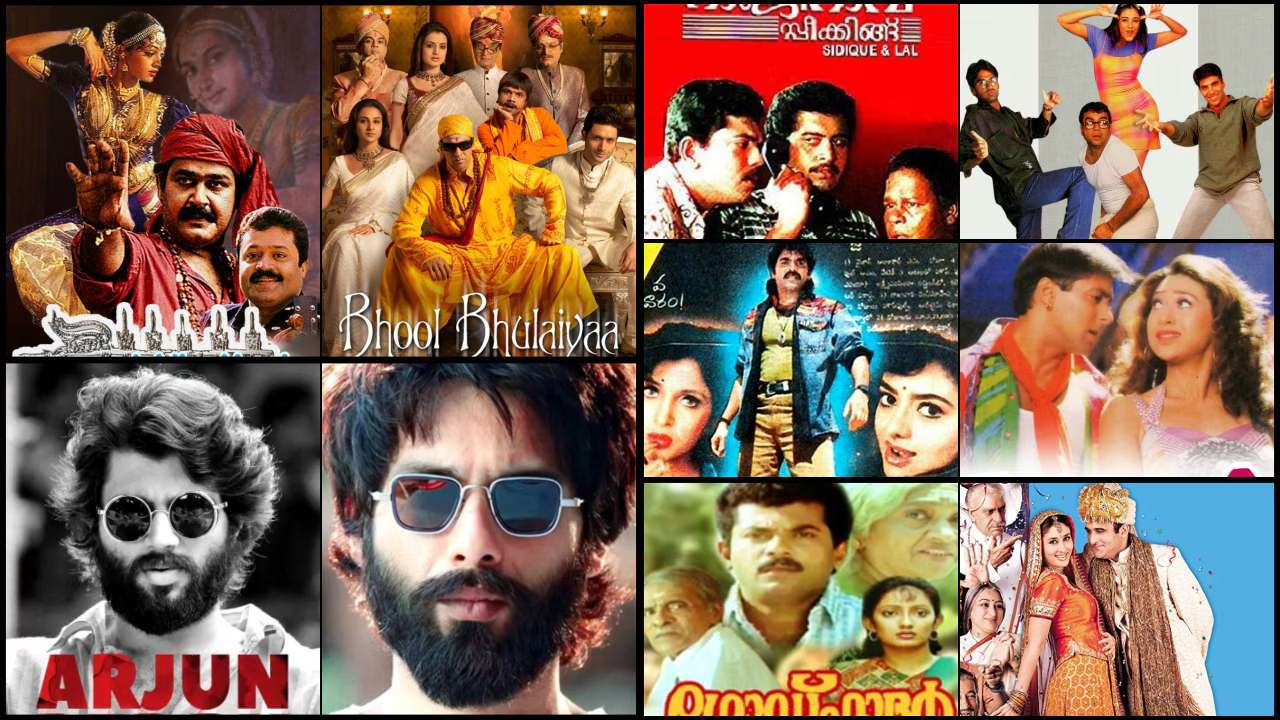
Understanding Movie Rights in India
To buy movie rights in India, a global filmmaker first needs clarity on what is actually being acquired. Many global filmmakers assume they are purchasing full ownership of a story. However, Indian copyright law separates original ownership from adaptation, remake, and derivative exploitation rights. Therefore, a producer must identify which bundle of rights is being transferred and which remain with the author or prior assignee.
In practice, the transaction is rarely about buying “the film.” Instead, it involves isolating adaptation rights within a defined territory and term. This is particularly important when negotiating cross-border remakes. Without structural clarity, producers risk acquiring limited rights that do not permit commercial exploitation in their intended markets.
Copyright Ownership vs Adaptation Rights
For a literary source, copyright generally begins with the author, subject to statutory exceptions and any valid assignment. A completed film carries its own copyright, while the underlying story, screenplay, music and other incorporated works may remain separately owned.
A filmmaker buying adaptation rights does not automatically acquire full copyright ownership. Instead, they secure permission to transform the original material into a new cinematic work. This distinction becomes critical when the original work is based on a novel, short story, web series, or earlier screenplay. Each underlying layer may carry separate ownership claims.
For global producers, this separation must be contractually explicit. If the agreement does not clearly define adaptation scope, language, territory, and format, enforcement becomes difficult. A structured overview of how these categories operate within the broader remake rights India ecosystem clarifies why rights isolation is foundational to compliant acquisition.
Literary, Film, and Format Rights Explained
These categories are not interchangeable. “Format rights” is an industry and contractual description rather than a single standalone statutory right. Protection may depend on copyrightable materials, confidential production knowledge, trademarks and the specific permissions granted under the licence.
These categories are not interchangeable. A producer acquiring film rights from a studio that previously adapted a novel must confirm that the studio actually holds derivative rights from the original author. Otherwise, the chain of title may be incomplete.
In addition, remake rights may apply to a previously produced film rather than the original literary source. In such cases, the buyer must confirm whether sequel, prequel, spin-off, and digital platform rights are included or excluded. Clarity at this stage prevents later disputes over OTT distribution, franchise expansion, or language remakes.
Assignment vs License: Structural Consequences
The legal structure of the transaction determines control. An assignment transfers ownership of specific rights to the buyer. A license grants permission to use the rights under defined conditions while ownership remains with the original holder.
The agreement should identify the work and specify the rights granted, duration, territory, royalty or consideration terms, sublicensing permissions and reversion conditions. Under Indian copyright law, an assignment must be written and signed. Unless the agreement provides otherwise, unexercised assigned rights can lapse after one year, an unstated duration defaults to five years, and an unstated territory defaults to India.
Assignments provide stronger long-term security but often cost more. Licenses may be time-bound or territory-restricted, limiting downstream exploitation. For global filmmakers planning multi-territory releases, streaming adaptations, or franchise development, a narrowly drafted license can create structural constraints.
Therefore, the acquisition model must align with the intended commercial strategy. Producers should evaluate duration, territorial scope, sublicensing rights, and reversion clauses before executing the agreement. Failure to distinguish between assignment and license structures can undermine distribution planning and international financing alignment.
Understanding these foundational distinctions is the first step in buying movie rights in India with legal precision.

Legal Due Diligence Before Buying Movie Rights
Before executing any rights agreement, global filmmakers must conduct structured legal due diligence. In India, ownership layers are often complex, especially when a story has moved through multiple formats such as novels, short films, web content, or earlier cinematic adaptations. Therefore, buyers must verify not only who is selling the rights, but also whether those rights are clean, transferable, and commercially exploitable.
Due diligence functions as a structural safeguard. Without it, producers risk development losses, financing delays, or injunctions that can halt distribution. The objective is to eliminate ambiguity before capital is committed.
Verifying Chain of Title
Chain-of-title verification is the foundation of rights acquisition. It involves reviewing every agreement that transferred ownership from the original creator to the current seller. Each link in that chain must be legally valid, properly executed, and internally consistent.
If a screenplay originated from a novel, the producer must confirm that the novelist assigned adaptation rights to the film producer. If the project was previously optioned, the expiration or termination must be documented. Ambiguous territory definitions, unsigned amendments, or expired options create structural vulnerability.
A disciplined review process aligned with the intellectual property rights in India film production guide ensures that copyright status, assignment validity, and derivative permissions are examined before funds are released. This compliance layer strengthens enforceability and reduces litigation exposure.
Buyers should also verify whether the work is subject to any reversion clauses that may automatically restore rights to the author if production timelines are not met. Overlooking such provisions can invalidate long-term exploitation plans.
Identifying Encumbrances and Hidden Claims
Encumbrances refer to third-party interests that restrict how the acquired rights may be used. These can include prior licensing agreements, investor participation rights, distribution pre-sales, or music publishing arrangements.
For example, if the original film incorporated licensed songs, the remake rights holder may not control soundtrack reuse. Music rights, performance rights, and publishing rights often require separate negotiations. Similarly, co-producers or financiers may hold backend participation that extends to remakes or derivative projects.
Hidden claims frequently arise from informal memorandums or side letters that were never formally terminated. Even if such agreements appear inactive, they may create legal friction if not clarified in writing.
Global producers should request warranties and indemnities covering undisclosed claims. This transfers certain risks back to the seller and provides contractual remedies if hidden encumbrances emerge later.
Moral Rights and Author Approvals
Indian copyright law preserves the author’s right to claim authorship and to object to modifications that prejudice their honour or reputation, even after economic rights have been assigned. These moral rights do not automatically create a general approval right over every adaptation. Any consultation, script-approval or creative-consent requirement should therefore be stated expressly in the agreement.
If a remake involves substantial cultural adaptation, script modification, or tonal changes, the original author may require consultation or approval. Contracts should clearly define whether creative consent is required and how disputes will be resolved.
Finally, producers must assess litigation exposure. Pending lawsuits, arbitration proceedings, or unresolved royalty disputes must be disclosed before closing. Only after these diligence layers are satisfied should the transaction move to formal agreement structuring.
Thorough due diligence converts a speculative rights negotiation into a defensible acquisition strategy.
Structuring the Movie Rights Agreement
Once due diligence confirms clean ownership, the transaction must be converted into a legally precise agreement. Structuring determines how the rights can be exploited, financed, sublicensed, and enforced. For global filmmakers, contract architecture is not merely administrative. It directly affects distribution planning, franchise expansion, and investor confidence.
The agreement must clearly define scope, duration, territory, and derivative permissions. Ambiguity at this stage creates operational limitations later. Therefore, each clause should reflect the buyer’s long-term commercial strategy rather than immediate production intent.
Option Agreement Model
An option agreement grants the producer exclusive rights to purchase adaptation rights within a defined period. During the option term, the producer can develop the script, attach talent, and secure financing. However, ownership does not transfer until the purchase is exercised.
Options reduce upfront financial exposure but introduce timing risk. If financing is delayed beyond the option term, rights may revert to the seller. Agreements must specify extension rights, renewal fees, and exercise procedures. In cross-border transactions, currency controls and remittance timelines should also be addressed.
Option structures are suitable for early-stage development. However, they must define what happens if production begins before full payment is completed. Without this clarity, disputes may arise over partial performance.
Purchase Agreement Model
A purchase agreement transfers ownership of defined rights immediately upon execution or upon satisfaction of payment milestones. This structure offers stronger security and greater leverage for international distribution and pre-sales.
The agreement must detail what is being assigned. Adaptation rights, remake rights, sequel rights, spin-offs, and merchandising rights should be explicitly listed. Vague language such as “all rights” may not withstand legal scrutiny if underlying limitations exist.
That framework clarifies how assignment language should isolate derivative exploitation rights without overlapping unrelated intellectual property claims. Purchase agreements should also include warranties, indemnities, and dispute resolution clauses aligned with the governing law and arbitration seat.
Territory and Language Clauses
Territorial scope defines where the adapted film may be produced, distributed, and exploited. Global filmmakers must determine whether rights are worldwide or restricted to specific regions. Territory definitions should also account for digital streaming, which can blur geographic boundaries.
Language rights are equally important. An agreement may permit adaptation into one language while reserving others for the original rights holder. If multilingual remakes or dubbed versions are anticipated, these permissions must be secured upfront.
Term length must be clearly stated. Perpetual assignments provide stability but increase cost. Time-bound licenses reduce upfront expense but may complicate long-term library exploitation.

Sequel and Franchise Control
Derivative rights determine whether sequels, prequels, spin-offs, series adaptations, or format expansions are permitted. If these rights are not explicitly included, they remain with the original rights holder.
Digital and OTT carve-outs require careful drafting. Some agreements exclude streaming rights or limit exploitation to theatrical release. In today’s distribution landscape, such carve-outs can significantly reduce revenue potential.
Therefore, structuring the movie rights agreement is not a template exercise. It is a strategic alignment between legal drafting and commercial ambition.

Cross-Border Acquisition for Global Filmmakers
Cross-border acquisition introduces additional regulatory, financial, and cultural layers beyond domestic transactions. When rights move across jurisdictions, producers must align copyright law, tax regulations, currency controls, and creative governance mechanisms. The agreement must withstand enforcement in more than one legal system.
Global filmmakers should structure transactions in alignment with the broader remake rights India framework to ensure that territorial isolation, derivative control, and compliance sequencing are preserved across markets. Without this structural alignment, cross-border adaptations can encounter licensing conflicts or repatriation complications.
The complexity increases when intellectual property is transferred between countries with different copyright traditions. Therefore, acquisition strategy must integrate legal drafting, revenue modeling, and cultural adaptation governance from the outset.
Importing Indian Stories for Global Markets
When a foreign producer acquires Indian intellectual property, the primary concern is ensuring that adaptation rights extend beyond India’s territorial boundaries. Agreements must specify worldwide exploitation rights or clearly define permitted territories.
Significant narrative changes should be reviewed against the author’s moral rights and any contractual approval provisions. Indian law protects attribution and provides remedies for modifications prejudicial to the author’s honour or reputation, while the agreement determines whether consultation or prior creative approval is required.
Foreign buyers must also consider dubbing, subtitling, and language version rights. If language exploitation is restricted, distribution strategies may be constrained. Streaming platform agreements must be examined to ensure no pre-existing exclusivity applies.
Currency regulations and remittance compliance must be structured carefully. Payment flows should align with Indian foreign exchange management rules to avoid delays or regulatory scrutiny.
Exporting International Stories into India
When an Indian producer acquires foreign rights, the transaction must satisfy Indian copyright standards while respecting the original jurisdiction’s legal framework. The agreement should confirm that adaptation rights include localization, cultural reinterpretation, and potential format adjustments.
Indian producers must evaluate whether the original work contains embedded music licenses or performer agreements that do not automatically transfer. These components may require renegotiation for the Indian market.
Distribution planning also affects structuring. If theatrical, satellite, and OTT rights are intended for different buyers, sublicensing permissions must be explicitly granted. Without sublicensing rights, downstream monetization becomes restricted.
Cultural adaptation governance is particularly important. Contracts should outline whether the original creator retains creative consultation rights or revenue participation tied to remake performance.

Acquiring Korean Remake Titles for the Indian Market
Indian production houses increasingly license Korean narrative properties for localized adaptation. However, acquiring Korean remake rights requires structured cross-border negotiation rather than informal discussions. The buyer must determine whether rights are controlled by the originating studio, a sales agent, or a format distributor. Without confirming the controlling entity, negotiations may result in defective or unenforceable agreements.
Unlike catalogue browsing exercises, acquisition focuses on isolating adaptation rights contractually. Producers must secure explicit language remake rights, define territorial exploitation boundaries, and clarify inclusion of OTT, satellite, and theatrical rights.
Structural Considerations in Korean Remake Licensing
Korean agreements often distinguish between narrative remake rights and format replication rights. If the work has episodic architecture or franchisable potential, additional permissions may apply. Buyers must also confirm whether sequel, prequel, or spin-off rights are bundled or reserved.
Case analysis of Indian remakes of Korean movies shows that localization clauses materially affect creative control. Agreements may require script approvals, consultation rights, or cultural modification boundaries retained by the original rights holder. These provisions directly influence production timelines and investor confidence.
Revenue structuring also requires precision. Some licensors negotiate fixed remake fees, while others retain backend participation tied to performance metrics. Royalty clauses must define gross receipts, allowable deductions, audit rights, and cross-territorial reporting obligations.
Within acquisition strategy, the priority remains enforceability, territorial clarity, and derivative rights control. When structured correctly, licensing Korean intellectual property becomes a regulated cross-border transaction aligned with financing, distribution sequencing, and long-term franchise viability.

Revenue Participation and Royalty Structures
Cross-border transactions frequently involve revenue-sharing rather than fixed purchase pricing. Royalty structures may include minimum guarantees, backend participation, or profit percentage calculations.
The agreement must define gross receipts, distribution deductions, and audit rights. Ambiguous definitions create disputes when revenues are reported across multiple territories and currencies.
Tax implications also require clarity. Withholding taxes, double taxation treaties, and cross-border remittance rules affect net returns. Producers should determine which party bears tax liabilities and how payments will be documented.
Finally, dispute resolution mechanisms should specify governing law and arbitration venue. A cross-border rights agreement without jurisdictional clarity exposes producers to procedural uncertainty.
Cross-border acquisition is therefore not simply a rights purchase. It is a multi-layered compliance exercise requiring coordination between legal, financial, and creative stakeholders.
Common Legal Mistakes When Buying Movie Rights in India
Even when negotiations appear commercially sound, structural drafting errors can undermine the entire acquisition. In India, informal practices and incomplete documentation are common in early-stage rights conversations. However, global filmmakers cannot rely on verbal assurances or loosely drafted memorandums.
The most frequent mistake is assuming that purchasing “remake rights” automatically includes sequels, spin-offs, digital exploitation, and future derivative adaptations. Unless these rights are expressly included in the agreement, they remain with the original rights holder.
Financial structuring errors also create long-term friction. Producers often negotiate headline pricing without understanding how backend participation, revenue triggers, or royalty escalations affect total liability. A clear understanding of pricing mechanics, as outlined in the remake rights fees analysis, helps prevent underestimating lifecycle costs tied to performance-based payouts.
Failure to anticipate downstream exploitation channels, particularly streaming and multi-language remakes, further complicates the acquisition.

OTT and Streaming Platform Conflicts
Streaming platforms have altered rights valuation and exclusivity structures. Some agreements restrict remake exploitation to theatrical release, while reserving OTT rights for the original producer. If digital carve-outs are not identified at acquisition stage, distribution planning may collapse later.
Exclusivity clauses require careful review. An existing streaming agreement for the original film may limit derivative adaptations in specific territories or languages. Similarly, co-production agreements may grant digital rights to third parties.
Producers must also clarify whether global streaming includes subtitled or dubbed versions. Territorial ambiguity in digital rights frequently leads to cross-border disputes.
Another recurring issue involves timing windows. If the original film remains under active streaming exclusivity, remake release timing may be restricted. Contracts should define blackout periods and sequencing obligations clearly.
Informal Agreements vs Enforceable Contracts
Another mistake is failing to execute and preserve the rights agreement and its amendments properly. Copyright registration is not mandatory for protection in India, but an assignment must be in writing and signed by the assignor or an authorised agent.
Producers sometimes proceed with development based on emails or handshake understandings. This exposes the project to injunction risk if the seller later negotiates with another buyer.
Another mistake involves failing to register agreements or document execution formally. While copyright registration is not mandatory in India, properly executed contracts strengthen enforceability and investor confidence.
Incomplete derivative rights present additional risk. If the agreement does not clearly include sequel, prequel, franchise, series, and format extensions, expansion opportunities may be blocked.
Avoiding these legal mistakes requires disciplined drafting, financial foresight, and formal documentation at every stage of the acquisition process.

Translating Rights into Production Execution
Acquiring movie rights is only the first phase of the transaction lifecycle. Once agreements are executed, the focus shifts from legal structuring to operational implementation. At this stage, contractual language must translate into production controls, insurance compliance, and documentation discipline.
A rights agreement that appears complete on paper can fail during execution if production teams do not align with its limitations. Therefore, producers must integrate legal obligations into scheduling, budgeting, and clearance workflows before principal photography begins.
From Legal Acquisition to On-Ground Production
The transition from contract to set requires coordination between legal counsel, executive producers, and line production teams. Rights scope must be reflected in script drafts, credit attribution, and publicity materials. If language rights or territorial limitations exist, marketing and distribution teams must be informed early.
Insurance policies depend on verified rights ownership. Errors and omissions (E&O) insurers typically require documented proof of chain of title and assignment clarity before coverage is issued. If adaptation rights are incomplete or ambiguously drafted, insurers may exclude coverage, increasing financial exposure.
Completion bonds introduce additional scrutiny. Bond companies assess whether rights are secure, transferable, and enforceable before guaranteeing delivery. Incomplete derivative rights or unresolved encumbrances can trigger bond refusal or additional escrow requirements.
Operational alignment is therefore inseparable from rights discipline. Producers relying on structured film production services in India ensure that contractual obligations are embedded within budgeting, scheduling, and compliance tracking systems from the outset.
Compliance During Shooting
During filming, compliance monitoring becomes critical. Credit clauses, moral rights acknowledgments, and author consultation provisions must be honoured. Deviations from agreed script parameters may require written approval if the agreement mandates creative oversight.
Documentation control is equally important. Executed agreements, amendment letters, insurance certificates, and royalty schedules must be centrally stored and accessible for audit. Distribution partners and financiers frequently request these records during due diligence.
If the project involves cross-border participation, remittance documentation and tax compliance records must be maintained for future audits. Failure to document payment flows can complicate revenue reporting and backend calculations.
Translating rights into production execution ensures that legal acquisition evolves into enforceable, insurable, and commercially viable filmmaking.
Conclusion
Buying movie rights in India requires more than commercial negotiation. It demands structured sequencing from rights identification and due diligence to contract drafting and operational integration. Each phase builds upon the previous one. Weakness at any stage can compromise the entire adaptation.
Global filmmakers must isolate adaptation rights clearly, verify chain of title, structure agreements around territory and derivative scope, and align cross-border compliance before capital is deployed. Financial modeling, insurance validation, and documentation control are not peripheral tasks. They are integral to rights security.
The broader remake rights India ecosystem operates as a compliance architecture rather than a transactional shortcut. Producers who treat rights acquisition as a layered governance process reduce litigation exposure, strengthen financing credibility, and protect long-term franchise potential.
Disciplined legal sequencing transforms rights purchases into sustainable production assets.
