
Introduction
South Korean cinema has quietly become one of the most influential forces in Indian filmmaking. Long before Parasite won Best Picture or Squid Game turned into a global streaming event, Indian directors were studying Korean thrillers and melodramas for their tight plotting, moral ambiguity and emotional punch, and reworking them for Indian audiences. The result is a long line of Hindi and regional films that trace their DNA back to Korean originals, some openly licensed, others quietly borrowed, and a few merely whispered about. Taken together, they map two decades of cultural exchange between two of Asia’s most prolific film industries.
What makes these adaptations worth examining is not the box-office arithmetic but the journey each story takes: what the Korean film does well, what the Indian version keeps, and what it changes to fit local audiences. It is also a story about remake rights India, the gradual shift from uncredited copying toward formal, paid acquisition of adaptation rights, which has turned Korean source material into a legitimate, monetisable asset for Indian producers and platforms. This guide walks through the most significant titles, grouped by how faithfully, and how legally, they were adapted.

Why Korean Stories Travel So Well to India
Korean and Indian audiences share an appetite for high-stakes emotion (revenge, sacrifice, family duty and moral dilemma) but Korean filmmakers tend to deliver it in lean, ninety-to-hundred-and-twenty-minute packages with disciplined plotting. For Indian directors raised on longer, song-driven spectacles, a Korean thriller offers a ready-made, watertight structure that can then be expanded with music, stars and local texture. The skeleton is strong enough to survive the additions, which is exactly why so many of these adaptations begin life as Korean blueprints.
Three Korean genres in particular have crossed over again and again. The revenge thriller, with its slow-burn build and explosive release, suits the larger-than-life confrontations Indian audiences expect. The race-against-time procedural (a parent or lawyer trapped by a ticking clock) adapts almost without friction, because suspense needs no translation. And the nostalgic family epic, telling a nation’s modern history through one ordinary life, maps onto India’s own taste for sweeping, multi-decade storytelling. What changes in the crossing is tone: where Korean originals often close on ambiguity, Indian versions add catharsis, melody and a clearer moral resolution.

Five Kinds of Korean Adaptation
Not every “Korean remake” is the same, and for anyone tracking licensing the distinction matters. Indian adaptations of Korean films fall into roughly five groups. The official remake is one where rights are formally acquired and the source is credited, as with Dhamaka. The licensed regional remake is made in Hindi, Tamil, Telugu or Malayalam under a specific studio deal, often as part of a multi-language rollout. The unofficial or uncredited adaptation lifts a story without paying for it, the category that Zinda made notorious. The inspired-by film borrows a premise or structure loosely without reproducing the plot. And the disputed inspiration is where the similarities are obvious but the makers deny direct copying, as the makers of Barfi! have always done.
Keeping these categories in view is the quickest way to understand both the creative debt and the legal status of any given film, and it is the lens used throughout this guide.
What Indian Remakes Tend to Change
Across all five categories, a few patterns repeat. Runtime almost always grows, because Indian releases accommodate songs, subplots and an interval. Star power reshapes the centre of gravity: a Korean ensemble piece becomes a vehicle for a single leading actor, and the script bends to give that actor more space. Endings soften, the bleak or ambiguous finish common in Korean cinema is frequently replaced with resolution and emotional payoff. And local texture is layered in everywhere, from food and festivals to regional politics and policing, so that a Seoul story feels like it always belonged in Mumbai, Kolkata or Kerala.
The films that work best are the ones that respect the original’s engine while changing its bodywork. The weaker adaptations tend to keep the plot but lose the discipline, adding melodrama where the Korean version trusted silence, or spectacle where it trusted tension. The case studies below show both outcomes, and they explain why two films can borrow from the same country and yet feel worlds apart in quality.
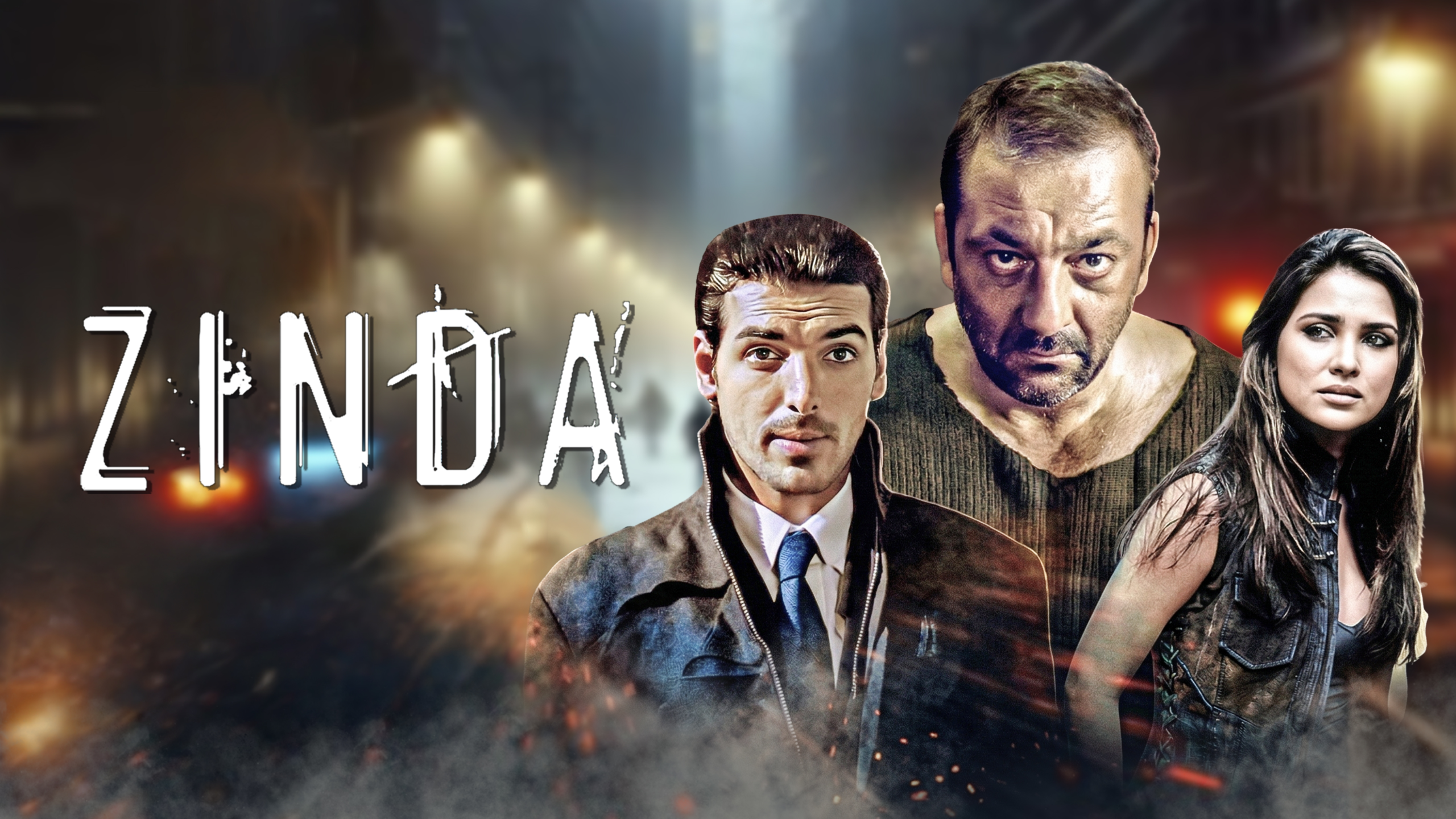
Zinda (2006) – The Unofficial Remake of Oldboy (2003)
No Korean film looms larger over Indian cinema than Park Chan-wook’s Oldboy (2003). A man is abducted and held in a single room for fifteen years without explanation, then suddenly released and given a few days to discover who imprisoned him and why. Its corridor fight, filmed in one unbroken side-scrolling take, and its now-infamous final twist made it a landmark of world cinema and earned it the Grand Prix at Cannes in 2004. It is precisely the kind of tightly engineered revenge story that Indian filmmakers found irresistible.
Sanjay Gupta’s Zinda (2006) followed it scene for scene. Sanjay Dutt plays the imprisoned man and John Abraham the antagonist, and the film reproduces the original’s premise, its captivity, its corridor brawl and its devastating reveal. Because the rights were never formally acquired, Zinda became the most cited example of uncredited adaptation in Bollywood, a film admired for its craft and criticised for its provenance in equal measure. Its real significance is historical: the controversy around it, and others like it, became part of the argument for the formal, licensed deals now handled by a dedicated Korean film agency in India. Zinda sits firmly in the unofficial category, and it remains the film most associated with India’s long fascination for Korean storytelling.

Barfi! (2012) – A Disputed Tribute to Lover’s Concerto (2002)
Where Zinda borrowed a thriller, Barfi! drew on a romance. Lee Han’s 2002 drama Lover’s Concerto (연애소설, Yeonae Soseol) tells the tender, bittersweet story of two close friends whose lives are reshaped when a third person enters their world. Told through letters, photographs and flashbacks, it builds to a quiet, heartbreaking twist, and although it was never a major box-office hit in Korea it became a cult favourite for its poetic storytelling and the chemistry of its leads.
Ten years later, Anurag Basu’s Barfi! (2012) shares notable similarities with it in emotional structure and central twist, reimagining the trio as Ranbir Kapoor’s mute Barfi, Ileana D’Cruz’s narrator and Priyanka Chopra’s autistic Jhilmil, wrapped in Chaplin-esque comedy and the visuals of Darjeeling and Kolkata. The film won multiple National Awards and became India’s official entry to the 2013 Oscars. Basu has always maintained that Barfi! was an homage drawn from many sources rather than a copy of any one film, which places it among the disputed inspirations rather than the licensed remakes, but its debt to Lover’s Concerto is hard to miss, and it remains the warmest example of a Korean story finding a bigger heart in India.
Notable Korean-to-Indian Remakes
Beyond those two landmarks, a steady run of Hindi films has drawn on Korean originals. Read less as a list of box-office numbers and more as a set of adaptation choices, they show how the same impulse (to import a Korean engine and rebuild the bodywork) produces very different results depending on how much of the original’s discipline survives the journey. A fuller catalogue of Korean films available for remake in India shows just how deep the well runs beyond the titles covered here.
Jazbaa (2015) – from Seven Days
The Korean thriller Seven Days (2007) is built on an unbearable bargain: a successful lawyer’s daughter is kidnapped, and the only way to get her back is to win an acquittal for a man she is sure is guilty. The clock, not the courtroom, is the real antagonist. Aishwarya Rai Bachchan’s comeback film Jazbaa (2015) was an official remake of it, directed by Sanjay Gupta, who kept the race-against-time spine intact. Where the Indian version diverges is mood: Gupta rebuilt the story in a rain-soaked, high-contrast Mumbai and leaned harder on melodrama than the Korean original’s cooler restraint.
Critics felt that shift cost some of the tension that made Seven Days so gripping, but as a fully licensed adaptation it is a clean example of how a Korean premise can be bought, transplanted and restyled. For producers, it also showed that a faithful structure still needs the original’s tonal discipline to fully land.
Rocky Handsome (2016) – from The Man from Nowhere
The Man from Nowhere (2010) was one of the highest-grossing Korean films of its year, a story about a withdrawn pawnshop owner who unleashes startling violence to rescue a young girl he has quietly befriended. Its reputation rests on its action: close-quarters knife work and long, unbroken fight staging that set a benchmark for the genre. John Abraham’s Rocky Handsome (2016), directed by Nishikant Kamat, set out to import exactly that intensity into Hindi cinema, which had rarely attempted combat at this level of choreography and brutality. Kamat’s version foregrounded Abraham’s physicality and a harder, more graphic style than mainstream Bollywood was used to. Reviews were mixed on the storytelling, but its real contribution was technical, it helped pull Hindi action toward the leaner, more visceral template that would define the genre’s later revival.
Bharat (2019) – from Ode to My Father
Some adaptations swap a plot; Bharat swapped a nation’s memory. Its Korean original, Ode to My Father (2014), tells modern Korean history (wartime evacuation, labour migration abroad, televised family reunions) through the long life of one ordinary man who keeps a promise made to his father. Director Ali Abbas Zafar transposed that structure onto India, anchoring Salman Khan’s character to Partition and the decades that followed, so that one family’s story becomes a walk through the nation’s modern memory. Zafar’s adaptation kept the episodic, nostalgic shape while replacing Korean milestones with Indian ones. Critics were divided on the execution and the star vehicle around it, but as an exercise in localising a country’s collective history rather than just its narrative, Bharat is one of the more ambitious entries on this list.

Dhamaka (2021) – from The Terror Live
The Terror Live (2013) confines almost its entire runtime to a single broadcast studio, where a news anchor takes a live call from a man who then blows up a bridge on the Han River, turning one room into a study of ego, media ethics and real-time panic. Dhamaka (2021), starring Kartik Aaryan and directed by Ram Madhvani, is an official remake that relocates the bombing to Mumbai’s Bandra-Worli Sea Link and keeps the claustrophobic, real-time format almost intact.
Released directly to streaming, it is one of the most faithful Korean adaptations in this guide, precisely because the OTT context rewarded the original’s lean confinement instead of fighting it. The choice also reflects a wider pattern: tight Korean thrillers are increasingly remade for the screen at home rather than the multiplex, where their restraint is an asset rather than a liability. (Note that a separate 2023 Telugu film of the same name is unrelated to this Korean source.)
Te3n (2016) – from Montage
Montage (2013) is a cold-case thriller about a mother who, years after her child’s unsolved abduction, watches a near-identical crime unfold just as the statute of limitations is about to expire. Te3n (2016) relocated that premise to Kolkata, and the city does much of the work. An elderly man, played by Amitabh Bachchan, has spent years refusing to let go of his granddaughter’s unsolved kidnapping, and the film’s grey, rain-slicked streets mirror his grief.
Where the Korean original is clinical and procedural, the Indian version is mournful and atmospheric, holding attention through place and performance rather than pace. Officially licensed, the film shares its premise with other Indian remakes, the same Korean source has been adapted more than once across languages, a reminder of how a single strong story can travel repeatedly. That restraint makes it one of the more distinctive Korean adaptations in Hindi, less interested in solving the case than in sitting with the loss.
Awarapan (2007) – from A Bittersweet Life
A Bittersweet Life (2005) is a sleek Korean noir about a loyal enforcer whose quiet, unspoken attachment to his boss’s mistress triggers a slow and bloody unravelling. Mohit Suri’s Awarapan (2007) is widely regarded as an unofficial adaptation, closely echoing the original’s brooding restraint and music-driven mood while relocating the story to a Mumbai underworld. Emraan Hashmi plays the conflicted enforcer, and the film leans into melancholy and melody rather than action. It was never credited as a remake, which places it among the uncredited adaptations that defined much of Bollywood’s early Korean borrowing, and it has aged into something of a cult favourite for exactly that brooding tone, a register Hindi cinema rarely sustains for a full film.
Do Lafzon Ki Kahani (2016) – from Always
Korea’s softer cinema has crossed over too. Always (2011) is a quiet romance about a former boxer and a visually impaired woman whose tentative relationship becomes a study in devotion and second chances. Do Lafzon Ki Kahani (2016), led by Randeep Hooda, adapted it for Indian audiences while keeping the original’s gentle, melancholic register rather than inflating it into spectacle. A licensed adaptation that found only a small audience, it nonetheless proved that Korea’s romantic dramas (not only its revenge thrillers and procedurals) have a place in the Indian remake conversation.
From Borrowing to Buying: Remake Rights in India
The arc from Zinda‘s uncredited borrowing to today’s formally licensed adaptations mirrors a wider professionalisation of the Indian industry. In the 2000s, a striking Korean premise could be lifted with little consequence; today, the legal and reputational risks of doing so are far higher, and audiences themselves are quick to spot an unacknowledged source. As Korean content has surged on streaming platforms, producers increasingly acquire adaptation rights up front, negotiating remakes as proper intellectual-property deals rather than quiet imitations. In practice that means starting from a formal remake-rights acquisition checklist and a clear paper trail long before a frame is shot.
The Kinds of Korean Remake
The streaming era has sharpened this further. When the Korean original is one click away on the same platform as its Indian remake, faithfulness and fair credit become commercial necessities, not just ethical ones, viewers will make the comparison themselves. That visibility has pushed studios toward cleaner licensing and closer collaboration with Korean rights-holders, and it has rewarded the adaptations that genuinely add something rather than simply translate.
That shift has also created a small ecosystem of intermediaries on the production side. Beyond rights brokering, studios planning India-Korea projects rely on production partners and a line producer Korea-side network to handle budgeting, permits and crew coordination across both countries, so that a licensed remake or co-production can actually be shot rather than merely optioned. Reference material such as a guide to Korean film production rates helps Indian teams budget these projects with realistic numbers.
Interest is widening upstream as well. Korean short films from the Busan circuit are now scouted for remake and format deals, which means the pipeline increasingly begins at festivals rather than with finished features. For Indian producers, the lesson of the last two decades is straightforward: the strongest Korean stories travel, but they travel best, and most safely, when the rights travel with them.
