
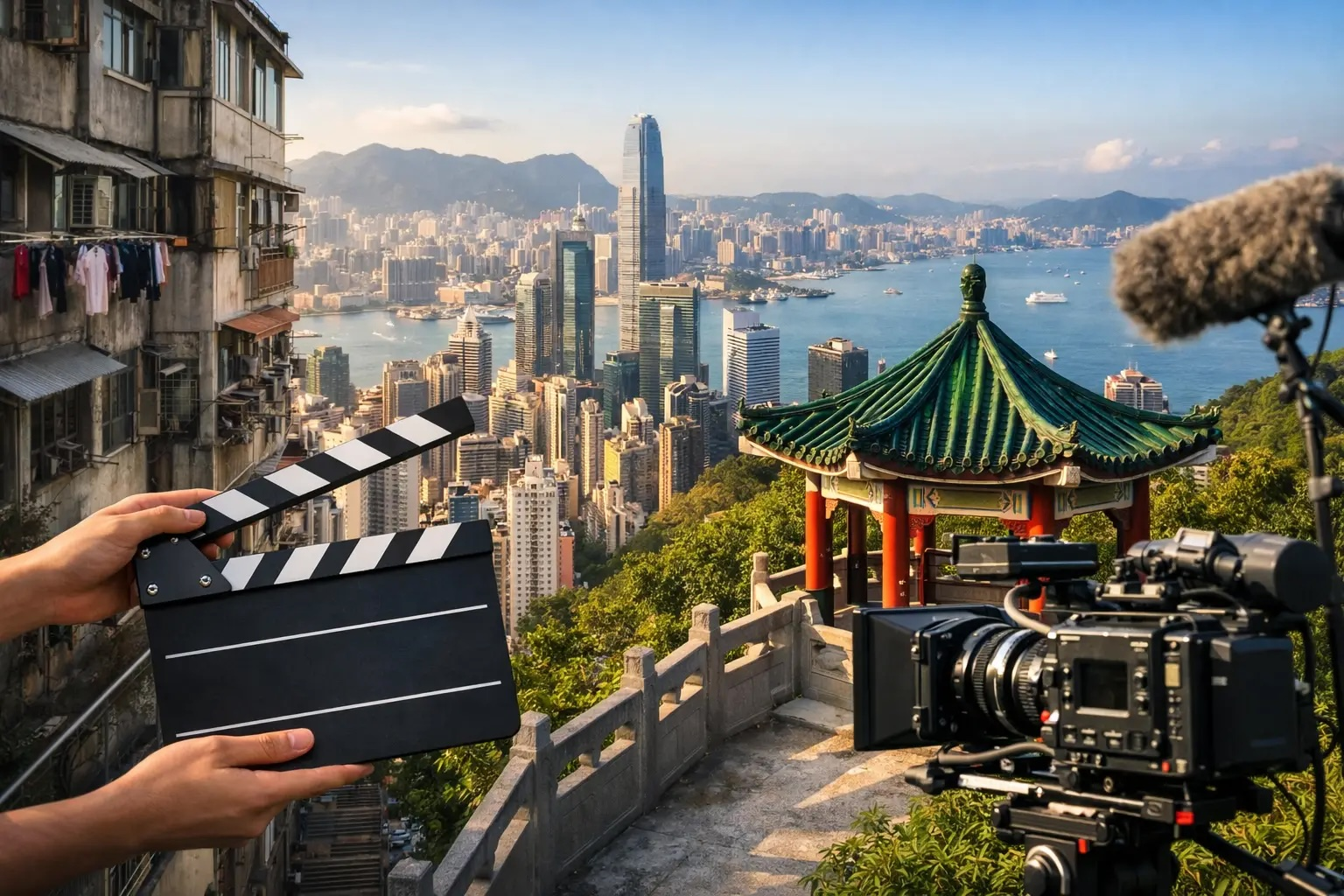
A Hong Kong shoot lives or dies on how well its ground operation is prepared. Our Line Producer Hong Kong desk controls the budget, schedule, crew and vendors, while film fixers in Hong Kong coordinate locations, permissions and local access. The city offers free government facilitation, no general permit for non-exclusive filming in public areas and no VAT or general sales tax, but controlled locations and exclusive use follow separate approval routes.
This guide sets out what a line producer in Hong Kong actually controls, how the permit system and the Film Promotion and Facilitation Section really work, where the city rewards a production and where it punishes assumptions, what it genuinely costs, and how Hong Kong sits inside the wider Asia production map. It is written for producers weighing Hong Kong as a standalone location or as the controllable gateway into Greater China.
Non-exclusive public filming may require only police notification, while government land, controlled premises and exclusive use follow separate application, fee and timing requirements. Confirm the route before locking the schedule.

What a Line Producer in Hong Kong Actually Runs
The line producer owns execution: the budget, the schedule, the crew, the vendors and every permission the shoot depends on. That ownership here is less about the volume of paperwork than about sequencing a compact but layered environment, where a single day can move from a public street to a government pier to a private tower lobby, each under a different authority and each on its own calendar.
The work starts long before the first shoot day. It means confirming which locations are genuinely available on the required dates, not merely photogenic, establishing which need government permission and which do not, pricing the administration charges and deposits honestly, and building a schedule around the slowest clearance rather than the fastest. On the floor it becomes call-sheet discipline, vendor management, safety and the real-time decisions that keep a dense-city day moving when a street, a lift lobby or a harbour crossing does not behave as planned.
The roles overlap, but accountability differs. The line producer holds the budget, schedule and vendor structure, while experienced film fixers in Hong Kong coordinate location research, authority communication and practical access before and during the shoot.

Permits and the Film Promotion and Facilitation Section
Hong Kong is unusually light on permits for a major city. Filming in public areas on a non-exclusive basis requires no permit at all; crews are simply encouraged to notify the police so the shoot proceeds unimpeded, and that notification carries no fee. For a great deal of run-and-gun street work, that is genuinely the entire process, which is part of why the city has such a deep production heritage.
The friction begins the moment a production needs something exclusive or controlled. Filming on government land and premises, and within Hong Kong waters, requires permission from the relevant department and carries an administration charge. The Film Promotion and Facilitation Section of the Cultural and Creative Industries Development Agency (CCIDA) exists to smooth exactly this: it provides free, one-stop assistance with locations and the permits a crew needs, and it is the single most useful institution a visiting production can engage early.
Timelines are the thing to plan around. Straightforward LCSD applications commonly require at least seven working days, while complicated cases involving further consultation can take ten or more. Other government properties and traffic-control requirements follow their own timelines, so the final allowance should be confirmed against the selected locations and activity. None of this is onerous, but all of it is sequential, and a production that treats the permission calendar as background rather than as a hard schedule input is the one that loses a day it had already paid for. A Hong Kong production-services team maps that calendar during prep.
Planning the Shoot: A Realistic Timeline
A realistic prep schedule runs backwards from the permission with the longest tail. Non-exclusive public filming requires no general permit, although police notification is encouraged. Straightforward LCSD applications commonly require at least seven working days and complicated cases ten or more; government properties, controlled locations and traffic restrictions follow their own processes.
The practical sequence is to engage the Film Promotion and Facilitation Section early, lock the hero locations and their permissions first, model the costs and deposits against confirmed dates, and only then build the day-by-day schedule around the slowest approval and the weather window. Crew and equipment are rarely the constraint here; permissions and season are. Building the plan in that order is what a resident line producer contributes that a remote production office cannot.

The Locations That Make Hong Kong
Hong Kong delivers an enormous range of looks inside a small, well-connected footprint. Victoria Harbour and the Central skyline supply the instantly recognisable frame; Kowloon districts such as Sham Shui Po and Mong Kok give dense, neon, street-level texture that has doubled for near-future and cyberpunk worlds for decades; and the outlying islands, country parks and reservoirs offer green, coastal and remote looks a short ride from the towers.
The city also carries heritage and religious locations, from temples and monasteries to colonial-era architecture and traditional markets, that stand in convincingly for a wider region when a production cannot access the country it is portraying. Public housing estates, elevated walkways and the harbour ferries add texture that is difficult to fake anywhere else.
Because the geography is compact, a production can realistically hold several distinct looks within a compact schedule, provided the permissions for each have been mapped in advance. That density is Hong Kong’s real advantage over sprawling alternatives, and it is also precisely why an unmapped schedule unravels fast: the looks are close together, but the authorities behind them are not coordinated with one another.
Crew, Studios and Equipment
The city carries a deep, experienced crew base built over decades as one of the world’s most prolific film industries. Heads of department, camera and lighting crews, grips, stunt teams and post facilities are all available locally and are fluent in international workflows, and English works alongside Cantonese on most professional sets. Equipment rental houses, sound stages and support services are mature and close at hand.
For productions comparing Asian bases, this depth is what separates Hong Kong from newer markets: the crew is not being assembled for your shoot, it already exists and has shot at scale. That maturity shows up as fewer surprises, faster problem-solving and a vendor market that understands international insurance, safety and delivery expectations without being walked through them.
Producers weighing Hong Kong against a line producer Korea operation or a line producer Japan base are usually choosing between comparable professional depth. When capability is a given on all three, the decision moves to cost, the specific look required, and which base offers the cleanest access to the surrounding region.

Costs and the Low-Tax Advantage
Hong Kong is not a cheap location, but its cost structure is cleaner than its reputation suggests, and the single biggest reason is tax. There is no VAT and no general sales tax, so budgets are not eroded by an indirect-tax layer that most other territories impose on equipment, services and vendor invoices alike. For a production of any size, that is a real and rare structural saving, not a marketing line.
What Filming Locations Cost
Government and private locations may carry application charges, hire fees, deposits, personnel costs and public-liability requirements. The amount varies by venue and the degree of disruption. Current location, crew and equipment figures are maintained in the Hong Kong filming costs, crew rates and incentives guide.
A production that wants the Hong Kong look at a lower headline cost sometimes splits the shoot, holding hero skyline and harbour days in the city and moving volume interior or crowd work to a cheaper regional base. That routing is a line-producer decision modelled early, not a rescue late, and it is one reason Hong Kong is so often planned as part of a regional package rather than in isolation.
When Hong Kong Is the Right Call, and When It Is Not
Hong Kong is the right call when a production needs its specific look, the dense vertical skyline and neon street texture nothing else quite replicates, or when it needs a controllable, English-speaking, low-friction base with real access to mainland China. It rewards projects that value certainty and professional depth over the lowest possible day rate, and that can shoot in the cooler, drier months.
It is the wrong call when the driver is a cash rebate, because Hong Kong does not offer one for foreign shoots, or when the budget is built around bottom-tier crew and location costs the city simply does not have. A production chasing the cheapest Asian base will find better headline numbers in Southeast Asia; a production that needs the Hong Kong look, the mainland gateway, or a mature crew that shoots at scale will not find a substitute. Naming which of these a project actually is, before committing, is the first decision a line producer helps make.
Funding and Incentives, Honestly
Hong Kong does not offer a general cash rebate for inbound foreign productions. Film Development Fund schemes support eligible Hong Kong-led productions and qualifying collaborations, with requirements varying by programme. A visiting foreign shoot should not assume access to that funding.
For a purely foreign shoot, those two structural advantages are the real incentive, not a rebate cheque. For projects with a Hong Kong or co-production element, the funding routes can be significant. The full breakdown of filming in Hong Kong costs, crew rates and incentives is set out separately, so this page stays on the execution question of who runs the shoot.

Hong Kong as the Gateway to Greater China
Hong Kong’s strategic value is not only its own locations; it is the access it provides. As a common-law, English-and-Cantonese, financially open city on the edge of the mainland, it is the natural staging point for productions that want proximity to China without operating entirely inside the mainland system from day one. It is also where the region’s financing and co-production conversations happen.
The CEPA Co-Production Route
Under CEPA, approved Mainland–Hong Kong co-productions are treated as Mainland films for distribution in Mainland China and are not subject to the foreign-film import quota, as confirmed by the Hong Kong Trade and Industry Department. That mechanism is why some projects route through Hong Kong specifically rather than shooting elsewhere in the region.
This gateway role is why the city belongs in a regional plan, not a single-country decision. A production routing through the Asia film production corridor can pair Hong Kong with a line producer in China operation for mainland scale, using Hong Kong as the controllable base. Read that way, the city earns its cost.
Post-Production and Delivery
Hong Kong is not only a shooting base; it carries mature post-production capacity, from picture and sound finishing to VFX and colour, built by the same industry that made the city a production centre. For a production that wants to keep the whole pipeline in one low-tax, common-law jurisdiction, finishing here keeps rights, deliverables and payments inside a single familiar system instead of scattered across borders and currencies.
The delivery question also ties back to the funding routes. A project structured as a Hong Kong or co-production, rather than a purely foreign shoot, can align its post and delivery with the Film Development Fund requirements and, where relevant, the co-production status that opens the mainland market. For a foreign production with no local element, post can still be done here on its merits, but that becomes a cost-and-capability decision rather than an incentive one. A line producer models where each stage of the pipeline should sit before the shoot, not after the rushes come in.

Weather, Seasons and Scheduling
Hong Kong’s calendar shapes its schedule more than producers expect. The typhoon season runs roughly from May to October, with the greatest risk from July to September, and a severe storm signal effectively shuts the city down: filming stops, permits pause and outdoor work becomes impossible until the signal is lowered. A production shooting in those months carries genuine weather contingency, not a token buffer.
The most reliable window is the cooler, drier stretch from late October to December, when light is clean and heat and humidity are manageable for long exterior days. Spring can be workable but brings fog and haze that soften the skyline the production probably came for. A line producer builds the schedule and the contingency around this calendar, because in Hong Kong the weather is a scheduling authority in its own right.

Logistics: Customs, Carnet and Crew Entry
Hong Kong accepts ATA Carnets for professional equipment, with Customs endorsement required on arrival and departure. Any separately controlled equipment still needs its applicable licence. Foreign crew may require a visa or entry permit depending on their activities; the government’s published normal processing time is four weeks.
Once on the ground, the compact geography is a logistical gift: unit moves that would cost half a day in a sprawling city are often minutes apart in Hong Kong. The trade-off is verticality and footfall, where load-in, parking and crowd control in a high-rise, high-density environment demand planning over improvisation. Managing that layer cleanly is exactly what Hong Kong production teams exist to do.

Insurance, Safety and Liability
Hong Kong operates under common law, which makes its liability and contracting environment familiar to most international productions and their insurers. Production insurance is expected, and for many controlled locations and street closures it is effectively a precondition of the permission, not optional protection. Errors-and-omissions cover protects the finished film against rights and clearance claims, and larger financed projects carry a completion bond as usual.
On safety, the density that makes Hong Kong photogenic also makes it demanding. Shooting on elevated walkways, in high-rise lobbies, around live traffic and on the harbour requires genuine crowd and access control, and the police notification for public work exists partly so safety and traffic can be coordinated. A line producer who treats insurance and safety as scheduling inputs, confirmed before the shoot rather than assembled during it, is the one whose Hong Kong days run to plan.
Line Producing in Hong Kong: Common Questions
Do I need a permit to film on the street in Hong Kong? Not for public areas on a non-exclusive basis. That filming needs no permit and no fee; crews simply notify the police as a courtesy. A permit and an administration charge apply once you need government land, government premises or Hong Kong waters, or exclusive use of a public space.
How long do government location permits take? Plan for at least seven working days for straightforward LCSD locations, and ten or more working days for complicated cases; traffic restrictions and street closures follow their own timelines. The Film Promotion and Facilitation Section helps for free, but the clearances are sequential, so the longest-tail permission sets the schedule.
Is there a cash rebate for filming in Hong Kong? No. There is no inbound cash rebate for foreign productions. The city funds local and co-produced films through the Film Development Fund, and a visiting shoot’s real advantages are the absence of VAT or sales tax and the free Film Promotion and Facilitation Section support.
When is the best time of year to shoot in Hong Kong? Late October to December is the most reliable window, cooler and drier with clean light. The typhoon season runs roughly May to October and peaks from July to September, when a severe storm signal can shut the city down, so those months need genuine weather contingency.
Working With a Film Fixer in Hong Kong
The right Hong Kong line producer is not a booking service but an execution lead. A film fixer in Hong Kong coordinates location access, authority communication, crew and practical requirements against the approved schedule. Experience improves filing completeness and anticipation of site conditions, but it does not replace the authority’s process or guarantee faster approval.
Whether a project needs full production-services coverage or a lean fixer-and-crew footprint, the value is the same: a production that arrives with its permissions mapped, its costs modelled honestly, its schedule built around the city’s real rhythms and its regional access understood. That is what turns Hong Kong’s on-paper ease into an actual advantage on the floor, and it is the difference between visiting the city and actually delivering in it.
