
Morocco Line Production: From Regional Choice to Global Hub
Morocco line production has reached a scale and sophistication that no other MENA territory has matched — the product of eight decades of hosting major international productions from Orson Welles shooting Othello in Essaouira in 1949 through to Gladiator, Babel, Inception, and the better part of Game of Thrones’ desert sequences. That production history did not just create a location reputation. It built the crew base, the permit infrastructure, the studio facilities, and the institutional knowledge that make Morocco operationally viable for international productions at scale today.
From Regional Choice to Global Production Hub
The transformation from filming destination to production hub happened gradually and then all at once. Early international productions came to Morocco for its geography — the Sahara, the Atlas Mountains, the medinas — and brought most of their operational infrastructure with them. Local crew were hired in supporting roles. Permits were navigated informally. Production infrastructure was improvised.
By the 1990s that model had changed. Ouarzazate had developed permanent studio infrastructure — Atlas Studios and CLA Studios — that could house full-scale productions without requiring temporary construction. The Centre Cinématographique Marocain had evolved from a bureaucratic permit office into a functioning film commission capable of coordinating multi-agency approvals through a single government channel. Local crew had moved from supporting roles into department head positions across camera, art direction, production design, and logistics. When productions returned to Morocco, they were not rebuilding from scratch — they were activating an existing infrastructure that had grown more sophisticated with each successive shoot.
The network of hire a line producer in Morocco relationships that developed during this period is what makes Morocco operationally distinct from MENA territories that offer comparable geography without comparable infrastructure. A line producer engaging Morocco today is engaging a production system, not just a landscape.

The Production Volume That Built Morocco’s Crew Base
Volume is the variable that differentiates Morocco’s crew base from that of competing MENA territories. A country that has hosted 200 major international productions over 40 years develops a different quality of crew than one that has hosted 20. The difference is not training — it is the accumulated operational intelligence that comes from solving real production problems across varied conditions, budgets, and creative demands.
Moroccan camera crews have worked alongside French, American, British, and Spanish directors of photography across productions ranging from intimate arthouse features to large-scale studio tentpoles. Art department teams have constructed sets representing ancient Rome, medieval Arabia, colonial Africa, and contemporary Middle Eastern cities. Location managers across the country have navigated permit frameworks spanning medinas, desert territories, mountain regions, and coastline — each with its own administrative logic. This breadth of operational experience is what international productions are accessing when they staff department head positions locally rather than importing their entire technical team.
The crew concentration is primarily in Ouarzazate and Casablanca, with supporting pools in Marrakech. For large-scale productions requiring full local crew across all departments, Ouarzazate functions as the primary talent market. For urban productions and productions requiring post-production access, Casablanca provides the larger infrastructure.
Moroccan Film Centre Incentives and the Financial Framework
The financial case for Morocco in international production planning is built on two compounding advantages — a government incentive framework that reduces effective production costs, and a base cost structure that is already significantly below European equivalents before any incentives are applied. Understanding how these two factors interact is what allows productions to model Morocco accurately in their budgets rather than treating it as an uncertain variable.
Tax Rebates, Cash Rebates, and Qualifying Spend
The Centre Cinématographique Marocain administers a rebate framework for qualifying international productions that covers eligible spend incurred within Morocco. The rebate applies to local crew costs, location fees, accommodation for production purposes, catering, transport, and equipment hire from Moroccan suppliers. It does not apply to imported equipment, non-Moroccan crew, or post-production work completed outside the country — the incentive is structured to maximise Moroccan local spend.
The rebate rate for qualifying international productions reaches up to 20% of eligible Moroccan spend. On a production with $3 million in qualifying Moroccan expenditure, that represents $600,000 in direct incentive return — a meaningful contribution to the overall capital structure. Productions with higher local spend ratios — those that hire extensively from Moroccan crew pools, use Moroccan locations extensively, and source equipment locally — access the upper range of the incentive more reliably than those that import heavily.
Morocco’s bilateral co-production treaty network compounds this advantage. Agreements with France, Spain, Italy, Germany, and several other European territories allow qualifying co-productions to access incentive frameworks in both jurisdictions simultaneously. A French-Moroccan co-production can structure its capital stack to access French tax incentives on qualifying French spend and Moroccan CCM rebates on qualifying Moroccan spend — effectively doubling the soft money available within the same production. This treaty infrastructure is more developed than most MENA competitors and reflects Morocco’s long-standing cultural and economic ties with European production markets.

How the CCM Permit System Supports International Productions
The operational advantage of the CCM permit framework is its consolidation function. International productions filming in Morocco submit a primary application to the CCM which then coordinates with the relevant government ministries, local authorities, heritage bodies, and military authorities where applicable. The production does not manage separate permit tracks through separate ministries for each location type — the CCM acts as the coordinating body across the system.
This single-channel coordination significantly reduces the administrative complexity that affects multi-location shoots in other MENA territories. A production filming across Ouarzazate’s desert environments, the Marrakech medina, and the High Atlas mountain region manages its permit requirements through one primary government relationship rather than three or four separate administrative tracks with different timelines, documentation requirements, and points of contact.
Processing timelines for CCM applications typically run 15 to 30 days for standard productions. Productions involving sensitive locations — military zones, certain heritage sites, areas near the Western Sahara administrative boundary — require additional coordination and longer lead times. The CCM’s institutional history since 1944 means it has established working relationships with every government body a production is likely to require access through, which reduces the uncertainty that comes with navigating unfamiliar administrative systems in less experienced territories.
Geographic Versatility and Global Stand-In Value
Morocco’s competitive advantage in international production is not reducible to any single landscape. It is the range of distinct environments accessible within a production-viable radius — and the degree to which those environments can be credibly adapted to represent geographies that are either inaccessible, prohibitively expensive, or politically complex to film in directly.
Morocco as a Stand-In for Middle East, North Africa, and Ancient Worlds
The medinas of Marrakech and Fes provide dense, layered urban environments that read as Middle Eastern or North African cities with minimal production design intervention. The warren of lanes, the traditional architecture, the souks and riads create a visual texture that cannot be constructed on a studio lot — it has accumulated over centuries and cannot be replicated. Productions representing ancient or contemporary cities across the broader Arab world have used these environments consistently because the alternative — building equivalent sets — is neither financially viable nor visually convincing at the same scale.
The Saharan edge near Merzouga and the Draa Valley provides desert landscape that is visually indistinguishable from Arabian peninsula environments when framed with production intent. The sand colour, the dune formation scale, and the light quality at this latitude match the Gulf desert environments that productions often need to represent — without the access restrictions, permit complexity, and extreme summer heat that affect shooting windows in Saudi Arabia, the UAE, and Oman.

The Atlas Mountains and Morocco’s Third Environment
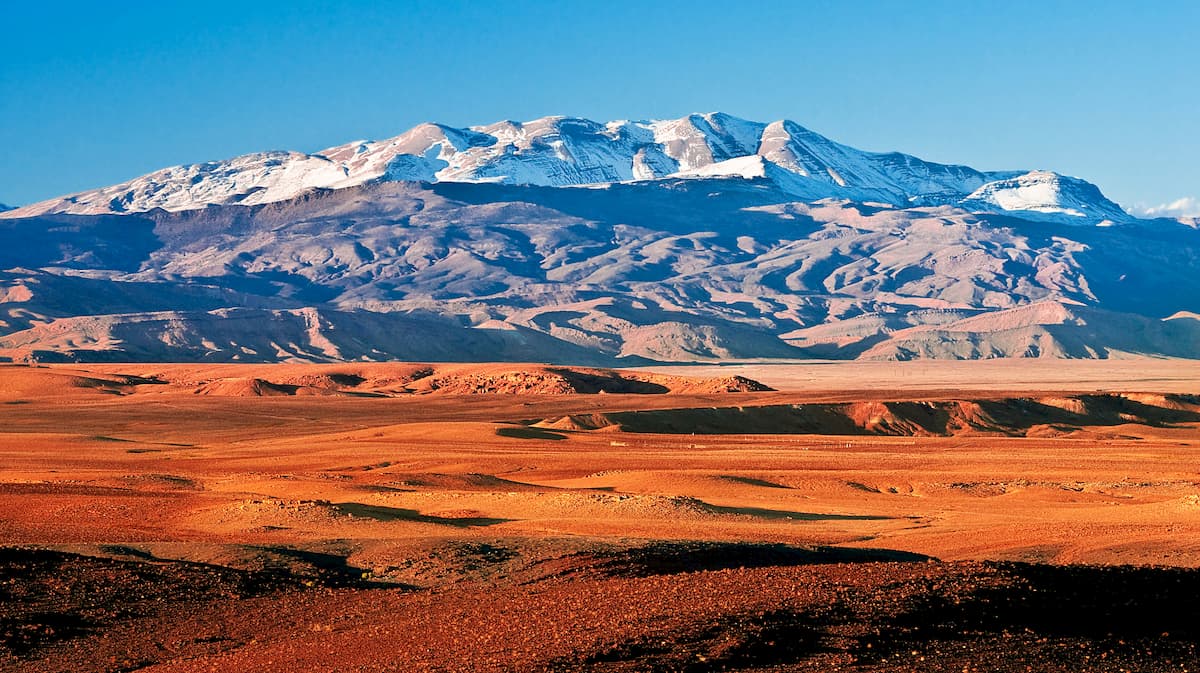
The Atlas Mountains provide a third distinct environment — altitude, snow coverage in winter months, dramatic rocky terrain, and Berber village architecture — within three hours of Marrakech. Productions requiring high altitude environments, mountain passes, or Central Asian visual references have used the Atlas consistently as an accessible and controllable alternative. The vertical range from valley floor to high pass within a single day’s driving distance allows productions to capture environmental contrast that would otherwise require multi-country logistics.
This geographic versatility is what differentiates Morocco from single-environment MENA territories. Jordan offers exceptional desert and ancient city environments but limited range beyond that core. Tunisia offers comparable desert environments with strong ancient Roman heritage. Morocco offers desert, mountain, coast, medina, and Saharan edge within a single production base. Understanding how global productions evaluate Morocco against Rajasthan and other stand-in territories reveals that the stand-in decision is never purely geographic — it is a function of which territory can deliver the full range of required environments within the production’s operational and financial constraints.

Ouarzazate, the Atlas Mountains, and the Sahara Production Corridor
Ouarzazate occupies a specific and irreplaceable role in Morocco’s production geography. Often described as the Hollywood of Africa, the description understates its operational significance. Ouarzazate is not simply a location — it is a production infrastructure node that has been built up over decades of international production investment.
Atlas Studios — one of the world’s largest film studio complexes by physical footprint — maintains permanent standing sets including Egyptian, Arabian, and ancient Roman environments that have been used and expanded across successive productions. CLA Studios provides additional stage capacity and workshop infrastructure. The combination of permanent sets, available stage space, and location environments within a day’s drive creates a production ecosystem that eliminates the construction costs and timeline risks that affect productions working in territories without established studio infrastructure.
The Sahara production corridor that extends south and east of Ouarzazate — through the Draa Valley, past Zagora, and toward the dunes at Merzouga — provides several hundred kilometres of desert environment accessible from the Ouarzazate base. Productions can move between studio-controlled sequences and vast location exteriors without relocating their base of operations. This operational continuity is a significant scheduling advantage — equipment stays deployed, crew relationships remain consistent, and the production does not absorb the logistical friction of a full company move between shooting environments.
Cost Structure and Production Economics in Morocco
The financial case for Morocco is built on two compounding layers. The base cost structure for crew, locations, accommodation, and equipment is significantly below European equivalents. The CCM rebate framework then applies on top of that lower base — which means the rebate is calculated on spend that is already competitive rather than acting as a correction to an expensive starting point.
Crew Rates, Studio Access, and Equipment Costs
Moroccan crew day rates across standard production departments run between 40 and 65 percent below French equivalents — the most relevant comparison given Morocco’s historical co-production relationship with the French industry. An experienced Moroccan director of photography, gaffer, or production designer operates at a rate that makes full local department head staffing financially viable, rather than the hybrid model that productions typically deploy in more expensive territories where senior crew must be imported to make up capability gaps.
Studio access at Atlas and CLA is priced to reflect a domestic market where volume sustains facilities rather than premium margins. Stage hire rates, standing set access fees, and workshop costs are structured to support the continuous production activity that keeps those facilities operational — which means international productions accessing them are not absorbing a premium for occasionally used infrastructure.
Equipment hire in Casablanca and Marrakech covers the standard international specification range — ARRI Alexa systems, RED cameras, and Sony Venice are available through established rental houses without requiring import. For productions bringing specialist equipment from Europe, Morocco operates within the ATA Carnet system, allowing temporary importation of professional equipment without customs duty provided equipment exits within the declared period. This reduces the customs complexity that affects equipment logistics in territories outside the Carnet framework.

Morocco vs Jordan vs European Locations — Where the Budget Goes
The direct budget comparison between Morocco, Jordan, and Southern European territories — Spain, Portugal, and Malta are the most relevant — reveals a consistent pattern. Morocco’s base costs sit below Southern European equivalents in crew and logistics, roughly comparable in equipment, and below Jordan in certain categories due to the more developed local vendor ecosystem. The CCM rebate then creates a meaningful gap versus European territories where incentive frameworks are structured differently.
For a production with $5 million in total below-the-line spend, routing $2.5 million through qualifying Moroccan expenditure generates approximately $500,000 in CCM rebate — a return that materially affects the production’s financing structure. The same production shooting in Spain or Portugal accesses different incentive frameworks that may or may not produce comparable returns depending on the specific qualifying spend composition.
The comparison with Jordan favours Morocco for productions requiring range — urban environments, desert, mountain, and coast within a single production base. Jordan remains the stronger choice for productions requiring proximity to Gulf markets, Jordanian-specific permit frameworks such as Wadi Rum access, or narratives that are specifically set in Levantine geography. Neither territory dominates the other absolutely — the choice is driven by the specific narrative and operational requirements of each production.
Morocco’s Position in the MENA Production Network and OTT Growth
Morocco’s integration into global production pipelines has followed a trajectory similar to India’s — from a territory that international productions visited for specific locations to one that functions as a full production partner with local crew at department head level, post-production infrastructure meeting streaming platform specifications, and a government framework actively structured to compete for international production spend. The transition is not complete in the way India’s is, but it is further advanced than any other African or North African territory.
How OTT Platform Demand Is Reshaping Morocco’s Production Capacity
Netflix, Amazon Prime Video, and Apple TV+ have all produced content in Morocco in the past five years with Moroccan crew in positions beyond background support. The scale of OTT commissioning has driven infrastructure investment that episodic and theatrical production alone would not have sustained — post-production facilities in Casablanca have upgraded colour grading pipelines, sound mixing stages, and digital delivery infrastructure to meet streaming platform technical specifications. The result is that a production shooting in Morocco can now complete post-production within the country rather than shipping material to a European facility for finishing.
The OTT demand pattern has also stabilised Morocco’s production calendar in a way that location-dependent shoots alone cannot. Feature film and commercial production is seasonal — concentrated in the cooler months between October and April when light quality and temperatures are manageable across most locations. OTT series production is less seasonally constrained because interior stages and controlled environments absorb more of the shooting schedule. Atlas and CLA Studios in Ouarzazate have benefited from this shift, with stage bookings extending further into the shoulder months than was typical in the pre-streaming era.
This infrastructure investment driven by OTT demand has a compounding effect on the cost structure available to all productions. Facilities that operate at higher utilisation rates price their services more competitively than those dependent on seasonal peaks. The crew base that develops from continuous OTT production activity is more experienced and more available than one that forms and disperses around occasional international shoots.
Integrating Morocco into Multi-Territory MENA Production Plans
Morocco’s role in the MENA production network is complementary rather than competitive with Jordan, Tunisia, and the Gulf territories. The differentiation is geographic and narrative rather than purely financial. Jordan’s Wadi Rum provides a desert environment with distinctive geological character — the red sand and sandstone formations read specifically as Jordanian or Martian, not as generic Arabian. Morocco’s Saharan edge near Merzouga provides a different desert register — golden dunes, broader horizons, and an environment that reads as North African or generic Arabian without the specific Jordanian signature. These are not interchangeable for productions that require geographic specificity, but they are interchangeable for productions that require desert as a visual category rather than a specific named location.

Morocco and Jordan as a Single Production Corridor
Productions planning multi-territory MENA shoots increasingly route Moroccan and Jordanian sequences through an integrated line production framework rather than managing two entirely separate production operations. The logistical connection between Casablanca and Amman is functional — both have international airports with reasonable connectivity, and production infrastructure moves between the two without the complexity that applies to cross-territory production in regions with less developed logistics networks. Understanding line producer Middle East as an integrated corridor rather than a collection of separate destination decisions is how the most sophisticated international productions approach MENA budgeting and scheduling.
The practical implication for production planning is that Morocco and Jordan can be sequenced within a single production schedule in a way that allows both territories to contribute their specific visual strengths without requiring the budget and timeline duplication of treating each as a standalone production. Morocco handles the North African urban, desert, and mountain sequences. Jordan handles the Levantine desert and ancient city sequences. Post-production for both can route through Casablanca or through a European hub depending on where the production’s primary relationships sit.
For productions evaluating this integrated approach, a structured film production execution and governance framework ensures that the operational complexity of multi-territory shoots is managed within a single accountable structure rather than distributed across separate local operators who have no visibility into each other’s schedules.
Conclusion
Morocco line production occupies a specific and defensible position in the global production landscape — not as a cheap alternative to European locations, but as a fully capable production territory with its own crew depth, infrastructure, incentive framework, and geographic range. The financial case is built on a base cost structure that is below European equivalents combined with a CCM rebate that compounds those savings further. The operational case is built on four decades of international production activity that has produced a professional crew base, permanent studio infrastructure, and an institutional permit framework that new-to-Morocco territories cannot replicate quickly.
The geography — medina, desert, mountain, coast, and saharan edge within a single production radius — makes Morocco structurally versatile in ways that single-environment competitors are not. The OTT investment cycle is extending that infrastructure advantage into post-production in ways that will make Morocco’s position in the global production network more durable over the next decade.
Productions evaluating Morocco for the first time and those returning with more complex requirements are accessing the same underlying system — one built by volume, sustained by institutional support, and increasingly connected to the global streaming infrastructure that now defines international production economics.
