
Himachal Pradesh occupies a distinct position in the Indian production landscape. The state’s combination of Himalayan terrain — alpine meadows, ancient Buddhist monasteries, colonial hill stations, high-altitude desert plateau, and forest-covered river valleys — provides a visual range that no single terrain type replicates. International and domestic productions use Himachal Pradesh not as a backdrop supplement but as a primary visual destination when the brief requires mountain authenticity that set construction or other locations cannot achieve.
The line producer function in Himachal Pradesh requires specific regional knowledge. Permits route through the Himachal Pradesh Tourism Development Corporation and district administrations simultaneously. Weather windows are narrow and variable — pre-production planning must account for road closures, monsoon blackout periods, and winter conditions that make the higher passes inaccessible for months at a time. Equipment transport into locations like Spiti Valley requires crew familiar with high-altitude logistics and single-lane mountain road operations that differ fundamentally from plains-based production.

Filming in Himachal Pradesh — Locations, Terrain and Production Range
Himachal Pradesh divides into three production zones, each with its own terrain logic, permit structure, and logistics requirements. The western Himalayan corridor — Manali, Dharamshala, Palampur — handles the largest volume of domestic and international shoots. The trans-Himalayan high-altitude zone — Spiti, Kinnaur, Lahaul — operates in a compressed seasonal window with specialist logistics requirements. And the hill-station belt — Shimla, Kasauli, Chail — serves productions requiring colonial architecture and managed mountain environments. Understanding which zone a production is entering is the first decision a line producer makes before any location scouting begins.
Manali, Dharamshala and the Western Himalayan Corridor
Manali functions as the primary base for productions shooting in the Kullu-Manali corridor. Located approximately 550 kilometres from Delhi via Chandigarh, Manali provides access to the Solang Valley, Rohtang Pass, the Beas River corridor, and surrounding oak and pine forests that shift through distinct visual registers across the seasons. The Rohtang Pass — accessible from June through October — opens access to Lahaul-Spiti and the higher Himalayan terrain; productions requiring snow-covered mountain landscapes use the pass access windows as primary shoot periods. The Kullu Valley below Manali provides a green, terraced agricultural landscape that reads as Central Asian highland in production, distinct from the purely alpine aesthetic of the higher elevations.
Dharamshala, the seat of the Tibetan government-in-exile, provides a culturally distinct filming environment. The McLeod Ganj area above Dharamshala combines Tibetan architectural form with Himalayan backdrop — productions requiring Buddhist cultural context, Himalayan town environments, or the specific visual register of Tibetan diaspora culture use Dharamshala as a primary location. The area carries significant international production familiarity; permit processing through the Kangra district administration is manageable within standard pre-production timelines for experienced HP line producers. The Kangra Valley and Dharamshala’s lower sections extend the visual range into tea gardens, fertile valley floors, and the southern Himalayan foothills.
Spiti Valley, Kinnaur and High-Altitude Desert Terrain
Spiti Valley represents Himachal Pradesh’s most demanding and visually distinctive production environment. At elevations between 3,800 and 4,500 metres, Spiti provides the Tibetan Buddhist plateau landscape — ancient monasteries, high-altitude desert, the Spiti River winding through rock-carved valleys — that productions covering Central Asian, Tibetan, or Himalayan narratives require. The Tabo Monastery complex, one of the oldest surviving monastery clusters in the Himalayas, and the Ki Monastery above the Kaza valley floor provide heritage filming environments with restricted but achievable permit access. The Chandratal Lake, at over 4,000 metres, delivers high-altitude lake landscapes that no comparable Indian location replicates at equivalent production cost.
Kinnaur and the Sutlej Valley Transition Corridor
Kinnaur, south of Spiti and accessible from Shimla via the Sutlej Valley, provides a transitional terrain — heavily forested lower slopes moving into apple orchards and the dramatic rock face of the Kinnaur Kailash range. The Sutlej River runs through the valley below the main road, providing river-gorge visual environments alongside orchard and village locations. Access from Shimla takes six to eight hours; productions typically base at Reckong Peo for Kinnaur shoots. The Sangla Valley above Reckong Peo provides a flat-floored high valley environment, unusual in the HP mountain geography, that works particularly well for village and pastoral sequences.

Shimla — Colonial Architecture and Hill Station Production
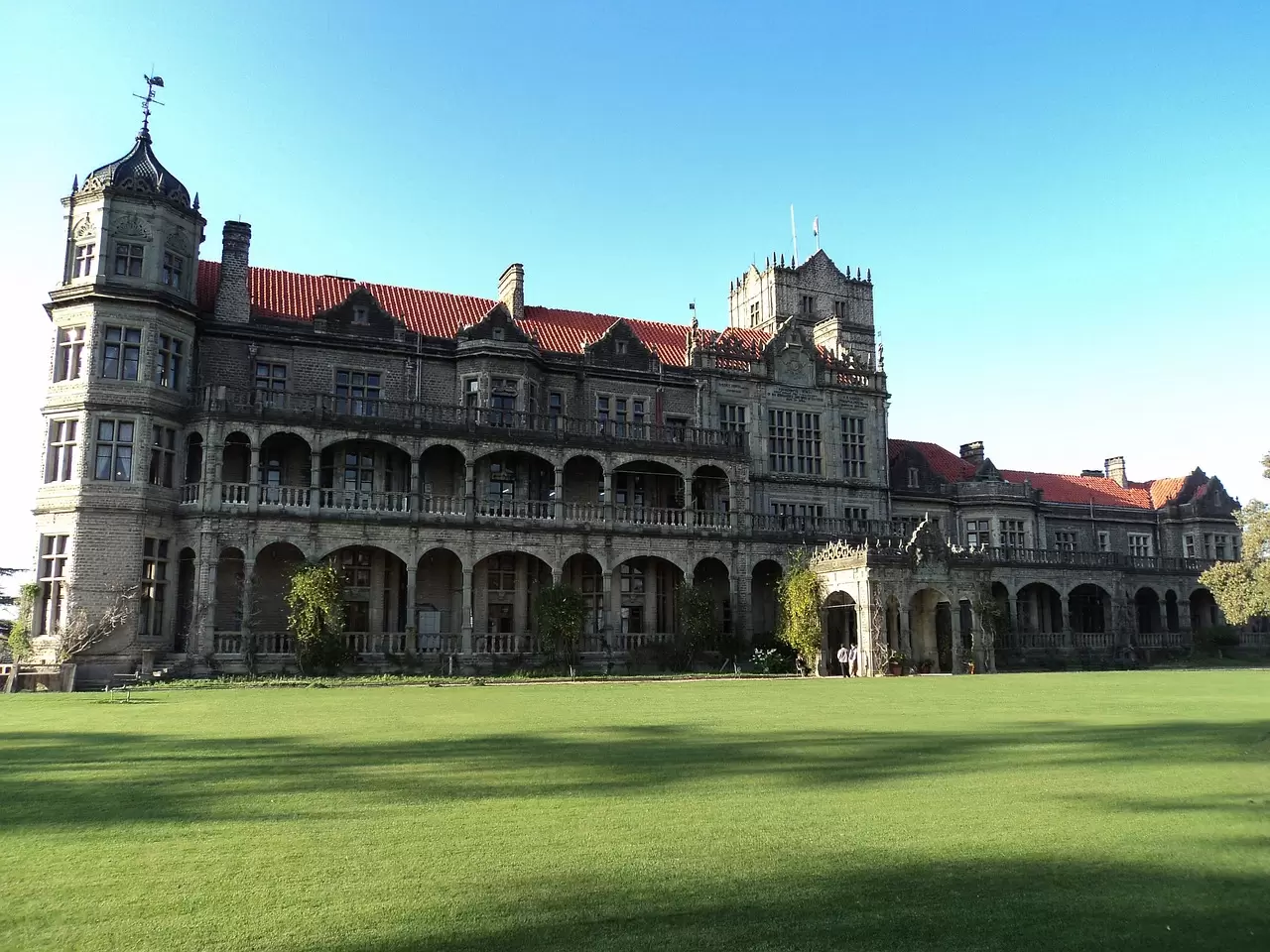
Shimla, the former summer capital of British India, provides a colonial-era hill station environment that reads distinctly from other Himalayan destinations. The Ridge, the Mall Road, Scandal Point, and the surrounding residential architecture — Victorian-era timber and stone construction set against steep forested hillsides — provide period-appropriate backdrop for historical productions and a visually distinctive setting for contemporary narratives requiring altitude and architectural heritage. The Gaiety Theatre on the Mall and the Christ Church at the top of the Ridge are among the most photographed colonial-era structures in north India, with established permit protocols for production access.
The Shimla-Kalka mountain railway, a UNESCO World Heritage Site, provides an additional production element that no comparable Indian hill station offers at scale. The narrow-gauge railway and its tunnels, bridges, and viaducts across the lower Himalayan range are accessible for unit filming through Northern Railway permits. The journey from Kalka to Shimla, taking five to six hours through 102 tunnels and across 864 bridges, provides a self-contained production environment unlike any available in the plains. Permit coordination routes through Northern Railway administration in Ambala in addition to state and local district processes.
Nearby Production Corridors — Delhi, Chandigarh and the Northern India Gateway

Delhi as the Primary Logistics Gateway
Delhi functions as the logistics hub for all Himachal Pradesh production. Equipment, international crew, post-production materials, and the primary production office for any substantial HP shoot base out of Delhi before and during the mountain phase. The eight-hour Delhi-Manali drive via Chandigarh, or the slower but more scenic Pathankot-Mandi route, is the standard production transfer corridor. Equipment convoys moving from Delhi into the Himalayas require a vehicle count and cargo manifest that the line producer coordinates in advance, particularly for heavy production equipment that cannot be transported by the smaller vehicles that access higher mountain sections.
The line producer Delhi function covers equipment procurement, customs clearance for imported international gear, international crew arrival handling at IGI Airport, and the production infrastructure that the HP operation draws on throughout the mountain schedule. Productions pairing Delhi interiors with HP mountain exteriors — a frequent combination for Indian commercial and OTT productions — benefit from a single line producer managing the full corridor, maintaining the Delhi logistics base while the production operates in the mountains.
Chandigarh and Shimla — The Northern Staging Point
Chandigarh sits at the base of the Shivalik Hills, one and a half hours south of Shimla and four hours from Manali. As the planned capital city designed by Le Corbusier in the 1950s, Chandigarh provides an architecturally distinctive urban filming environment that contrasts visually with the Himalayan terrain to the north. The Capitol Complex — the Secretariat, High Court, and Vidhan Sabha buildings — is a UNESCO World Heritage Site with an established permit process for production access. The city’s grid structure, Rose Garden, Rock Garden, and modernist residential sectors provide further architectural variety for productions requiring a planned, distinctive urban environment.
Chandigarh as Production Staging Base for HP Shoots
Productions using Himachal Pradesh as their primary mountain location frequently stage logistics through Chandigarh, using the city as both the overnight transfer point on the Delhi-Shimla corridor and as a production location in its own right. The line producer Chandigarh Shimla function covers the Chandigarh urban environment and the Shimla hill station corridor as a paired production territory — two locations that work together naturally for productions needing both modern planned city architecture and colonial hill station visual environments within the same northern India shoot.

Amritsar, Rishikesh and the Adjacent Territory Network
Amritsar, approximately 220 kilometres west of Chandigarh, provides the Punjab cultural production environment — the Golden Temple complex, the Wagah Border ceremony, and the dense lanes of the old city combine visual, cultural, and political significance that make Amritsar one of the most consistently filmed destinations in northern India. Productions shooting HP mountain locations with a Punjab cultural requirement frequently include Amritsar as a single-day unit move from Chandigarh. The Golden Temple’s distinctive visual register — the white marble sarovar, the causeway, the golden upper structure — is universally recognisable and carries strong production value for both domestic and international audiences.
Rishikesh, in Uttarakhand approximately four hours south-east of Shimla, provides the Ganga riverbank environment — ashrams, suspension bridges across the river, ghats, and the distinctive register of a north Indian pilgrimage city where the river exits the Himalayan range. The Uttarakhand border with Himachal Pradesh is close enough that productions based in the HP corridor can extend into Rishikesh without significant logistical repositioning. Haridwar, 25 kilometres downstream from Rishikesh, adds the major Ganga ghats and the Har Ki Pauri festival filming environment to the available palette.
Line Producer Operations in Himachal Pradesh

Permits, Film Policy and Location Access
Himachal Pradesh operates a film-friendly policy framework through the HP Tourism Development Corporation and the Department of Language, Art and Culture. The state issues production permissions covering most public locations; forest and wildlife clearances route through the HP Forest Department separately. Monument access — including ASI-protected sites such as the Masrur Rock Cut Temple complex and the Triloknath Temple — requires separate Archaeological Survey clearance that runs parallel with state permission rather than sequentially after it.
District administrations vary in response timelines and production familiarity. Shimla district processes permits with consistent familiarity given the volume of production through the state capital each year. Lahaul-Spiti requires extended coordination timelines. Productions planning Spiti Valley shoots should schedule permit applications a minimum of eight weeks ahead of principal photography — restricted area proximity to the Tibet border, multiple agency clearances, and high-altitude access restrictions create a longer administrative pipeline than most other Indian state production environments.
Crew, Equipment and High-Altitude Production Logistics
Crew availability operates through a two-tier system. A core of experienced local professionals based in Shimla and Manali have worked on international and domestic productions — line producers with HP administration relationships, directors of photography familiar with high-altitude light conditions, and art directors experienced with monastery and heritage location access protocols. This core is supplemented by Delhi-based crew who deploy into HP on a shoot-by-shoot basis, a standard arrangement for productions with a Delhi production office managing the mountain phase.
Equipment transport follows the road network constraints precisely. The primary production routes — NH5 Shimla-Kinnaur, NH3 Manali-Leh, and the Spiti access roads — are single-lane mountain roads subject to landslide closures, particularly during and after the monsoon season. Productions must budget for generator-supported power at remote locations, diesel fuel logistics, and a communications plan that accounts for mobile network dead zones across significant sections of the high-altitude route network.
Weather Windows, Seasonal Access and Shoot Planning
Himachal Pradesh divides into distinct seasonal production windows that an experienced line producer builds into the schedule from pre-production. The lower hill station belt — Shimla, Kasauli, Dharamshala — is accessible year-round but most productive between March and June and September through November, avoiding the heavy monsoon months when cloud cover eliminates mountain visibility. The Manali and Kullu corridor runs from April through October. Spiti Valley is accessible from June through September only — winter cuts road access from both the Shimla and Manali-Rohtang sides simultaneously.
Snow production requiring white-covered landscapes works from December through February in the lower and mid-range locations around Shimla and Kasauli, and from November through May at Rohtang and the higher passes. A line producer with HP seasonal knowledge can sequence a multi-location shoot to move through locations as their access windows open and close, covering maximum visual range within a single production deployment without repositioning the Delhi logistics base.
Film Incentives, Cost Structure and HP Government Support
Himachal Pradesh does not operate a cash rebate framework equivalent to the structured incentive systems of Rajasthan or Gujarat, but it does operate active production facilitation through the HP Tourism Development Corporation. The HPTDC provides location scouting support, liaison with district authorities, and in some cases transport and accommodation facilitation for productions that register through the official channel. Productions filming at locations managed by the Tourism Department — including viewpoints, heritage rest houses, and certain forest rest houses — access these through HPTDC rather than directly.
Cost structure in Himachal Pradesh reflects the mountain logistics surcharge that applies to any high-altitude production environment. Labour rates for skilled crew are broadly comparable to Delhi and lower than Mumbai, but transport and accommodation costs in remote locations add a premium that the production budget must account for explicitly. Spiti and Lahaul shoots typically carry a 30-40% logistics premium over an equivalent day in Shimla or Manali. This is not a disincentive — the visual distinctiveness of those locations justifies the cost differential — but it must be built into the budget from pre-production rather than discovered during the shoot.
Budgeting for Altitude: Mountain Logistics Surcharge
Local contractor relationships are central to cost management in HP. The line producer’s established vendor network — vehicle operators familiar with mountain road conditions, accommodation providers who can block-book for production periods, equipment transport specialists who know which roads are accessible at which seasons — directly determines whether a production spends at budgeted rates or absorbs unexpected logistics costs. A line producer deploying into Himachal Pradesh without this local vendor infrastructure is operating at a significant cost and operational disadvantage compared to one with HP-specific relationships built through prior shoots in the state.
Extending the Himalayan Shoot — Bhutan and Eastern High-Altitude Territory

Bhutan as a Visual and Geographic Extension of Himalayan Production
Productions completing a Himachal Pradesh shoot increasingly look east to Bhutan as a natural visual extension of the Himalayan production. Where Himachal Pradesh provides the Indian Himalayan register — dense cultural production history, well-established infrastructure, and environments shaped by centuries of both Tibetan and Mughal influence — Bhutan provides the pristine Himalayan kingdom register: Dzong fortress architecture set above river valleys, prayer-flag-lined mountain passes, untouched forest corridors, and a production environment that international audiences read as visually distinct from any Indian location.
The line producer Bhutan function covers the entry framework specific to international productions in the kingdom — the Tourism Council of Bhutan permit system, the daily sustainable development fee structure that applies to most international production visitors, and the operational logistics of shooting in a country with limited commercial production infrastructure outside Thimphu and Paro. Productions routing from Himachal Pradesh to Bhutan typically exit via Delhi, where direct or single-connection flights to Paro operate from Indira Gandhi International Airport.
Pre-Production Planning for Multi-Destination Himalayan Shoots
Planning a shoot that combines Himachal Pradesh with Bhutan, Uttarakhand, or Ladakh requires a pre-production structure that accounts for multiple permit systems, variable weather access windows, and different crew sourcing environments operating simultaneously. The line producer function across a multi-destination Himalayan shoot coordinates these variables into a single production plan — sequencing locations by access window, managing permit timelines in parallel across multiple state and national authorities, and structuring crew deployment between bases as the production moves across the mountain territory.
The India line production network framework that applies to international productions in India covers the entry documentation, imported equipment customs clearance, and the regulatory structure that applies when a production’s primary shoot is in India but the narrative includes cross-border Himalayan extensions into Bhutan or Nepal. Planning these elements during pre-production — not during the shoot itself — is the only approach that keeps multi-destination Himalayan productions within their budgeted parameters and their permit timelines intact.
