
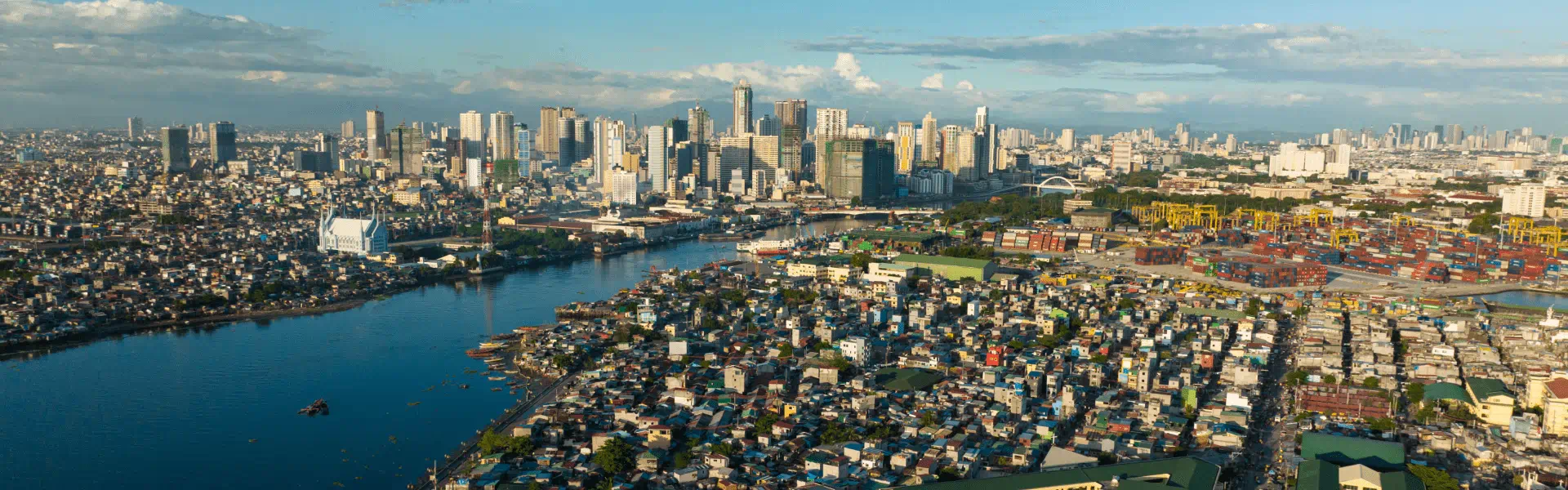
A Philippines shoot rewards a production that plans its island logistics before anything else. Our Line Producer Philippines desk holds the budget, schedule, crew and vendors, while film fixers in the Philippines coordinate locations, permits and island-by-island access, so an incoming feature, series, documentary or commercial runs on one plan from a Manila base out to the outer islands. The draw is genuine location range on a low-cost base; the discipline is sequencing permits, domestic freight and weather windows so the saving survives contact with the schedule.
Why the Philippines Works as an International Production Base
The Philippines is among the most geographically diverse production territories in Southeast Asia, 7,641 islands concentrated across three principal island groups, each offering a distinct visual environment within a single national jurisdiction, which is what lets a line producer in the Philippines hold one schedule across islands that would otherwise read as three separate countries. An international production working from a Manila base can access tropical island coastlines, dense urban environments, mountain terrain, rice terrace landscapes, and Pacific Ocean water sequences within logistics distances that comparable multi-country productions require weeks to coordinate. The advantage is substantial visual range within one country and currency, but location permissions remain local and must be sequenced separately for every city, municipality, protected area and controlled site.
The Philippines has hosted major international productions across feature film, television drama, streaming originals, and advertising campaigns consistently since the 1970s. Apocalypse Now established the country’s profile for large-scale international production. The decades since have built a crew market, a vendor network, and an institutional familiarity with international production standards that newer Southeast Asian locations cannot replicate. English is an official language of the Philippines and the working language of its professional production industry, which reduces the communication friction that many Asian production territories present for English-language international productions.
What the Philippines Offers That Neighbouring Territories Do Not
The combination of English-language fluency, geographic diversity, and production infrastructure maturity places the Philippines in a distinct competitive position within Southeast Asia. Thailand and a line producer Vietnam offer strong crew markets and competitive cost structures, but neither operates in English as a primary language at the professional level. Indonesia offers comparable geographic diversity but with a more complex permit system and less consolidated crew infrastructure, and the line producers in Cambodia match the Philippines on cost while trailing it on English-language crew depth. The Philippines delivers the visual range of a multi-island archipelago with the operational accessibility of an English-language production environment.
Manila’s urban production environment (from the colonial architecture of Intramuros to the contemporary glass infrastructure of Bonifacio Global City) covers European-substitute, contemporary Asian, and generic tropical urban visual requirements within a compact city geography. Palawan’s coastline and island environments operate under tourism, property and environmental controls that require advance coordination. The Visayas, including Cebu, Bohol and Siargao, add coastal, reef and island-settlement environments reached by domestic flight from Manila.

Why International Productions Use a Philippines Film Fixer
The role of a film fixer in the Philippines becomes most operationally significant at the transition between Manila-based logistics and island-location execution. The permit system for island locations outside Metro Manila operates through local government units (the LGU) rather than a central national authority. Across Palawan, Cebu and the Visayas, a Philippine production fixer coordinates the applicable LGU shooting permit and any site-specific barangay, environmental, protected-area or property-owner approval required for the selected location.
Film fixers in the Philippines extend their operational reach far beyond permit processing. A fixer embedded in Palawan manages barangay-level community relations, local labour mobilisation, boat charter logistics, and real-time weather assessment at the location, functions that no Manila-based production office can replicate remotely. On island shoots where the production is days away from Manila resupply, the fixer is not support staff. They are the production’s operational presence. The difference between a fixer who understands remote island production and one who operates as a Manila-first coordinator is the difference between a shoot that proceeds and one that stalls waiting for decisions that should have been made in pre-production.
A Line Producer Asia network connects Philippines-based productions to the broader regional corridor, with equipment routed on carnets from Singapore and Hong Kong hubs, and co-production structures with Australian and Korean partners that use the Philippines as a service territory.
Filming Locations in the Philippines: From Manila to the Outer Islands
The Philippines location profile operates across three distinct tiers of production accessibility that must be understood in pre-production rather than discovered during the shoot. Metro Manila and the immediate surrounding regions (Cavite, Laguna, Batangas) constitute the first tier: full production infrastructure, established permit pathways, crew within commuting distance of the base. The major island destinations (Palawan, Cebu, Bohol, Siargao) constitute the second tier: high visual value, domestic flight access, LGU permit systems, limited local crew requiring mainland supplementation. Remote island and mountain environments constitute the third tier: extraordinary visual distinctiveness, significant logistics complexity, extended pre-production lead times.
Productions that attempt to apply first-tier operational logic to second or third-tier locations consistently encounter the specific Philippine production failure mode, a schedule built for accessible infrastructure that meets island logistics reality on the shooting day rather than in pre-production. A line producer Philippines with multi-tier experience builds the pre-production track for each tier separately, connecting them within a unified shooting schedule that accounts for weather windows, inter-island transport, LGU processing times, and the absence of equipment rental and backup crew at remote locations.
Manila, Luzon and the First Production Tier
Metro Manila’s filming environments cover a wider range than the city’s reputation as a dense urban environment suggests. Intramuros (the walled colonial city) provides Spanish colonial architecture that photographs as European or Latin American with minimal set dressing. BGC and Makati’s glass tower districts cover contemporary Asian city environments. The Manila Bay waterfront, Binondo Chinatown, and the residential zones of Quezon City and Marikina each offer distinct urban textures. Rizal province and the Laguna lake region extend the production reach to agricultural landscapes, volcano terrain, and freshwater lake environments within two hours of Manila.
Luzon beyond Metro Manila provides the Ifugao rice-terrace landscapes, where the UNESCO-listed Rice Terraces of the Philippine Cordilleras include the Batad and Bangaan clusters in Banaue municipality, alongside Nagacadan, Hungduan and Mayoyao (confirmed by the UNESCO World Heritage Centre), and filming there requires coordination with the Ifugao heritage authority and local community consent and the volcano environments of Bicol, where Mayon Volcano’s near-perfect cone has been used for disaster narrative and action production sequences. North Luzon’s Ilocos region offers well-preserved colonial town architecture at Vigan, another UNESCO site, and tobacco plantation landscapes that produce a visual environment unavailable elsewhere in Southeast Asia.

Palawan, the Visayas and the Island Production Corridor
Palawan is the location that consistently drives international production interest in the Philippines. El Nido’s limestone karst islands and lagoons, Coron’s WWII shipwreck dive sites, and Puerto Princesa’s subterranean river (another UNESCO site) represent a concentration of visually extraordinary environments within a single island province. The Palawan permit system runs through the provincial government and the specific LGUs for each municipality. El Nido locations can carry site-specific conditions relating to crew footprint, beach access, equipment and marine activity. Confirm the applicable LGU, property and protected-area requirements for the selected location.
The Visayas offer operational variety alongside visual diversity. Cebu functions as a secondary production hub with its own crew market, equipment rental capacity, and hotel infrastructure sufficient for mid-scale productions. Bohol’s Chocolate Hills and tarsier sanctuary environments have specific wildlife protection restrictions for filming. Siargao’s surfing coastline and mangrove channel environments have been used extensively for commercial and music video production. Each Visayas island operates under its own LGU permit framework, which a Philippine production fixer with regional production experience navigates as part of standard pre-production rather than as a complicating variable discovered on location.

Permits, Compliance and the Philippine Production Regulatory Framework
Philippine location permissions remain locally administered. The 2026 DILG–FDCP framework standardises the basic application, but the permit is still issued through the applicable city or municipality, with separate approvals retained for protected areas, heritage properties, roads, police support and other controlled activities.
FDCP, FLEX and the 2026 LGU Permit Framework
Location permits remain LGU-led under DILG–FDCP Joint Memorandum Circular No. 01, series of 2026. The framework standardises the application requirements and targets simple transactions for processing within three working days, but implementation depends on each LGU adopting the required ordinance. Protected areas, heritage sites, roads, police support and other controlled activities retain their additional approval routes, as the official FDCP announcement confirms.
FDCP’s Film Location Engagement Desk (FLEX) offers year-round inter-agency assistance to local and foreign productions, helping coordinate access and approvals across the agencies involved. A Philippine production partner is recommended, but FLEX is not a mandatory national filming permit or a blanket location approval.
FDCP administers the International Co-Production Fund and oversees official co-production certification where applicable. Treaty status and project eligibility should be confirmed against the current FDCP programme before structuring the production. The FDCP’s official production support framework outlines current procedures and the incentive programmes available to qualifying international productions. The complete filming compliance for foreign films covers how international productions structure their Philippines operation within the broader compliance requirements that govern multi-territory shoots.
LGU Permits, Environmental Clearances and Location-Specific Requirements
The applicable city or municipal office issues the shooting-location permit under its adopted local process. Barangay coordination or clearance may also apply depending on the local ordinance and selected site. Heritage and protected locations retain their respective custodian, DENR, PAMB or cultural-authority approvals.
Filming in protected landscapes, marine areas and wildlife sites may require DENR, Protected Area Management Board, LGU and site-custodian approval. Whether an ECC, Certificate of Non-Coverage or another environmental clearance applies depends on the activity and production footprint, not simply the presence of a camera. Productions that treat environmental permits as the last item in the checklist encounter the longest delays, so they are mapped early.

Crew, Equipment and Production Infrastructure in the Philippines
The Philippines has one of Southeast Asia’s deepest English-speaking production crew bases, developed through continuous engagement with international shoots since the 1970s. The Manila crew base is technically competent across all standard production departments and operationally experienced with international production standards, communication styles, and delivery expectations. The depth of the crew market means that mid-scale productions can crew entirely from Manila without supplementation, while large-scale productions requiring multiple units may supplement specialist departments from elsewhere in Asia or Australia through the appropriate immigration and work-authorisation process. ATA Carnets apply to equipment, not travelling crew.
The crew market’s primary strength is its English-language fluency combined with production experience that extends across commercial, music video, television drama, and feature film formats. This breadth of format experience matters operationally, crew who have worked across formats adapt to the specific rhythms and priorities of an incoming international production more quickly than crew markets specialised in a single format. The Philippines also has a strong tradition of below-the-line production craft (set construction, art department fabrication, costume) that benefits period and production design-intensive projects specifically.
Philippine Crew Departments, Rates and Availability
The strongest departments in Manila’s crew market are art direction and production design, built through decades of commercial and music video production for international brands that use the Philippines as a South-East Asian production base, the same depth that Philippine line-production services draw on to crew a feature unit at short notice. Cinematography is competent at the HOD level with strong commercial and drama experience. Sound departments are well-equipped for drama production. Stunt coordination and action unit work has developed substantially through the Philippine action film industry’s long domestic output.
Crew Rates and Equipment Hire
Crew rates in the Philippines are competitive within Southeast Asia and significantly below equivalent rates in Singapore, Australia, and Western Europe. The rate differential is a primary financial reason international productions route through Manila for shoots that could technically be executed elsewhere, the crew cost saving often funds the island logistics complexity of multi-location Philippine shoots. Working-day, overtime and turnaround terms must be confirmed against current local quotations and the final crew deal memo.
Equipment rental in Manila covers current-generation camera systems (ARRI, RED, Sony Venice) at the major rental houses in the Makati and Quezon City production zones. Grip and lighting packages are well-stocked for single-unit productions. Specialty equipment not available locally routes from Singapore or Hong Kong, with transit time varying by routing, customs and freight availability. Island location shoots build equipment redundancy into their packages because the logistics of replacing damaged or failed equipment on a remote island are significantly more complex than replacing it in Manila.
How a Line Producer Controls the Budget
Film fixers protect location and field costs by resolving access and logistics early; the line producer retains responsibility for the complete production budget, schedule and cost reporting. The country runs a selective FLIP cash rebate, but for most international productions it is a bonus rather than the reason to shoot here; the figures, cycles and qualifying rules sit on the dedicated cost page. What a line producer actually manages is the far larger below-the-line spend: crew, kit, locations, accommodation and schedule.
The real case for the Philippines is the cost base itself, where crew rates, location fees, accommodation and production services run well below comparable Western specifications, which is why budget-led work lands here without ever filing a rebate claim. The full breakdown of the cost of filming in the Philippines, by crew rate and department, sits alongside this page.
FDCP Support and the Regional Picture
FLIP is a selective 20% cash rebate on verified Qualifying Philippine Production Expenditure, capped at PHP 25 million. A qualifying cultural bonus can add five percentage points and raise the maximum support to PHP 30 million. The applicant must be an eligible Philippine company, and format-specific minimum spends, application cycles and audit requirements apply, so it is best treated as potential upside rather than guaranteed budget income. These terms are set out in the current FDCP programme; the detailed figures sit on the cost page.

Island Logistics, Scheduling and What a Line Producer Philippines Manages
The operational complexity that distinguishes Philippines production from most other international territories is island logistics. Productions that have operated in countries with contiguous geography (where crew, equipment, and supplies can be moved overland between locations) encounter a fundamentally different logistical structure in the Philippines. Between Manila and Palawan is a ninety-minute domestic flight. Between Palawan’s El Nido and Coron is a boat transfer. Between Manila and Siargao, equipment moves on direct or connecting domestic services, depending on the current airline schedule and cargo acceptance. Equipment that needs to move between these points does not roll onto a truck, it is checked onto an aircraft, transferred at airports, cleared through domestic terminal security, and loaded onto boats for final delivery to remote beach locations.
Film fixers in the Philippines managing multi-island schedules are not performing the same logistical function as a fixer managing a city shoot. They are managing a supply chain. Equipment staging in Manila before island departure. Redundancy kits that travel with the unit rather than being sourced locally on failure. Generator fuel logistics for locations without grid power. Boat schedules and weather windows that override the shooting schedule when sea conditions deteriorate. Accommodation in locations where the production is the largest single occupant of the available hotel inventory. Every one of these variables has a pre-production resolution, none of them is a problem that improvisation can solve on the day.
Domestic Flights, Equipment Staging and Last-Mile Logistics
Domestic aviation in the Philippines operates through a hub-and-spoke structure centred on Manila’s NAIA and Cebu’s Mactan-Cebu International Airport. Equipment moving to Palawan, Siargao, or Camiguin transits through these hubs with strict weight and dimension limits enforced on provincial routes served by smaller turboprop aircraft. A line producer Philippines managing equipment logistics plans staging at the hub airport (not at the origin) and sets equipment-arrival buffers route by route, based on aircraft type, freight acceptance, baggage limits and the final road or boat transfer. These are production planning allowances, not published carrier timelines. Last-mile delivery from the provincial airport to the actual location adds further lead time: boat transfers, vehicle hire across rough roads, and community portering in locations where vehicles cannot reach.

Weather, Seasonal Planning and the Philippine Production Calendar
The Philippines typhoon season (June through November, with peak activity in July through October) is the primary scheduling constraint for island location productions. Tropical cyclones can disrupt domestic flights, ports, boat services and coastal filming for periods that vary by storm and location. Productions working during the peak season therefore need route-specific weather contingency.
PAGASA broadly identifies June to November as the rainy season and December to May as the dry season, with tropical-cyclone activity peaking around July to October. Rainfall patterns vary substantially by island and coast, so Palawan, Cebu, Siargao and eastern locations must be scheduled against their own climatology and the current forecast, as set out in PAGASA’s official climate guidance.

What the Line Producer Function Controls Across the Full Philippine Production
The line producer Philippines role across a full archipelago production encompasses functions that in most other territories are divided between separate operational departments. Island logistics coordination. Multi-LGU permit management running in parallel across locations being prepared simultaneously. Crew transportation between islands on overlapping prep and shoot schedules. Equipment redundancy management for remote locations where a replacement can take days to reach the set. Generator fuel supply chains for off-grid locations. Weather monitoring and contingency schedule management.
The productions that execute the Philippines most effectively are those that understand this scope before engaging a line producer rather than after. The production that arrives expecting a Manila-model operation and encounters an island logistics reality mid-shoot has no recovery path within the existing schedule and budget. The production that builds the full archipelago logistics model into pre-production (with the correct line producer engaged early and the correct budget for island complexity built in from the first cost report) finds that the Philippines delivers on its visual promise with the operational reliability that its infrastructure, at full capability, genuinely provides.
Budget Control Across the Islands
Across a multi-island production, the line producer Philippines also functions as the single financial accountability point. Daily cost reports consolidate expenditure across units shooting simultaneously on different islands. Vendor payments are centralised through a single purchase order structure even when suppliers are geographically dispersed across three or four provinces. Insurance documentation covers locations, equipment, and crew movement across island transfers, a risk exposure that mainland-structured insurance policies routinely fail to address adequately. The LP who understands this financial architecture, and builds it into the production’s cost management system from week one, is the difference between a production that comes in on budget and one that tracks invisible overruns across islands until week four.
