

India’s film industry now operates as a two-directional IP market. Stories originate here and move outward through adaptation licensing. Foreign formats arrive and are localised for Indian audiences. Between those two flows sits the business of adaptation India — a structured trade governed by territory-specific pricing, legal prerequisites, documentation standards, and professional intermediaries who keep deals from collapsing between commercial intent and contractual reality. This page covers the mechanics: how deals are structured, how revenue is built, what legal infrastructure they require, and how representation operates in cross-border transactions.
How Adaptation Deals Are Structured
Cross-border remake transactions do not open with a price negotiation. They begin with an evaluation — a structured assessment of whether a story can travel at all, and at what cost. The sequence matters because deals that skip the evaluation phase tend to fail at execution, either because the story resists localisation or because the legal groundwork was never completed before commercial terms were agreed.
Rights Evaluation — What Happens Before a Deal Opens
Before any territory or fee discussion begins, the original work is assessed for narrative universality, genre portability, and cultural elasticity. Narrative universality asks whether the emotional stakes of a story survive translation across cultural contexts. Genre portability asks whether the form — crime thriller, family drama, investigative procedural — operates within the receiving territory’s production conventions. Cultural elasticity asks how much localisation the story can absorb before it ceases to function as the same property.
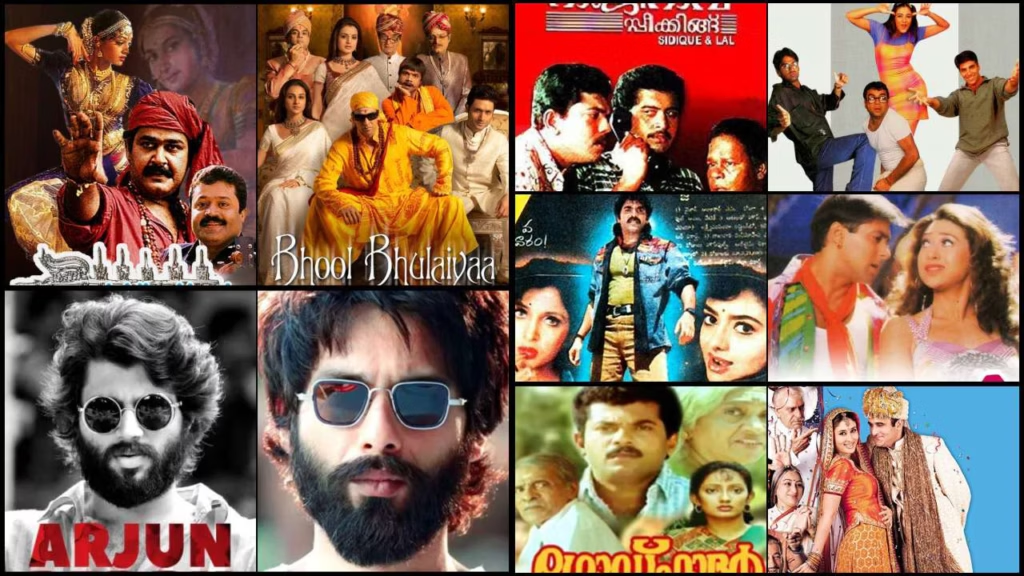
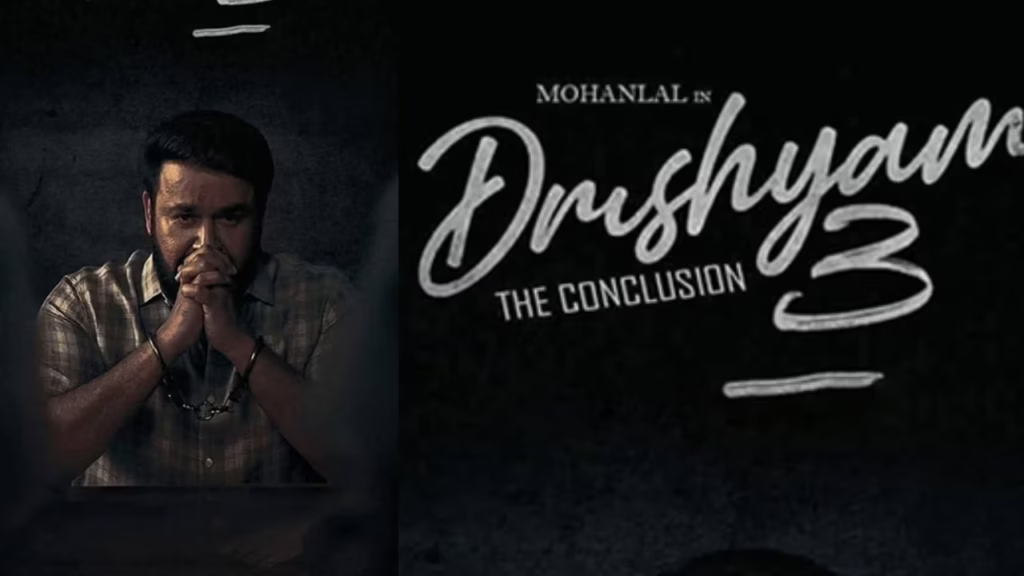
Drishyam remains the clearest evidence of how this works in practice. The original Malayalam film was evaluated not only for its domestic performance but for the transferability of its central dramatic mechanism — a father systematically dismantling a police investigation — which proved culturally neutral enough to operate across Hindi, Telugu, Tamil, Kannada, Sinhalese, Chinese, and Korean versions without requiring structural alteration. The emotional architecture was universal; only the surface cultural details changed. Evaluation identified this before any deal opened.
Evaluation failure is equally instructive. Stories built around very specific regional social structures, caste dynamics, or politically localised humour often stall at this stage because the cost of re-engineering them for a foreign market exceeds the commercial value of the adaptation. Identifying this early saves all parties from long negotiations that close without a deal.
Scope Definition — Territory, Language and Exploitation Rights
Once viability is established, negotiations move into scope definition. This is where the commercial architecture of the deal is built, and where inexperienced sellers consistently leave value on the table by treating the deal as a single transaction rather than a portfolio of separable assets.
Language rights, territorial exclusivity, sequel options, format derivatives, and streaming exploitation rights are each priced and structured independently. A Hindi remake licence does not include Korean, Mandarin, or Arabic adaptation rights. An OTT licence for one territory does not extend to theatrical distribution in another. Each right is a separate commercial asset that can be licensed, withheld, or sequenced depending on market timing and strategic intent.
Buyers operating across theatrical, streaming, and broadcast release windows have accelerated this unbundling. Buyers who commission content ecosystems rather than standalone titles now expect remake agreements to include episodic adaptations, spin-off rights, and format derivatives — whether an original film can be repackaged as a limited series, an anthology entry, or a franchise extension. A rights holder who does not map these at scope definition stage will routinely find that the acquiring producer has exploited a derivative without triggering any additional payment obligation.
Execution Timelines and Renewal Structures
Cross-border adaptations rarely develop on the same timeline as domestic remakes. International productions are typically aligned with local market cycles, broadcaster commissioning windows, festival slates, or content calendars that may not coincide with the licensor’s preferred timeline. A rights agreement built for domestic remake logic — tight production deadlines, clear release windows — often fails in cross-border application because it does not account for how differently international development moves.
Agreements that hold up in cross-border contexts tend to include performance-linked extension provisions, staggered development milestones, and renewal triggers that keep the deal alive through realistic production timelines rather than forcing breach or abandonment. Delayed execution clauses protect the originating producer from indefinite licence lock-up while giving the adaptation producer room to develop properly. Without these, commercially viable rights can sit under licence for years while the acquiring party runs out of development money — blocking the original holder from relicensing to a better-capitalised buyer.
Commercial Architecture — Pricing, Revenue and Pre-Selling
The commercial side of the remake rights India market has matured significantly. Rights are no longer informal add-ons negotiated after production financing is secured. They are now modelled as standalone revenue assets and, in some cases, as financing instruments that de-risk production before principal photography begins.
How Remake Rights Are Priced Across Territories
Pricing varies sharply by territory and reflects a combination of market size, production cost benchmarks, distribution infrastructure, and the acquiring party’s capitalisation. Hollywood and select Chinese buyers command premium licensing fees because they operate within production ecosystems that can absorb high upfront rights costs against large anticipated returns. Southeast Asian markets — particularly Korea, Thailand, and Indonesia — typically price within tighter ranges but structure deals with greater royalty participation and performance bonuses that can exceed the base fee if the adaptation performs.
Emerging MENA markets and parts of South America tend to prioritise distributor-led arrangements over flat licensing fees, reflecting the infrastructure reality that streaming rather than theatrical release drives commercial return in those territories. Documentation quality directly affects valuation across all markets. Buyers with access to structured IP portfolios — clean chain-of-title, adaptability notes, prior performance data — are willing to pay premiums over comparable properties where those materials are absent or disorganised.
Revenue Structures Beyond Flat Licensing Fees
Flat licensing fees remain common for smaller markets and lower-capitalisation buyers, but the more commercially sophisticated end of the adaptation market has moved toward revenue structures that align long-term incentives between the original rights holder and the adaptation producer. Backend participation, viewership-triggered escalations, and performance bonuses tied to streaming thresholds or theatrical benchmarks have become standard components of deals involving major buyers.
These structures matter because they extend the commercial relationship beyond the point of closing. An IP owner receiving backend participation has an ongoing interest in the adaptation’s success — which typically improves cooperation during production and reduces disputes. A performance bonus tied to viewership thresholds aligns the original holder’s incentive with the buyer’s distribution strategy, making the licensor a stakeholder in long-term commercial performance rather than a one-time licensor. For detailed benchmarks and pricing models across territories, see remake rights fees.
A Deal in Practice — From Option Through Close
A Korean buyer acquiring adaptation rights to a commercially successful Hindi crime thriller provides a useful working example of how these structures operate together in a single transaction.
The deal opens with a twelve-month option at a fee representing approximately 12% of the anticipated full licence value. The option gives the acquiring producer time to develop a localised treatment, test the concept with their domestic broadcast contacts, and secure preliminary distribution interest — without committing to the full rights fee before those steps are complete. The option period is not a formality. Most cross-border deals that close were optioned first; most that bypass this stage and move directly to licence negotiation collapse during due diligence.
Executing the Licence — Rights Parcels and Holdback Terms
On exercise, the full licence is structured across separated rights parcels. Korean theatrical rights are transacted as a standalone asset. Korean streaming rights — held in this case by a domestic SVOD distributor with regional reach — are separately carved out and priced at a premium because streaming front windows now determine most commercial return in that market. Chinese theatrical rights, which the original holder had considered bundling, are withheld and reserved for a separate negotiation. Bundling them into the Korean deal would have depressed the per-territory price; holding them separately preserves optionality for a better-capitalised Chinese buyer.
The agreement includes a sequel holdback: the Korean adaptation producer cannot develop a sequel or prequel without returning to the original rights holder on pre-agreed first-look terms. A language basket clause specifies that Mandarin, Japanese, or Thai dub and subtitle distribution each triggers a per-territory royalty rather than being absorbed into the base licence fee. Backend participation is set at 5% of net streaming receipts above a defined threshold, with a performance bonus triggered at a pre-agreed streaming benchmark on the acquiring distributor’s primary platform.

The full agreement closes eleven weeks after option exercise. Chain-of-title was clean at first contact because the seller had completed remediation twelve months earlier, before approaching any buyer. That preparation compressed the legal close from what typically takes four to six months into under three.
Pre-Selling Adaptation Rights as a Financing Instrument
Pre-selling remake rights before a film releases — and in some cases before principal photography begins — has shifted from an opportunistic practice to a deliberate financing strategy for Indian producers developing commercially strong IP. By securing a licensing agreement with an international buyer at development stage, a producer can use the guaranteed licensing revenue as collateral for production financing or to reduce the equity requirement from co-producers and distributors.
This approach requires the original IP to be packaged in a form that satisfies international buyer due diligence before the finished film exists. Buyers evaluating pre-production rights packages assess the screenplay rather than the completed work, which means narrative architecture, documentation quality, rights clarity, and adaptability notes become material to commercial valuation. Scripts that demonstrate clean ownership, strong genre portability, and structured adaptability notes — essentially a brief on how the story can be localised — attract stronger pre-production interest and better pricing than comparable scripts presented without that documentation.

Legal Infrastructure for Cross-Border Adaptation
Commercial interest does not close a deal. Legal infrastructure does. Cross-border adaptations fail at the legal stage more often than at the commercial stage because chain-of-title problems, ambiguous ownership, and inadequate compliance documentation surface during due diligence after deal terms have been negotiated. Rebuilding legal groundwork at that point is expensive and frequently ends in abandoned transactions.
Chain-of-Title Verification
Chain-of-title documentation establishes that the person offering adaptation rights actually owns them — unambiguously, with no competing claims, through every stage of development from original author to current rights holder. In Indian film production, chains-of-title are often more complex than buyers from markets with standardised IP infrastructure expect. Writers may have assigned rights informally. Producers may have acquired rights without documenting the assignment properly. Co-producers may have retained interests that were never formally waived.
International buyers — particularly major distributors and co-production financiers — now require representations and warranties that go beyond domestic norms: moral rights waivers where jurisdictionally permissible, indemnity caps, jurisdiction-specific dispute resolution clauses, and explicit confirmation of who holds sequel, prequel, and derivative rights. A rights package that satisfies a domestic broadcaster often falls short of what a Hollywood studio or European acquisition team needs before committing legal fees to closing a transaction.
Older Films and Regional Productions — Title Remediation
Historical contracts for older films and regional language productions represent the most frequent source of chain-of-title problems in cross-border transactions. Contracts executed before the 1990s commonly did not anticipate adaptation rights, sequel exploitation, or streaming licensing — categories that simply did not exist or were commercially negligible at the time. When buyers conduct due diligence on these properties today, they routinely find gaps requiring remediation before a deal can close.
Remediation typically involves obtaining supplemental assignments from original authors or their estates, securing confirmations from financiers who may have retained interests, and in some cases obtaining court-validated clarifications where contractual ambiguity cannot be resolved administratively. This process is slow and expensive — often six to twelve months when multiple parties must be located and agreements negotiated with each independently.
When Remediation Stalls a Transaction
Buyers operating on active commissioning cycles do not hold deals open while sellers work through historical ownership issues. A seller with a clean title at the point of first contact closes transactions that are simply unavailable to one who arrives with unresolved chain-of-title and a remediation timeline measured in months. When a buyer with genuine interest and available capital disengages, the transaction rarely restarts — the same buyer has typically moved to another property with less friction, and the window does not reopen.
Compliance and Legal Readiness
Major content buyers — global streamers, international distributors, and co-production financiers — have standardised their acquisition requirements at a level that reflects their need for absolute legal certainty before committing resources at scale. Compliance is not a legal formality — it is the threshold condition for market access. Rights holders whose documentation does not meet those standards are effectively excluded from the highest-value tier of the adaptation market regardless of the commercial strength of their IP.
The two reference documents below are used by production teams, rights holders, and legal advisors during cross-border adaptation transactions:

Execution and Representation in Cross-Border Transactions
Cross-border adaptation deals require intermediaries who understand both the commercial mechanics and the legal infrastructure of the specific territories involved — and who have existing relationships with the buyers, distributors, and legal counsel active in those markets. The emergence of professional representation as a standard component of the business of adaptation India reflects how much the market has formalised.
What Remake Rights Agents Do in Cross-Border Deals
A remake rights agent India operates at the execution layer: connecting sellers with the international producers and distributors most likely to be interested in a specific property, validating chain-of-title before buyer due diligence begins, structuring commercial terms that reflect current market benchmarks, and managing compliance requirements across the jurisdictions involved in a transaction.
The practical value of representation is not simply access — most IP owners can identify potential buyers without an agent. The value is in execution: knowing which buyers are actively commissioning in a particular genre and territory, understanding what documentation those buyers require before they will commit, and being able to move quickly when a commissioning window opens. Catalogue owners who manage this process without representation frequently find themselves ready to negotiate after the buyer has moved to another property.
Representation also provides credibility signalling. Buyers in established markets use agent relationships as a proxy for legal hygiene and documentation quality. A rights holder represented by a known intermediary is assumed to have passed a basic compliance check that an unrepresented rights holder has not completed.
Reverse Adaptation — Indian Producers Acquiring Foreign Formats
India’s position in the cross-border adaptation market is not solely that of rights exporter. Indian studios and streaming platforms are increasingly active buyers of foreign formats, acquiring international properties for localisation and domestic release. Korean thrillers, Scandinavian crime formats, and Latin American drama structures have all been acquired and adapted for Indian audiences, with varying commercial results.
This reverse flow has had a professionalising effect on the Indian side of adaptation transactions. Indian buyers operating in international markets are held to the same documentation and compliance standards as their foreign counterparts when acquiring rights. The experience of being on the acquiring side — dealing with foreign rights holders’ chain-of-title requirements, agents’ commercial expectations, and acquisition teams’ compliance thresholds — has accelerated the adoption of equivalent standards when Indian IP owners operate as sellers.

Credibility and Long-Term Deal Flow
In international rights markets, reputation accumulates through transaction history. Buyers track reliability, legal hygiene, delivery against milestone commitments, and dispute-free execution with the same rigour they apply to creative quality. A licensor or producer who completes three cross-border transactions cleanly — on time, with accurate documentation, without triggering injunctions or compliance failures — is treated as a preferred counterparty for future deals regardless of whether those projects were commercially successful.
Disputes and rights lapses compound in the other direction. A single injunction, a failed delivery, or a chain-of-title challenge that delays or kills an adaptation leaves a mark in markets where intermediaries and buyers communicate regularly. Sellers who have transacted cleanly two or three times find that buyers come to them — which compresses both deal timelines and legal costs because due diligence on a known counterparty moves faster than on an unknown one.
How Rights Failures Compound Over Time

The market for Indian IP in international adaptation is expanding, but the buyers at the highest tier are becoming more selective, not less. Producers who entered the market through streaming commissions in 2019 and 2020 have since executed enough transactions to distinguish quickly between rights holders who are operationally ready and those who are not. A property that arrives with clean chain-of-title, structured documentation, current pricing, and professional representation moves through due diligence in weeks rather than months. One that arrives without those foundations stalls — and in a market where the most active buyers are always running parallel conversations on competing properties, stalling is usually terminal. Producers building proactive acquisition pipelines consult the Korean films available for remake in India as the primary source for properties with confirmed rights availability and active Indian market positioning.
