

A remake rights agent in India operates at the intersection of intellectual property law, cross-border deal structure, and production logistics. Their job is not to explain what remake rights are — it is to acquire them, price them correctly, structure the agreement so it holds across jurisdictions, and protect the original IP owner through every stage of the licensing chain. This guide covers what that work actually looks like: the mandate, the deal mechanics, the compliance layer, and what producers should evaluate before engaging one. The legal ownership framework — who holds rights under Indian copyright law and how disputes are resolved — is covered in depth in the remake rights India authority guide.

What a Remake Rights Agent Does in India
The core mandate of a remake rights agent covers three distinct functions: identifying which Indian IPs have international remake potential, clearing the legal path to a transaction, and closing a deal that protects all parties through the life of the adaptation. Each function requires a different skill set, and agents who do this well work all three simultaneously rather than sequentially.
IP Scouting and Market Matching
Scouting is not passive. A working remake rights agent maintains active relationships with production houses, streaming platforms, literary agencies, and festival acquisition teams across the markets they cover — typically Korea, Japan, Indonesia, China, the Middle East, and Hollywood. When a film performs well theatrically or on OTT, the agent’s job is to assess its adaptation quotient before an inbound inquiry arrives.
The assessment involves more than box office numbers. Genre fit matters: thrillers, family dramas, and emotionally complex social narratives travel well. The structure of the original script matters — tight three-act stories with a single moral dilemma remake more cleanly than ensemble narratives with regional cultural specificity baked into the plot. Platform context matters: a story acquired for OTT-only remake in Indonesia is priced and structured differently from a theatrical remake commissioned by a Chinese distributor.
Market matching means pairing the right IP with the right buyer in the right territory. An agent representing a Malayalam thriller with strong emotional architecture may approach Korean studios first, then Indonesian platforms, then MENA OTTs — in that order, based on current acquisition appetite, not just geographic proximity. The agent’s network determines how efficiently this matching happens and how much leverage they carry in opening conversations. A well-connected agent in Seoul or Jakarta shortens the pipeline from initial outreach to term sheet by months.
Chain-of-Title Due Diligence
Before any deal can proceed, the agent must confirm clean chain of title. The rules on film copyright and chain of title in India underpin every such check. This means tracing every creative contributor to the original work — the story originator, screenwriter, dialogue writer, lyricists, composers, director where applicable — and verifying that rights have been formally assigned in writing to the entity selling them.
Indian film productions, particularly pre-2015, frequently operated without explicit written assignments. A producer may have paid a writer informally and received no signed transfer of screenplay rights. Under Section 19 of the Copyright Act, any assignment that is not in writing and signed by the assignor is legally unenforceable. This creates a common category of risk: the film was made, released, and commercially successful, but the remake rights cannot be transferred because the screenplay assignment was never properly documented.
The agent’s role is to surface this before a deal is tabled. A clean chain-of-title audit covers written assignments for story and screenplay, music licensing separation (especially relevant for Indian films where background score and songs are often licensed separately), moral rights status under Section 57, and whether any prior option agreements exist that would restrict the current sale. Where gaps are found, the agent coordinates with the IP owner to execute retroactive assignments or obtain no-objection letters before proceeding. Presenting a buyer with a chain-of-title gap after negotiations have advanced is the fastest way to kill a deal.

Contract Architecture and Deal Terms
Structuring the agreement is where the agent’s value is most directly measurable. A poorly structured remake agreement can expire before a production starts, fail to protect the original IP owner against derivative works, or leave sequel rights unprotected — meaning the buyer can commission a sequel to an Indian original without returning to the rights holder.
Core deal architecture includes the option period and purchase price (typically 12–18 months with two renewal options before the purchase right triggers), territorial and language scope, platform rights (theatrical, OTT, or both), duration of the remake license, exclusivity terms by territory, and backend participation clauses for the original IP holder. First right of refusal on sequels and spin-offs is not automatic — it must be explicitly inserted. Agents who routinely work remake transactions know to request it as standard; producers engaging an agent for the first time often do not.
Cross-jurisdictional enforcement is a separate consideration. Indian copyright law governs the assignment; the remake will be produced under the laws of the buyer’s territory; distribution may involve a third country. The agent must either coordinate with legal counsel in each relevant jurisdiction or work within an established legal framework that accounts for this. Agents operating without formal legal partnerships tend to produce agreements that are commercially reasonable but legally thin — workable until something goes wrong.

How Agents Structure Remake Deals
The transaction sequence for a remake rights deal has a standard arc, though the timeline and complexity vary significantly by territory and buyer type. Understanding how agents move through this arc — and where deals most commonly stall — is useful for producers evaluating whether their IP is ready to bring to market.
Option Agreements and Purchase Timelines
Most international remake transactions begin with an option rather than a direct purchase. The buyer pays a fee — typically 10–15% of the agreed purchase price — for an exclusive window to develop the project, secure financing, and commission a local adaptation of the script before committing to the full acquisition. The option period is negotiable but usually runs 12 to 18 months, with a single or double renewal right at additional cost.
The agent’s job during this phase is to ensure the option agreement is structured in the IP owner’s interest. This means: the option fee is non-refundable and non-deductible from the purchase price unless explicitly agreed otherwise; the purchase price is locked at signing and cannot be renegotiated if the market shifts; renewal fees escalate to reflect time cost; and the option lapses cleanly if the buyer does not exercise it, with all rights reverting without condition.
Purchase timelines once the option is exercised vary by territory. Korean studios typically move quickly — a committed buyer can reach production start within 9 to 12 months of rights acquisition. Chinese co-productions have historically involved longer regulatory clearance cycles. Hollywood-adjacent deals often involve additional development steps (local writer rooms, studio approvals, talent attachment) that can extend timelines by 18 months or more beyond option exercise. The agent needs to set realistic expectations on both sides to prevent deals from unravelling during this period.
Territory, Platform and Language Splits
A single piece of IP can generate multiple separate transactions when territories and platforms are correctly delineated. An Indian thriller might be sold for a Korean theatrical remake, an Indonesian OTT-only adaptation, a dubbed Hindi-to-Arabic version for MENA streaming, and a Hollywood development option — simultaneously, without conflict, provided the agreements are territorially clean.
Language rights and territory rights are not the same. A Korean-language remake licensed for theatrical release in South Korea does not automatically cover Korean-language OTT distribution in Japan, or a Japanese remake in Korean. These splits require precise drafting. Agents who work multi-territory deals simultaneously must track which rights have been granted, which remain available, and what holdback periods apply — a buyer in one territory will typically insist on a holdback window before a competing adaptation can release in an adjacent market.
Royalties, Backend Points and First-Refusal Clauses
The flat licensing fee is the most visible element of a remake deal but not necessarily the most valuable over time. Backend participation — a percentage of net revenues from the remake — can exceed the flat fee significantly if the adaptation performs well. Indian producers often accept flat fees because they are unfamiliar with the leverage available in backend negotiations, particularly for stories with proven commercial track records.
A competent agent pushes for backend points on every deal where the original has demonstrable commercial success. The percentage varies: 2–5% of net adjusted revenues is typical for territory-specific OTT adaptations; theatrical remakes with franchise potential may carry higher backend participation alongside escalators tied to box office thresholds.
First right of refusal on sequels is equally important and often more valuable. If an adaptation becomes a franchise in its territory, the original IP owner should have a contractual right to participate in sequel licensing rather than watching a Korean or Chinese studio build a franchise on their story without further compensation. Agents familiar with remake transactions insert this as standard. For a full breakdown of how licensing fees are structured by territory and deal type, see the dedicated remake rights fees guide.

Hiring a Remake Rights Agent: What Producers Need to Know
Not all remake rights agents operate at the same level. The range in India spans from informal brokers who make introductions without formal mandates to structured agencies with legal partnerships, established buyer relationships in multiple territories, and documented transaction histories. The difference matters most when a deal encounters a complication — chain-of-title dispute, option lapse, buyer default, or enforcement issue in a foreign jurisdiction.
Scope of Mandate — What the Agent Covers
A clearly scoped mandate prevents disputes between producer and the representative about who owns which relationship and what commission is owed. The mandate should specify: which territories the agent is authorised to approach on the producer’s behalf; whether the mandate is exclusive or non-exclusive in each territory; the commission rate and what it applies to (flat fee only, or flat fee plus backend); the term of the mandate and what happens if no deal closes within that period; and whether the agent can sub-license outreach to territory representatives or must handle all approaches directly.
Commission rates in India typically run between 10% and 20% of the gross deal value, depending on the agent’s level of involvement. Agents who handle the full transaction — scouting, negotiation, documentation, and closing — command higher rates than those who facilitate introductions only. Be cautious of agents who ask for exclusivity across all territories without a defined term; this can effectively freeze an IP from reaching the market if the agent is inactive.
Legal Compliance and IP Protection
The agent’s compliance role extends beyond the transaction itself. A remade film that encounters a chain-of-title challenge after release — because a co-writer was never formally assigned, or a music rights holder objects to use of a theme in the adaptation — creates liability that traces back to the original rights transaction. Agents who maintain rigorous pre-deal compliance reduce this risk materially.
Compliance work includes verification of all assignment records, registration of the agreement with the Copyright Office where applicable, confirmation that moral rights have been addressed under Section 57, and coordination with Indian embassies or cultural bodies in the buyer’s territory where the deal involves government-backed incentive programmes. For an overview of who legally holds remake rights under Indian law and how ownership is determined when documentation is incomplete, the remake rights ownership guide covers the statutory framework in plain language.
Red Flags in Agent Agreements
Several patterns in these agreements warrant scrutiny. Perpetual exclusivity without a performance clause is the most common — if the agent closes no deal within 18–24 months, the producer should have the right to terminate without penalty. Vague commission language that applies to “any transaction arising from introductions made by the agent” can create disputes years after the mandate ends if a producer reconnects independently with a buyer the agent introduced. Commission on options as well as purchases doubles the fee before a deal is confirmed; this is negotiable and should be flagged.
Sub-agency clauses allowing the agent to represent the IP through undisclosed third parties in foreign territories create accountability gaps. The producer should always know who is approaching buyers on their behalf. Equally, agents who request creative approval rights over adaptations — ostensibly to protect the original — are overstepping the commercial mandate. IP protection is a legal and contractual function, not a creative one.

Celluloid Pact: Agent Process and Track Record
Celluloid Pact has been operating as a remake rights agent in the Indian market since the period when the remake rights ecosystem was still largely informal. The firm’s documented transaction history — most prominently the Drishyam franchise deals — provides a reference point for how structured remake rights work should function. The process Celluloid Pact follows is standardised across transactions, with variation only in territory-specific legal requirements and buyer-side deal terms.
How the Process Works
Every transaction begins with a mandate review and IP intake. The production company or rights holder provides all available documentation: original agreements with writers, composers, and directors; any prior option or licensing agreements; box office records and OTT performance data; and any existing interest from foreign parties. Celluloid Pact conducts a preliminary chain-of-title assessment at this stage to identify gaps before approaching buyers.
Market positioning follows. Based on genre, narrative structure, and current acquisition appetite in target territories, a priority territory list is established. Buyer outreach is conducted territory by territory to avoid simultaneous competing offers that could undermine negotiating position. Where government or cultural body engagement is required — film development funds, co-production treaty frameworks, or embassy clearance for deals involving countries with specific cultural exchange protocols — Celluloid Pact coordinates that engagement in parallel with commercial negotiations.
Once a buyer progresses to term sheet stage, Celluloid Pact’s legal partnerships in the relevant jurisdiction take over the agreement drafting. Celluloid Pact maintains oversight on the commercial terms while local counsel handles jurisdictional compliance. Final agreement execution is coordinated from the Indian side, with the IP owner retained as the signing party throughout — the agent never takes title to the IP, only a commercial mandate to transact on behalf of the owner.
The Drishyam Precedent
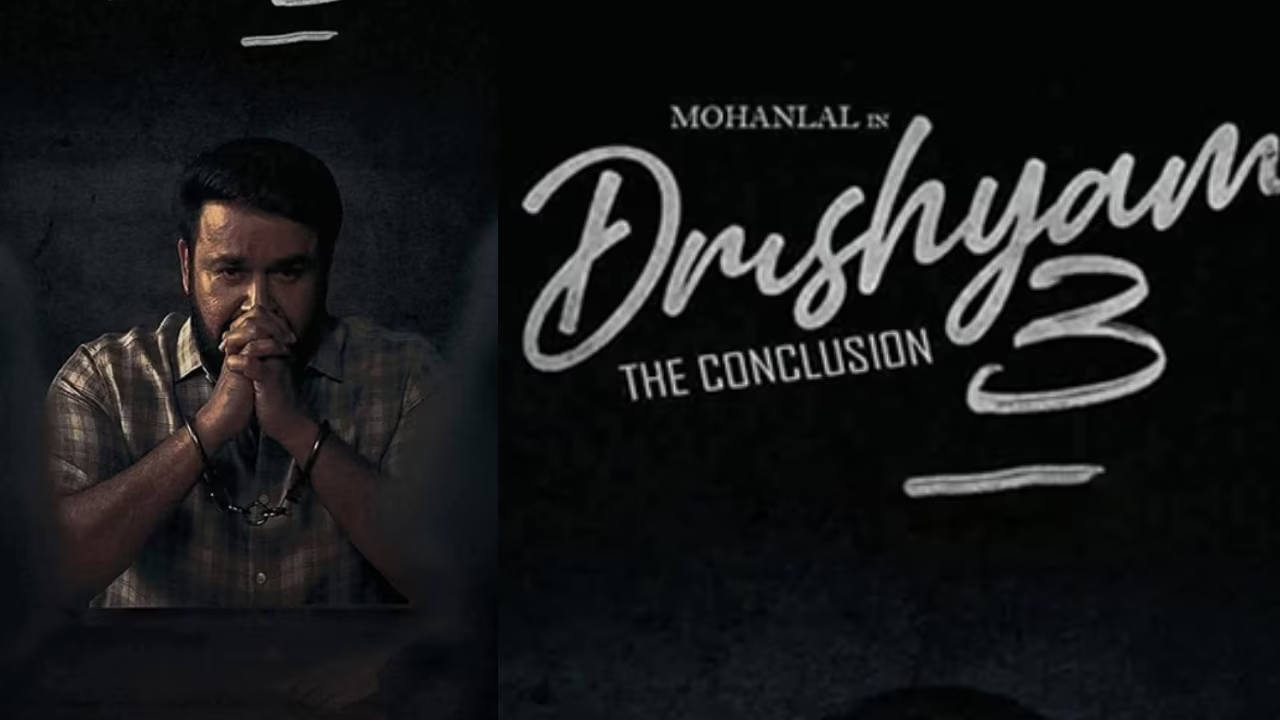
The Drishyam transaction remains the most instructive example of remake rights structured correctly in the Indian market. Celluloid Pact was engaged by Falcon Pictures to manage international remake rights for the original Malayalam film. The deal closed with the Chinese distributor responsible for Sheep Without a Shepherd, which grossed over USD 199 million — at the time, one of the highest-grossing foreign remakes in Chinese theatrical history.
The structural feature that made the Drishyam deal exceptional was the first right of refusal clause inserted for all sequels. This was not standard practice in Indian remake rights transactions at the time. Celluloid Pact’s insistence on this clause meant that when Drishyam 2 and later Drishyam 3 were produced, Falcon Pictures retained the right to manage international remake transactions for each sequel rather than having those rights fall to the producer of the remake directly. The result was a continuously managed franchise IP rather than a one-time transaction.

Global Licensing Hierarchy and Territory Management
Across Celluloid Pact’s transaction portfolio, the licensing hierarchy reflects both market maturity and acquisition appetite at any given time. Hollywood remains the highest-value territory for premium Indian thrillers with crossover appeal, with deal values ranging from ₹8 to ₹10 crore for high-potential IPs. China has historically been the second-highest value market, with deals in the ₹4 to ₹5 crore range for stories that translate well to the Mandarin-language audience — though platform access and regulatory context shape these transactions significantly.
Korea represents a high-quality, strategically important market for emotionally complex narratives; deal values typically range from ₹2 to ₹3 crore, but Korean remakes carry significant secondary value by elevating the original IP’s international profile. Indonesia operates at higher volume with lower per-title fees — USD 25,000 to USD 35,000 per transaction is typical — and MENA OTT platforms, particularly UAE and Saudi Arabia-based streamers, are increasingly active at ₹1 to ₹1.5 crore per deal for Hindi-language and South Indian content with proven platform performance.
Territory management across a multi-market portfolio requires the agent to track holdback periods, renewal windows, and performance triggers simultaneously. A single IP managed correctly across four territories generates four separate revenue events plus potential backend participation in each — a structurally different outcome from a single flat-fee sale.
The template agreement below covers option structure, territory scope, backend participation, and first-refusal clauses — the core commercial framework Celluloid Pact uses across multi-territory transactions. For producers actively sourcing Korean properties, the Korean films available for remake in India provides a catalogued reference of titles with confirmed rights availability across Indian platforms and theatrical markets.
