
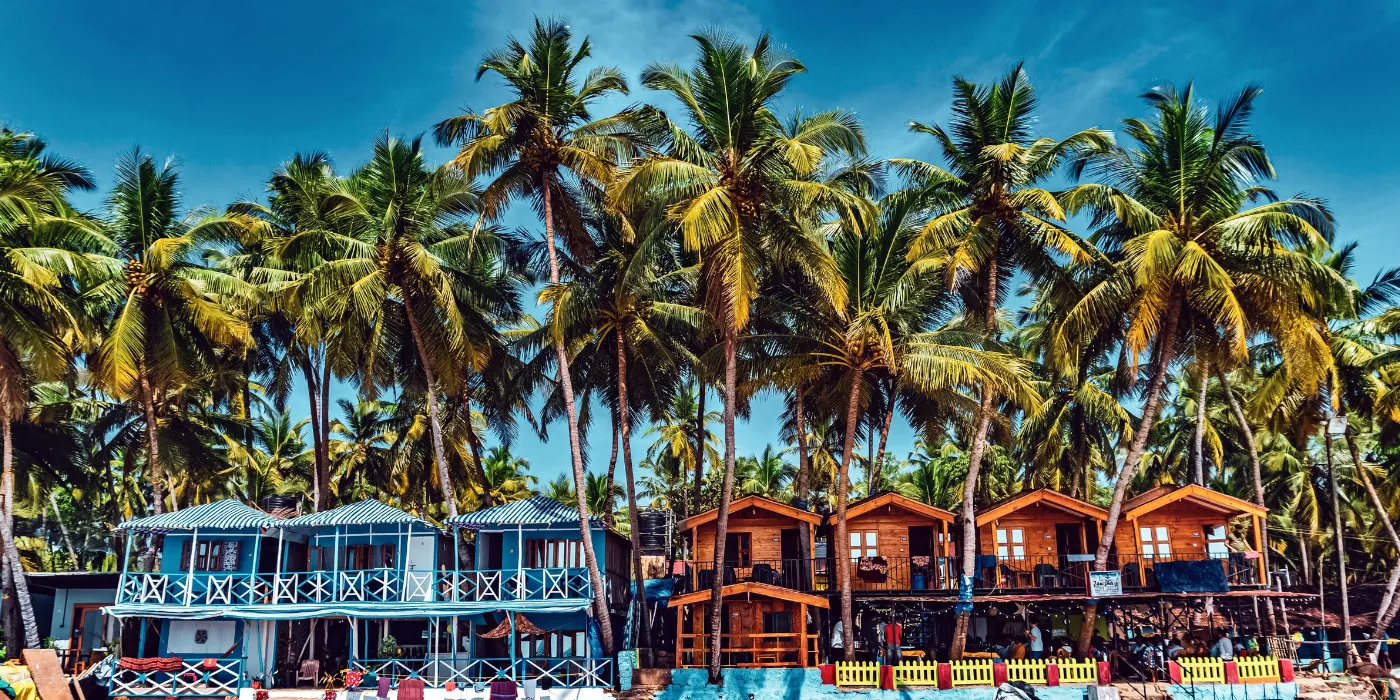
Goa operates as a compact, high-output filming territory for international productions requiring coastal visuals, Portuguese colonial architecture, and tropical environments within a single location frame. The state’s production infrastructure — permit systems, crew networks, accommodation clusters, and vendor chains — is calibrated for international shoots, with North and South Goa offering distinct visual and logistical profiles that can be sequenced within a single production week. For international features, OTT streaming projects, and advertising productions, Goa delivers a range of environments that would require multi-country travel to replicate elsewhere.
Why International Productions Film in Goa
Goa’s visual range is concentrated in a compact geography. Beach frontage running from Morjim in the north to Palolem in the south gives productions access to varied coastal formats — wide open beaches, cove settings, cliffside vantages, and harbour backdrops — without multi-day location travel. The Portuguese colonial layer in Panaji’s Latin Quarter, Fontainhas, and Old Goa’s church district provides period architecture that is difficult to replicate elsewhere in India. This combination — tropical coastline and colonial built environment within a single territory — is the primary draw for international features and high-end commercial productions.

Goa’s film-friendliness at the administrative level is well established. The state has processed international production permits consistently over two decades, and its police department, coastal authority, and heritage conservation body have developed clear workflows for location access. This reduces pre-production friction for productions entering from outside India and gives Goa a measurable advantage over comparable territories where permit systems are less institutionalised.
Indian commercial productions use Goa extensively for song sequences, romantic narratives, and action sequences — a production legacy that has built the location’s crew familiarity and permit infrastructure to a level that directly benefits international shoots. Productions entering Goa for the first time inherit an ecosystem shaped by continuous high-volume domestic and international production activity, which is a material operational advantage over filming in territories where international production is still establishing its baseline.
Production Proximity to Mumbai
Goa’s proximity to Mumbai — one hour by air, four hours by road — is a structural production advantage. Crew, equipment, and specialists can be mobilised from Mumbai to Goa on the same day if required. Productions that encounter location or scheduling changes mid-shoot can draw on Mumbai’s resources rapidly without the multi-day logistics overhead that remote location territories create. This connectivity makes Goa a lower-risk choice for productions that value operational flexibility alongside visual quality.
Seasonal Scheduling — The Goa Production Window
The primary international production window in Goa runs from October to March. This period combines post-monsoon greenery (October–November), the driest clear-light conditions (December–February), and the pre-summer moderate temperature range through March. December and January deliver the highest production value light conditions — sunrise and sunset quality during this window is difficult to replicate in the monsoon or early summer months.
The monsoon season (June to September) creates significant production risk — rain unpredictability, coastal access restrictions, road flooding in North Goa’s interior zones, and equipment protection requirements all compound. Productions that schedule in the monsoon window should plan for a thirty to forty percent schedule contingency and budget accordingly. Some productions deliberately schedule monsoon shoots for specific visual requirements — rainfall and stormy-sea aesthetics for particular narrative contexts — but this demands experienced Goa-based line production management to execute within budget parameters.
The high-season period (November to March) coincides with peak tourism density in North Goa beach zones. Early morning unit calls before 7am, late afternoon and evening windows, and off-beach inland locations are the primary tools for managing crowd density. South Goa locations offer more consistent crowd control conditions throughout the high-season window.
International Productions Shot in Goa
Goa has served as a filming location for international productions across multiple genres over three decades. The Portuguese colonial architecture of Old Goa and Fontainhas has been used as a stand-in for South American, Southeast Asian, and southern European colonial settings. The beach corridor has been used for advertising productions from European, Japanese, and Australian clients requiring tropical coastal environments without the permitting complexity of Southeast Asian locations.
The Best Exotic Marigold Hotel (2012) used Goa alongside Rajasthan, establishing the territory’s viability for British prestige production at scale. Bourne Supremacy location scouts identified Goa’s coastal profile as a Mediterranean stand-in — a casting that reflects how international productions have consistently used Goa’s Portuguese visual language to access European aesthetics at Indian production costs. More recent streaming platform projects have used Goa’s coastal and heritage architecture in both Indian-set and globally-distributed narrative contexts. Productions bringing an international crew into Goa work through a line producer Goa framework that manages permits, crew, and location logistics end to end.

Location Breakdown — Key Filming Zones
Goa’s filming zones divide naturally into three distinct production environments — North, South, and Central — each offering a different visual and logistical profile. Productions are often sequenced across all three within a single week without requiring base camp relocation. North Goa delivers beach frontage and coastal energy; South Goa provides the cleaner, more controlled beach environments used by prestige productions; Central Goa covers the Portuguese colonial architecture concentrated in Panaji and Old Goa. Understanding which zone anchors the shoot determines unit base placement, permit routing, and the crew travel time that shapes daily scheduling.
North Goa — Beach Frontage and Coastal Infrastructure
North Goa covers the primary beach corridor from Morjim and Ashwem through Vagator, Anjuna, Baga, and Calangute. This stretch is the highest-demand filming zone for international productions. Beaches are wide, crew and equipment access via vehicle is practical, and the concentration of accommodation options allows large crews to base within fifteen minutes of key locations. Anjuna and Vagator offer rocky headland formations and clifftop positions used for action sequences and dramatic coastal framing. Baga and Calangute carry higher tourist density but can be managed with early morning unit calls and access control coordination with local police.

Morjim and Ashwem at the northern tip offer cleaner beach environments with lower tourist density. These locations are preferred for productions requiring wide coastal frames without crowd management overhead. The olive ridley turtle nesting season (October to February) creates coastal buffer restrictions at Morjim during the primary shooting window — this must be factored into location scouting during pre-production.
South Goa — Clean Coastline and Forest Fringe
South Goa provides the cleaner beach environments used for high-end commercial, OTT, and prestige feature production. Palolem, Colva, Benaulim, and Agonda are the primary locations. Palolem’s curved bay and palm-line geometry suits period and prestige production work. Colva and Benaulim offer longer unbroken beach stretches with better crowd control conditions than North Goa during peak season. South Goa also provides access to the inland Salaulim reservoir catchment and the forested Western Ghat fringe — environments that add natural variety beyond the coastal frame for productions requiring multi-environment scheduling within the territory.
Central Goa — Colonial Architecture and Period Settings
Panaji (Panjim) is the primary base for colonial architecture sequences. Fontainhas, Goa’s Latin Quarter, maintains 18th and 19th-century Portuguese residential architecture in a compact walkable grid — pastel-coloured houses, Catholic-church-anchored street patterns, and low-traffic lanes that can be cleared for filming with manageable permit overhead. The Mahalaxmi Temple precinct and Panaji riverfront add further character for urban sequences requiring South Asian context alongside the Portuguese visual language.
Old Goa, ten kilometres east of Panaji, contains the Basilica of Bom Jesus and Sé Cathedral — UNESCO-listed structures that require heritage authority permits for exterior filming but can be accessed through established channels. Fort Aguada on the Sinquerim headland is used for period and action sequences requiring coastal fort architecture. The combination of Fontainhas, Old Goa, and Fort Aguada within a fifteen-kilometre radius gives productions a dense colonial location cluster accessible from a single central base.
Ad Film and Commercial Production in Goa
Goa is the primary destination for Indian advertising productions requiring coastal and European colonial aesthetics. The volume of commercial shoots — fashion campaigns, automotive launches, FMCG advertising, and luxury brand content — has created a mature vendor ecosystem for advertising-format productions that operates independently of the feature film production cycle. Studio-configured beach locations, prop suppliers familiar with advertising-grade set dressing, and location managers with commercial shoot experience are available without the advance build time required in less active territories.
International advertising productions use Goa primarily for three visual formats: tropical beach lifestyle (North Goa beach corridor), European colonial character (Fontainhas and Old Goa), and luxury resort and villa settings (both North and South Goa inland belt). Each of these formats has an established location and permit pathway that Goa-experienced production teams can activate within short pre-production windows. A five-to-seven day commercial shoot in Goa covering two or three location types is a standard production configuration that the territory’s infrastructure handles without logistical strain.
OTT platform productions — particularly those requiring aspirational lifestyle content with Indian coastal settings — have increased their Goa volume substantially since 2020. Netflix, Amazon Prime, and Disney+ Hotstar shoots in Goa have further developed the territory’s infrastructure for streaming-format productions, including improved access to location-managed upscale properties that previously required individual owner negotiation. Productions extending from Goa into the wider coastal South India corridor — Kerala, Tamil Nadu, and Pondicherry — will find the operational framework at line production in South India.

Production, Permits and Budget
Goa’s production infrastructure is calibrated for international shoots in a way that most Indian states are not. The crew base, vendor chains, and permit pathways have been refined over three decades of continuous international production activity — first through the advertising industry, later through feature film and OTT work. Productions do not need to build from scratch. The question is whether the existing infrastructure matches the scale and format of the incoming production, and where Mumbai supplementation is required.
Production Services and Crew Infrastructure
The Goa production services layer operates as a standing ecosystem rather than a project-by-project assembly. Local crew heads, established equipment suppliers, and accommodation contractors who work with international productions regularly are available on short lead times. For departments that exceed local capacity — large lighting packages, specialist camera systems, full art department builds — the Mumbai supplement pipeline is routine and well-tested. Productions that plan their Mumbai supplement requirements during pre-production rather than on location avoid the cost and schedule friction that last-minute crew sourcing in Goa produces.
Crew Resources and Mumbai Supplement
Goa maintains a mid-sized crew pool suited for productions up to fifty crew on local hire. For larger international productions, the crew base is supplemented from Mumbai — a three-to-four hour drive or one-hour flight. Camera assistants, gaffers, grips, and art department teams rotate regularly from Mumbai to Goa shoots. The local Goa crew base is strongest in location management, production assistance, and hospitality coordination — disciplines shaped by decades of international production activity in the state. Hindi and English fluency is standard across the Goa production crew network.
Equipment Inventory and Technical Supply
Equipment rental in Goa covers mid-range camera, grip, and lighting inventory. Productions requiring specialist camera systems, large lighting packages, or aerial units bring equipment from Mumbai or Hyderabad. International kit arriving through Goa’s Manohar International Airport (Mopa) or Dabolim Airport follows standard customs procedures, with bonded carnets available for temporary import of production equipment. Productions routing equipment through Mumbai first benefit from the established customs processing infrastructure at CSIA before onward transport to Goa by road.
Unit Bases and Accommodation Management
Goa’s accommodation infrastructure for large productions is concentrated in North Goa between Calangute and Candolim, and in South Goa around Colva and Benaulim. The cluster of mid-range and five-star properties in these corridors allows productions to negotiate block room rates for large crews without dispersal across zones. Production vehicles can access beach locations directly in most North Goa zones — a logistical advantage that reduces the secondary transport layer required in more congested Indian cities. Catering infrastructure in Goa for international productions is typically handled by Mumbai-based production catering contractors who deploy to Goa for the shoot duration.

Permit and Permission Framework
Goa’s core filming permissions are processed through the Goa State Film Commission (GSFC), which issues location permission letters that serve as the primary clearance document for beach, heritage, and public space filming. The GSFC has processed international production applications across feature, commercial, and OTT formats, and its turnaround for standard location permits is consistently faster than comparable state bodies in Maharashtra or Rajasthan.
Coastal Regulation Zone Requirements
Coastal filming in Goa is subject to the Coastal Regulation Zone (CRZ) framework, which restricts permanent structures and certain equipment configurations within 500 metres of the high-tide line. International productions need to review CRZ applicability for specific beach locations and obtain CRZ authority clearance for shoots within the restricted zone. Generator placement, crane positioning, and vehicle access within the CRZ buffer require specific approvals. Productions that plan this at the location scouting stage rather than on the shoot day avoid the delays that most CRZ-related production problems produce.
Heritage and Police Coordination
Heritage locations — Old Goa churches, Fort Aguada — require Archaeological Survey of India (ASI) or state heritage authority approvals that run parallel to GSFC permits. These have standard processing paths and are not unusual approvals for experienced Goa production teams. Police permissions are location-specific and coordinated through the relevant district SP office. A production with its GSFC letter in place will generally find police coordination straightforward. Fontainhas residential street filming requires specific neighbourhood notification and coordination with the Latin Quarter residents’ bodies — this is managed at the location management level by the production team. Productions that extend from Goa into Kerala — where the permit framework operates differently across district and forest authorities — will find specific guidance at line producer Kerala.
Budget Benchmarks for Goa Productions
Goa sits in the mid-cost tier among Indian filming territories — more expensive than Rajasthan or Himachal Pradesh due to tourist-driven accommodation and transport pricing, but significantly less costly than equivalent coastal or colonial locations in Europe or Southeast Asia. Key cost variables for international productions in Goa include accommodation (affected by peak season premiums in December–January), transport (affected by tourist-zone monopoly pricing in North Goa), and permit fees (GSFC and coastal authority fees are fixed and predictable).
Film fixers in Goa operate at the intersection of location access, vendor management, and permit coordination. For productions entering Goa without an established local network, an experienced fixer covers the ground logistics that production management cannot handle remotely — live location status checks, vendor rate negotiation at market rather than international-client rates, and real-time permit status tracking with the relevant authorities. The fixer function in Goa is distinct from the broader line producer role: fixers operate within Goa specifically, while the line producer manages the full production system including above-the-line logistics, budget oversight, and client communication.
Film Fixers in Goa: Vendor Access and Location Fee Management
Vehicle and transport costs in Goa deserve specific attention in budget planning. Tourist-zone transport pricing in North Goa operates on a premium rate structure that differs significantly from production transport rates in Mumbai or Delhi. Dedicated production vehicle contracts, negotiated before the shoot rather than on location, are the primary tool for controlling transport cost overruns. Large vehicle requirements — trucks for equipment and art department, crew buses — should be sourced from Mumbai-based transport contractors with Goa experience rather than from local Goa vendors who specialise in tourist-market pricing.
Local crew day rates in Goa are lower than Mumbai equivalents. A production assistant-level position in Goa runs at sixty to seventy percent of the Mumbai rate, with location and logistics crew at comparable savings. Mumbai-supplemented crew on Goa shoots carry Mumbai day rates plus travel and accommodation, which narrows the cost differential for departments that need to be fully supplemented from outside. Productions that invest in building Goa-based department heads during pre-production achieve better cost efficiency on the shoot than productions that import the full crew from Mumbai.

Pre-Production Planning for Goa Shoots
Effective pre-production for a Goa shoot covers six primary planning streams: location scouting and clearance, permit applications (GSFC, coastal authority, heritage where applicable), crew assembly, accommodation block booking, equipment sourcing and transport planning, and catering and unit base logistics. The sequencing of these streams matters — accommodation in peak season (December–January) books out two to three months ahead, so block room negotiation should begin before the permit process is initiated rather than after.
Location scouting for Goa shoots should be conducted in the same season as the planned shoot where possible. Light quality, tourist density, and beach access conditions vary significantly between October and March even within the primary production window. A scout conducted in late October produces different data from a scout in January for the same locations. Productions that rely on stock photography or previous shoot data for location selection without a fresh scout carry scheduling risk that manifests on shoot days as access and condition mismatches.
Location Scouting in Season: Why Recce Timing Determines Permit Accuracy
Permit lead times for standard Goa beach shoots run two to three weeks through the GSFC for straightforward applications. Heritage location permits (Old Goa, Fort Aguada) should be initiated four to six weeks before the shoot date to allow for ASI processing time. Coastal authority CRZ applications run parallel to GSFC and should be submitted simultaneously. Police coordination in Goa is typically completed within the week before the shoot once other permits are in place and can be handled by the local production team without requiring production management involvement from the home base.
Full on-ground execution for international shoots in Goa — covering permits, crew, logistics, and compliance — is managed through the line producer Goa framework, which handles the full production services stack from pre-production through wrap. Production teams based in Mumbai coordinating Goa shoots will find scheduling, crew sourcing, and logistics guidance at line producer Mumbai.
