
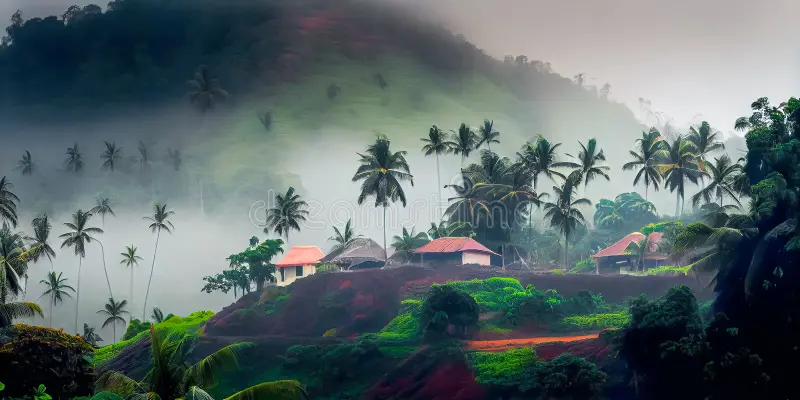
Filming across Kerala and the wider South India is less a single-location exercise than a corridor operation: crew, equipment and budgets are planned across several states that feed one production pipeline. Kerala supplies the natural range, backwaters, hills, forest and coast, while Chennai, Hyderabad, Bengaluru and Goa add studio capacity, equipment depth and coastal variety. This guide sets out the practical side of that corridor for a line producer: where the crew comes from, what a shoot actually costs, how permissions and safety work on the ground, and how travel and season shape the schedule.

The South India Production Corridor
South India does not operate as a single market. It functions as a connected execution corridor where Kerala, Tamil Nadu, Karnataka, Telangana and Goa support one pipeline, and line production in South India works best when the states are treated as one connected system rather than separate markets, with a production routing between them according to what each does best rather than sourcing everything from one base.
Kerala’s Role and the Wider Ecosystem
Kerala is often the entry point, valued for realism, natural environments and location density rather than controlled studio production. The broader ecosystem expands what is possible: Tamil Nadu, anchored by Chennai, is one of India’s strongest studio-driven bases; a line producer in Hyderabad brings large-format studio scale, including infrastructure such as Ramoji Film City; and Bengaluru contributes a tech-savvy crew and post capability. A production that needs built sets or heavy infrastructure leans on those hubs while shooting Kerala’s looks, so the state rarely carries a large project entirely on its own.
That division of labour is the corridor’s real value. The backwaters, hill stations and coast supply the frames; the metros supply the stages, the senior technicians and the post pipeline. A line producer’s first planning decision is which parts of the script belong in Kerala and which are better served from a neighbouring hub.
Multi-State Routing
Large productions rarely stay confined to one state. The planning task is to map terrain to narrative and align crew, equipment and permits across the corridor, then route the shoot so each leg is taken once rather than crossed repeatedly. Done well, the corridor turns regional spread into an advantage instead of a logistics cost.
Routing is fixed early because permits and crew depth differ between states, and a unit that improvises its movement late usually pays for it in idle days and repeat transfers. The sequence of locations, the points where crew joins or releases, and the equipment hand-offs between hubs are all set in pre-production so the shoot moves in one direction through the region.

Crew Across Kerala and South India
South India carries some of India’s deepest technical crew pools, particularly across camera, art direction, sound, VFX and large-format production disciplines. For a production the practical question is where each department comes from and how a unit scales up or down without losing control.
Kochi, the Crew Hub
Kochi is the heart of Kerala’s film industry and its deepest talent pool, from directors and cinematographers to production assistants and sound engineers, many of them experienced on both Malayalam and international work. Most Kerala crews are assembled here, and it is where a production bases its core unit before dispatching it to the rest of the state.
Because the Malayalam industry is technically mature, a Kochi-based unit can cover the below-the-line departments, camera, grip, electrical, art and sound, from within the city for most projects. The constraint is depth at the top end and in specialist roles, which is where the wider corridor comes in.
Thiruvananthapuram, Munnar and Scaling Up
Thiruvananthapuram, the state capital, has a growing industry and capable crew, while Munnar and the smaller centres provide crew on a more localised scale suited to lighter units. Small, independent shoots run flexibly and cheaply on this base, drawing what they need locally and keeping the footprint small.
Larger productions need tighter coordination and usually supplement the local pool with senior technicians and specialist departments brought in from Chennai, Hyderabad or Mumbai, an underwater team, a stunt unit, a VFX supervisor or a designer the local market cannot supply at volume. Deciding that local-versus-imported split early is the core of crewing a South India shoot, and it is one of the larger swings in the budget.

Budgeting a Kerala and South India Shoot
South India is generally more cost-effective than the established northern hubs, with lower production costs and competitive rates, which is much of why streaming and OTT work has moved toward the region. The savings only materialise, though, when the crew, equipment and routing are planned together rather than treated as separate line items.
Cost Structure and Equipment
Kochi offers a favourable budget environment, with several rental houses supplying cameras, lighting and grip at competitive rates. Thiruvananthapuram is similar on equipment and studio rentals, though some specialist services cost more where availability is thin, and Munnar and the interior carry a travel and logistics premium because kit and crew have to be moved in and supported away from the hubs.
The largest single budget swing is what is sourced in-state versus what is imported. High-end cameras, specialist lenses and the senior departments brought from Chennai, Hyderabad or Mumbai add freight, travel and per-diem on top of the rate, so a realistic Kerala budget is built around a clear line between what the local market covers and what has to travel.
Incentives and Cost Control
Kerala does not run a blanket cash rebate for incoming productions in the way Rajasthan or Madhya Pradesh do. The Kerala State Film Development Corporation operates a single-window clearance for shoots in the state and runs the Chitranjali Studio facilities, while its subsidy scheme is oriented toward Malayalam films produced and processed within Kerala rather than toward outside units.
The practical implication is to budget against facility access and clearance support rather than an assumed rebate, and to model the local-versus-imported split, the corridor routing and the season together so the region’s genuine cost advantage, lower crew and living costs, actually lands in the budget instead of staying a headline. Where a project needs a documented incentive, that case is usually built around the wider corridor and central schemes rather than a Kerala state rebate.
Permits, Compliance and Safety
Filming in Kerala requires structured coordination with local authorities, and unlike the metro cities where permissions are centralised, approvals here are often handled at the local level, especially across public spaces, coastal zones and culturally sensitive locations.
Permissions and Clearances
The KSFDC single-window mechanism is the front door for shoot clearance in the state, but a production still deals with district administration, local police and, for forest and protected-area work, the Forest Department on its own lead time. Coastal-zone and temple shoots carry their own approvals. A line producer in Kerala holds those relationships and files early, because the slowest approval, not the fastest, sets the start date.
Safety and Cultural Compliance
Safety differs from a high-density urban shoot. Crowd control is generally easier in rural and semi-urban locations, but water bodies, uneven terrain and weather are the real risks and need managed protocols, safety crew and cover for water and height work in particular.
Cultural compliance matters too: filming in temples, villages and traditional settings calls for respectful engagement and alignment with local norms and customs, which communities generally reward with cooperation and access. Getting that engagement right is often the difference between a location that opens up and one that closes mid-schedule.

Locations Across the Corridor
The corridor’s locations run from Kerala’s compact diversity to the coastlines of the neighbouring states, which is what lets a single routing cover several visual registers without long repositioning moves.
Kerala: Backwaters, Hills and Forest
Kerala’s strength is compact, varied geography: within a few hours a unit moves between backwaters, hill stations, dense forest and coastal belts, which cuts long-distance relocation. The Alappuzha and Kumarakom backwaters and traditional houseboats give the signature settings, the hills and tea estates around Munnar the highland frames, and waterfalls such as Athirappilly the forest-and-water sequences that the state is known for.
That density is a scheduling asset, and along the Malabar belt the variety clusters unusually tightly: the Wayanad forests, working ports and coastal beaches can sit within a tight radius of roughly fifty kilometres, so a single base doubles for jungle, port-industrial and coastal looks without the long unit moves a northern India schedule would otherwise force. Holding one base and reaching distinct looks on day trips keeps the crew together and the per-day cost of moving down, while the temples, festivals and traditional art forms add cultural texture on top of the landscape.

Coastal Locations Beyond Kerala
The corridor extends the coastal range well past Kerala’s own beaches. Gokarna in Karnataka offers pristine, uncrowded beaches reached on short treks and a temple-town character for authentic, unspoilt beach scenes; Mangalore combines a working port city with beaches such as Panambur, known for its kite festival, and Tannirbhavi, plus busy markets and urban-coastal texture.
South Goa, quieter than the commercialised north, supplies tranquil stretches like Palolem and Agonda for idyllic coastal backdrops, where a line producer in Goa handles the permits, crew and coastal logistics on the ground. Routed from a Kerala base, these add coastal looks on a manageable transfer without requiring a northern India move, which is why a coast-heavy script often runs as a Kerala-plus-Karnataka-or-Goa schedule rather than staying inside one state.

Travel, Logistics and Seasons
Locations across Kerala and the wider South India corridor are diverse but spread out, so travel and season drive the schedule as much as the script does, and both are planned in detail before the unit moves.
Getting Around and the Shooting Calendar
Kochi’s Cochin International Airport is the busiest in Kerala and carries the majority of the state’s air traffic, with wide international and domestic connectivity, while Thiruvananthapuram serves as a second international gateway on largely Gulf and Southeast Asian routes. Interior locations like the backwaters and hill stations add travel time and need buffers built into the call sheet.
The ideal window runs from roughly October to February, when the weather is cooler and drier; outside it humidity is high, and the June-to-September monsoon disrupts outdoor and water-based work, though it also delivers the lush, dramatic look some projects want with the right cover. Off-season shoots carry contingency. Accommodation in Kochi ranges from crew-friendly hotels to budget options, while Munnar and peak-season backwater stays book out and price up early.

Post-Production and Wrap
Post-production is usually split across the corridor: Kerala typically handles principal photography while editing, visual effects and sound are completed in Chennai, Hyderabad or Mumbai, where the deeper post facilities sit. Wrap logistics, equipment returns, vendor settlement and travel demobilisation are planned alongside the shoot so the unit closes cleanly rather than scrambling at the end of the schedule.
Handled as a corridor rather than a single location, Kerala and South India give a production deep crews, a real cost advantage and a wide visual range across a few connected states. For a line producer the work is in routing the crew, the budget and the travel around the season so that range is captured without the schedule sprawling, which is exactly what makes the region a dependable base for film, OTT and advertising work.
