
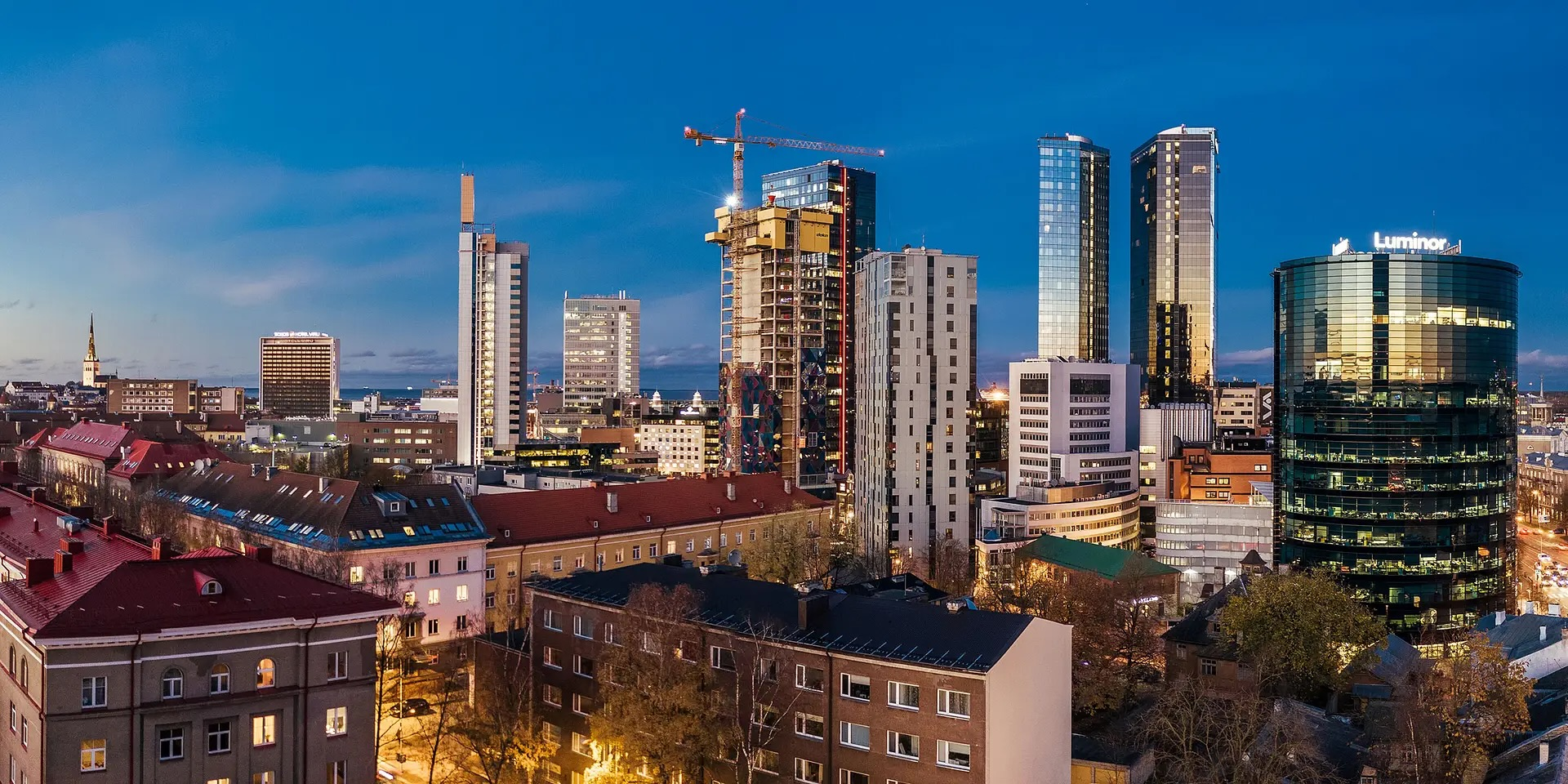
A line producer Estonia gives an international production a single accountable base in Tallinn for crew, permits, equipment and budget, working across a country that pairs medieval Old Town streets, Soviet-era brutalism and a clean modern city inside one compact jurisdiction. Estonia has moved from a locations curiosity to a serious production destination on the back of one number: in March 2026 the government raised the Film Estonia cash rebate from 30% to 40%, one of the highest headline rates in Europe. For an incoming feature, series or commercial, that shift changes the budget maths before a single day is scheduled.
This guide sets out how a shoot actually works here: what Tallinn and the wider country offer as locations, the depth of local crew and studios, how permits, ATA carnets and the rebate application are handled, and how film fixers in Estonia turn a location list into confirmed shooting days. The country is small, English-speaking and administratively light, and it runs one of the most digital public administrations in the world, which is exactly why productions that plan around it recover more of their spend and lose less time to friction than in larger, slower markets.

Why Estonia, and Why Now
The headline draw is the 40% cash rebate, administered by the Estonian Film Institute through the Film Estonia programme launched in 2016 and running on an annual budget of around 6 million euros. The rebate returns a share of qualifying Estonian spend, and at 40% it cuts a producer’s net cost of shooting in Estonia by roughly a seventh against the pre-2026 rate. The mechanics, thresholds and application route are set out in full on the Estonia film rebate page; the point for a production is that the incentive is real, fast to process and covers features, documentaries, animation, high-end TV drama and post-production alike.
Timing matters because the rate rise lands on top of an already-proven base rather than a promise. Estonia spent a decade building service capacity through co-production and inbound work before it lifted the rebate, so the 40% arrives with the crew, studios and administrative machinery already in place. That sequencing is what separates it from territories that advertise a high number but cannot yet carry a large unit, and it is why productions are moving Estonia up the shortlist for 2026 and beyond.
The Tenet Track Record
The credibility came before the rate rise. Christopher Nolan brought Tenet to Tallinn for roughly a month, with the Warner Bros unit spending about 16 million euros in the city and using Estonia as one of seven countries on the film. That shoot proved the country could carry a top-tier international production on its crew, permits and infrastructure, not just its backdrops, and it put Tallinn on the map for location managers who had not previously considered the Baltic.
Tenet is the marquee name, but Estonia’s service industry has been built on a steady run of features, series and commercials that rarely make headlines. Weighed against a line producer Romania plan or the wider Europe line producer picture, productions increasingly pick Estonia on execution as much as cost: the difference is a base that has already delivered at scale, not one being tested for the first time on your budget.
Tallinn and the Location Range
Almost every Estonian shoot is built around Tallinn, and the city’s value is range within a short drive. Inside one compact capital a schedule can move from a medieval core to Soviet-era concrete to a modern financial district, then out to forest and coast, without the long company moves that erode a budget elsewhere. That density of contrasting looks, held close together and cleared by one local team, is the practical reason location interest in Estonia converts into booked shoots.
Geography is the quiet advantage. Estonia is flat, small and well connected, so a unit rarely spends a shooting day in transit, and the same short distances that make company moves cheap also let a production hold one base while covering wildly different looks. For a line producer that compactness is a scheduling tool: the day is built around the light and the location rather than the drive between them.

Old Town and Historical Looks
The UNESCO-listed Old Town is one of the best-preserved medieval cores in Europe: cobbled lanes, guild houses, town wall and church spires that double for a wide span of historical periods without set dressing. It reads convincingly as Hanseatic, Northern European or generic old-world, and its condition means a production spends less on dressing and restoration than a comparable core elsewhere. Because it is a living heritage site, filming is permit-controlled and time-boxed, so scenes are planned around access windows a local team books in advance.
The surrounding districts extend the historical palette into 19th-century wooden housing, industrial-heritage quarters and grand civic architecture. For period productions the appeal is that these registers sit minutes apart, so a single unit can cover several eras in a day rather than travelling between them.
Linnahall and Soviet Architecture
Linnahall is the emblem of Estonia’s Soviet-modern look: a vast brutalist venue on the waterfront, built for the 1980 Moscow Olympics sailing regatta, which Nolan used for Tenet’s opening set piece. It headlines a deep bench of Soviet-era architecture, from housing blocks and cultural palaces to decommissioned industrial sites, that gives productions an Eastern Bloc register hard to find intact elsewhere in the EU. These sites are photogenic but access-controlled and structurally variable, so clearance, safety and logistics are a line-producer job rather than a walk-up.
That Soviet layer is one of Estonia’s genuine points of difference. Productions needing a Cold War, dystopian or Eastern European look get period-correct concrete without building it, and pair it with a crew that knows how to light and rig these spaces. It is a register many Western European territories simply cannot offer at this scale or condition.
Modern City, Coast and Countryside
Tenet also used the Estonian Art Museum, KUMU, whose clean modern architecture doubled for an Oslo interior, and Tallinn backs that with a compact glass-tower financial district, a working passenger port and residential districts that read as generic Northern European city. The contemporary layer means Estonia is not only a period destination; it carries modern and near-future looks within the same short radius.
Outside the capital the country opens into forest, peat bog, lake and a long Baltic coastline with islands, plus manor houses and Lahemaa National Park within easy reach for productions that need nature, wilderness or period estates. The distances are short and the population sparse, so remote-feeling landscapes sit close to the Tallinn base, which keeps company moves cheap and makes multi-look days realistic rather than aspirational.
The location bench is unusually varied for the size of the country: Baltic beaches and dunes, dense forest and open bog, lakes and river valleys, decommissioned military and industrial sites, and a scatter of manor houses and small towns that read as period Europe. Few of these need long travel from Tallinn, so a production can hold a single base and still cover wilderness, coast and heritage across a schedule.

Studios, Crew and Equipment
Estonia’s reputation rests on more than scenery. Screen has called it a plugged-in locations industry, meaning the crew, kit and administrative capacity behind the country are sized for real international production. For a visiting unit that translates into a base able to staff and equip a demanding shoot without importing most of its team, which is the difference between a location that photographs well and a jurisdiction that can actually carry a schedule from prep through delivery.
The ecosystem is deep for a country of its size because Estonia treated audiovisual as an export industry, not a subsidy. Service companies, rental houses, studios and post facilities grew around inbound work, so a visiting production plugs into vendors who deal with international units routinely rather than occasionally. That familiarity shows up in the small things that decide a schedule: clear call sheets, insurance and safety handled to EU norms, and departments that anticipate a foreign director’s workflow instead of learning it on the day.
Sound Stages and Studios
Estonia has working sound stages and studio capacity that let a production add controlled interiors, weather cover and set builds to its location plan, including stages used by established local studios for international work. That matters in a Baltic climate: the ability to move a scene indoors, or build a set to shoot rain, night or a period interior on demand, is what keeps a schedule intact when the season turns. Stage rental and build carried out locally is also qualifying Estonian spend, so it feeds the rebate directly.
The practical planning move is to decide early which parts of the shoot want a stage and which want a real location, because that split drives both the budget and the qualifying-spend base. A local line producer models that mix against the rebate at budget stage rather than deciding it on the floor, where changing it costs both time and recovery.

Crew Depth and Film Fixers in Estonia
The crew base is experienced, English-speaking and used to international standards and workflows, built up over years of service work and co-production. Acting as film fixers in Estonia, the local team holds the vendor, permit and location relationships that turn a plan into confirmed dates: camera, lighting and grip packages, art and construction departments, and the production accountants who prepare the rebate audit. For most incoming productions the senior spine travels and the rest is crewed locally, which keeps the cost advantage real rather than eroded by imported labour.
Crew depth is also the quiet reason Estonia can absorb a large unit at short notice. A production books stages and gear, but it is the standing crew base and the fixers coordinating it that determine whether a compressed schedule holds, and it is the hardest thing for a newer territory to replicate. Current-generation camera, lighting and grip packages are available through local rental houses, so most premium kit can be sourced in-country rather than freighted in.
Post-production is part of the same offer. Estonia has editing, sound and picture-finishing capacity, and because post carried out locally is itself rebate-eligible, a production that keeps some or all of its finishing in-country lifts the qualifying-spend base rather than exporting it. For a shoot already using Estonian stages and crew, keeping post in the same jurisdiction is often the cleanest way to raise the recovery.

Cost: The Layer That Decides the Shortlist
Cost is the layer a line producer models last and productions decide on first. Estonia sits below the major Western European hubs on the fundamentals, crew day rates, location fees, accommodation and services, without the thin depth that makes some cheaper markets a false economy. It is not the rock-bottom option in Eastern Europe, but it pairs a mid-Baltic cost base with one of the region’s highest rebates, and that combination is what moves it up a shortlist rather than any single line being cheapest.
Crew and Production Rates
Crew is where Estonia’s cost advantage is clearest. A camera crew day in Tallinn typically runs in the region of 750 to 2,500 euros depending on the size of the unit and the package, with days built around a ten-hour base, and rates that sit well below the equivalent in France, Germany or Ireland. Estonia has no film unions and no government-set rate card, so crew and talent day rates and buyouts are negotiated rather than fixed, which gives a line producer Estonia real room to build a package to the shape and budget of the production rather than working to a mandated grid.
How the Rebate Compounds
The 40% rebate, the top rate that applies when the production engages Estonian creative crew and 30% otherwise, is where the base cost and the incentive compound. Because the rebate returns a share of qualifying local spend, every euro a production keeps in Estonia, on crew, stages, equipment and post, comes back partly funded, so the effective cost of working locally falls further than the headline rate suggests. Independent modelling of the rise put the net saving to producers at around 14% against the old rate, before any base-cost advantage is counted, and that saving lands on the whole local spend rather than a narrow slice of it.
Against other locations the comparison is rarely just a day rate. A line producer models the landed cost: base spend, the rebate recovery, carnet and freight if kit is imported, travel and per diems for a travelling spine, and the schedule risk that weather or thin crew depth adds elsewhere. Set out that way, Estonia competes because the full picture holds together, cost plus recovery plus reliability, not because one number wins.

Estonia Versus Georgia and Other Rebate Territories
The sharpest cost comparison is with Georgia, the country’s closest low-cost competitor, where a line producer Georgia works from a very cheap base, a deep pool of experienced crew and 23 climate zones inside one territory, backed by a 20 to 25% cash rebate, and for a production chasing rock-bottom day rates and extreme location variety it is hard to beat on raw cost. Estonia does not try to undercut it. It counters with a 40% rebate, close to double Georgia’s rate, so the higher headline recovery can outweigh Georgia’s cheaper starting point once the full budget is modelled rather than compared line by line.
The other half of the comparison is logistics. Estonia sits inside the European Union and the Schengen area, so crew and equipment from across the EU move without visas, carnets or customs friction, and the whole shoot runs to EU labour, safety and insurance standards. Georgia, outside the EU, adds carnet, visa and customs steps that Estonia removes. Against other EU rebate territories, from Romania to the Baltics, Estonia now sits at the top of the rate band while matching them on EU access, which is why it increasingly wins a shortlist on the combination rather than any single number.
Permits, Carnets and Logistics
Estonia’s administrative lightness is a genuine competitive advantage. Filming permits run through defined municipal and site-level processes, EU labour and safety frameworks apply, and the country’s digital-government infrastructure keeps paperwork fast. Access-controlled sites such as Linnahall, the ports and heritage interiors carry their own approvals, which a local team sequences against the shoot rather than discovering late in prep.
The digital-state angle is not a gimmick. Company registration, tax handling and much official correspondence run online, which shortens the administrative tail that slows productions in heavier bureaucracies. A shoot still needs a local entity and local partners, but the paperwork around them moves faster than most incoming teams expect, and that speed is part of why permit decisions and rebate clearances come back quickly.
Filming Permits in Estonia
Estonia’s permit process is unusually light. Tallinn has no dedicated film office yet still clears shoots fast, sometimes in about a week, and much public-area filming needs no permit at all provided the general public is not disturbed. The one standard requirement is to notify the Tallinn Transport Department where filming restricts pedestrians or needs traffic management, and to allow more lead time for anything that touches public transport.
Timelines are short and predictable. A straightforward public shoot is typically arranged in around two weeks; a shoot running past 11pm allows about 30 days; and filming that affects public transport lines allows around 40 days. Private property needs the owner’s permission, heritage interiors and the UNESCO Old Town carry their own site approvals, and drone work is cleared through the Estonian Transport Administration against its restricted-zone rules. Holding all of this against the shoot is work a line producer Estonia does in prep, not a same-day arrangement.

ATA Carnets and Bringing Equipment In
Where a production brings its own kit from outside the European Union, it moves on an ATA carnet. The carnet is an international customs document, administered by the World Customs Organization and the International Chamber of Commerce and accepted in more than 80 countries, that lets professional film equipment enter temporarily without paying import duty or VAT. It is valid for twelve months, covers multiple trips and multiple countries, and acts as its own customs guarantee, so no separate bond is posted at the border. Cameras, lenses, lighting and grip are listed by description, serial number and value on the carnet’s schedule.
For Estonia the EU rule is the one that matters: gear arriving from a non-EU country clears into the Union on the carnet at the point of entry, and once inside it moves freely to any member state, while equipment already within the EU needs no carnet at all. Customs stamp the carnet’s counterfoils on entry and exit, and everything listed must leave within the validity or duty becomes payable, which is why a line producer pre-clears the carnet at Tallinn so the unit is released ahead of the first shoot day. From June 2026 the EU, UK, Norway and Switzerland are moving to digital ATA carnets, which makes that clearance faster and less error-prone to manage.
EU Logistics and Free Movement
Estonia’s EU and Schengen membership is a logistics advantage that non-EU rebate territories cannot match. Crew, cast and equipment from anywhere in the European Union move into Estonia with no visa, no carnet and no customs formality, because the Union is a single market and travel area. For a production already working elsewhere in the EU, talent and kit can be redeployed to Tallinn as freely as moving between cities in one country.
The EU framework also standardises the parts of a shoot that create friction elsewhere: labour and safety rules, insurance norms and employment compliance all follow common European standards a visiting production will recognise. Only equipment and crew arriving from outside the EU need the carnet and authorisation steps above. That combination, free internal movement plus one recognised standard, is a large part of why Estonia slots cleanly into a wider European schedule.
The Rebate Route and Seasons
The rebate route runs through a local partner by design: an international production applies for the Film Estonia cash rebate through an Estonian production service company, which submits on its behalf, and decisions are typically returned within about a month. That is why film production services in Estonia and the rebate are best planned together, with the Estonia rebate figures set out in full for productions weighing several territories. Season is the other planning variable: Estonia runs long, bright summer days and short, dark, cold winters, so daylight hours and weather cover are scheduled deliberately rather than assumed.
Eligibility is broad but rule-bound, so the qualifying-spend base is defined at budget stage rather than assumed. What counts is Estonian spend paid to parties subject to Estonian taxation, which is why the structure of the shoot, how much crew, stage, equipment and post sits in-country, sets the size of the rebate directly. A production that plans the spend deliberately recovers more than one that shoots first and reconciles later.

Planning an Estonia Shoot with a Line Producer
Facilities, crew, carnets and incentives only deliver when they are sequenced against one plan. Stage availability, location clearances, crew calendars, permits and the rebate application all have to be locked together, and that coordination is the line producer’s job. A local desk turns the country’s 40% headline into recovered cash by building the budget and the qualifying-spend base from the first recce, not reconstructing it at audit. The Europe line production region guide covers how Estonia sits within a broader European or global schedule.
For an incoming production the single accountable contact matters more than any one location or stage. It is what lets a unit compare Estonia on real availability and cost, route the qualifying spend correctly, and hold the plan together from prep through delivery. Whether the brief calls for film production services in Estonia or line production services in Estonia, the execution base is the same: one team owning the plan end to end.
