
A line producer Romania engagement is, at its core, one accountable desk standing between a foreign production and everything the country asks of it: the crew, the permits, the customs paperwork on incoming kit, the studio bookings, and the audited spend the cash rebate is paid against. Romania hosts a steady flow of international service work, and the productions arriving now expect that desk to run at international standard.
This page is the execution side of a Romanian shoot: what a line producer and film fixers in Romania actually do, the crew and studio base they draw on, and the locations a schedule can reach. The money side, meaning how the 30% rebate works, what qualifies and what a day really costs, sits on our Romania film incentives and rebates guide. Together they are the two halves of the same decision.
The audience is the foreign producer, the streaming platform and the Indian production house planning a European base for a feature, a series or a large commercial. What follows assumes the shoot is real and the only open question is who runs it on the ground, and how well.

What a Line Producer in Romania Runs
The line producer is the production’s single point of control in the country. Everything that touches money, time or liability on Romanian soil runs through the role, from the first budget draft to the final audited claim. On an inbound shoot the value is not local knowledge alone; it is one person carrying the whole schedule, holding the contingency, and answering for the numbers when two departments collide.
The Job, End to End
A Romanian line producer builds and defends the budget, engages the crew and the rental houses, negotiates studio and location access, sets the schedule against the seasons and the light, and keeps the cost report current so the production always knows where it stands. They register the local entity that incurs the qualifying spend, keep the audit trail the rebate depends on, and carry the relationships with the studios, the labs and the authorities that decide whether a shoot moves or stalls. On a foreign production the line producer also translates between two ways of working, so that a call sheet built in Mumbai or London behaves the way the crew on the floor in Bucharest expects.

The Budget and the Cost Report
The budget is where a Romanian shoot is won or lost long before the camera turns. A line producer who knows the market prices the schedule against real local rates rather than a foreign template, flags the line items where the rebate does and does not apply, and builds the currency and contingency assumptions that keep a euro-denominated budget honest against local spend. Once the shoot is running, the weekly cost report is the instrument that keeps a production solvent: it tracks committed against actual, warns before an overage becomes a crisis, and feeds the audit that the rebate claim will eventually rest on. A clean report is not paperwork; it is what lets a producer make the next decision with the real number in front of them.
Where the Rebate Sits in the Job
The 30% cash rebate is real and it shapes the budget, but it is claimed, not gifted. It follows genuine local spend routed through a registered entity, audited after completion and paid against an approved report. Structuring the production so the spend qualifies, and treating the receivable as bridged finance rather than day-one cash, is part of the line producer’s job. The current rate, cap, minimum spend, cultural test and disbursement timeline are set out on our Romania film rebate guide; here the point is only that the desk running the shoot is the same desk that makes the claim stand up. A line producer Estonia runs the same play on a higher 40% headline rebate, so productions weighing the Baltics against Romania trade Estonia’s bigger recovery against Romania’s deeper studios and lower cost base.
Film Fixers, Permits and Access on the Ground
Underneath the line producer sits the fixing layer, the part of the job that turns a plan into a place the camera can actually roll. In Romania it is rarely a single permit; it is a stack of them, and the slowest one sets the date.
The Permit Layer
A Bucharest street shoot runs through the city’s film office, with the police and traffic authorities sitting above it for closures and rolling shots. Step outside the capital and the layers change: national parks and protected landscapes carry their own environmental process, heritage bodies govern the old towns and the castles, and each private estate and location owner grants access on its own terms. None of it is unusual for a mature territory, but all of it has to be mapped at the recce rather than discovered in the week before the shoot, because the approvals run in parallel and the slowest of them decides the start date.
| What needs clearing | Who governs it |
|---|---|
| Street and public-space filming | Bucharest City Hall and the relevant police, traffic and location authorities |
| National parks and protected landscapes | Their own environmental permitting process |
| Old towns, monuments and castles | Heritage bodies, plus each private owner |
| Aerial and drone work | Civil aviation framework, on a separate track |
| Incoming non-EU equipment | Customs; temporary-admission route confirmed with the broker (ATA carnet where eligible) |
Drone, Closures and the Slower Approvals
Aerial work runs on a separate track through the civil aviation framework rather than the film office, with its own lead time, and a production that leaves it late finds the drone unit grounded while the rest of the crew waits. Road closures, rolling shots and anything touching a protected monument sit in the same category: routine to secure, but only if the application goes in early. The fixer’s job is to know which of these is the long pole on a given schedule and to start it first.
Customs, Carnet and Foreign Kit
As a European Union member, Romania lets equipment move freely from within the bloc, while for non-EU equipment, the production should confirm the appropriate temporary-admission route with its customs broker; an ATA carnet can be used where eligible, but it is not the only route, and it has to be prepared before the unit lands rather than argued at the airport. Foreign crew can work alongside a Romanian core, but immigration, employment, tax and social-security obligations should be confirmed for each nationality and engagement, and the paperwork for both is routine when it is handled early and a familiar delay when it is not. This is the unglamorous machinery a production only notices when it goes wrong.
What Film Fixers in Romania Actually Do
Beyond permits, film fixers in Romania carry the local intelligence a schedule cannot buy from a map: which estate will really open its gates in October, which road can hold a low-loader, where power and parking sit for a night exterior, and which head of department is free in the window the production needs. The fixer’s value is measured in problems that never reach the producer, and it is the reason a strong local unit is worth more than a cheaper one that leaves the gaps to be found on the day.

Crew, Studios and Equipment
Romania’s service strength rests on infrastructure that budgets consistently underestimate: a studio base built over seven decades, a crew pool that can staff a large unit when booked early, and a rental and post market that keeps a shoot from having to import what it needs.
The Studio Base
The country carries genuine stage capacity, anchored by the historic Buftea complex and the Castel Film studios outside Bucharest, with backlots that have held standing sets for series and features alike. When a major streamer needed to build an entire town for a flagship title, it built it here rather than fake it elsewhere, which is the clearest measure of what the base can carry. For a production weighing a European stage, the combination of real space and a low cost base is the argument, and it is why the studios book out in the peak season well ahead.
Crew Depth and Rates
Around the studios sits an experienced crew, many with international credits earned on the inbound work of the past two decades, priced against current Romanian quotations rather than Western European benchmarks. The depth is real enough to staff a large unit without thinning the market, though the peak inbound season tightens both crew and kit, so the schedule and the rate both reward booking early. Heads of department work in English and to the structures an international production expects, which shortens the distance between a foreign producer’s intention and what actually happens on the floor.

Equipment and Post
Camera, grip and lighting hire is available locally to international standard, which keeps a budget simple and avoids the carnet where it can. Romania is not only a shooting destination: its post and visual-effects houses work to international delivery standards, and a fair share of inbound work now finishes in the country rather than carrying every frame home. Where a production wants full film production services Romania can supply the chain end to end, from the stage to the deliverable, which is part of what lets more of the spend stay local and qualify for the rebate.
Insurance, Safety and the Practical Layer
Romania is a straightforward country to operate in once the paperwork is in order. Production insurance is arranged locally or ported from a production’s home policy, work runs to European health-and-safety norms an international crew will recognise, and the practical layer, from unit bases and catering to accommodation near the studios, is well developed after two decades of inbound work. The things that slow a shoot here are rarely the country itself; they are the approvals a production started too late.

The Locations a Romanian Schedule Delivers
The location range is wide enough to hold a full schedule without leaving the country, which is what lets a production commit a real base rather than pass through. The look runs from imperial-era cities to fortified hill towns, from castle interiors to empty mountain passes, most of it within a few hours of a full crew base in Bucharest.

Bucharest and the Cities
The capital is a location in its own right, carrying grand boulevards, communist-era monumentalism and pockets of Belle Époque that have doubled for a range of European capitals. Beyond it, Cluj, Sibiu and Brașov offer intact historic cores that read as period Europe with far less dressing than a Western equivalent would need, and at a fraction of the access cost. For a production that needs a city to play somewhere else, Romania’s urban range is one of its most underrated assets.
A recce here is where the schedule stops being a wish. It tests access, power, light, parking, noise and the road position for every option, and it is where a location that looked like one clean shot on a scout reveals itself as a road closure with a traffic plan attached. Building the schedule off a proper recce, rather than off photographs, is the difference between a shoot that holds its days and one that loses them to the things nobody checked.

Transylvania, the Castles and the Carpathians
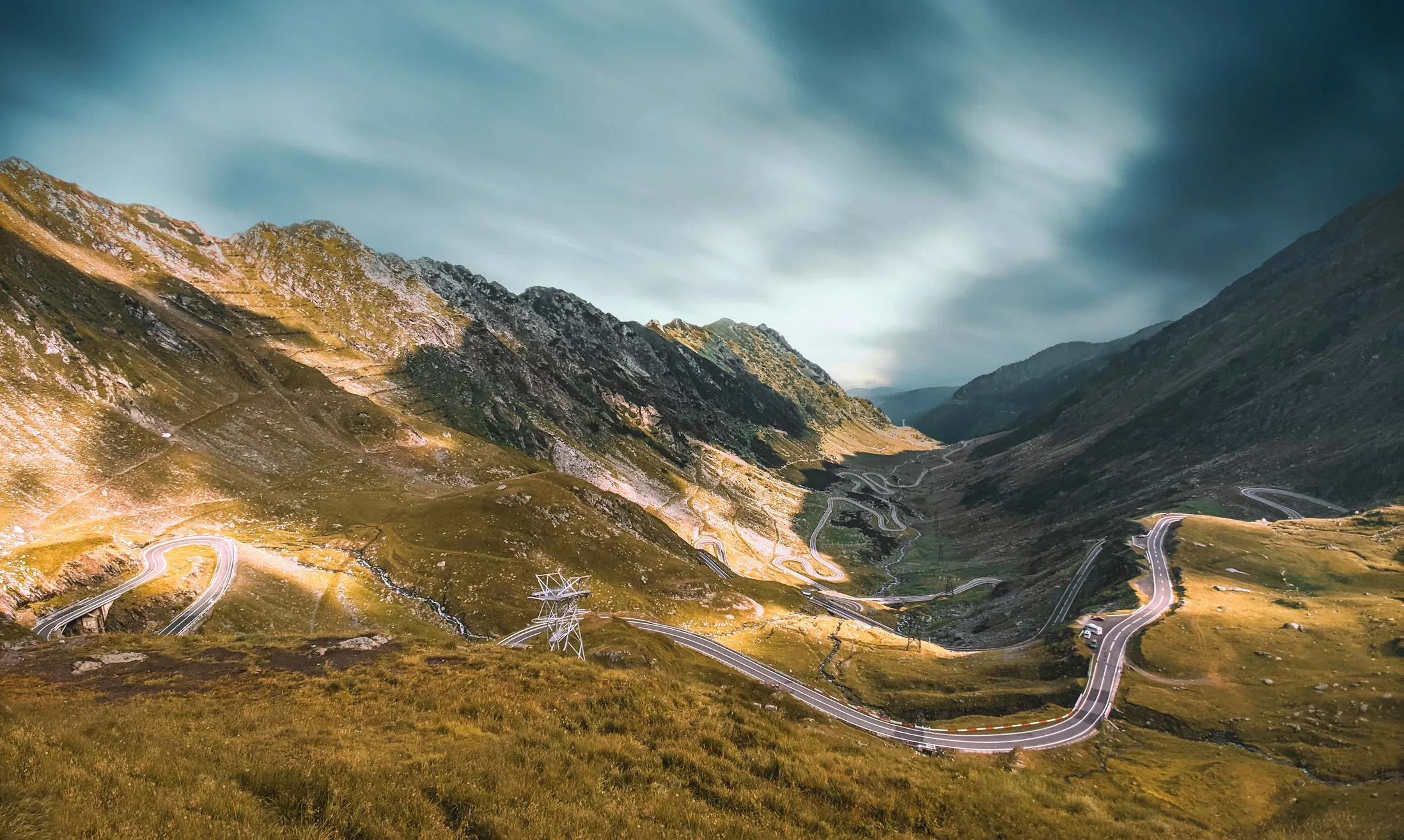
North and west of the capital, Transylvania supplies the fortified towns, the painted monasteries and the castles that are the country’s signature asset, Bran and Corvin among them. Beyond the towns, the Carpathians and the Transfăgărășan pass give a production high mountain drama within a day of a full crew base, and the Danube Delta and the Black Sea coast extend the range further still. The variety inside a single border is one of the reasons a whole schedule can be held in Romania.
The Danube Delta and the Black Sea coast are a distinct register again, a wetland wilderness and a working coastline that few European schedules can reach without a long-haul move. Placed end to end, the range means a production can shoot a period city, a mountain chase, a castle interior and a waterway sequence off a single crew base, which is the compression that justifies committing to Romania rather than splitting a schedule across three countries.
Scheduling Romania: Seasons, Light and the Peak
Romania runs a full continental climate, and the calendar shapes both the look and the cost. The long light and workable weather of late spring through early autumn is also the peak inbound window, when crew, kit and studio space tighten and rates firm up; a production landing in that window competes for the same gaffer as everyone else, so it books early or pays for the privilege. The winter months are cheaper and quieter, with real snow for anything that needs it and a crew base with more availability. A line producer who reads the calendar builds weather cover into the schedule rather than hoping around it, and steers the shoot into the season that serves both the frame and the budget.
Formats: Features, Series, Commercials and Documentaries
The base serves different formats differently. A returning series rewards the standing-set economics of the backlots and a settled local crew; a feature draws on the full studio and location range; a large commercial values a deep crew pool and permit timing confirmed for its specific locations; a documentary leans hardest on the fixer’s access and the light footprint. The production base can support features, series, commercials and documentaries. Incentive eligibility, qualifying spend and cultural-test requirements vary by format and are covered in our Romania film incentives and rebates guide.
Common Mistakes to Avoid
The recurring errors on a Romanian shoot are all avoidable, and a line producer who has run the country before is there to prevent each of them before it reaches the floor:
- Leaving the carnet or the drone approval to the last week.
- Budgeting against a template that ignores local rates and the rebate’s exclusions.
- Booking into the peak season without locking crew and studio early.
- Treating the rebate receivable as day-one cash rather than bridged finance.

Why a Principal Desk, Not a Local-Only Fixer
The local fixer is part of the delivery team on every Romanian shoot we run: the permits, the crew list, the locations and the daily ground coordination are theirs, and the shoot depends on that knowledge. What Global Producers adds sits above it. We carry a production across territories, hold its budget and schedule, and integrate the Romanian unit into one structure, so that a producer running a multi-country slate gets consolidated reporting and a single point of cross-border accountability where it needs one, rather than a different principal, accounting standard and idea of contingency in every country.
On a single shoot in one country, engaging the strongest local company is often the right call, and we would say so. The calculus changes with volume: a production running several titles across several territories needs the local knowledge and consistency together: the same cost coding, the same weekly report, the same person answerable when two schedules collide. That is what the principal desk adds, and it is why our line producer Romania service is built to work with the local unit, not to replace it.
A unit that brings recurring volume into a market is also a different customer to a Romanian vendor than a production that arrives once and leaves, which shows up in access, in priority and in price. For a producer weighing Romania against its neighbours, that leverage travels: our network runs the same way across the region, including film fixers in Bulgaria and the wider Europe line producer map.
Basing the Shoot in Romania
For an Indian production in particular, the appeal is a European base run by a desk that already speaks both languages of the job: the international standard the crew works to, and the cost discipline an Indian budget expects. The rebate, the studio depth and the location range make the case on paper; a principal that has carried productions between those two worlds is what makes the shoot behave once it lands.
Romania rewards the production that commits to it. The rebate follows genuine local spend, the studio and crew depth reward a real base, and the location range is wide enough to hold a whole schedule in one country. Engage a desk with a real claims record, structure the spend early, and commit the base rather than passing through, and Romania can deliver a competitive net cost with execution to international standard. Line up the money side against Romania’s incentive requirements, and the country is ready to shoot. Line production services in Romania keep that plan under one team from prep through to wrap.
