
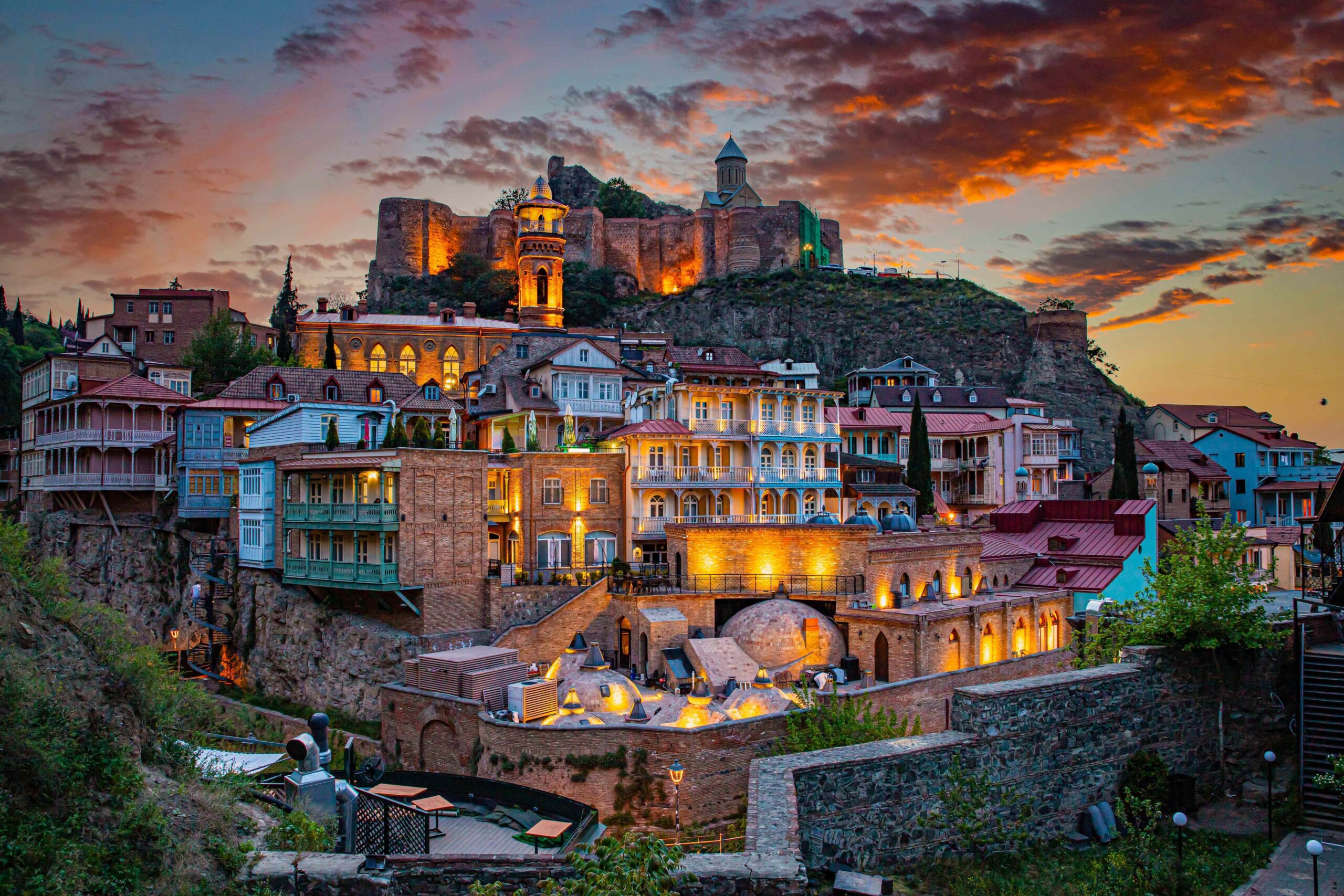
Georgia as a European Production Corridor Territory
Georgia occupies a specific position within the European production corridor that no other territory in the region replicates. Positioned between Eastern Europe and Central Asia, with Tbilisi functioning as the operational hub, Georgia provides international productions with a combination of visual range, cost efficiency, simplified permitting, and a 20-25% cash rebate that makes it the natural eastern anchor of the European production network. Productions that approach Georgia as an isolated filming destination miss the full value it provides when structured correctly as part of a corridor shoot, connecting the EU compliance framework, co-production treaty access, and Caucasus visual environments into a single operational and financial package. Structuring that package is line producer Georgia work, run from Tbilisi across the permit, rebate and location layers at once.
The Visual Case: Tbilisi and the Caucasus
The visual case for Georgia is well established. Tbilisi’s architectural layering (Soviet-era modernism, Ottoman streetscapes, Stalinist civic buildings, and contemporary glass structures) creates a density of visual registers within a single city that no Western European capital provides at comparable production cost. The Caucasus mountain environments accessible within two to three hours of Tbilisi (Kazbegi, the Georgian Military Highway, the Svaneti region) provide high-altitude terrain with a visual register unavailable anywhere else in the European production corridor. The Kakheti wine country, Mtskheta’s UNESCO heritage churches, and the semi-desert landscape of David Gareja extend Georgia’s range from alpine to Mediterranean-like environments within a single national jurisdiction and a single permit framework.

The Financial Case: Rebate and Treaty Access
The financial case is equally strong. Enterprise Georgia administers the Film in Georgia cash rebate, worth 20-25% of qualifying local expenditure, competitive within the European corridor and operationally simpler to access than Western European rebate programmes that carry complex cultural test requirements. Productions entering Georgia through the Europe controlled compliance hub framework access the full European production corridor, connecting Georgia’s cost efficiency and visual range to the compliance infrastructure that international studios and platform commissioners require.
Georgia Within the European Production Network
Within the European production corridor, Georgia functions as the cost-efficient visual range anchor for productions that need Caucasus environments, Eastern European visual registers, or post-Soviet architectural depth within a financially viable budget structure. Productions based in Western European territories for their compliance-heavy sequences extend into Georgia for location work that the corridor’s higher-cost territories cannot provide at equivalent visual quality. Productions originating in India or the Middle East use Georgia as a European production base that delivers EU-aligned compliance without Western European cost pressure, bridging the gap between the corridor’s financial architecture and the budget parameters of productions from high-growth markets.
Georgia maintains bilateral co-production treaty relationships with France, Germany, and other European partners, allowing productions structured as Georgian-European official co-productions to access both the Film in Georgia cash rebate on Georgian qualifying spend and their European partner’s incentive mechanism simultaneously. This financial stacking architecture mirrors Morocco’s position within the MENA corridor, a cost-competitive territory with European treaty access that rewards correct financing structure from the pre-production stage.

Tbilisi: Production Infrastructure, Locations and Visual Range
Tbilisi is Georgia’s production anchor, concentrating crew infrastructure, equipment rental, post-production facilities, and production office infrastructure within a city that simultaneously provides the country’s most diverse and operationally accessible filming environments. That concentration is what makes line production services in Georgia practical to run from a single base. Productions base in Tbilisi and reach every significant Georgia location (Kazbegi, Kakheti, Mtskheta, David Gareja) as day or overnight extensions. The city’s Tbilisi International Airport provides direct connections to major European production markets including Frankfurt, Paris, Warsaw, and Istanbul, making crew and equipment logistics straightforward for multi-territory corridor shoots using Georgia as one production block within a broader European schedule.
The Tbilisi crew market has been developed through sustained international production engagement, primarily through European co-productions and the consistent flow of international advertising production that has used Georgia as a European location for over two decades. Camera, production design, grip, and art departments operate at European technical standards. English is widely spoken at the HOD level. Production managers and line producers experienced in international workflows are available through the established Tbilisi production community. This crew depth means that international HODs arriving in Tbilisi integrate into a working professional environment rather than building a local crew from scratch.
Tbilisi’s Filming Environments: Visual Range and Permit Framework
Tbilisi’s Old Town (the Abanotubani district with its sulfur bath domes, carved wooden balconies, and winding stone alleys) provides a visual register that doubles for Eastern European, West Asian, or generic historical European settings with minimal set dressing. The Narikala Fortress above the Old Town adds a heritage skyline anchor. Permits for Old Town locations route through Tbilisi City Hall, with processing timelines of three to five working days for standard street and public space applications. Heritage proximity work at Narikala requires coordination with the Ministry of Culture alongside the municipal permit, a parallel track that adds lead time but is manageable within a pre-production schedule that accounts for it from the outset.

Rustaveli Avenue’s neoclassical facades and wide boulevard provide a civic European scale that supports embassy scenes, government building sequences, and prestige urban exteriors without the permit complexity of equivalent Western European civic locations. The Bridge of Peace and Rike Park riverside district delivers contemporary glass-and-steel environments suited to brand campaigns and modern drama. Fabrika (a repurposed Soviet factory turned creative district) provides industrial brick, murals, and café environments for music video and indie production work. Soviet modernist structures across the city (the former Bank of Georgia headquarters, the Palace of Rituals, the Wedding Palace on the hill above the Mtkvari River) provide bold geometric environments for espionage, dystopian, and high-concept narrative production.
Locations Beyond Tbilisi: Mountain, Heritage and Desert
Kazbegi and the Georgian Military Highway, approximately two and a half hours from Tbilisi, provide high-altitude alpine terrain, Gergeti Trinity Church on its ridge above the Terek River is one of the most photographed heritage sites in the Caucasus and one of the most visually distinctive filming locations available within the European production corridor. The highway itself, with its switchbacks and mountain road sequences, has been used for action production work including car-to-car sequences. Permit coordination for Kazbegi routes through the local municipal authority alongside a national parks access application, manageable within standard pre-production timelines for international productions.
Mtskheta, forty minutes from Tbilisi, provides UNESCO-listed stone churches and dramatic river confluence geography used for mythic and historical narratives. David Gareja, two hours southeast of Tbilisi, provides semi-desert terrain with rock-hewn monastery complexes, a visual environment that doubles for Central Asian or sci-fi settings unavailable anywhere else in the European corridor. Kakheti’s wine country, one and a half to two hours east of Tbilisi, provides vineyard-terraced hills, fortress walls, and pastoral European landscapes suited to romance and heritage production. Each of these locations reaches from Tbilisi as a day extension, the production base does not need to move for any of them.

Georgia’s Financial Position and European Co-Production Treaty Access
Georgia occupies a distinct position within the European production corridor, close enough to the EU’s eastern border to participate in European co-production treaty frameworks, different enough in visual register and cost structure to provide what no EU member state provides at equivalent operational efficiency. Tbilisi’s architectural layering (Soviet-era modernism, ancient fortification districts, Caucasian vernacular housing, and contemporary glass development within a compact city footprint) creates a visual density that serves as a credible stand-in for a wider range of settings than any single Western European capital can replicate. The Caucasus mountain environments accessible within two to three hours of Tbilisi add an alpine and high-altitude visual register that no other European production territory provides at Georgia’s cost level.
The production case for Georgia is not built on a single advantage. It is built on a combination that no comparable territory in the broader European corridor replicates simultaneously, a 20-25% cash rebate on qualifying local spend, production costs 30-40% below Western European equivalents, a crew base developed through sustained international engagement, a permit system that is pragmatic and responsive by European standards, and a visual range that extends from ancient heritage architecture to Soviet industrial environments to sub-alpine landscapes within a geography compact enough to manage within a single production base.
For international productions entering Europe’s eastern production layer, Georgia functions as a cost-efficient execution territory within the framework of the Europe controlled compliance hub that governs how productions structure their European corridor shoots across the full territory range from Portugal to the Caucasus.
Georgia’s Position Within the European Production Tier
Within the European production tier, Georgia sits alongside line producer Bulgaria and Turkey as a cost-efficient execution territory, distinct from the Western European markets that offer higher incentive rates within more expensive production environments. Georgia’s 20-25% rebate is lower than Portugal’s SCRI.PT and RIPAC regime at 25 to 30% or Bulgaria’s 25% cash rebate at headline level, but Georgia’s lower cost base across crew, locations, and logistics means that the net production cost after rebate application is consistently more competitive than territories with nominally higher rebate rates and significantly higher cost structures. Estonia is the clearest example at the other end of that trade-off: film fixers in Estonia pair a 40% rebate with a higher Baltic cost base, so Georgia holds the edge on net cost while Estonia leads on headline recovery.
The Rebate and Who Runs It
Enterprise Georgia administers the rebate programme, working with the Georgian National Film Centre on the culture side, and runs the application and beneficiary-certification process international productions must complete. Registration is a prerequisite: the applicant must be a legal entity registered in Georgia, at least half of the total production budget must be mobilised at the time of application, and the beneficiary certificate that follows starts a one-year clock for filing the independently audited cost report. The registration process establishes the production’s legal status in Georgia and creates the documentation framework within which the rebate claim will be audited at wrap. Productions that integrate the Enterprise Georgia application into their pre-production timeline as a parallel track alongside creative development (rather than treating it as an administrative step to complete before cameras roll) consistently achieve cleaner audit documentation and faster rebate disbursement.

Tbilisi’s Visual Architecture: Districts, Layers and Regional Locations
Tbilisi functions as Georgia’s sole production base for international shoots. The capital concentrates the country’s crew market, equipment rental infrastructure, production office capacity, international hotel accommodation, and proximity to the programme and film-body offices within a single urban geography. Productions shooting in Mtskheta, Kakheti, Kazbegi, or David Gareja all base their operations in Tbilisi, using the capital as the logistics anchor from which regional locations are reached as shooting days rather than requiring separate operational bases.
The city’s filming environment is genuinely diverse within a compact geography. Tbilisi’s Old Town (the Abanotubani sulfur bath district, the streets beneath Narikala Fortress, the carved wooden balcony architecture of the historic quarters) provides an Ottoman-Caucasian visual register that photographs as Eastern European or West Asian depending on framing and art direction, with minimal set dressing required to shift between periods and settings. Rustaveli Avenue’s neoclassical facades and civic scale provide a different register, formal, European, suited to embassy scenes, upscale urban narratives, and anything requiring wide-format civic grandeur rather than intimate historical texture.
Tbilisi’s Distinct Visual Layers and Their Production Applications
The Bridge of Peace and Rike Park’s riverside contemporary architecture provide a third visual register within the same city, modern, photogenic, internationally neutral in identity, suited to brand campaigns, music videos, and contemporary drama that requires a sophisticated urban environment without the visual clichés of London or Paris. Fabrika (a repurposed Soviet factory complex now operating as a creative hub) provides industrial brick, murals, and a subcultural energy suited to youth-oriented narratives and music video production. The Soviet modernist structures concentrated in Tbilisi’s outer districts (the former Bank of Georgia headquarters, the Palace of Rituals) provide a dramatic brutalist geometry suited to espionage narratives, dystopian settings, and high-concept visual productions.
This range within a single city means that a production based in Tbilisi can access six or seven visually distinct environments without a single company move. The line producer sequences these environments into a schedule that minimises travel while maximising visual variety, a practical efficiency that no Western European capital provides at equivalent cost.
Beyond Tbilisi: Mtskheta, Kazbegi, Kakheti and David Gareja
Georgia’s regional locations extend the visual range significantly beyond what Tbilisi provides. Mtskheta (forty minutes from the capital) offers UNESCO-listed stone churches and river confluences that provide mythic, ancient, and Biblical visual environments within straightforward day-trip logistics. The Military Highway north from Tbilisi through the Caucasus to Kazbegi delivers alpine massifs, switchback mountain roads, and high-altitude landscapes at two to three hours from the production base, environments that serve as stand-ins for Himalayan, Central Asian, or generic alpine settings at a fraction of the logistics cost that genuine high-altitude production in comparable environments would impose.
Kakheti’s wine country (one and a half to two hours east of Tbilisi) provides vineyard terrain, Tuscan-like hills, and fortress architecture that doubles convincingly for Southern European rural settings. David Gareja’s rock-hewn monastery complex and ochre desert landscape two hours southeast of the capital provides a semi-arid, otherworldly environment suited to Central Asian stand-in work, sci-fi settings, and anything requiring an ancient, harsh, and visually unusual exterior landscape. The fixer embedded in each region activates the local permit relationships, landowner access, and logistics infrastructure that allows these locations to be accessed efficiently from the Tbilisi base without the production resetting its operational logic at each regional transition.

Georgia’s Regulatory Framework, Cash Rebate and EU Alignment
Georgia’s production regulatory framework sits in a specific position relative to the European corridor, it is not an EU member state and therefore does not participate in the EU compliance architecture that governs productions in Bulgaria, Portugal, or other EU territory shoots. However, Georgia maintains bilateral co-production treaty relationships with France, Germany, Italy, and several other European territories that allow productions structured as official Georgian co-productions to access European financing mechanisms alongside the Georgian National Film Center’s rebate programme. For productions designed within a European co-production structure, Georgia’s treaty network makes it financeable through European channels despite its non-EU status.
The Film in Georgia cash rebate returns 20% of qualifying local spend, with a further 2-5% earned through a cultural test that rewards Georgian creative and department-head hires (the line producer credit among them), on-screen depiction of Georgia, local post-production spend, and qualifying festival or distribution outcomes. Qualifying spend categories include Georgian crew wages at all levels, location fees paid to Georgian landowners and public authorities, equipment rental from Georgian-registered vendors, accommodation and catering sourced through Georgian suppliers, and post-production work completed within Georgia. Non-qualifying spend includes international air travel, above-the-line talent fees for non-Georgian performers, and services delivered by foreign vendors without Georgian business registration.
Georgia’s Permit System: Tbilisi City Hall, Ministry of Culture and Regional Authorities

Georgia’s permit system is pragmatic by European standards, responsive, relationship-driven, and calibrated to accommodate international production timelines without the extended processing windows that characterise heritage-heavy Western European permit frameworks. Tbilisi City Hall administers street filming permits, park access, traffic management, and crowd control coordination for the capital’s public spaces. In practice a film fixer in Georgia is the person who walks those applications through and keeps the relationships warm between shoots. Processing times for standard Tbilisi urban permits run three to seven working days for straightforward locations. Heritage sites (Narikala Fortress, the Old Town’s protected architectural zones) require additional approval from the National Agency for Cultural Heritage Preservation, adding five to ten working days to the lead time for locations involving physical proximity to protected structures.
Regional permits outside Tbilisi route through a combination of local municipal authorities and, for UNESCO-listed sites like Mtskheta, through the Ministry of Culture’s heritage division. The practical implication for schedule design is that all permit applications (Tbilisi urban, heritage, and regional) must be initiated simultaneously in pre-production rather than sequentially by shooting location. The fixer’s network of established relationships with each permit authority compresses processing timelines meaningfully, approvals that take seven working days through cold application channels typically move in three to four days through a fixer with established relationships at the relevant authority.
EU Alignment, Compliance and International Production Obligations
Despite Georgia’s non-EU status, productions structured as European co-productions through bilateral treaty frameworks must maintain compliance standards compatible with their European co-production partner’s requirements. A French-Georgian co-production must meet CNC documentation standards on the French qualifying spend side and Enterprise Georgia audited-cost standards on the Georgian qualifying spend side simultaneously. The compliance architecture that governs how international productions manage these dual documentation obligations across European and non-EU territory shoots is covered in the filming compliance for international productions guide, including the specific documentation requirements that apply when a production’s qualifying spend crosses between EU and non-EU European territories within a single co-production structure.
Line Producer and Fixer Operations Across Georgia
The line producer function in Georgia operates within a production environment that rewards local knowledge and penalises assumptions imported from other European territories. Georgia’s permit system, vendor ecosystem, and crew networks function through relationships and informal channels that are as important as the formal institutional frameworks, and often move faster when engaged correctly. That relationship layer is what a production is really buying when it engages film production services in Georgia, rather than labour and equipment alone. A line producer without established Georgian production relationships consistently encounters longer approval timelines, higher vendor rates, and less responsive municipal coordination than one with institutional knowledge built through sustained Georgia-based production work.
Film fixers in Georgia provide the operational complement to the strategic oversight a line producer in Georgia carries. Fixers activate the local authority relationships that accelerate permit approvals, manage the community communication that prevents residential or heritage objections from disrupting shooting windows, coordinate local labour across drivers, runners, crowd marshals, and background talent, and handle the real-time problem-solving that keeps shooting days intact when conditions change on location. In Tbilisi’s historic districts (where access windows are restricted, equipment placement is regulated, and heritage supervisors can close a shoot without notice if permit conditions are being breached) the fixer’s continuous on-site presence is the operational mechanism that keeps the production within its approved framework.
Regional Operations: Mtskheta, Kazbegi, Kakheti and David Gareja
Regional shoots outside Tbilisi require the fixer to function as the operational bridge between the production’s Tbilisi-based logistics infrastructure and the local conditions at each shooting location. Mtskheta’s UNESCO heritage sites have their own access protocols and restoration guarantee requirements that do not transfer from the standard Tbilisi permit framework. The Kazbegi route’s mountain roads require advance coordination with local emergency services and weather monitoring, conditions that change within hours and that a fixer with established local relationships can assess and communicate to the line producer before schedule commitments are made rather than after the unit has departed Tbilisi.
Kakheti, Mtskheta and the Day-Trip Radius
Kakheti’s wine country locations (private agricultural estates, village interiors, vineyard exteriors) are accessed primarily through the fixer’s landowner relationships rather than through any formal permit system. The fixer negotiates access terms, confirms shooting windows that do not conflict with harvest or agricultural operations, and manages the community expectations of local landowners who may be hosting an international production for the first time. David Gareja’s remote desert environment requires advance logistics coordination (fuel, water, generator power, and emergency medical access) that the fixer structures as a complete self-contained day operation rather than assuming Tbilisi’s production infrastructure extends to the location.
Georgia rewards productions that treat it as a corridor territory rather than a one-off location. The rebate, the permit route and the crew base all reward early structuring, which is line producer Georgia work from the first budget, with local fixers holding the location and authority relationships on the ground. Our Europe strategic line production region guide sets Georgia within that wider corridor.
