
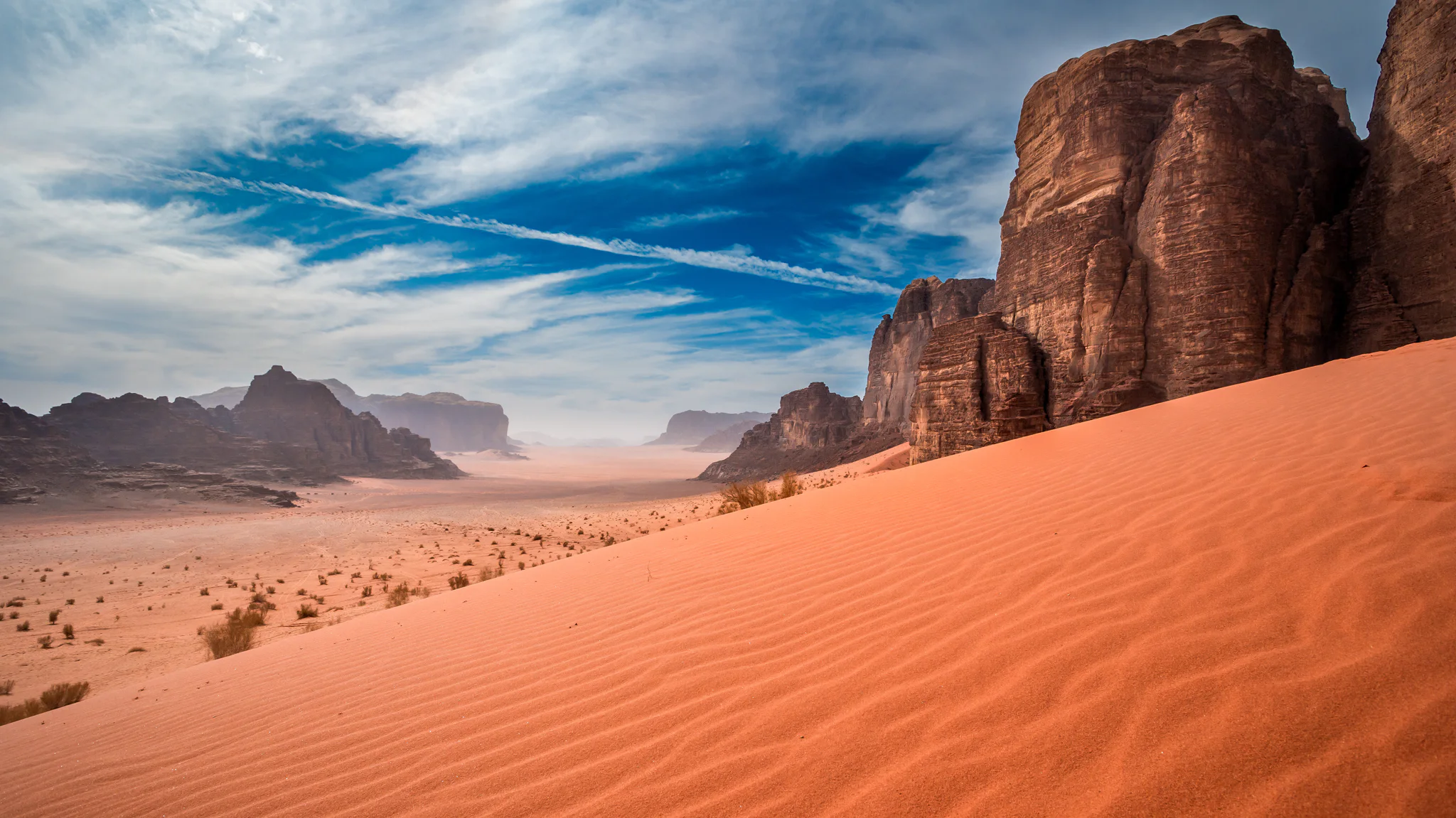
Cheat locations are standard practice in international film production. Productions shoot one territory and present it as another — sometimes to sidestep access restrictions, sometimes because the infrastructure in the actual country cannot support the production, and usually because the cost gap makes the alternative impossible to justify. The selection logic is not primarily visual. A location that matches the brief on camera but cannot be shot within schedule and budget is not a solution.
Stand-in selection is a pre-production judgment that combines visual alignment, production infrastructure, permit access, and cost efficiency into a single assessment. Getting the visual right is the starting point. Making it work operationally is what determines whether the production actually lands. This guide covers the cheat location methodology — how decisions are made, how locations are validated, and where the execution fails — alongside the MENA territory circuit, which provides the primary stand-in infrastructure for productions based in Europe, the Gulf, and North Africa.
Why Productions Use Cheat Locations
The reasons productions choose to cheat a territory rather than shoot in it fall into three distinct categories. Access restrictions are the most absolute: Afghanistan is off-limits on security grounds for any commercial production, Pakistan has been closed to international film crews for decades, North Korea is inaccessible, and Yemen, Libya, and Syria carry insurance exclusions that make production there impossible regardless of any other consideration. When the actual territory is not an option, a stand-in is not a creative choice — it is the only available route.
Access Restrictions and Political Closures
The second category is political and reputational risk rather than hard closure. Saudi Arabia has been historically difficult for international productions — until recently, most productions that required Saudi visual settings shot in Jordan, Egypt, or India. The combination of access unpredictability, the complexity of obtaining permits, and production insurance limitations made Saudi Arabia a territory that most line producers would route around even when formal access was technically possible. Significant regulatory change is underway, but the institutional instinct to cheat Saudi Arabia in accessible territories has not disappeared overnight.
The third category is purely economic. Some territories are technically accessible but cost-prohibitive for the scenes they need to deliver. Shooting a two-day exterior establishing sequence in Paris costs a fraction of the budget it would require to shoot an equivalent sequence in Pondicherry or Goa — where the colonial architecture is comparable, the permit process is understood, and the day rate differential is substantial. The stand-in does not exist because Paris is inaccessible. It exists because the budget allocation makes the India option rational.
Infrastructure as the Deciding Variable
Infrastructure is the factor that production professionals weight most heavily once visual alignment and access are confirmed. A location with the right look but no reliable crew base, no equipment rental ecosystem, and no established permit process is not a cheat location — it is a liability. The most used stand-in territories in the world are not the ones with the most accurate visual match. They are the ones with the most developed production infrastructure relative to the territory they are doubling.
Jordan, Morocco, and Tunisia anchor the MENA stand-in circuit because of this infrastructure logic. Jordan has a developed permits process, a crew base with international credits, and a government film commission that understands production requirements. Morocco has one of the largest filming infrastructure ecosystems in the Arab world — crew depth, studio facilities, equipment rental, and a government incentive structure that actively supports foreign production. Tunisia has a media city, a defined permit process, and a specific visual range — North African medina and desert — that makes it the right choice for certain briefs where Morocco and Jordan are over-used or geographically wrong.
The production brief determines which territory best combines visual alignment with operational viability. A Jordan location scout that reveals the right landscape but inadequate crew capacity for the schedule is a territory that fails the stand-in brief regardless of how it looks. The stand-in is only as good as the production infrastructure that supports the execution.

MENA Cheat Locations — Saudi, Egypt, Jordan, Morocco and Tunisia
Within the MENA region, the stand-in logic runs on a combination of access constraints, cost structure, and visual compatibility. Saudi Arabia is the most frequently cheated territory in the region — historically restricted for international productions, with NEOM beginning to open a premium window but the broader Saudi visual still being delivered through Egypt, Jordan, and India. The rest of the Middle East — Iraq, Syria, Yemen, Libya — falls across various territory combinations depending on the specific visual brief and the production’s operational requirements. Full production infrastructure, crew depth, and permit frameworks across the MENA corridor are covered in the MENA line producer hub.
Saudi Arabia — Access Restrictions and the Cheat Location Imperative
Saudi Arabia remains the most frequently cheated territory in MENA. Historically closed to international productions on access and content grounds, the practical approach for most shoots has been to deliver the Saudi visual through Jordan, Egypt, or India depending on the specific brief. NEOM and the Saudi Film Commission’s recent initiatives have opened a narrow window at the prestige end — but for the majority of international productions, the cheat location call remains the right one operationally.
The Saudi brief breaks into two distinct visual requirements that demand different cheat solutions. The desert and terrain brief — red dune fields, open Arabian plateau, rock formation silhouettes — is most effectively delivered through Jordan’s Wadi Rum for dramatic cinematic scale, and through Rajasthan’s Jaisalmer and Sam dune territory for productions that need cost efficiency alongside visual credibility. The contemporary urban Saudi brief — high-rise commercial districts, wide highway corridors, and the specific architectural palette of Riyadh — maps more naturally to Egypt’s New Cairo developments and, for some productions, to Gulf-adjacent locations where the built environment register is close enough to hold on camera without significant set dressing.

Jordan — Wadi Rum and the Arabian Desert Brief
Jordan is where we go for the dramatic Saudi desert visual. Wadi Rum — the red sand, the rock formation silhouettes, the scale of the open desert — handles Saudi-coded briefs that need cinematic weight rather than generic flat terrain. The production infrastructure around Wadi Rum is well established for international shoots. Petra and the Al-Shara highlands extend the brief into heritage and ancient Arabian territory. Jordan’s terrain is more visually dramatic than the Saudi interior and the permit process is significantly more straightforward. Engaging a line producer Jordan reduces the permit load substantially — Jordan’s Film Commission operates a structured clearance process that most MENA alternatives do not match for speed or predictability on international schedules.

Egypt — Urban Saudi Equivalent and the Cost Advantage
Egypt handles the urban Saudi equivalent — Cairo’s commercial and older residential districts share architectural typology with Riyadh and Jeddah’s mid-century zones, and the Egyptian desert provides accessible arid terrain at a significantly lower production cost than Jordan. For productions that need the Saudi brief at scale and on a tighter budget, Egypt is the first call. The Egyptian production framework includes government incentives that strengthen the cost case further for longer shoots.

Morocco — North Africa, Arabian and Iberian Cheat Location Briefs
Morocco is a production territory we know from the ground up. The range of environments that operate as cheat locations here is broader than any other single MENA country. Marrakech’s medinas cover the North African, Arabian, and broader Islamic city brief — the Djemaa el-Fna surrounds, the souks of the Medina, and the riad district provide authentic Islamic urban texture that reads across Moroccan, Algerian, Libyan, and generically Arabian briefs without set dressing intervention. The Atlas Mountain corridors give access to highland Berber terrain that covers Central Asian and certain Afghan visual briefs at a quality level that is difficult to find elsewhere in the region.
Chefchaouen operates as a specific visual signature — the blue-painted mountain city is stylised enough to function as a distinct production environment rather than a generic stand-in. It works for productions that need something visually precise and immediately recognisable as North African without looking generic. The Saharan zones accessible via Merzouga and Zagora deliver the sandy desert grammar comparable to Jordan’s Wadi Rum at a different cost and logistics structure. The line producer Morocco infrastructure is mature — a large local crew base with international credits, established permit processes, and equipment rental ecosystems developed through decades of major international production.

Tunisia — Medina, Desert and the North African Production Brief
Tunisia is a territory we have produced in, and its value as a cheat location is consistently underestimated by productions that default to Morocco. The Tunis Medina — UNESCO-listed, largely intact, and with an architectural density and lane texture that is specific to North African Islamic urban environments — delivers the Arabian city brief at a cost point that is noticeably lower than Marrakech. The Kairouan Medina extends the brief into a more conservative, less tourist-processed Islamic city texture for productions that need authenticity over accessibility.
The southern desert zones — Douz, Ksar Ghilane, the salt flats of Chott el-Djerid — provide the Saharan and Arabian desert visual at a production cost that makes Tunisia competitive with India for certain desert briefs. The Star Wars and Indiana Jones production heritage in Tunisia’s south is not coincidental — the terrain delivers a specific desert visual grammar that Morocco’s Sahara approaches but does not fully replicate. For productions that need the North African Arabian brief with a lower total cost than Morocco and a more operationally manageable territory than Egypt, Tunisia is the right call. The permit environment is straightforward, the local crew base has international feature and commercial credits, and the government production support is active.

The Line Producer Brief on a Cheat Location Shoot
A cheat location brief carries a pre-production obligation that a standard location shoot does not: the cheat must be validated before the shooting schedule is locked. This is not a creative decision — it is a production management decision. The line producer and fixer’s first job is confirming that the location actually delivers the brief on camera, not in a location report.
Validating the Cheat Before the Director Commits
Validation means test footage against reference material from the target territory, assessed by the director and DP before any location is confirmed. It means identifying specifically which streets, which terrain angles, and which light conditions hold the visual illusion — and which ones break it. Ajmer’s Dargah lanes work for Kabul; the approach road to the Dargah does not. Gurugram’s Cyber City reads as Shanghai in wide shots; certain mid-range angles with visible Indian signage do not. This level of specificity is what distinguishes a fixer who has worked cheat location briefs before from one who has not.

The Production Layer That Closes the Gap
Terrain provides the foundation. The production layer closes the remaining gap: extras casting for ethnic and cultural alignment, wardrobe sourced to match the target territory, practical signage on set or signage treatment in post, and prop sourcing that carries the visual coding of the country being cheated. On a well-managed cheat location shoot, the audience should not be able to identify the substitution from the finished cut. That outcome is a production management achievement, not a post-production one — it is delivered through the quality of the brief, the precision of the location validation, and the discipline of the production layer on the day.
Budget discipline in the production layer is the difference between a cheat that works and one that creates expensive problems in post. Cutting on extras quality is the most common failure point — casting locally without sufficient alignment to the target territory’s demographic, wardrobe, and behavioural register results in a visual inconsistency that DI cannot fix. The extras brief must be as precise as the location brief. Casting for physical type, wardrobe fitting for cultural authenticity, and a behavioural briefing that covers crowd movement, posture, and interaction patterns all need to be built into the production day, not handled on arrival at set.
Camera discipline reduces the requirement on the production layer. A director and DP who understand the specific sightlines — which angles hold the cheat and which ones break it — can shoot a clean result with less set dressing intervention. Productions that rely on post-production to fix cheat location failures consistently spend more than productions that manage frame discipline on the day. The line producer’s pre-production obligation is to communicate these sightline constraints to the director before the shoot begins, not to discover them during principal photography.
Why Some Cheats Fail
Most cheat location failures are not terrain failures — the landscape reads correctly. They are production layer failures that break the illusion in details the location recce did not flag. Road markings are one of the most common: Indian road paint, signage fonts, and lane configurations are distinct enough to read on camera in medium shots even when the wider landscape passes. Utility poles and overhead cable configurations differ significantly between territories and are difficult to remove in post without significant cost. Vehicle types and number plate formats are a persistent issue on road-heavy sequences — a single background vehicle with a recognisable Indian registration format can undermine an otherwise clean Saudi or Chinese urban cheat.

Production Layer Failures
Extras behaviour is the subtler problem. Movement pace, crowd density patterns, interaction distances, and body language differ meaningfully between cultural zones — and experienced audiences read these even when they cannot articulate what feels wrong. Skin tone consistency across the frame, particularly in crowd sequences, requires careful casting and placement rather than simply hiring the right ethnic profile for the principal extras. Architectural density breaks are the hardest to manage: a single modern structure in the wrong style in the background of a historical brief, or a contemporary glass building visible in a period street, can force a pickup or a VFX repair. The most expensive cheat location failures are discovered in the edit, not on the day.
Stand-in selection and execution discipline are two separate competencies. A production can find the right location and still fail the cheat through poor execution, or succeed with an imperfect location through exceptional production management. The two operate together. India’s specific stand-in range — covering Middle Eastern, European, East Asian, and restricted-territory briefs — is covered in the dedicated India stand-in pages. For MENA territory briefs, Jordan, Morocco, Tunisia, and Egypt provide the production infrastructure, crew depth, and permit frameworks that make stand-in work operationally viable rather than theoretically possible.
