
Why Thailand Is Southeast Asia’s Primary International Production Hub
Thailand is not simply another Southeast Asian filming destination with competitive day rates. It is the region’s most operationally mature international production environment — built through three decades of sustained engagement with Hollywood studio productions, European art house features, Japanese and Korean OTT originals, and global advertising campaigns that have collectively created a production infrastructure that no other Southeast Asian territory has replicated at equivalent depth. The Philippines offers English-language accessibility. Malaysia offers Borneo’s rainforest environments. Indonesia offers Bali’s Hindu-Balinese visual register. Thailand offers all of Southeast Asia’s visual diversity within a single national production base — and does so within a permit system, crew market, and equipment rental infrastructure that has been refined through repeated international production pressure into something that consistently works under the timeline and budget constraints that international productions actually operate under.
Thailand’s Cinematic Production History and What It Built
The productions that have used Thailand are the reference points for what the territory delivers operationally. The Beach established Koh Phi Phi Leh as a global filmmaking environment and also established the lesson that unrestricted international filming access in Thailand’s most protected environments cannot be assumed — the aftermath of that production shaped the conservation-linked permit framework that now governs marine national park filming.
The Hangover Part II demonstrated what Bangkok’s urban density delivers when an international production engages it correctly — a city that photographs as visually specific as New York or Tokyo without looking like either. Marco Polo used Thailand’s northern environments as a stand-in for medieval Central Asia at a fraction of the cost that a comparable Central Asian production would impose. The operational knowledge accumulated through these productions — the permit relationships, the crew networks, the equipment infrastructure — is what a line producer Thailand activates when an international production arrives.
Three Decades of International Production Infrastructure
The crew depth that three decades of international production have created in Thailand is the territory’s most difficult-to-replicate competitive advantage. Camera departments experienced in ARRI Alexa 35, RED Monstro, and Sony Venice systems operate at international technical standard across Bangkok and extend to Chiang Mai and Phuket through established location crew networks. Art direction and production design departments who have executed large-scale period and contemporary set builds for international features bring a material sourcing and construction capability that goes well beyond what local production would develop without sustained international demand. Stunt coordination teams with international action film credits — vehicle chases, aerial rigging, water sequences, fight choreography — operate within Thailand’s production environment as a developed specialisation rather than a borrowed skill from other markets.
Equipment rental infrastructure in Bangkok covers current-generation cinema systems, full grip and lighting packages including LED and HMI at international specification, underwater housings and marine production packages, drone systems operated by Civil Aviation Authority of Thailand-licensed pilots, and speciality rigs for vehicle and aerial mounting. The Bangkok rental ecosystem has been built to serve international productions with short lead times — productions arriving in Thailand with four weeks of pre-production typically access the same equipment quality as productions with twelve weeks, because the rental infrastructure is sized for demand rather than calibrated to the minimum needed for domestic production.
Thailand’s Cost Advantage and Currency Structure for International Productions
The Thai baht’s exchange rate against the US dollar, British pound, euro, and Gulf currencies consistently produces a cost advantage for internationally financed productions that translates across every budget category simultaneously. Below-the-line crew rates in Bangkok sit 40-55% below equivalent Western European market rates for comparable technical standards and experience levels. Equipment rental runs at 30-45% of London or Paris equivalent rates for the same camera and lighting packages. Location fees for heritage architecture, royal palaces’ adjacent zones, private estates, and commercial venues sit at rates that allow productions to include multiple high-value location days within budgets that a single day’s access in equivalent European environments would exhaust.
A production budgeted at $3 million USD executing in Thailand accesses a production environment — crew depth, equipment quality, location range, accommodation, catering, and transport infrastructure — that a comparable Western European or North American budget would be unable to match. The currency advantage compounds across every cost category rather than appearing only in labour costs as it does in markets where the crew market is developed but the equipment and logistics infrastructure requires importing from higher-cost sources. Thailand’s self-contained production ecosystem means the currency advantage is comprehensive rather than selective.

Thailand Production Locations — Bangkok, Chiang Mai, Phuket and Beyond
Thailand’s production geography operates across three distinct regional systems that each deliver a different visual register and a different operational profile. Bangkok anchors the country’s primary production base — the city where production offices, crew infrastructure, equipment rental, and international hotel accommodation concentrate, and where the widest range of urban visual environments are accessible within a single operational zone. Chiang Mai anchors the northern corridor — a secondary production base with its own crew networks and rental infrastructure, and a gateway to the northern highlands, mountain temple environments, and jungle terrain that Bangkok cannot reach as day extensions. The southern coastline — Phuket and Krabi anchoring the Andaman Sea side, Koh Samui and Koh Tao on the Gulf of Thailand — delivers the marine and island visual environments that have defined Thailand’s global cinematic identity from The Beach through to contemporary OTT productions.
Bangkok — Urban Production Environments Across Six Visual Registers
Bangkok provides six visually distinct production environments within a single city footprint that most productions can access without overnight travel from a central base. Chinatown — Yaowarat Road and its lateral streets — delivers neon-lit market density, Chinese lantern architecture, and a visual register that photographs as authentically Asian without being specifically Thai, making it one of the most versatile urban environments in Southeast Asia for productions requiring a credibly crowded Asian commercial district. Thonburi’s canal network and wooden stilt house communities on the western bank of the Chao Phraya provide a historic Southeast Asian waterway environment — narrow khlongs, traditional boat traffic, vernacular domestic architecture — that reads as period or contemporary depending on the production’s approach and that requires boat-access logistics the line producer manages through established river permit relationships.
Heritage, Financial District and Secondary Bangkok Environments
The Grand Palace complex and Wat Pho provide Buddhist heritage architecture at international monumental scale — but neither permits uncontrolled commercial filming within the protected zones. Production access for these environments requires coordination with the Bureau of the Royal Household and the Fine Arts Department respectively, and the resulting permit windows are controlled in scope and duration. Productions that want the Grand Palace’s architecture without the permit complexity frequently use Bangkok’s secondary temple environments — Wat Arun across the river, Wat Suthat in the old city, and the complex of temples along Ratchadamnoen Avenue — which offer comparable Buddhist visual register with more responsive permit frameworks. The financial district’s glass tower cluster around Silom and Sathorn provides a contemporary corporate urban environment that reads as internationally non-specific — suited to financial thriller, corporate drama, and contemporary lifestyle production that needs sophisticated urban scale without European or American visual specificity.
Chiang Mai, Northern Thailand and the Mountain Corridor
Chiang Mai operates as a self-contained secondary production base — not a location that is serviced from Bangkok but a city with its own crew networks, rental resources, and production infrastructure that has been developed through sustained documentary, travel content, and feature film activity in the northern region. The old city’s moat, the 300 temple complexes concentrated within and around the walled zone, and the night markets and craft production neighbourhoods provide an urban visual environment distinct from Bangkok — smaller scale, more navigable, more intimate in its relationship between architecture and human activity. Doi Suthep — the mountain temple overlooking the city at 1,676 metres above sea level — provides Buddhist mountain heritage at altitude within 45 minutes of the production base.
The northern highlands accessible from Chiang Mai deliver the jungle and mountain terrain that no other regional production base in Thailand can reach within a working day. Mae Hong Son province’s forested valley environments, Pai’s river gorge and hill tribe village landscapes, and the Doi Inthanon national park’s highland ecosystems all fall within the northern production corridor’s operational reach. The Mae Klong river valley in Kanchanaburi province — three hours from Bangkok rather than from Chiang Mai — provides the jungle river environment most associated with international productions requiring Southeast Asian wilderness, including the railway bridge over the River Kwai that has its own filming permit framework through the Kanchanaburi municipal authority.
Phuket, Krabi and the Andaman Sea Coastline
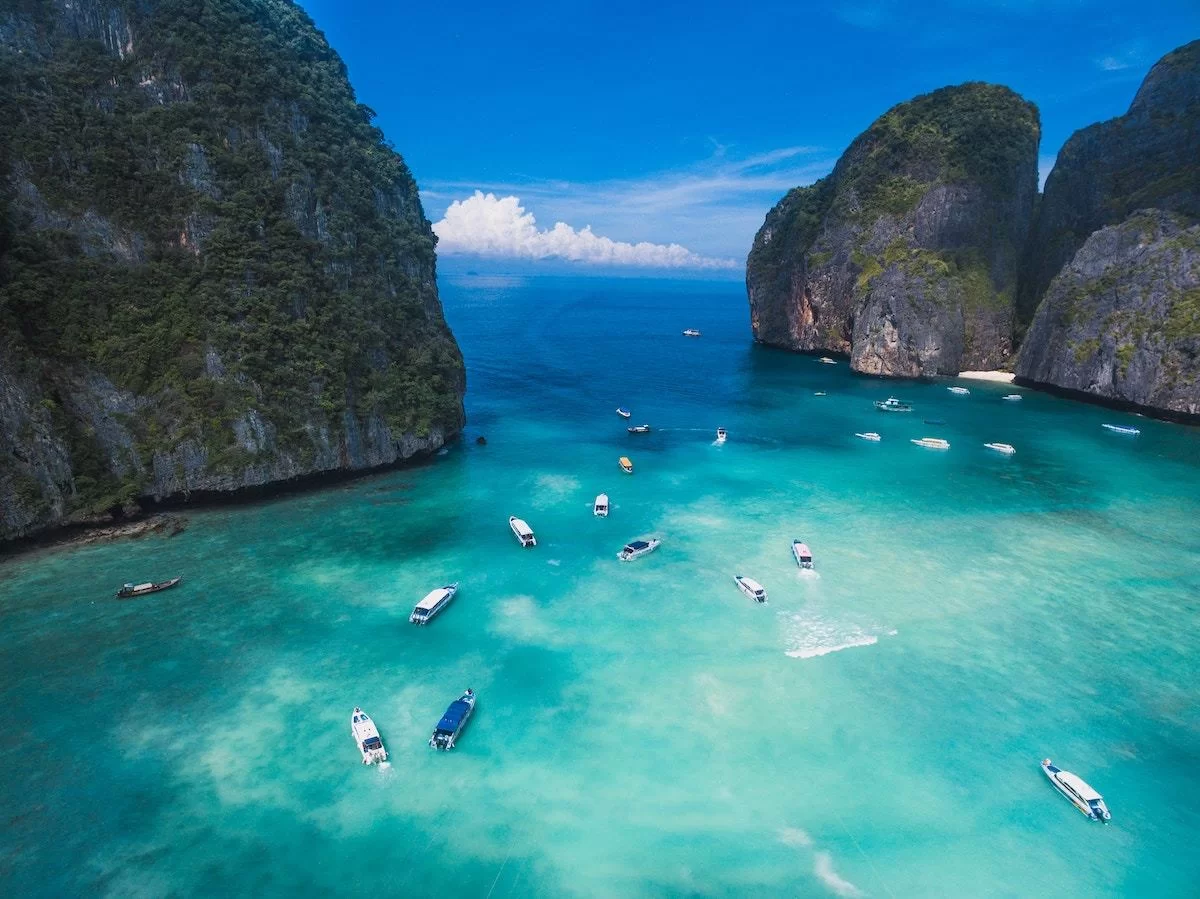
Thailand’s Andaman Sea coastline delivers the limestone karst island formations, turquoise marine environments, and white sand beach settings that define Southeast Asia’s coastal visual identity in international cinema. Krabi’s Railay Beach, accessible only by boat, provides a setting completely insulated from road traffic and commercial development — the visual isolation that productions requiring pristine beach environments need, within a permit framework managed by the Krabi provincial authority and the marine national park administration. Koh Phi Phi Leh — the island that The Beach made internationally famous — operates under a conservation permit framework that controls commercial filming access in response to the environmental damage caused by that production. Current access for international productions requires advance application to the Krabi Marine National Park authority with conservation impact assessment documentation.
Phuket provides the Andaman coastline’s production infrastructure anchor — international hotel accommodation, established helicopter and drone operations through Phuket-based operators, marine charter services for boat-access filming, and underwater production capability through dive operators with professional production experience. The combination of Phuket’s logistics base with Krabi’s dramatic limestone environment and the outer island chain’s marine environments gives international productions access to the full Andaman visual register within a single operational base.

Thailand’s BOI Film Incentive and Production Permit Framework
Thailand’s financial case for international productions rests on two foundations that work together rather than independently — a cost structure that consistently delivers 40-55% below Western European equivalents across every below-the-line budget category, and a BOI incentive framework that adds structured financial support on top of that existing cost advantage for productions that engage the registration process correctly. Productions that access both layers simultaneously — competitive base costs plus BOI incentive returns — achieve production economics that make Thailand straightforwardly the most financially efficient large-scale production environment in Southeast Asia for shoots requiring the territory’s specific visual range.
How the BOI Incentive Framework Works for International Productions
Thailand’s Board of Investment administers incentive support for qualifying international productions through a framework designed primarily around import privileges and tax structure rather than the direct cash rebate model that Jordan’s RFC, Portugal’s FICA, or Malaysia’s FIMI operate. The distinction matters financially — BOI incentives do not return a percentage of qualifying spend in cash after wrap, they reduce the cost of producing in Thailand by eliminating import duties on professional production equipment and providing corporate income tax exemptions for BOI-registered production entities operating in Thailand.
The import duty exemption is the most immediately tangible BOI benefit for international productions. Professional film production equipment — cameras, lenses, lighting, grip, sound equipment, drone systems — brought into Thailand temporarily for an approved production enters duty-free when the production is BOI-registered and the equipment is declared through the correct temporary importation procedure. For large-scale productions bringing significant equipment from their home country rather than sourcing entirely from Bangkok rental houses, the duty saving is material. Equipment with a declared value of $500,000 USD entering Thailand at the standard duty rate of 15-30% would attract $75,000-150,000 in import costs without BOI registration. BOI registration eliminates this cost entirely for qualifying productions.
VAT Refund, Tax Exemptions and BOI Registration Timeline
The corporate income tax exemption applies to the Thai production service company or production entity established to execute the shoot — an exemption period of three to eight years depending on the BOI promotion category under which the production qualifies. For productions operating in Thailand on a project basis rather than establishing a permanent entity, the more relevant BOI benefit is the VAT refund mechanism for qualifying production expenditure. Engage a Thailand-based production coordinator experienced with BOI registration early in pre-production — the registration must be completed before principal photography begins and the application process has documentation requirements that take four to six weeks to assemble correctly.

Thailand’s Permit System — Film Office, Local Authorities and Restricted Zones
The Thailand Film Office — operating under the Department of Tourism and within the Ministry of Tourism and Sports — functions as Thailand’s national filming facilitation body for international productions. Its role is advisory and facilitative rather than permit-issuing — the Film Office does not issue location permits but provides letters of support and introductions to the relevant local authorities, national park administrations, and special zone managers that actually control location access. International productions that engage the Film Office at the start of their Thailand pre-production consistently access permit authorities more effectively than those that approach local authorities without the Film Office introduction.
National Parks, Marine Zones and Restricted Location Permits
Location-specific permits route through whichever authority controls the relevant environment. Bangkok street filming requires coordination with the Bangkok Metropolitan Administration’s events division for public space access and with district offices for specific neighbourhood shooting. National park locations — Khao Yai, Doi Inthanon, Erawan, Kanchanaburi’s forest environments — require permits from the Department of National Parks, Wildlife, and Plant Conservation, which imposes crew size limits, equipment restrictions, and operating hour constraints that productions must design around rather than negotiate away. Marine national park locations — including the Similan and Surin Islands, Koh Phi Phi Leh, Ang Thong Marine Park — require permits from the Marine National Parks division with specific restrictions on commercial filming that distinguish them from the mainland national park permit framework.
Multi-Authority Permitting Framework and Location Access Constraints in Thailand
Restricted zones that require special permission beyond standard location permits include royal palace grounds and their environs — any filming that includes palace architecture in the foreground requires Bureau of the Royal Household approval on a sequence-by-sequence basis — and military installations of any kind, including historical military sites and active facilities. Religious sites under temple jurisdiction — wat premises — require permission from the specific temple administration rather than any central authority, and the terms of access vary significantly between temples depending on their relationship with international film production.
Download the Cambodia filming checklist — choosing between Thailand, Vietnam and Laos — covering how Thailand’s permit framework, BOI incentive structure and production infrastructure compare against Vietnam and Laos for productions evaluating Southeast Asia corridor options.
The production services Asia framework covers how Thailand’s permit and BOI registration system connects to the broader Asia corridor production architecture — including how productions combining Thailand sequences with India, Philippines, or Malaysia territory work manage parallel permit tracks and BOI equivalent registration processes across multiple Asian territories simultaneously.
Line Producer Thailand — Crew, Equipment and Production Infrastructure
The line producer Thailand function operates within a production services ecosystem that has been built to international standard through sustained international production demand rather than aspirational development. The distinction is operational — Thailand’s crew market, equipment rental infrastructure, and production logistics systems have been tested by productions with genuine international delivery requirements, aggressive shooting schedules, and technical specifications that domestic Thai production cannot always match. The gaps and strengths in the ecosystem are known rather than speculative, which means a line producer with Thailand experience can tell a production exactly what it can access locally and where it needs to supplement from Bangkok import or international sourcing before pre-production begins.
Thai Crew Market — Departments, Rate Cards and International Experience
Camera departments in Bangkok operate at international technical standard across the current generation of cinema acquisition systems — ARRI Alexa 35 and Mini LF, RED Monstro and Raptor, Sony Venice 2 — with crew members who have worked on Netflix originals, Amazon Prime Video productions, and major studio features as both primary units and additional units. HOD-level camera crew — DoPs, camera operators, focus pullers — who have worked the Thailand-based sequences of international productions bring the workflow fluency that prevents the friction that first-time international crew members working in a new market introduce into shooting schedules. Below-HOD departments are deep enough in Bangkok to support multi-unit simultaneous shooting without the crew shortage ceiling that limits multi-unit production in smaller Southeast Asian markets.
Art Direction, Stunt Coordination and Crew Rate Structure
Art direction and production design is where Thailand’s sustained international production history is most visible in the crew market. Set dressers, prop buyers, construction coordinators, and standby art directors who have built period environments, contemporary interiors, and large-scale practical sets for international features bring material sourcing knowledge — where to find specific historical artefacts, how to source particular architectural salvage, which fabricators can execute specific build requirements at international standard — that cannot be acquired through training alone and that takes years of international production exposure to develop. This accumulated knowledge significantly reduces the production design research and sourcing overhead that productions face when working in a territory for the first time.
Stunt Coordination, Safety Protocols and Crew Day Rates
Stunt coordination in Thailand operates as an established specialisation with international film industry credentials rather than a capability borrowed from martial arts or sports disciplines. Vehicle work, aerial rigging, water sequences, fire gags, and fall work are all represented within Thailand’s stunt community at levels that satisfy the safety certification and experience documentation requirements of international completion bond underwriters and studio safety departments. Thai stunt coordinators have worked alongside Hollywood stunt departments on major studio productions, which means their safety protocols, documentation practices, and emergency response planning align with the international standard that bond companies assess during pre-production safety reviews. Crew day rates across all departments sit at 40-55% below equivalent Western European rates — with Bangkok HOD rates at the higher end of the regional range and below-the-line crew in Chiang Mai and regional locations sitting 15-25% below Bangkok equivalent rates.

Equipment Rental, Studios and Post-Production in Thailand
Bangkok’s equipment rental infrastructure covers current-generation cinema acquisition systems, full grip and lighting packages at international specification, and speciality equipment categories that smaller Southeast Asian markets cannot supply locally. Camera rental houses in Bangkok maintain ARRI, RED, and Sony Venice inventory with associated lens sets covering spherical and anamorphic glass from Cooke, Zeiss, Leica, and Panavision — supply depth sufficient for multi-camera international features without the lead time and import logistics that equivalent equipment supply in the Philippines or Vietnam would require. Lighting and grip packages covering LED, HMI, and tungsten systems at feature film scale, dolly and crane inventory including Technocrane and remote head systems, and specialised underwater housing packages for the Andaman Sea and Gulf of Thailand marine shooting environments are all available from Bangkok-based rental houses with established international client relationships.
Studios, Post-Production and Regional Equipment Access
Studio infrastructure in Thailand is concentrated in Bangkok — RS Film Studio and GTH Studio represent the territory’s largest controlled production environments — with soundstage capacity suited to large-scale set builds and controlled lighting environments for productions that need interior flexibility alongside Thailand’s exterior location range. Phuket has developed a secondary studio infrastructure serving the advertising and commercial production market that shoots year-round on the Andaman coast, providing controlled interior environments for the commercial production community that bases operations on the island during peak season.
Post-production in Thailand has developed significantly through the animation and VFX industry that emerged alongside the international feature film production sector. Digital intermediates, colour grading, and visual effects work for productions shooting in Thailand can be completed within the territory at international delivery standard for major streaming platforms and theatrical distribution. The Asia film production corridor network connects Thailand’s post-production capabilities to the broader corridor architecture — including co-post arrangements between Thailand facilities and Japanese, Korean, and Indian post-production houses for productions executing across multiple Asian territories.
The filming compliance for international productions framework covers how Thailand’s crew documentation requirements — work permit obligations for international crew, equipment carnet procedures, and VAT compliance for production expenditure — integrate into the broader compliance architecture that international productions must maintain across Asian territory shoots.

Planning a Thailand Production — Seasons, Logistics and Line Producer Engagement
Thailand’s production calendar is governed by a three-season weather cycle that affects different regions of the country differently — and the critical planning insight is that the Gulf of Thailand coast and the Andaman Sea coast operate on opposite monsoon cycles, meaning that a production planning to use both eastern and western coastlines in the same schedule needs to understand that the weather window that favours one may be unfavourable for the other.
The cool dry season running from November through February is Thailand’s primary international production window. Temperatures across the country sit between 18 and 32 degrees Celsius depending on region and altitude. Humidity is manageable across most shooting environments. Rain is minimal across both coastlines and the central plains. The northern highland environments are at their clearest — Doi Suthep and the Chiang Mai mountain corridor produce the crisp light that makes aerial and landscape photography there look distinctly different from the hazy conditions that prevail during the hot season. This is the window when large-scale international productions schedule their principal photography in Thailand, which means crew availability tightens from late November through January as multiple productions compete for the same experienced HOD pool.
Hot Season, Andaman Coast and Gulf of Thailand Windows
The hot season from March through May brings temperatures that reach 38-42 degrees Celsius in Bangkok and the central plains — conditions that reduce crew productivity during midday hours, require additional cooling infrastructure for equipment and cast, and make certain exterior environments physically demanding to shoot in. The compensation is that the Andaman Sea coastline — Phuket, Krabi, Koh Phi Phi — is at its clearest and calmest during this period. Andaman diving visibility peaks in March and April, underwater filming conditions are at their best, and the sea surface is typically flat enough for boat-based filming without the motion disruption that wind chop introduces. Productions planning significant Andaman marine sequences sometimes deliberately schedule during the hot season to access these optimal water conditions despite the mainland temperature challenge.
Best Shooting Seasons and Weather Windows for Thailand Productions
The monsoon season divides across the two coastlines in a pattern that creates genuine production planning complexity. The Gulf of Thailand coast — Koh Samui, Koh Phangan, Koh Tao, the coastal strip of Surat Thani — receives its heaviest rainfall from October through December, which falls within what is otherwise the cool dry season on the Andaman side. A production combining Gulf of Thailand island sequences with Andaman coast sequences cannot assume that a single seasonal window favours both. The line producer maps the shoot geography against the relevant coastal monsoon cycle rather than applying a single Thailand weather assessment to the entire schedule.
Bangkok, Chiang Mai and Shoulder Season Considerations
Bangkok itself sits in the central plains and receives monsoon rainfall from May through October — the wettest months being August, September, and October when flash flooding of the city’s drainage-limited street system is a genuine logistical risk for productions with outdoor urban sequences. The line producer’s Bangkok pre-production includes flood risk assessment for scheduled exterior locations and contingency planning for covered or elevated alternative environments when the wet season forecast warrants it. Chiang Mai’s wet season runs slightly earlier — May through September — with rainfall concentrated in afternoon and evening hours, which allows morning shooting windows to proceed reliably even during the monsoon period if the schedule is designed around the precipitation pattern.
The shoulder seasons — March to May and October to November — offer the advantage of reduced crew competition and lower accommodation rates against the disadvantage of less predictable conditions. Productions with flexible timelines that can absorb a weather contingency day or two access these periods at meaningfully lower costs across accommodation, transport, and some vendor categories that peak-season demand inflates.

How to Engage a Line Producer for Thailand Shoots
The line producer engagement for a Thailand shoot covers eight operational areas that run in parallel from the point of territory confirmation: BOI registration initiation, Film Office introduction letter, permit track management across all locations in the schedule, crew sourcing and deal memo management across all departments, equipment rental confirmation and equipment carnet coordination for any internationally arriving gear, accommodation blocking for international crew, visa coordination for all non-Thai crew members, and the shoot-day logistics infrastructure — transport, catering, base camp, crowd management — that keeps the production on schedule through location transitions.
BOI Registration, Crew Sourcing and Shoot Day Logistics
BOI registration must be the first pre-production task initiated after territory confirmation — the application takes four to six weeks to process and the registration must be in place before cameras roll for the import duty exemptions and VAT refund mechanisms to apply. Productions that initiate BOI registration late lose the incentive benefits for the equipment and early vendor spend that occurs before the registration completes. The line producer manages the BOI application documentation — production company credentials, project brief, shooting schedule, Thai service company registration — as a day-one pre-production task running in parallel with location scouting and crew sourcing rather than as an administrative step completed after creative decisions are finalised.
Crew sourcing for international productions in Thailand benefits from the line producer’s existing crew relationships rather than open market recruitment. The HOD pool in Bangkok that has international production credits is not large relative to the overall Thai production workforce — it numbers in the hundreds rather than thousands across all departments. A line producer who has worked with these crew members on previous international productions can confirm their availability, verify their current technical standard, and structure deal memos that reflect international delivery requirements without the negotiation friction that cold engagement introduces. The film production services framework covers how Thailand line production engagement connects to the broader international production services architecture — including how Thailand shoots within multi-territory Asia corridor movements are managed from a single operational layer rather than as isolated territory engagements.
Conclusion
Thailand’s position as Southeast Asia’s primary international production hub rests on a combination that no other single territory in the region currently replicates — operational infrastructure built through three decades of sustained international production, a visual range spanning six distinct urban registers in Bangkok alone through northern highland terrain to two separate coastlines with different marine and island environments, a BOI incentive framework that reduces equipment import costs and provides tax structure advantages for qualifying productions, and a crew and equipment ecosystem that has been tested by international delivery requirements at a scale that confirms its capability rather than assuming it.
The line producer function in Thailand converts this combination into an executable production plan — mapping the shooting schedule against the correct seasonal windows for each regional environment, initiating BOI registration and Film Office engagement as the first pre-production tracks, managing the parallel permit applications across national park, marine, heritage, and municipal authorities that Thailand’s diverse location range requires, and deploying the crew and equipment relationships that allow a Thailand production to access the territory’s full capability without the friction of establishing those relationships from scratch.
For productions evaluating Southeast Asia as a primary or secondary shooting territory — whether for feature film, OTT originals, commercial campaigns, or documentary production — Thailand consistently delivers the most complete combination of visual range, operational infrastructure, financial competitiveness, and international production experience that the region offers at any scale from single-unit commercial shoots to multi-unit studio features.
