
Africa is not one film market but a group of very different ones, and the first job of a line producer Africa desk is choosing the right territory before running the shoot inside it. We hold the budget, schedule, contracts and cross-border logistics, while film fixers in Africa coordinate locations, permits and local access on the ground, so an incoming feature, series, documentary or commercial runs on one plan from Morocco’s deserts to South Africa’s studios and Kenya’s savannah. Across the territories covered here, crew and location costs can be competitive with Europe or North America, but imported equipment, remote access, wildlife controls and cross-border moves can erase that advantage, so countries are compared on net production cost and execution risk, not on a continental average.
This hub covers the African territories currently supported through the Global Producers network: Morocco, Egypt and Tunisia in North Africa, Kenya in East Africa, and South Africa and Mozambique in Southern Africa. It is not intended as a directory of every African film market. The country pages hold the detail on crew depth, permit authorities, incentive rules and current costs, market by market. This hub makes the first decision: which territory delivers the required look and budget, and how the production legs fit together when more than one country is involved.

What a Line Producer Africa Desk Coordinates
Territory Selection and the Anchor Country
The work starts with the decision the brief usually leaves open: which African territory actually delivers the look, the crew depth and the budget the production needs. That choice drives everything after it, because it changes the incentive on offer, the permit authority, the equipment-import route and the size of the local crew available without flying people in. A shoot that could go to South Africa for studio depth, Morocco for desert and studios, or Kenya for wildlife is three different budgets and three different schedules, so naming the anchor country early is what sets a realistic budget and schedule. Additional territories are added only where a specific sequence genuinely requires it, which keeps the permit, incentive and logistics load proportionate to the film.
Cross-Border Budgets, Crew and Equipment
From there it is familiar production carried across borders. One master budget in the financing currency, reconciled as the shoot moves between territories and reported to financiers on one consistent basis; a schedule built around company moves, visa lead times and each authority’s permit calendar rather than map distance; and contracting validated against the specific labour, tax and insurance rules of the country where the work is actually done. That single line of control sits with the regional producer, while local fixers run scouting, authority liaison, property access and the daily field requirements in each market.
Equipment and people move differently in Africa than within a single European bloc. Camera and grip packages travel on an ATA Carnet where the destination country accepts one, and on a country-specific temporary-import procedure where it does not, so the customs route is confirmed per border rather than assumed. Crew visas and work authorisation are planned the same way, country by country. A locally registered or licensed film agent, representative or production-services company may be required in some territories and not in others, and that requirement is checked against each country the shoot touches rather than assumed continent-wide.
Choosing an African Territory by Production Brief
In practice the six supported territories sort into fairly clear choices by production brief. The table below compares them on the terms that actually decide a shoot, best production use, operating base, crew and equipment depth, permit characteristic and incentive position, with the detailed rates and processes held on each country page.
| Territory | Best production use | Operating base | Crew & equipment depth | Permit characteristic | Incentive position |
|---|---|---|---|---|---|
| Morocco | Period, desert and studio-backed epics | Ouarzazate / Marrakech | Deep; local HODs, extras and desert units | CCM-routed; heritage and desert permits | National cash rebate via the CCM |
| Egypt | Ancient world, the Nile and Cairo density | Cairo / EMPC | Substantial; strong on large historicals | EFC single coordination channel; antiquities access gates the schedule | Cash-rebate route via the EMPC |
| Tunisia | Compact Roman and Saharan doubles | Tunis / the south | Leaner than Morocco; regional crew for scale | CNCI-routed; site-specific desert permits | No automatic national cash rebate; support is project-specific |
| Kenya | Wildlife, savannah and highland adventure | Nairobi | Deepest in East Africa; imports for scale | KFCB filming licence via a registered film agent; conservation-area rules | No established running cash rebate yet |
| South Africa | Studio depth and the widest doubling range | Cape Town / Johannesburg | Deepest of the six; studio-standard | Provincial and city permits; well-mapped | dtic incentive, 25% of qualifying spend (conditions apply) |
| Mozambique | Indian Ocean coast, islands and a remote look | Maputo / the coast | Smaller; regional supplementation may be required | INICC licence with a local producer; coastal and island access | No dedicated film cash rebate |
Most productions settle on one of these as the anchor and add a second only where a specific sequence requires it. Which one leads depends entirely on the brief: studio depth and doubling range point to South Africa, desert and heritage scale to Morocco, the ancient world and the Nile to Egypt, compact Roman and Saharan geography to Tunisia, wildlife and highland adventure to Kenya, and Indian Ocean coast and islands to Mozambique.
North Africa: Morocco, Egypt and Tunisia
North Africa is one of the continent’s most established international-production corridors, built on decades of large-scale foreign work and a landscape that doubles for ancient-world, Middle Eastern and other arid historical settings. Among the three, Morocco carries the deepest infrastructure, Egypt the strongest heritage access, and Tunisia the leanest cost base.
Morocco: Studios, Desert and Heritage Scale
Morocco pairs a deep studio and crew base around Ouarzazate and Marrakech with a national cash rebate administered by the Centre Cinématographique Marocain and desert, kasbah, coast and mountain locations. It has carried decades of studio features from Lawrence of Arabia through Gladiator, Kingdom of Heaven and the Essaouira sequences of Game of Thrones, and that accumulated depth means heads of department, extras, horses, armourers and desert logistics can generally be sourced from the established local production market. The specifics sit with our film fixers in Morocco.

Egypt: Nile, Cairo and Antiquities Access
Egypt offers what the corridor’s other markets cannot match on heritage: the pyramids, the Nile, Cairo’s density and the open Western Desert. The Egypt Film Commission is the sole coordination channel for foreign-filming approvals, working with the relevant defence, interior, antiquities and customs authorities, with a cash-rebate route tied to the Egyptian Media Production City. Heritage and antiquities access is the variable that defines an Egyptian schedule, and our film fixers in Egypt coordinate that access on the ground.

Tunisia: Compact Roman and Saharan Geography
Tunisia completes the corridor with a compact geography and a low cost base. Its Roman amphitheatre at El Djem, the Saharan ksour and cave dwellings of the south used for Star Wars, and the desert and oasis landscapes that carried The English Patient run through the Centre National du Cinéma et de l’Image, where film fixers in Tunisia coordinate location access, desert logistics and the permits each site carries. Larger or specialist units may require additional regional crew, depending on the production scale and technical brief.
Productions continuing from Morocco, Egypt or Tunisia into Jordan or the Gulf should use the MENA line producer hub for the cross-region execution framework.
East Africa: Kenya and the Nairobi Base
East Africa is a different proposition again, and Nairobi is its practical base. The city carries the region’s deepest crew market, equipment houses and international air links, and from it a production reaches the Rift Valley, the savannah and wildlife of the Maasai Mara and Amboseli, the highlands, and the Indian Ocean coast around Mombasa and Diani. It is the natural anchor for wildlife, adventure and landscape-led work, with a long screen history from Out of Africa to The Constant Gardener and a continuous run of natural-history production.

Filming licences are issued by the Kenya Film Classification Board under the Films and Stage Plays Act, with foreign productions facilitated through a registered film agent; the Kenya Film Commission promotes the industry and the destination but is not the licensing authority. A national cash-rebate scheme has been discussed but is not yet an established, running programme, so a shoot is modelled on the cost base and the logistics rather than an assumed percentage back. Location access runs through county and national authorities and, for wildlife and protected areas, the relevant conservation bodies, whose rules on vehicle numbers, distance from animals and off-road movement shape a schedule as much as any permit. Our Line Producer Nairobi page covers that base and the wildlife-permit sequencing that defines a Kenyan shoot.
Southern Africa: South Africa and Mozambique
South Africa: Crew, Studios and Doubling Range
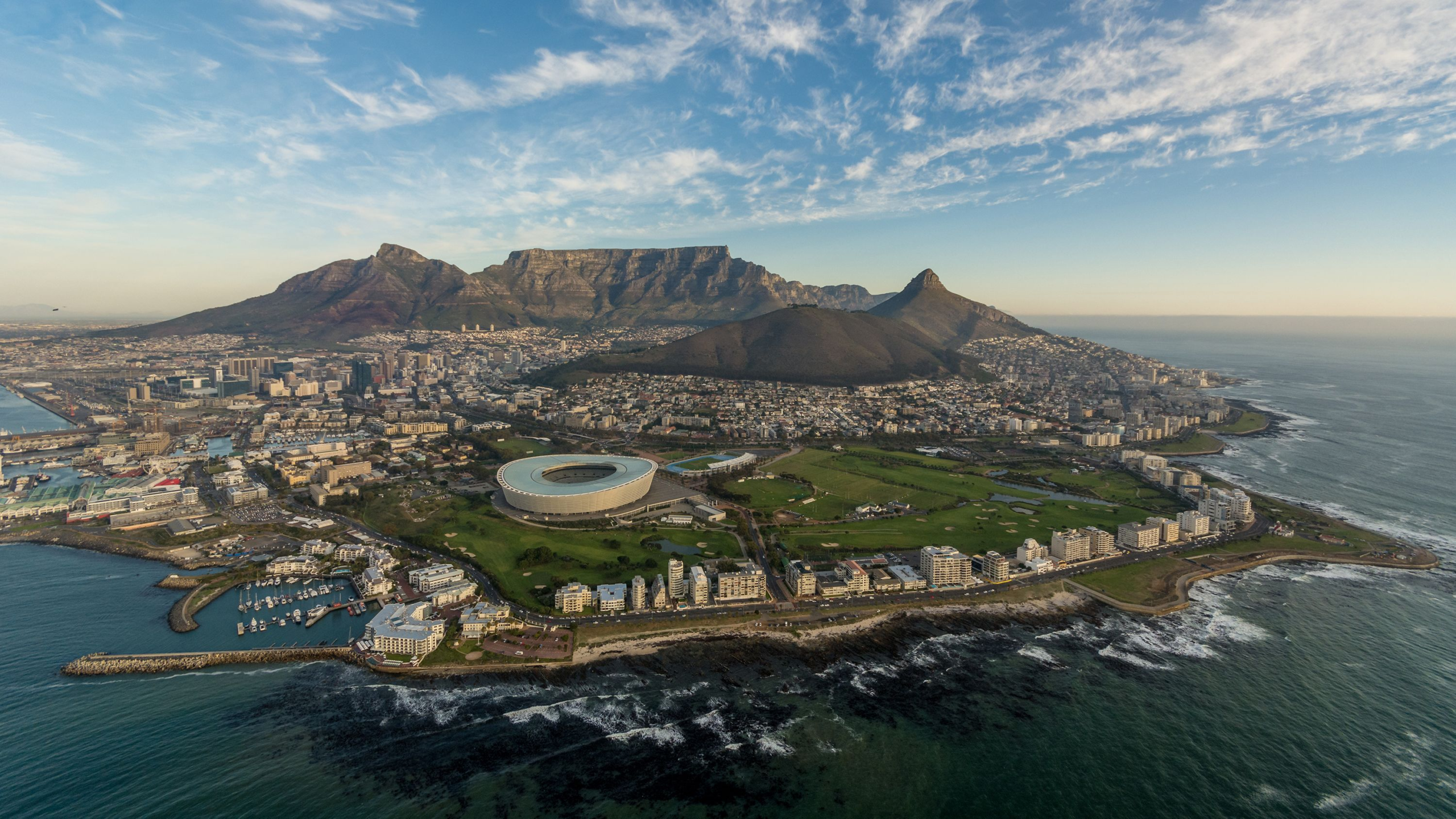
South Africa carries the most production infrastructure of the six territories here. Cape Town in particular offers a mature crew market, purpose-built studios, full equipment depth and a location range from Atlantic coastline and mountains to the Karoo interior, the winelands and city environments that double for Europe and North America, most of it within a working day of the city. Decades of international features, series and high-end commercials have produced a workforce able to crew most productions locally, with regional supplementation considered for the largest multi-unit shows.
The Department of Trade, Industry and Competition administers the Foreign Film and Television Production and Post-Production Incentive, calculated at 25% of qualifying South African production expenditure with defined caps and conditions; eligibility, approval and payment timing are confirmed against the current programme before the incentive is treated as production finance. The South African base is covered in full on our line producer Cape Town page.

Mozambique: Coast, Islands and Remote Logistics
Mozambique sits to the north-east and adds what South Africa cannot: a long Indian Ocean coastline, the Quirimbas and Bazaruto archipelagos, and the restored wildlife of Gorongosa. Its framework is administered through the national institute INICC under the Audiovisual and Cinema Law and its 2024 regulations, with no dedicated film cash rebate to model and a smaller local crew base that may require regional supplementation on larger or specialist productions. The case for shooting there is the location and the cost base rather than an incentive cheque, and island and remote-coast work carries its own freight, boat-transfer and accommodation logistics. Our line producer Mozambique page covers the permits, crew and coastal logistics in detail.

Crew, Equipment and Cost Control Across Africa
Crew depth is where these territories separate most sharply. South Africa has the deepest, most self-sufficient market of the six, followed by the North African corridor around Morocco, Cairo and Tunis and the East African base in Nairobi, each able to crew mid-scale work locally while larger multi-unit shows supplement from South Africa or Europe. English is the working production language in South Africa and Kenya and is widely used at head-of-department level in the North African hubs, while French and Arabic carry much of the day-to-day in the Maghreb, so the communication mix is confirmed against the specific unit rather than assumed.

Equipment follows the crew: full camera, lighting and grip houses in Cape Town, Johannesburg, Marrakech, Cairo and Nairobi, with lighter provincial and island markets served from those hubs on the same freight-and-transfer logic that governs any remote shoot. Costs can be competitive with Europe and North America across these territories, but the advantage is not uniform and is easily eroded: imported kit and crew, currency exposure between the financing and local currencies, remote or marine access, wildlife controls and cross-border moves all move the real number. The figure that matters is net production cost against execution risk for the specific country, and those figures live on each country page rather than as a single continental average.
Incentives, Permits and Compliance
There is no continent-wide African incentive, and the terms differ significantly from one country to the next. South Africa runs the dtic Foreign Film and Television Production and Post-Production Incentive at 25% of qualifying expenditure; Morocco offers a national cash rebate through the CCM; Egypt’s cash-rebate route runs via the Egyptian Media Production City alongside the Egypt Film Commission; Tunisia has no automatic national cash rebate, with tax treatment and any public support project-specific; Mozambique has no dedicated film rebate; and Kenya’s framework is still developing with no established running scheme. The incentive question is therefore answered country by country, and the current rates, caps and eligibility for each sit on that country’s own page.

Permit, Customs and Local-Representation Routes
Permits follow the same logic. Every country here issues location permissions through its own national and local authorities, with separate routes for heritage sites, protected and wildlife areas, coastlines, cities and controlled locations, none of them interchangeable across borders. Equipment clears on an ATA Carnet where the destination accepts one and on a local temporary-import procedure where it does not, and a locally registered agent or service-company structure is required in some territories and not in others. Mapping those requirements against the schedule, in each country the shoot touches, is the core of what a regional producer adds beyond arranging crew and locations.
Because the picture changes country to country and, in several markets, year to year, the discipline is to confirm the current position against each authority at budgeting rather than carry an assumption from a previous shoot. A rate, a processing time or a registration requirement that held in one territory last season is not evidence for the next, and the plan is built on what each country confirms now.
Seasons, Terrain and Company Moves
These are broad planning windows, not fixed production calendars; the final allowance must be checked against the specific location and current seasonal conditions. Season and terrain still have to be planned as hard constraints rather than preferences, because the territories here sit in different climatic zones and their best shooting windows do not line up. The desert regions of Morocco and southern Tunisia, together with Egypt’s Western Desert, are generally most workable in spring and autumn, with midsummer heat limiting daytime hours and midwinter shortening usable light, while Cairo and the Nile corridor extend a little further into the shoulder seasons. Kenya’s schedule is built around two rainy seasons, the long rains around March to May and the short rains around November, with the dry months delivering the reliable light and passable tracks that wildlife and savannah work depends on.
South Africa runs opposite the northern hemisphere, so its long dry Western Cape summer, roughly November to March, is both its peak location window and its busiest, most competitive crewing period. Mozambique’s coast carries a tropical wet season and cyclone risk from about November to April that governs when island and remote-coast units can safely operate.
Terrain and Cross-Border Company Moves
Terrain then decides how a day actually runs. Desert, wildlife reserve, island and mountain locations each carry their own access, safety and logistics load, from convoy and fuel planning in the Sahara to vehicle and distance rules in Kenyan conservancies and boat-transfer windows off the Mozambican coast, and none of it is interchangeable between countries. Company moves compound the effect. A move between Marrakech and Ouarzazate remains inside one national permit and customs regime, whereas adding an East or Southern African country introduces a fresh visa timeline, equipment-import route and permit authority. The practical rule is to anchor the shoot in one territory’s prime season and sequence additional legs so weather, customs and permit risks are managed separately rather than compounded.
Engaging a Line Producer Africa Desk
A production plan for Africa is built around one anchor country, with each additional territory treated as a separate leg carrying its own permit calendar, incentive position, customs route and visa timeline, so a two- or three-country shoot runs as a sequence of planned hand-offs rather than improvised border crossings.
Global Producers’ line producer and film-fixer network holds those elements under one budget and one schedule, with the country-level crew, permit, incentive and cost detail routed to each territory’s own page. For an initial plan, provide the script or treatment, the proposed countries and dates, a location brief, crew size and equipment origin, and any wildlife, heritage, aerial, marine or desert requirements, so the permit sequence and preliminary budget can be mapped before dates are committed.
