
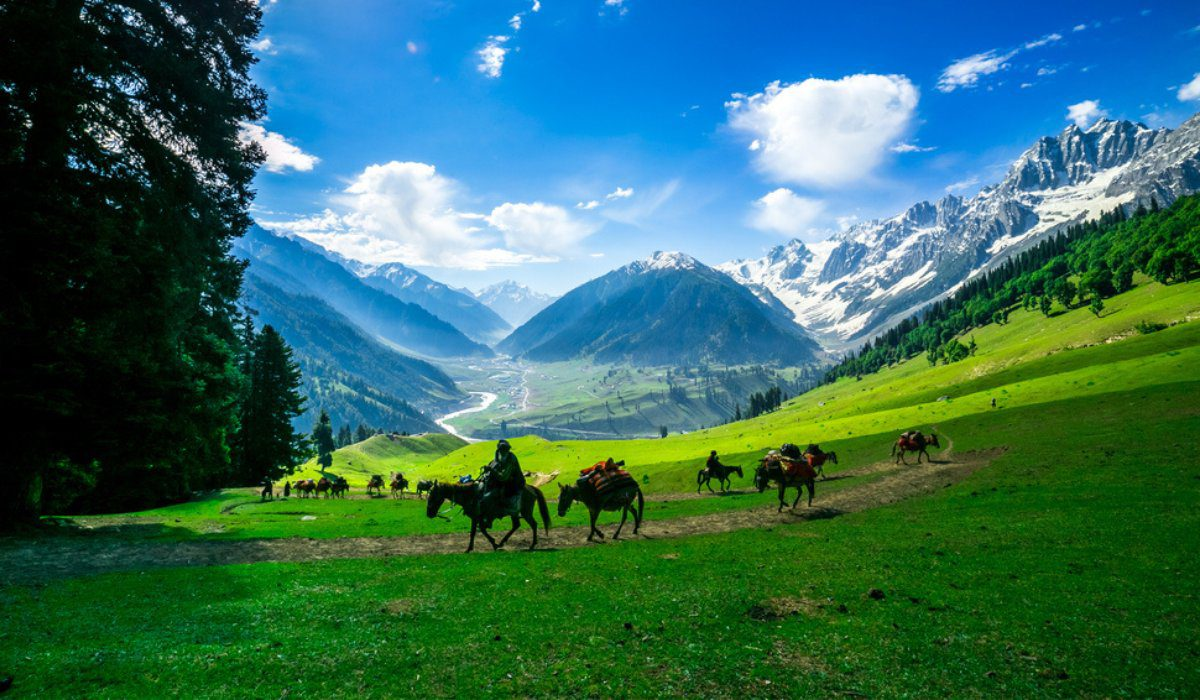
Using Kashmir as a stand-in for Switzerland is one of Hindi cinema’s oldest location strategies. Long before productions could reach the real Alps, Kashmir was the industry’s Switzerland: the ski meadows above Gulmarg, the river valleys around Pahalgam and the gardens along Dal Lake carried decades of songs that were meant to read as central Europe. The valley earned the epithet “the Switzerland of India,” and for a run of films from the 1960s onward it did the job that Interlaken and Tyrol would later be paid to do.
That history is specific, not sentimental. Kashmir Ki Kali placed Shammi Kapoor against Srinagar and its gardens in 1964; Bobby put its most famous song in a Gulmarg hut in 1973; the 1983 romance Betaab shot a valley near Pahalgam so memorably that the spot was renamed Betaab Valley. When militancy sharply reduced filming in the valley from the late 1980s, the look did not disappear so much as relocate. Yash Chopra took the same snow-meadow-and-chalet register to actual Switzerland and northern Europe, and a generation of audiences learned to read it as the Alps rather than as Kashmir.
With the valley filmable again, the equivalence is worth revisiting on its merits rather than its nostalgia. The useful questions are practical: which Kashmir locations genuinely read as which European settings, in which months each look is available, what the permit and access reality is, and what the trade actually costs when set against a Schengen shoot. This guide answers those questions and leaves the commercial execution to the dedicated Kashmir production desk.

Which Kashmir Locations Read as Which European Looks
The valley is not one look but several, and each substitutes for a different European register rather than a single generic “Alps.” Getting the match right is the whole game: a location that reads as an Austrian foothill in June will not read as a Swiss ski resort in the same frame, and the schedule has to respect that.
Gulmarg sits high in the Pir Panjal, with the gondola ascending above the treeline toward Apharwat Peak and the Khilanmarg meadow below it. In winter it is the ski-resort and high-alpine register; in summer the same slopes turn to open green pasture. Pahalgam and the adjoining Betaab and Aru valleys, threaded by the Lidder river, give the wooded river-valley look that reads as the Austrian or Swiss foothills. Sonamarg, higher up toward the Zoji La, adds the glacier-meadow register near the Thajiwas glacier. Down in the valley, Dal Lake, the shikaras and the Mughal gardens of Nishat and Shalimar give a lakeside-and-formal-garden look that is closer to central Europe than to the high mountains. Yusmarg and Doodhpathri, quieter and west of the main circuit, carry the rolling-meadow, Sound-of-Music register. The table maps the substitution honestly, listing only films whose Kashmir shoots are on record.
Kashmir Location and Season Map
| Kashmir location | European look it reads as | Best window | Films shot here (on record) |
|---|---|---|---|
| Gulmarg & Khilanmarg | Swiss ski resort and high-alpine winter | Dec–Mar (snow), Jun–Sep (green) | Bobby (1973) |
| Pahalgam & Betaab Valley | Austrian / Swiss-foothill river valleys | May–Oct | Betaab (1983), Haider (2014) |
| Aru & Sonamarg | Green alpine pasture and glacier meadow | May–Sep | Bajrangi Bhaijaan (2015) |
| Srinagar, Dal Lake & Mughal gardens | Central-European lakeside and formal gardens | Apr–Oct | Kashmir Ki Kali (1964), A Passage to India (1984; Srinagar) |
| Yusmarg / Doodhpathri | Rolling meadow, Sound-of-Music register | May–Sep | – |
How the Location Match Works in Practice
A dash in the last column means no verifiable shoot is recorded at that spot, not that it fails on camera. The point of the map is register, not name-dropping: match the European look you are cheating to the Kashmir valley that actually carries it, in the month that carries it, and the substitution holds.
The verified cases are instructive about how the substitution works in practice. Betaab (1983) shot its valley near Pahalgam so effectively that the location took the film’s name and is now signposted as Betaab Valley. Bajrangi Bhaijaan filmed across Pahalgam, Aru and Sonamarg, with its border climax staged at the base of Thajiwas Glacier near Sonamarg. In both cases the valley was asked to be somewhere it is not, which is exactly the discipline a European substitution needs: choose the frame that sells the look and keep the giveaways out of shot.
The record is not only a Hindi-cinema one. David Lean shot the closing stretch of A Passage to India (1984) in and around Srinagar, using the Kashmir Valley for a register that reads as neither Britain nor the plains, which is the same quality that makes the valley useful as a European substitute.

Where the European Illusion Breaks
The stand-in works until something in the frame says India, and knowing where that happens is what separates a convincing European sequence from a distracting one. The water gives Dal Lake away fastest: the shikaras and houseboats are unmistakably Kashmiri, and no amount of grading turns them into a Swiss lakefront. The Mughal gardens of Srinagar are beautiful, but their geometry and planting read as Mughal, not as a European formal garden, so they substitute for mood rather than for a specific place. At ground level the giveaways multiply: Indian road markings, utility poles, number plates, roadside signage and the texture of local traffic all pull a shot back to India the moment the camera drops from the peaks to the street.

Terrain has its own limits. Gulmarg has the alpine scale and the snow, but not the architectural density of a built-up Swiss resort, so it carries wides and skiing action better than a village street. Pahalgam supplies foothills, pine and river, but not the European village fabric of stone houses and shopfronts. Sonamarg is a strong glacier-meadow wide, yet its visitor activity and local transport betray it in anything broader than a controlled sightline. The rule that follows is simple: Kashmir sells landscape convincingly and built environment rarely, so the frame has to be chosen around what the valley genuinely gives.
Building the Alpine Frame
Because the illusion lives in the frame, the alpine match is built as much in the choices around the camera as in the location itself. The first lever is coverage: establishing and wide shots lean on Kashmir’s real strength, its landscape and scale, while medium and close work is staged with controlled sightlines that keep the identifiable elements out of shot. Restricted focal lengths and careful blocking do most of the work, isolating a chalet, a snowfield or a treeline from the road and the signage a few metres away.
Art direction carries the rest. Removing or dressing out Indian signage, utility poles, number plates and picture vehicles is routine but non-negotiable, and any chalet, ski-resort or European-road element usually has to be built or augmented rather than found. Wardrobe and picture-vehicle continuity are planned to the European reference, and where the built environment cannot be faked in-camera, licensed European establishing plates or production-owned reference plates or limited visual effects extend the world without a second unit crossing a border. The last discipline is continuity of snow and vegetation across shoot days, since a warm spell or a green-up between setups can break a sequence the edit assumes is continuous.
Read as a quick decision grid, the match and its limits line up like this.
| Creative requirement | Best Kashmir option | What works | What reveals Kashmir |
|---|---|---|---|
| Swiss ski exterior | Gulmarg / Apharwat | Snowfield, gondola, mountain scale | Resort architecture and signage |
| Austrian foothills | Pahalgam / Aru | River, pine forest, green valley | Roads and settlement texture |
| Glacier meadow | Sonamarg / Thajiwas | Snowline and open pasture | Local transport and visitor activity |
| European lake | Srinagar / Dal Lake | Water, mountain backdrop, gardens | Shikaras and houseboats |
| Rolling alpine meadow | Yusmarg / Doodhpathri | Open pasture and forest edge | Limited European built environment |
Kashmir, the Real Alps, or a Hybrid Shoot
None of this makes the choice automatic, and the honest version is a shot-list decision rather than a budget slogan. Kashmir is the right call when the brief mainly needs what it genuinely has: landscape, snow, lakes, meadows and mountain scale, carried by song, action and dialogue coverage that lives in the environment rather than in a recognisable town. It is the wrong call when the story leans on recognisable European architecture, working railways, ski-resort towns or dense road infrastructure, all of which Europe owns and Kashmir cannot convincingly fake at scale.

The middle path is a hybrid, and it is often the strongest. A small European unit or a stock-and-plate package captures the establishing architecture, the railway or the town that has to be real, while Kashmir carries the bulk of the dialogue, action and song coverage at an Indian rate base. That split plays to each side’s strength and keeps the giveaways out of the frames that would expose them. Where Kashmir stops making sense is when weather certainty, specialist mountain infrastructure or a run of recognisable European built environments are essential; at that point the valley is fighting its own limits, and the schedule is better served by Europe or a more predictable stand-in. The test, in every case, is the shot list, not a percentage.
The Cost and Access Case Against a European Shoot
The commercial argument is the Indian rate base. A Kashmir unit is crewed and priced in rupees, with no Schengen day rates and no euro exposure across the below-the-line, which is the economic advantage that historically attracted this work in the first place. What it is not is a blanket “save thirty to fifty percent” promise. The real saving depends on unit size, how much senior crew and kit have to travel up from the metros, how many days the schedule holds against weather, and whether the dates sit in peak tourist season, when accommodation tightens. The honest framing is a materially lower cost base, quantified per project rather than as a slogan.
The customs and mobility picture is conditional, and worth stating precisely rather than assuming away. India-sourced equipment avoids international temporary-import handling altogether, which is the simplest path and the reason most Kashmir units build around local and metro-sourced kit. Foreign equipment must be listed in the India Cine Hub application and cleared through the applicable ATA Carnet or Customs Exemption Letter route. India Cine Hub advises allowing at least seven working days for the exemption letter; airport release and inspection timing are confirmed separately with the customs broker. Foreign cast and crew still need the applicable Indian film visa and the India Cine Hub permission framework, not a tourist or business visa. Set against the logistics, day rates and euro base of an actual filming in Europe schedule, Kashmir trades some of that convenience for a lower cost base and fewer currency-conversion and cross-border supplier layers for an India-based production.
Seasons: When the Snow Look and the Green Look Are Available
The substitution is seasonal, and getting the window wrong is the most common way the look fails. The winter-Alps register, meaning snow meadows, ski runs and the gondola to Apharwat, is a Gulmarg shoot roughly from December to March, with January and February the most reliable months for deep, dependable powder. The green-alpine register, the Sound-of-Music meadows and the river valleys, runs from about May to October, when Pahalgam, Aru, Sonamarg and the high pastures are open, clear and in leaf.
Between those two windows, and around the shoulder weather of April and November, road access to the higher locations can close at short notice, and the pass roads toward Sonamarg and beyond are the first to shut. The valley generally receives less monsoon rain than many parts of the plains, but summer rain, cloud and changing visibility can still disrupt exterior continuity. The practical rule is that the calendar drives a Kashmir schedule far more than it drives a metro one, and the contingency days belong in the plan from the first draft.

The Honest Limits: Permits, Security and Infrastructure
Three things keep Kashmir from being a like-for-like swap for a European location, and a serious plan prices all three. Permits run through the Jammu and Kashmir single-window and the district authorities, and some zones near the Line of Control or defence installations may be restricted or unavailable for filming, so location clearance is a real step rather than a formality. Security conditions and seasonal access can change independently, and filming access has previously been suspended during periods of unrest. Treat both as schedule risks requiring current local advice, insurance review and contingency planning.
Infrastructure is the third. The trained-crew and equipment depth is thinner than a metro: units typically assemble a core in Srinagar and bring the specialist departments and heavier kit up from Mumbai or Delhi, staging through Srinagar airport. None of this rules the valley out, and it is not unusual for a hill schedule; it means the permit path, the weather contingency and the crew-and-kit plan sit in the budget from the start, not as an afterthought once the location is locked. The wider picture of how India substitutes for other parts of the world, from desert to coast, sits in our Indian stand-in locations for global settings overview.

Kashmir Versus Ladakh on Camera
Kashmir is often lumped with Ladakh, but the two do not do the same job on camera, and since 2019 they are not even the same territory: Ladakh became a separate Union Territory of Leh and Kargil on 31 October that year, administered on its own. The visual split is sharper than the administrative one. Ladakh is high-altitude desert and lunar plateau, the register for Tibet, the Silk Road and Central Asia, and it does not read as green Europe at all. Kashmir is the green, wooded, snow-fed alpine look, the one that stands in for Switzerland and Austria.

So a production weighing the two for a European sequence wants Kashmir, while the line producer Ladakh route is for the high-desert and Central-Asian briefs. Measured against the real Alps, Kashmir gives most of the look at the Indian rate base, with the access and season caveats standing in for the reliability and infrastructure an established European location would offer. For a director who can build the schedule around the weather window, that is a favourable trade; for one who cannot, Europe or a more predictable stand-in may be the safer call.
How to Shoot the Kashmir and Switzerland Look
Matched to the right valley and the right month, Kashmir still does on camera what it did for Hindi cinema for half a century. It can read as alpine Europe at an Indian cost base, provided the production can plan around the valley’s access, weather and seasonal constraints.
A convincing Kashmir-for-Europe shoot is planned from the first recce. Our line producer Kashmir desk scopes the location map, season window, permits, crew and working budget around the sequence.
