
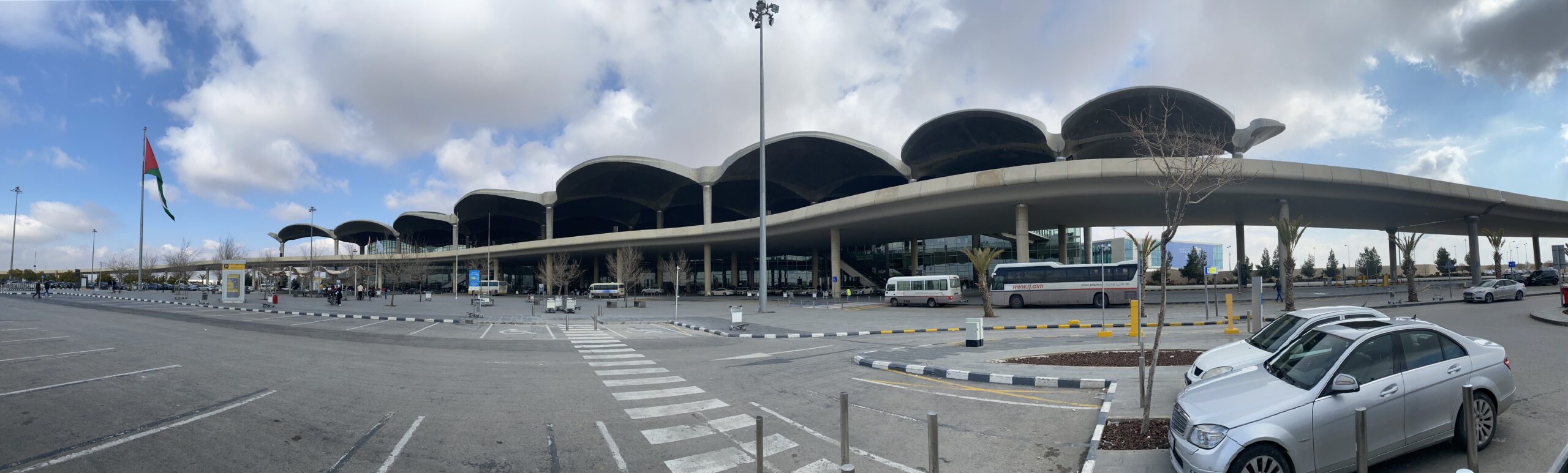
Airport filming Jordan cost at QAIA and Marka is built from office-confirmed planning allowances, airport-operator charges, security escorts, airside requirements, drone approvals and the access window approved for the production. This page owns the fee, permit-cost and lead-time comparison for those two airports.
Jordan has three commercial airport environments. King Hussein International Airport in Aqaba is covered by the companion Jordan airport filming locations guide and quoted separately against the submitted brief. That guide also compares location character, genre fit, access zones and scheduling across QAIA, Marka and Aqaba.
Our guide to Jordan’s incentives and filming-permit framework explains the national application and rebate structure.
Figures and Methodology
The figures in this guide are Global Producers’ working budget allowances, checked by our production office in September 2026 against current local quotations and on-ground airport-shoot planning. They are not published statutory tariffs or guaranteed final charges. The confirmed amount depends on the filming zones, operating hours, crew size, security requirements, aircraft involvement, equipment, aerial work and the approvals required for the individual production. Every cost line is reconfirmed in writing before the production budget is locked.
Current Airport-Filming Allowances
For preliminary budgeting, our office currently carries a filming allowance from JOD 3,000 per day at Queen Alia International Airport and from JOD 1,000 per day at Marka. These are office-confirmed production allowances rather than universal airport tariffs. Security escorts, airside access, overtime, drones, aircraft, customs and operator-specific requirements are assessed separately against the approved brief.

Filming Permits for Jordan Airports: QAIA and Marka
Filming at QAIA and Marka may involve Royal Film Commission facilitation, but operative approvals remain with the relevant airport operator, CARC, security authorities and, where applicable at Marka, the defence authority. Each cost and approval line is therefore confirmed against the submitted zones, crew, equipment and filming schedule.

How the Airport Choice Changes the Budget
Airport filming Jordan cost is not a single budget line. It breaks into the location fee, airport-operator or defence-authority clearances, security escort, and, where drones are in the brief, CARC registration and customs deposit. Productions that underbudget on airport shoots consistently do so because they plan for one number rather than four. Marka and QAIA serve categorically different production briefs. This page covers both: what each location costs, what authority coordination each requires, and what a line producer needs confirmed before either location goes live.
QAIA: live international operations mean airport-operator charges for non-public zones, mandatory security and escorts, airside clearance layers and filming windows restricted around passenger and airline schedules.
Marka: the airport operator, CARC and, for airside work, a possible defence layer. A lower starting allowance does not mean fewer approvals; the layering shifts from live-operations management to authority coordination.
Aqaba: quoted separately, because this page does not publish an Aqaba working allowance; King Hussein International Airport costs are confirmed against the submitted brief and current airport conditions.
Airport Filming Jordan Cost, QAIA
QAIA is the more expensive of the two locations. The cost structure breaks into four categories: the location fee, airport-operator charges for non-public zones, security escort, and drone-specific costs when aerial work is in the brief. Productions should budget all four simultaneously. No single permit covers every fee category, and some require direct payment to different authorities at different stages of the pre-production process.
Location Fees and Schedule
Our office currently budgets from JOD 3,000 per filming day at QAIA, approximately US$4,500 with the stated coordination layer, subject to confirmation by the relevant authority. This allowance covers site coordination, access coordination with the airport operator, and the core location permit reference. It does not cover security escort or airport-operator charges, both of which are invoiced separately by each authority.
Our current quotation carries an out-of-hours surcharge for shoot days running past 18:00 or starting before 06:00. Productions running more than five consecutive days at QAIA can, on our working allowance, often negotiate a block rate; contact is handled through the RFC location department at film.jo. Airport-operator fees apply separately for access beyond the public terminal zone: our current quotation carries airside access at JOD 200–400 per zone per day, invoiced by the operator directly and independent of the location permit total.

Security Escort Requirements
Our planning assumes at least one security escort per active camera position on every QAIA shoot day, arranged through the permit process and additive to the base location fee, subject to confirmation by the relevant authority. Our current office allowance for escorts runs USD 500–800 per escort per day for standard public-zone shoots, rising to USD 1,500–2,000 per day when airside or apron access requires airport security co-assignment.
Crew size directly affects the escort requirement. Our working allowance assumes productions over 15 crew need two escorts running simultaneously. Any equipment trolley moving between zones requires a separate zone approval, cameras and sound equipment cannot be transported unescorted between departures and arrivals even within the same terminal. Productions staging equipment overnight at QAIA between shoot days should also budget for equipment security during non-shooting hours; this can be arranged and is invoiced separately from the filming-day escort cost.

Drone Costs and CARC Registration
Aerial work at QAIA requires Civil Aviation Regulatory Commission (CARC) approval. Jordan’s drone framework applies within airport airspace at a stricter tier than standard location shoots. Our current office budget for CARC airport drone work: drone registration and filming permit runs JOD 500 (approximately USD 705) per registration period; the customs deposit for imported drone equipment is JOD 1,000 (approximately USD 1,410), refundable on re-export with countersigned airport customs documentation; daily airspace coordination runs JOD 200 (approximately USD 280) per flying day.
Our production schedule allows at least seven days for CARC airport-airspace approval. Required documentation includes drone make, model, serial number, operator certification, flight plan, and an insurance certificate meeting CARC minimum coverage thresholds. On our current filing checklist, any flight within 1.5 kilometres of the active QAIA runway also requires Air Traffic Control (ATC) notification, submitted on the production’s behalf. Productions importing drone equipment should initiate customs deposit paperwork before departure. The refund requires airport customs to countersign exit documentation, which adds a day to wrap logistics if not pre-arranged during pre-production.

Permit Process and Planning Lead Times
Our production schedule normally allows at least 10 working days from submission of a complete application, with additional time carried for airside, security, drone or defence approvals. Incomplete applications, including those missing insurance, signed crew lists or precise zone descriptions, may be returned for completion and can extend the review period. A permit reference is not released piecemeal; all elements must be confirmed before it is released to the airport operator for zone-level processing.
The permit application requires: production company registration, director and DOP identification, full crew list with passport numbers and roles, complete equipment list covering cameras, lighting, drones and production vehicles, scene descriptions mapped to each zone requested, public liability insurance meeting the minimum on our current filing checklist (JOD 1,000,000 coverage), and the signed RFC location agreement. After permit confirmation, a dedicated site coordinator is assigned as the single point of contact for all location logistics, including airport-operator zone clearances and escort scheduling.
Expedited Review and Compressed Timelines
Where the relevant authorities accept an accelerated review, our office has planned around a five-working-day window; this is not a guaranteed service period. For Marka airside work, our office plans well ahead of the shoot; our schedules currently carry an additional five to seven working days for the defence-liaison stage, subject to the submitted brief and the authorities involved. Where the sequencing allows, the line producer can request that the Marka airport-operator and defence-liaison stages run in parallel rather than back to back.
Marka Airport, Costs and Access
Marka’s cost structure is lower than QAIA’s, but the access pathway involves more authority layers. Filming coordination may involve RFC facilitation, but the facilities are managed by the Marka airport operator and, for airside zones, the Royal Jordanian Air Force. Both must sign off when the brief includes runway, apron, or hangar access. Productions working with film fixers in Jordan who have Marka experience consistently report that the layering is manageable with the right permit sequencing. The complications arise when applications go to the wrong authority first.
Marka Location Fees
Our office currently carries a Marka location allowance from JOD 1,000 per filming day, approximately US$1,500, subject to confirmation by the relevant authority. The lower office allowance reflects Marka’s lower level of scheduled commercial-passenger activity and the different access framework, not a simpler set of approvals. Our current allowances for specific zone access: runway use from JOD 300–500 per day depending on zone and sequence length; Marka building interiors for controlled filming sequences are negotiated case by case, with historical rates in the JOD 200–400 range per building per day; production vehicle staging on the apron is included within the base fee for agreed footprints.
Marka does not carry the zone complexity of QAIA. Most filming-accessible areas sit within a single permit perimeter once dual-authority clearance is confirmed. On our working allowance, daily crew movement at Marka is simplified. There is no zone-by-zone escort requirement once the perimeter is cleared, even though the upfront permit process is more layered than at QAIA.

Defence Liaison and Military Clearance
Marka’s partial military use means any filming in airside zones, runway, apron, adjacent hangars, requires defence liaison clearance in addition to the RFC and Marka airport-operator permits. The defence liaison request is initiated through the permit process, but the review timeline sits with the defence authority. Our schedules currently carry an additional five to seven working days for the defence-liaison stage when airside access is required, subject to the authorities involved.
The defence liaison process is methodical rather than obstructive in practice. The key variables affecting review time are: how much of the military zone is requested, whether military aircraft appear within frame in the scene descriptions, and whether the production has any geopolitical context the defence coordination committee needs to assess. Productions that provide precise scene descriptions, specific structures, sight lines, camera positions, lighting setups, move through defence liaison consistently faster than those submitting general zone requests, which may be returned for clarification and reset the review timeline.
Sequencing Defence Liaison for Faster Review
The RFC can facilitate a restricted-disclosure permit process for productions with confidentiality requirements, where scene descriptions are redacted to the minimum level needed for military review. This is handled case by case and should be requested at the point of initial RFC consultation, not after the application has already been submitted, to avoid the restart that reclassification requires.
For Marka shoots involving military character, CARC crew clearances or defence liaison, our film fixers in Jordan coordinate the access framework with the assigned authorities. Marka’s permit chain runs through the Marka airport operator and the Royal Jordanian Air Force, not through the airport-operator and security process that governs QAIA. These are different institutions, different contacts, and different review timelines. Documented Marka experience, correctly prepared applications and active coordination through the assigned authorities are what keep the permit chain moving. Productions that approach Marka without that preparation can encounter delays at various stages of the permit chain.
Marka Cost Drivers Compared With QAIA
Marka costs vary with the requested runway length, apron footprint, hangar or building access, aircraft involvement, defence visibility, set-dressing requirements and filming window. These elements are priced against the approved zones and operator conditions rather than treated as production assets automatically available at the base allowance.
Line Producer for Airport Filming Jordan
Airport filming Jordan cost management is, in practice, a line producer function. An experienced line producer manages the permit budget, sequences the authority approvals and controls cost-escalation points such as escort counts, overtime and drone-day windows. These items can increase an airport-shoot budget when pre-production planning is incomplete. Engaging a line producer after the permit application has already been submitted may leave fewer opportunities to control those costs.
How a Line Producer Coordinates the Airport Approval Tracks
RFC facilitation, where applicable, works with production companies and line producers rather than individual crew members. This means the line producer is the single operational contact for the RFC coordinator, the airport-operator zone liaison at QAIA, and the Marka operator and defence liaison channel at Marka. All location decisions flow through the line producer’s brief; the RFC does not relay operational instructions to individual departments on set.
Film fixers in Amman engaged four to five weeks before filming may be able to run the Marka operator and defence-liaison stages in parallel. Our current schedule carries five to seven working days for the defence stage, subject to the submitted brief and authority review. QAIA sits within the Amman-based operational network: the airport-operator zone clearances, escort scheduling, and airport authority contacts are all Amman-based institutions a capital fixer works with daily. Airport filming at QAIA does not require specialist travel or remote authority coordination. It requires the same city-level coordination that an Amman fixer manages for every production operating in the capital. Productions that engage a fixer after the application is filed may lose the timeline compression that parallel processing provides.
Pre-Production Timeline and Deliverables
The airport filming Jordan pre-production window should run a minimum of 15 working days from location confirmation to the first shoot day. Our office currently budgets 20 working days when Marka airside access is included. The following breakdown reflects our recommended timeline structure for productions using both facilities.
Where RFC facilitation applies, our working schedule uses the following sequence. Airport-operator, CARC, security and defence decisions remain with their respective authorities.
Week one: RFC application submitted with complete documentation, insurance certificate, crew list with passport numbers, equipment list, full scene descriptions mapped to specific zones. RFC coordinator assigned. Airport-operator zone clearance request submitted for QAIA airside zones. Defence liaison request submitted for Marka airside access if in scope, with parallel processing specifically requested.
Week two: RFC reviews and returns queries. The airport operator processes zone clearances. The Marka operator processes the Marka facility permit. Defence liaison review runs in parallel if correctly sequenced. CARC drone operator registration submitted if aerial work is in the brief. Escort scheduling briefed to RFC coordinator based on confirmed crew count and zone sequence.
Week three: the applicable filming-authorisation stage is confirmed. Zone clearances confirmed by the QAIA and Marka operators. Security escorts confirmed and scheduled against shoot days. Equipment customs documentation processed for any drone imports. RFC site coordinator location walkthrough scheduled at both facilities before first shoot day.

The Risk Window
The risk concentration sits in weeks two and three, when zone-level clearances stall without experienced coordination managing the review. Productions that have run airport shoots at QAIA or Marka without a line producer often report week-three clearance delays as a common cause of schedule overrun and budget escalation. Our operational recommendation is to budget the line producer before finalising the location allowance.
Production timelines, CARC clearance sequences, and the permit errors most commonly made by independent productions at Marka are documented in the film fixers Jordan case studies, drawn from live productions across both QAIA and Marka.
Our Jordan production team coordinates shoots across QAIA and Marka. Productions in pre-production can request a cost estimate covering the applicable filming-authorisation filing, airport-operator charges, security escorts, CARC drone requirements and city logistics through a single brief. The full airport permit checklist covering both locations, zone descriptions, document requirements, and cost category planning, is available as a airport filming Jordan checklist. For the complete location and logistics framework, see the filming in Jordan guide.
Rates and planning windows verified September 2026. Reconfirm the final quote, authority requirements and access conditions against the submitted brief.
