
A film fixer Amman Jordan operates at the intersection of two distinct systems: the Royal Film Commission’s national permit framework and the city-level authority network that governs how shoots move through Amman’s streets, heritage sites, and residential districts. Understanding the difference between these two layers — and why both are necessary — is the starting point for any international production entering Jordan through the capital.
Amman anchors every Jordan production operationally. Queen Alia International Airport receives the crew and equipment. The city’s rental infrastructure supports the shoot. The RFC’s Amman office — located on Rainbow Street — processes the primary rebate documentation. And the fixer network based in the capital manages the municipal coordination, location access, and day-to-day logistics that determine whether a shoot runs on schedule or stalls waiting for a permit that should have been filed three weeks earlier. This page covers how that city-level execution layer works: the specific filming zones, the permit pathways, the day-trip corridor, the regional handoff to Petra and Wadi Rum, and how to engage a fixer whose authority relationships actually cover the ground your production needs to move across.

Filming Amman — The City Execution Layer
Amman’s filming environments break into three operational zones, each with a distinct permit pathway and a different authority relationship that your fixer needs to hold before the first travel day. The city’s historic core, its heritage monuments, and its contemporary residential districts require different lead times, different institutional contacts, and different crew protocols. A fixer without established relationships across all three zones creates gaps that surface on location — not during pre-production when they can still be resolved. The RFC’s single-window system covers national-level approval, but city-level execution depends entirely on relationships that the RFC cannot supply.
Al-Balad and Downtown Amman
Al-Balad — Amman’s historic downtown — is the city’s most visually dense filming environment. Souks, Ottoman-era buildings, the Al-Husseini Mosque, and the compressed street life of a working commercial district make it a consistent choice for productions doubling Amman as Beirut, Cairo, or a generalised Middle Eastern urban environment. The permit pathway runs through Amman Municipal Corporation rather than the RFC’s single-window system, which catches productions off-guard when they assume RFC pre-approval covers the city’s municipal layer. It does not. The fixer’s AMC relationships determine how quickly clearances move — and whether police coordination for street closures takes five days or three weeks depending on who places the call.
Shoot Timing and Access
Shoot timing is the dominant logistics variable in downtown Amman. The district is quiet between 04:00 and 06:30. By 08:00 the narrow lanes carry enough foot and vehicle traffic to make crowd management the primary operational concern rather than the shoot itself. The fixer’s role shifts from permit expeditor to operational buffer — managing shopkeeper cooperation, coordinating private property access along the shooting axis, and keeping the crew footprint contained in a district where every extra metre of cable or equipment creates a negotiation with a business that has not been compensated for the disruption. Productions that have tried to manage this without a fixer embedded in the specific lanes they are shooting consistently encounter the same problem: the permit covers the area, but the execution on the ground requires individual relationships that no permit document replaces.
Downtown Amman’s visual range extends beyond the Al-Balad core. The area around Hashemite Plaza connects the historic district to the Roman Theatre without requiring vehicle repositioning, which makes it a logical base for shoots that need both a souq register and a classical-architecture register within the same half-day block. The fixer manages the territory boundary between the municipal permit zone and the Department of Antiquities zone that begins at the Theatre perimeter — an institutional handoff that requires both contacts to be active simultaneously on a combined shoot day.
Roman Theatre and the Citadel
The Roman Theatre and the Citadel at Jabal al-Qala’a are Department of Antiquities sites, which means RFC approval must be accompanied by a separate DoA clearance — a two-track permit process that adds two to three weeks to the timeline compared with purely municipal locations. Productions that budget a standard RFC lead time for these sites arrive under-permitted. The fixer’s DoA relationship is what compresses that gap without compromising the permit’s validity.
Roman Theatre
The Roman Theatre’s 6,000-capacity semicircular structure, dating to the 2nd century AD, reads as classical Mediterranean architecture and has featured in commercial and feature productions as a stand-in for Rome, Athens, and a range of classical-world settings. Its position at the base of downtown Amman means it can be combined with an Al-Balad shoot in a single production day when the fixer has both permits running in parallel — a coordination task that requires AMC and DoA contacts to be aligned on the same timeline.
Citadel at Jabal al-Qala’a
The Citadel at Jabal al-Qala’a sits above the city with a wide sight-line across downtown Amman and the Jordan valley beyond. The Temple of Hercules at the Citadel provides a monumental foreground that reads as distinctly Levantine — useful for productions that need visual specificity rather than interchangeable regional signifiers. The elevated position also gives the Citadel a different atmospheric quality from street-level downtown work, which makes it a natural second register for a production that has already covered Al-Balad and wants architectural contrast within the same city schedule.
Both heritage sites impose equipment restrictions that the fixer communicates to the crew before departure: no heavy rigs on the monument footprint, no vehicle access beyond the designated staging perimeter, and specific anchoring prohibitions that affect how lighting and camera support can be deployed. The fixer manages the DoA site liaison and ensures the equipment staging plan is cleared before the crew departs from the city base — not after they arrive at the location with gear that cannot be used as loaded.

Rainbow Street and King Abdullah I Mosque
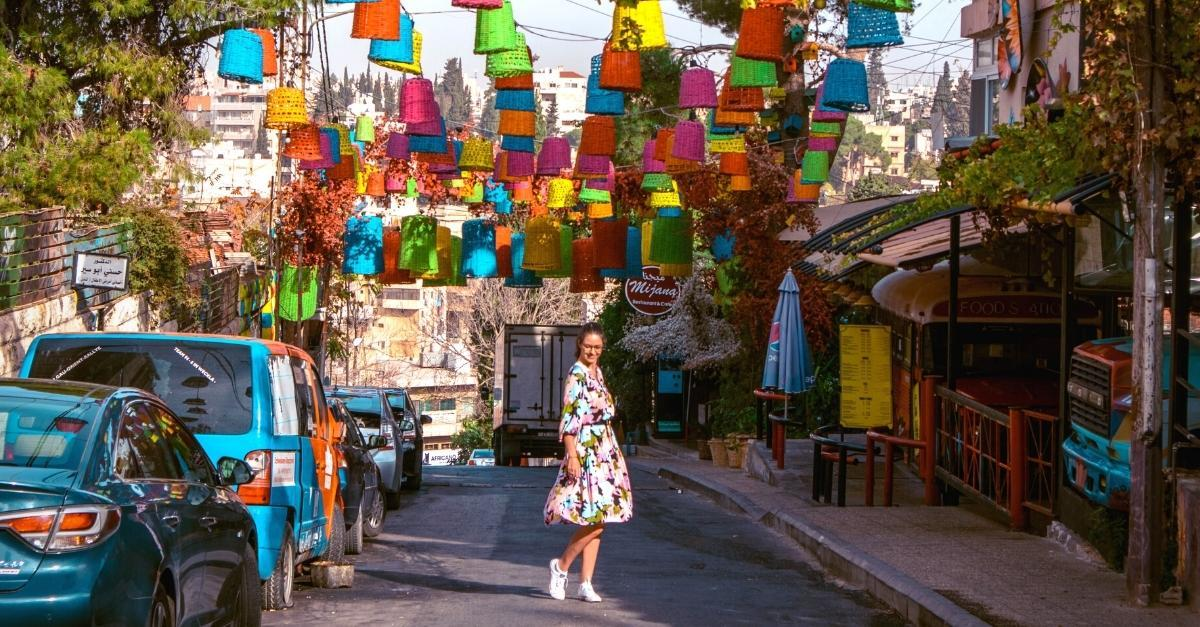
Rainbow Street in the Jabal Amman district functions as the contemporary counterpoint to downtown’s historical density. Boutique cafes, independent galleries, and the open streetscape of a residential hill neighbourhood produce a modern-Amman register that works for present-day drama and commercial work that needs a Middle Eastern urban setting without the compressed visual intensity of Al-Balad. The RFC’s Amman office is on Rainbow Street, which has a practical implication beyond the geography: fixer relationships with RFC staff are often maintained through proximity and direct contact rather than formal submission channels, and productions whose fixers hold these relationships find their permit tracks moving at a different speed from those working through cold applications. Proximity to the RFC is not the same as an established relationship, but a fixer who does not have one is operating at a disadvantage that shows up in processing time.
King Abdullah I Mosque — with its distinctive blue dome visible from across the Amman skyline — requires a religious authority clearance in addition to standard municipal coordination. Exterior shooting is achievable with proper advance notice and full crew compliance with modesty protocols: covered shoulders and legs for all crew members present, no filming during active prayer periods, and production equipment staged outside the mosque perimeter rather than brought to the immediate shooting position. Interior access is treated as a negotiated exception managed through the fixer’s contact at the mosque administration, not through the RFC pathway. Productions that arrive expecting interior access on the strength of an RFC permit alone encounter a refusal at the door that could have been avoided with four additional weeks of fixer-managed negotiation during pre-production.

Amman Day-Trip Corridor
Amman’s position in central Jordan puts three significant filming locations within same-day reach — your unit can depart from the city base, shoot the location, and return without an overnight logistics operation or a secondary crew staging base. This is operationally valuable for productions with a primary city shoot that want to extend their visual range without committing to a full second-unit relocation. The fixer manages the day-trip operation from the Amman base: vehicle convoy coordination, location permit activation, equipment access at each site, and the communication chain that keeps the director’s schedule aligned with the drive time and the permit window.
| Location | Distance from Amman | Drive Time | Same-Day Return |
|---|---|---|---|
| Jerash (Roman ruins) | 48 km | ~45 min | Yes |
| Dead Sea (Jordan shore) | 60 km | ~1 hr | Yes |
| Baptism Site (Al-Maghtas) | 50 km | ~1 hr | Yes |

What the Amman Fixer Manages on Day Trips
Day-trip operations from Amman are not a simplified version of a city shoot — they are a different logistics model with their own permit pathways and institutional contacts. Jerash requires a separate Department of Antiquities clearance, typically processable within two weeks through an established fixer contact. The permit covers the Roman city’s colonnaded streets and oval plaza, which read as a different visual register from the Roman Theatre — broader, more overtly archaeological, and suited to wide establishing work rather than close-range drama.
The Dead Sea’s Jordan shore operates under a mixed authority structure: public beach access differs from resort-ground shooting, and the distinction matters for where heavy equipment can be staged and whether the RFC’s rebate documentation can capture the expenditure in the correct qualifying category. The fixer coordinates both the permit and the budget coding simultaneously — not as separate tasks handled by different people, but as a single process where the permit structure determines the documentation structure.
The Baptism Site at Al-Maghtas carries UNESCO heritage status, adding a conservation compliance layer managed through the Jordan Tourism Board’s site administration — a separate contact from the DoA and the RFC. Productions that assume the RFC’s single-window system covers all heritage sites encounter the same correction at each UNESCO-designated location: the RFC coordinates the rebate, but the access permit runs through a different institutional track that the fixer must have already activated before the shoot date. The day-trip corridor works reliably when the fixer’s authority relationships cover all three location types simultaneously. It fails when one permit track stalls because the fixer’s contact at the relevant authority is not current.

Petra and Wadi Rum — Regional Cluster Handoff
Petra is 230 kilometres south of Amman — approximately three hours by road under standard conditions. Wadi Rum is a further 100 kilometres beyond Petra, placing it at four hours from the capital. Both locations require overnight crew accommodation, multi-day equipment staging, and permit pathways that are managed regionally rather than through Amman’s city-level authority network. Treating Petra and Wadi Rum as extensions of an Amman-based fixer operation is the structural error that disrupts the majority of Jordan shoots that encounter difficulty in the southern territory. The geography alone makes continuous Amman-based management impractical. The permit architecture makes it structurally impossible without a dedicated regional operator on the ground.
When You Need a Dedicated Regional Fixer
Petra’s permit framework operates through the Petra Development and Tourism Region Authority — a separate regulatory body from the RFC’s general single-window system, though RFC involvement remains relevant for rebate documentation across the full Jordan shoot. The visual scale of the site — the Siq canyon approach, the Treasury facade, the monastery at Ad Deir — requires specific equipment access agreements that vary by zone within the PDTRA-managed area. Indiana Jones and the Last Crusade used Petra’s Treasury as the exterior of the Temple of the Grail precisely because the topography cannot be substituted. The permit complexity at Petra reflects its status as a managed UNESCO heritage site with its own administrative structure, not a location that responds to standard RFC lead times or AMC-style municipal coordination.
Wadi Rum
Wadi Rum’s operational profile is different again. The desert terrain requires four-wheel-drive logistics infrastructure throughout — standard production vehicles cannot access the interior locations that make Wadi Rum visually distinctive. The permit pathway runs through Wadi Rum Protected Area management, a body that operates independently from both the RFC and the PDTRA. Crew accommodation options are limited to Aqaba or the Rum Village camp infrastructure; there is no practical daily return base for a crew staging from Amman or even from Petra. Productions that have attempted Wadi Rum as a day extension from Petra consistently underestimate the combined effect of terrain, equipment wear on desert tracks, and drive-time variability that makes schedule commitments unreliable.
Film fixers in Amman can manage the national coordination architecture for a southern cluster — RFC documentation, permit tracking, logistics scheduling from the capital — but ground execution at Petra and Wadi Rum requires a fixer embedded in those locations with the PDTRA relationships and the desert logistics infrastructure that the Amman network cannot replicate at distance. The handoff model functions when the Amman fixer manages the national framework and the regional fixer manages the location execution. It breaks down when one party attempts to cover both. The full production support framework for multi-location Jordan shoots — including how RFC rebate documentation flows across a capital-and-southern-cluster itinerary — is covered on the Jordan production support page.

RFC Rebate and Engaging a Film Fixer in Amman
Jordan’s Royal Film Commission offers a 25% base cash rebate on qualifying Jordanian expenditure. Productions that meet specific eligibility criteria — minimum spend thresholds, local crew percentage requirements, and location diversity conditions — can qualify for an additional uplift of up to 20%, bringing the maximum incentive to 45% of qualifying spend. The RFC application is centralised through the Amman office, and the fixer’s role in structuring expenditure documentation to capture the maximum qualifying amount is operationally significant enough to affect the effective cost of the entire shoot, not just the administrative overhead of the rebate application itself.
Documentation Anchored in Amman
The RFC rebate claim requires expenditure documentation that is categorised, supplier-verified, and submitted within the RFC’s processing windows. Productions that manage this without a fixer who understands what the RFC’s reviewers are looking for in each expenditure category consistently leave qualifying spend off the claim. Crew day rates, location fees, equipment rental invoices, and accommodation costs all need to be structured in a format the RFC accepts, and the distinction between qualifying and non-qualifying expenditure is not always apparent from the production accounting side without prior RFC experience.
The fixer’s role in rebate documentation is interpretive rather than administrative: knowing which supplier invoices to prioritise for RFC categorisation, how to structure location fee agreements so they appear in the right budget category, and when to engage the RFC reviewer for a processing update rather than waiting on standard turnaround. For productions running a multi-location shoot across Amman, the day-trip corridor, and the southern cluster, the documentation challenge is compounded by the fact that different locations fall under different permit authorities — and the RFC’s categorisation requirements reflect those distinctions in ways that affect which costs qualify. The Jordan film fixers case studies guide includes documentation examples from multiple production types, covering how Amman-based and regional fixer coordination has been structured for both the rebate claim and the compliance record across different shoot configurations.
The full permit architecture governing what a production can access — and what the RFC’s compliance framework requires at each location type — is covered in the film permission in Jordan guide, including the documentation requirements that run alongside the rebate claim throughout the production rather than as a separate post-shoot exercise.
How to Hire a Film Fixer in Amman
Film fixers in Amman should be engaged eight to ten weeks before the production start date — earlier if the shoot includes DoA heritage sites or a day-trip corridor requiring multiple simultaneous permit tracks. The RFC maintains a reference list of accredited fixers operating in the capital. The fixers in Jordan guide covers the evaluation framework in detail: what to look for in a fixer’s AMC relationships versus their RFC relationships, how to assess their DoA contacts, how to probe for PDTRA experience if your shoot extends south, and how to structure the engagement agreement so the fixer’s accountability is aligned with the production’s compliance requirements rather than just the permit delivery milestone.
Structuring the Engagement
For productions coordinating multi-city schedules across Amman, the day-trip corridor, and the southern cluster, the planning framework that connects the fixer operation to the full production compliance and rebate structure sits with the line producer Jordan layer. The Amman fixer handles city-level execution. The regional fixer handles southern location execution. The line producer holds the architecture that connects both and ensures the RFC documentation covers the full shoot rather than only the portions that fell within a single fixer’s operational territory. Getting that structure in place before pre-production locks is what prevents a multi-location Jordan shoot from compressing every permit and documentation problem into the final two weeks before the shoot date.

Amman’s infrastructure — the airport, the RFC office, the equipment network, and the city’s concentration of experienced production service operators — makes it the operational capital of Jordan in practice as well as on paper. A film fixer Amman Jordan who holds the right authority relationships across the municipal, heritage, and RFC layers is not a logistical convenience — they are the execution layer that turns approved permits into shoots that run on schedule, within the RFC’s qualifying expenditure framework, and with the compliance documentation to support a full rebate claim at the end of the production.
