

Tunisia, Morocco, Turkey, and Jordan sit at different edges of the MENA production map, but they share a structural logic that makes them consistently useful for international film, television, and commercial production. Each has its own incentive architecture, its own crew depth, and its own visual register. Used individually, each solves a specific brief. Routed intelligently as a corridor, they give a production access to desert, Mediterranean, Ottoman, and ancient-world environments within a single production mobilisation.
This guide covers the four territories as operational production choices — not as tourism destinations. The focus is permit systems, crew infrastructure, rebate structures, and the practical logistics of moving a production across the MENA corridor.
Why MENA Works for International Production
The case for MENA as a production region has strengthened over the past decade for reasons that have nothing to do with aesthetics and everything to do with execution. Permit systems have matured. Crew bases have deepened. Incentive programmes have moved from aspirational policy to cashable mechanisms with defined timelines and documented disbursement records. Productions that ran comparison exercises between MENA and Eastern Europe five years ago often found Europe winning on infrastructure. The same comparison today frequently closes in MENA’s favour once rebate stacking and location exclusivity are factored in.
Geographic and Aesthetic Range Across the Corridor
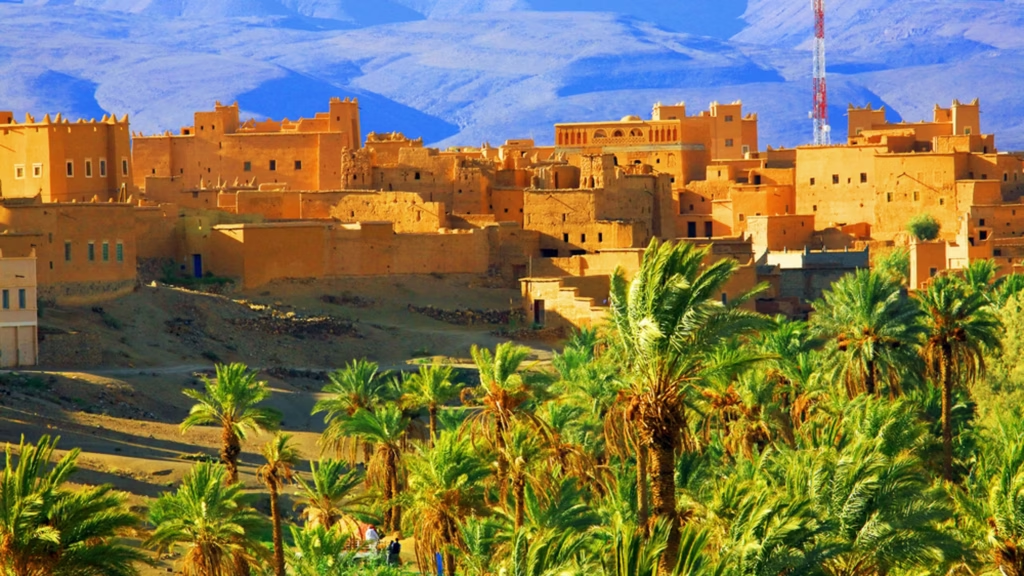
The four-territory corridor covers more visual range than most production regions twice its geographic size. Morocco delivers the Atlantic coast, the High Atlas mountain terrain, the Sahara dune systems of Merzouga and Erg Chebbi, the medina density of Marrakech and Fez, and the blue-washed architectural identity of Chefchaouen. Tunisia adds the Roman imperial scale of El Djem and Dougga, the Star Wars desert landscape of the Tataouine south, and the Mediterranean port environments of Carthage and Sidi Bou Said. Turkey opens the Eurasian corridor — Byzantine Istanbul, the fairy-chimney geology of Cappadocia, the Aegean coastline, and the Anatolian steppe. Jordan rounds the corridor with Wadi Rum desert, Nabataean Petra, the Dead Sea, and Amman’s versatile urban fabric.
A production that needs to build a visual world spanning North Africa, the ancient Mediterranean, and the Arabian Peninsula can source all of it within this corridor — with crews, equipment, and permit relationships that are already established in each territory.
Incentive Landscape — Four Cashable Rebate Systems in One Region
Each territory in the corridor operates an independent incentive mechanism, and all four are structured as cash payments rather than tax credits — meaning they are accessible to foreign productions with no local tax liability. Morocco’s Centre Cinématographique Marocain administers a production support fund with rebates tiered by local spend and crew localisation. Tunisia’s rebate has been rebuilt post-2020 with a formal application process and defined disbursement windows. Turkey’s Ministry of Culture and Tourism operates a cash support fund for qualifying international co-productions and service productions. Jordan’s Royal Film Commission runs the most streamlined system in the group — up to 25% cash back on qualifying Jordanian spend with a permit process that runs faster than any comparable territory in the region.
Productions can stack these incentives across a multi-territory shoot — qualifying spend in each country for its respective rebate — rather than concentrating all spend in one territory to maximise a single incentive. A Morocco-Tunisia-Jordan corridor production can generate three separate rebate claims, each processed independently. The film production services layer that connects these territories is what makes multi-country rebate stacking operationally viable rather than theoretical.

Territory Profiles — Morocco, Tunisia, Turkey, Jordan
Morocco — Atlantic Desert and Medina Infrastructure
Morocco is the most production-mature territory in North Africa, with a crew base built on three decades of continuous international volume. The Atlas Corporation Studios in Ouarzazate remains one of the largest backlot facilities in the world outside of the US and India, and it has hosted productions from Lawrence of Arabia’s era through to Netflix originals. Game of Thrones shot the Essos sequences — Astapor, Yunkai, Meereen — entirely in Morocco, using Ouarzazate and Aït Benhaddou as the primary environments. That production scale left behind a crew pool that is comfortable with studio-level complexity.
Morocco’s visual range is broader than its Sahara reputation suggests. The Atlantic coast near Essaouira and Agadir carries a Portuguese colonial architecture that reads as European or Latin American depending on the lens. Chefchaouen’s blue-washed medina has become a standalone visual brief for productions needing a distinctly North African urban aesthetic. The High Atlas passes and Dades Valley gorges are usable for mountain-range briefs that other MENA territories cannot deliver. To hire a line producer in Morocco with the crew relationships and location access to navigate this range is the starting point for any Morocco production.
Tunisia — Roman Heritage, Desert South, and Mediterranean Light
Tunisia’s production credentials predate its current reputation. The country hosted Star Wars filming from 1976 onwards — the Lars Homestead exterior in the Tataouine region is one of the most recognised location decisions in cinema history. The El Djem Amphitheatre, a UNESCO-listed Roman colosseum built to 70% of the scale of the Colosseum in Rome, has been used for ancient-world sequences that would cost orders of magnitude more to replicate in Europe or on a studio backlot. These are not marginal locations — they are world-class controlled environments with established permit relationships.
Tunisia’s incentive programme offers a rebate on qualifying local production spend, with the application managed through the Centre National du Cinéma et de l’Image. Processing times have stabilised post-2022, and the regulatory environment for foreign crews — particularly around equipment import and drone clearance — is more straightforward than Morocco at comparable budget levels. The Mediterranean north, including Sidi Bou Said and the Carthage coastal terrain, carries a light quality that is distinct from both the Saharan south and the Levantine east — useful for productions that need the North African Mediterranean look without the logistical density of Moroccan shoots. A line producer Tunisia with active government relationships is the critical enabler for heritage location access.
Download the Tunisia film tax incentives and line producer guide — covers the current rebate structure, application process, qualifying spend categories, and permit timelines for international productions.

Turkey — Eurasian Range, BOI Incentives, and Istanbul as a Production Base
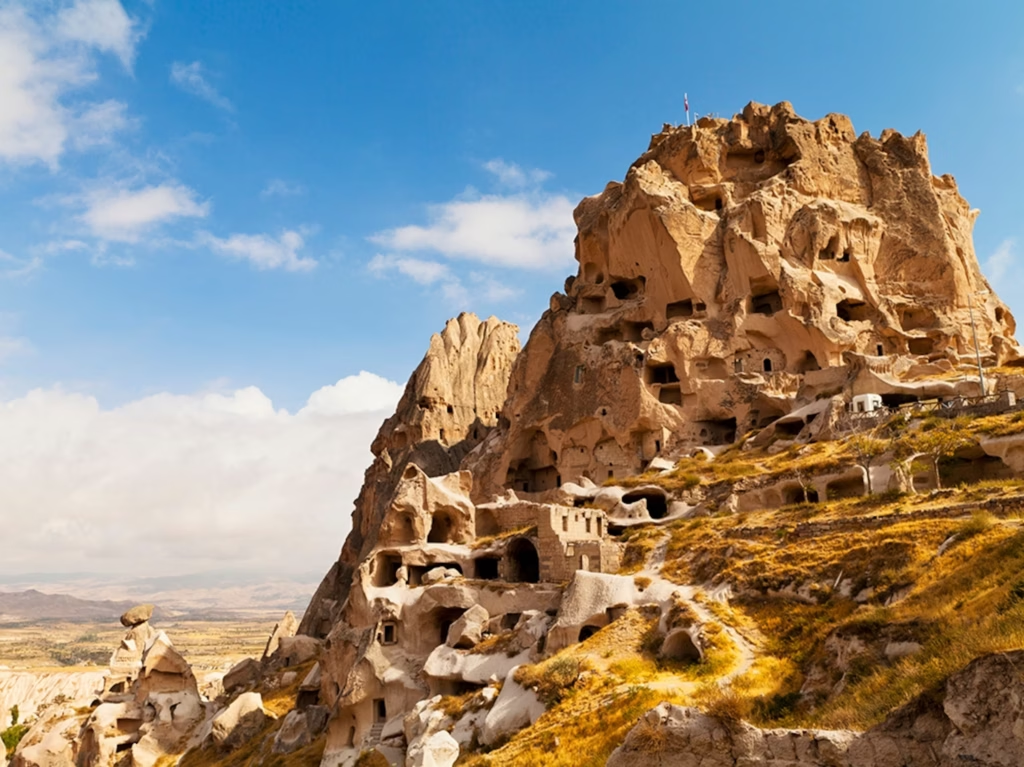
Turkey’s production advantage is its dual identity. Istanbul is simultaneously a European city and a Middle Eastern one — Byzantine, Ottoman, and contemporary layers stacked in the same frame. A production briefed on a generic international city with historical depth can shoot Istanbul without committing to either a European or a MENA location identity, which makes it uniquely flexible for scripts that need that ambiguity. Beyond Istanbul, Cappadocia’s volcanic rock formations are one of the most distinctive geological environments available anywhere in the world — the kind of location that reads as science fiction, fantasy, or ancient-world without requiring any set dressing. The Aegean coast around Bodrum and Izmir carries a Greek-island quality that is visually indistinguishable from the Greek islands themselves at a significantly lower cost and permit burden.
Turkey’s Ministry of Culture cash support for international productions covers service productions and co-productions meeting local spend thresholds. The Istanbul crew base — built through years of international advertising, feature, and television production — is deep enough to staff a long-form series without significant above-the-line imports. Equipment rental in Istanbul covers full cinema-grade packages. The practical production advantage over Morocco and Tunisia is infrastructure density: Istanbul has the international hotel stock, air connectivity, and post-production facilities that remote-location shoots in the other MENA territories require planning to access. For permit structure, crew sourcing, and incentive administration detail, see line producer Turkey.
Jordan — RFC Cash Rebate, Wadi Rum, and the Stand-In Model
Jordan’s role in the MENA corridor is increasingly as the precision environment — the territory where a production goes when the brief requires specific control over a desert or heritage environment and cannot afford logistical unpredictability. Wadi Rum’s permit system, run through the RFC and the Wadi Rum Protected Area Authority, gives a production defined access windows, managed crew infrastructure on-site, and a track record that runs from Lawrence of Arabia to the Dune franchise. Petra’s access is similarly managed — complex but navigable through established RFC relationships.
Jordan is also the most versatile stand-in in the corridor. Wadi Rum doubles for Saudi Arabia’s AlUla corridor and Egypt’s Sinai desert with documented production credibility. Amman’s newer districts substitute for Gulf city environments. This stand-in capacity means a production can use Jordan to cover two territory briefs simultaneously — the Saudi brief and the Egypt brief — within a single mobilisation and a single RFC permit process. The 25% cash rebate on qualifying Jordanian spend makes it cost-effective at feature film scale.
Download the Jordan film fixers case studies PDF — permit timelines, crew configurations, and location logistics from productions that have shot Wadi Rum, Petra, and Amman.
Routing Multi-Territory MENA Productions
Combining Morocco and Tunisia for North Africa Breadth
The Morocco-Tunisia combination is the most common multi-territory routing in the North Africa corridor, and it follows a clear production logic: Morocco delivers scale and infrastructure, Tunisia delivers exclusivity and heritage depth. A production that shoots its principal desert sequences in Morocco’s Sahara and its ancient-world sequences at El Djem or Dougga in Tunisia is using each territory for what it does best, rather than stretching one country’s visual range beyond what it can credibly deliver.
The practical routing runs Morocco first — mobilise in Ouarzazate or Marrakech, shoot the desert and medina sequences, then move the core unit to Tunis for the heritage block. Equipment usually stays in Morocco for the desert shoot and is either shipped across or supplemented with Tunis-based rental for the Tunisia phase. Crew overlap is manageable: Moroccan crew will often travel to Tunisia for a short block, and Tunisian ADs and location managers are routinely brought in from Tunis when the production crosses the border. The two countries share enough cultural and linguistic overlap that cross-border crew coordination is significantly simpler than, for example, a Turkey-Jordan routing.

Crew, Equipment, and Cross-Border Logistics
Multi-territory MENA productions fail at the logistics layer more often than at the creative layer. The camera package clears Casablanca customs in three days and then sits for eleven days at Tunis-Carthage because the carnet wasn’t prepared for the secondary territory. The generator that was confirmed for the Wadi Rum camp was actually booked out to a competing production. The Turkey shoot runs three days over because the Istanbul permit was issued for a different exterior than the one the director wants. These are the failure modes of MENA multi-territory production, and they share a common cause: insufficient pre-production coordination at the logistics level.
Equipment, Crew Travel, and the Carnet Problem
Equipment carnets for multi-territory MENA shoots need to list all territories in the routing from the point of original issue — not amended at each border. The amendment process at MENA borders is slower and less predictable than the original issuance process in the home country. Generator and power infrastructure needs to be confirmed with local suppliers a minimum of six weeks before the first shoot day in each territory, with a written confirmation and a deposit in place — not a verbal agreement with a fixer. Crew travel visas for cross-border movement within the MENA corridor vary significantly: Turkish crew require specific documentation to enter Jordan; Moroccan crew require advance documentation to enter Tunisia for a work engagement rather than tourism. A line producer who has routed a prior production across the same territory combination will have solved all of these problems once already — which is the single most reliable qualifier when hiring for a multi-territory MENA shoot.

Engaging Line Producers Across the MENA Corridor
The structural question for any multi-territory MENA production is whether to run a single line producer across the full routing or to appoint territory-specific LPs who are coordinated through a central UPM or production manager. Both models work — the right choice depends on the complexity of the shoot and the LP’s actual network geography.
Hub Model vs Territory-Specific Line Producer
A single LP running a Morocco-Tunisia production is viable if that LP has active crew relationships and location contacts in both territories — not if they’re strong in Morocco and managing Tunisia remotely via a local fixer they’ve never worked with. The hub model works when the central LP’s network genuinely spans the corridor. When it doesn’t, the result is a production that is well-managed in one territory and reactive in the other. A line producer Middle East with a documented multi-territory MENA track record is the clearest signal of genuine corridor capability — not a single-territory LP who has expanded their pitch deck.
Territory-specific LPs coordinated through a central production manager is the more conservative model and generally produces better outcomes on first-time corridor routings. The Morocco LP handles Morocco. The Tunisia LP handles Tunisia. A production manager sitting above both ensures that the logistics interfaces — equipment movement, crew handoffs, permit timelines — are coordinated at the production level. The cost is higher. The failure rate is lower.
Pre-Production Planning for Multi-MENA Shoots
MENA multi-territory pre-production should begin permit applications a minimum of eight weeks before the first shoot day across all territories simultaneously — not sequentially. The common error is to finalise the Morocco permits, then begin the Tunisia application, then start Jordan. That sequential approach adds six to eight weeks to the pre-production timeline for no operational reason. The RFC, the Centre Cinématographique Marocain, and the CNCI in Tunisia all accept applications from productions that have not yet completed their home-country clearances — start all three at the same time.
Budget contingency for MENA multi-territory shoots should sit at a minimum of 15% of below-the-line spend. The 10% contingency standard that applies to single-territory shoots underestimates the number of logistics variables that multiply when a production crosses two or three borders. Currency fluctuation alone — particularly on Moroccan dirham, Tunisian dinar, and Jordanian dinar positions — can move a budget by 3–5% without any production overage. Build the contingency before the shoot, not as an emergency fund after the first overrun.
The most effective pre-production investments on a MENA corridor shoot are a recce that covers all territories in sequence — not individual territory scouts run three months apart — and a single consolidated production bible that logs permit contacts, equipment access points, crew leads, and contingency locations for each territory side by side. Productions that run this level of pre-production discipline across MENA routings consistently deliver closer to budget than those that treat each territory as a discrete production event joined by travel days.
