
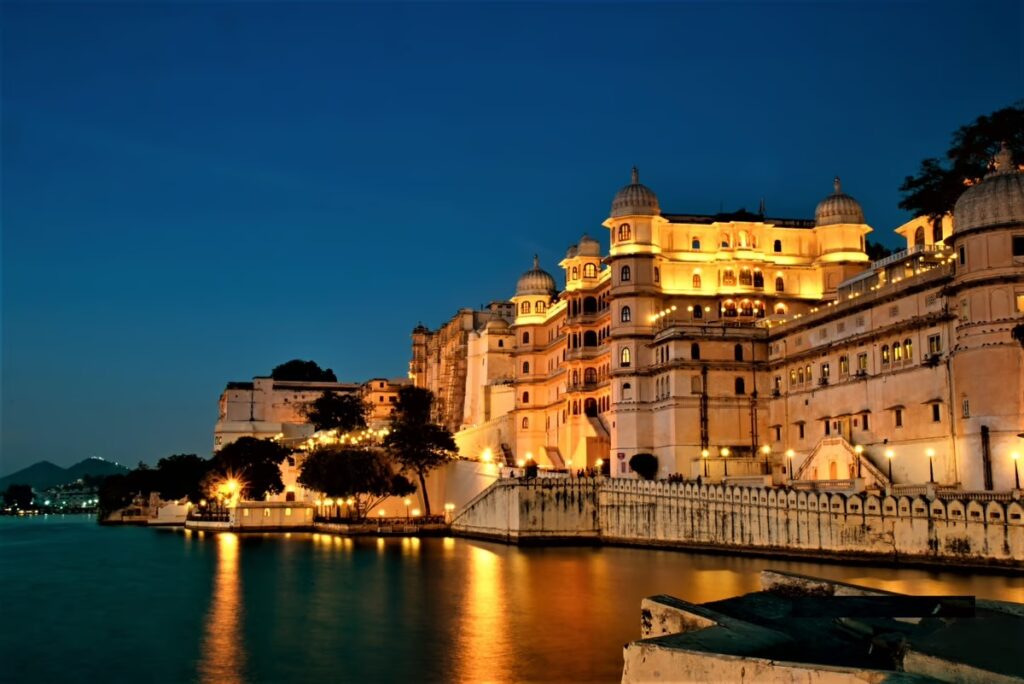
Filming at Udaipur City Palace means working inside a living Mewar landmark, the largest palace complex in Rajasthan, still associated with the Mewar royal family and run as a museum by a private charitable trust rather than a government monument authority. That single fact shapes everything: access, permissions, scheduling and cost run through the City Palace administration, not a state film office.
The reward is one of India’s most cinematic and most filmed settings, from the James Bond era of Octopussy to Hindi features that use the palace as itself. This guide covers what the City Palace gives a camera, the films actually shot there, the lakeside locations around it, and how permissions work at a trust-controlled heritage property, which is where most productions get the authority wrong.
Filming at the City Palace: Inside a Living Mewar Landmark
Udaipur’s City Palace is not a single building but a four-hundred-year accumulation of palaces, courtyards, terraces and balconies on the eastern bank of Lake Pichola, begun by Maharana Udai Singh II in the sixteenth century and extended by successive rulers of Mewar. For a camera, that means visual depth and continuity within one controlled footprint.
What the City Palace Is, and Who Controls It
The public museum sections of the City Palace are administered by the Maharana of Mewar Charitable Foundation, a private charitable trust headquartered in the palace and funded largely by entrance fees. The Shiv Niwas and Fateh Prakash wings operate as heritage hotels under the family’s HRH Group, and private residence areas remain with the family. No single trust controls the whole complex: filming access is confirmed property by property across the foundation, the hotel group and the family, and ancillary public-space, police, drone and lake approvals remain separate again.
The foundation, set up in 1969 by Maharana Bhagwat Singh Mewar, runs the City Palace Museum and the conservation of the public sections, while the HRH Group operates the Shiv Niwas and Fateh Prakash palace-hotels within the same walls. For a production this means a single complex can require two or three separate conversations (museum administration, hotel management and, for restricted areas, the family), each with its own answer and timeline.
Architectural Scale and What It Gives a Camera
Within the complex, courtyards, corridors, chambers and rooftop terraces coexist in a single visual system, so productions can move from grand establishing exteriors to intimate interior scenes without a company move. The elevation over Lake Pichola adds natural scale to exteriors, while the interiors offer textured, reflective, heavily detailed surfaces that sets cannot convincingly replicate.
That density also makes the palace adaptable. One section can read as royal India, another can be framed for a Central Asian or Middle Eastern setting, and the architecture supports vertical, layered and symmetrical compositions, which is why directors return to it for both period realism and stylised, neutral “fictional kingdom” backdrops.
The named courtyards and halls inside the museum are the working sets. Mor Chowk, the Peacock Courtyard with its glass-mosaic peacocks, Badi Mahal’s hilltop garden courtyard, the mirror and coloured-glass work of the inner palaces, and the long sequence of balconied chowks each give a distinct, camera-ready space within a few minutes’ walk, which is what lets a production shoot several looks against one location agreement.
It is also why productions choose the palace over a constructed set. The centuries of accumulated stonework, patina and architectural evolution read as authentic on camera in a way a build cannot match, and for many period productions, constructing a comparable palace environment can exceed the cost and lead time the real location demands. For that kind of work, the City Palace is often the more convincing and the more economical option.

Films Shot at Udaipur City Palace and Around the Lakes
Udaipur’s screen history is specific, not generic, and it is the reason the palace carries international recognition rather than just local appeal.
The Octopussy Legacy
The 1983 James Bond film Octopussy put Udaipur on the global map. Its India sequences were spread across the city: the Lake Palace and Jag Mandir stood in for Octopussy’s island palace, the hilltop Monsoon Palace (Sajjangarh) became the exterior of villain Kamal Khan’s lair, and the Shiv Niwas wing of the City Palace served as Bond’s hotel. Four decades on, the city still trades on the association.
The film used the city as much as the palaces: the boat sequences on Lake Pichola, the auction, and a chase through the old city around the City Palace. The legacy is unusually durable: Octopussy is still screened nightly at rooftop restaurants and hotels in Udaipur, and the Bond association remains part of how the city is marketed to productions and tourists alike.
Indian Cinema at the City Palace
Hindi cinema has used Udaipur for just as long. Guide (1965) shot across the city and its lakes; Vidhu Vinod Chopra’s Eklavya: The Royal Guard (2007) used the Udaipur palaces; and Sanjay Leela Bhansali’s Goliyon Ki Raasleela Ram-Leela (2013) filmed across Udaipur and its palace locations, alongside a long line of features from Mera Gaon Mera Desh to Yaadein and Dhamaal. In Hindi films the palace usually plays itself; international productions adapt it into a fictional or composite royal setting.
That steady demand is why Udaipur retains an experienced local crew and fixer base for heritage and lake shoots, and why the palace appears regularly in advertising and OTT production alongside features. The constant is that the location is treated as a premium, controlled asset, booked and scheduled rather than simply walked into.

Key Locations Around the City Palace
City Palace is the anchor, but its value multiplies through the lake locations around it, most reachable within minutes, several of them under their own separate control.
Lake Pichola, Jag Mandir and the Taj Lake Palace

Lake Pichola is the visual core of Udaipur, its reflective surface amplifying every palace on its banks. The Taj Lake Palace (the white-marble island palace of Jag Niwas, an Octopussy location) now operates as a Taj luxury hotel, so commercial filming is subject to property approval, the hotel calendar, guest privacy and the production footprint. Jag Mandir, the second island palace, is more workable for controlled shoots, with access by boat on timed windows.
The distinction matters in planning: the Lake Palace delivers the most iconic frame and the least availability, so productions that need that exact look build long lead times and fallbacks, while Jag Mandir, the lakefront ghats and the City Palace terraces give comparable grandeur with far more control over access and movement.

Fateh Sagar, Jagdish Temple, the Gardens and the Monsoon Palace
Beyond Pichola, Fateh Sagar Lake and its Nehru Island open up wide, less dense compositions for travel and transitional scenes. Jagdish Temple, steps from the City Palace, adds a carved vertical anchor for culturally rooted sequences; Saheliyon Ki Bari brings fountains, marble pavilions and symmetry for softer, romantic frames; and Sajjangarh, the Monsoon Palace, gives the hilltop, sunset-facing exterior that Octopussy made famous.
A second tier of locations widens the palette further. Bagore Ki Haveli on Gangaur Ghat offers period courtyards and a lakefront step-well frontage; the Gangaur and Lal ghats give working waterfront and old-city texture; the lanes around Jagdish Temple supply dense market and residential frames; and the Ahar cenotaphs, the royal chhatris east of the city, add a quieter heritage register away from the tourist core.

Permissions for Filming at the City Palace
This is the part most productions plan incorrectly, because the City Palace is not governed the way a protected monument is.
A Private-Trust Property, Not an ASI Monument
Filming permission for the City Palace comes from the City Palace administration and the Maharana of Mewar Charitable Foundation, and from the HRH Group for the Shiv Niwas and Fateh Prakash hotel wings, not from the Archaeological Survey of India. ASI and state archaeology govern other Rajasthan heritage sites (the hill forts of Chittorgarh and Kumbhalgarh, for example, sit under the formal ASI shooting framework), but City Palace sits outside that, under the trust. A production that sends a generic state or ASI application for City Palace is applying to the wrong authority and loses time.
| Area of the complex | Who controls filming |
|---|---|
| Museum courtyards & galleries | Maharana of Mewar Charitable Foundation |
| Shiv Niwas (palace-hotel wing) | HRH Group |
| Fateh Prakash (palace-hotel wing) | HRH Group |
| Private residence areas | Family approval: generally restricted |
Getting it right means starting from the property, not the process: establish which body controls the specific spaces in the script (museum, hotel or family) and open each conversation directly and early. A local line producer identifies the correct controller for each space, prepares the production file and follows the museum, hotel and private-property approval tracks against the schedule.
What the Trust Controls and Restricts
Working from the City Palace administration, approvals define the exact shooting zones (museum courtyards and galleries are negotiable, the private residence is not) and carry conservation limits on rigging, lighting intensity, drone use, heavy equipment and crew size to protect the structure. The palace remains an active museum with heavy tourist footfall, so shooting windows are scheduled around visiting hours, and filming is priced as a commercial arrangement. The hotel wings add their own layer: hotel-management approval and guest-privacy limits, on the property’s booking calendar rather than a filming season. Early, written confirmation, zone by zone, is the only reliable way in. A broader India filming compliance checklist covers the standard clearances that sit around any heritage-property approval.
Costs and Lead Times
Budgeting the City Palace is less about a published fee than about the commercial terms the administration and hotel group set for the spaces and dates a production needs, the lost-revenue allowance for blocking museum or hotel areas, and the cost of working around visiting hours. Lead times are the binding constraint: trust and hotel approvals for a heritage property of this profile take weeks, and a late confirmation can force a reshuffle across the whole Udaipur schedule. The fee is rarely the expensive part; the access window and the lead time are. For producers costing a full state schedule around the palace, our Rajasthan line producer guide maps the wider corridor and the state’s permit and incentive structure.
Production Logistics and Planning in Udaipur
Around the permissions, Udaipur’s strength is compactness: handled well, it is one of the most efficient heritage bases in India.
Location Density and Shoot Efficiency
Palaces, lakes, gardens, temples and old-city streets sit within a short radius, so a production can capture several distinct environments without relocating its base. That cuts company moves (usually the most time-consuming part of a location shoot), keeps equipment deployed across consecutive setups, and lets a second unit prep a nearby location while the main unit works the palace.
Most units base within a few kilometres of Lake Pichola, where the cluster of heritage and luxury hotels keeps crew close to the primary locations and shortens daily moves. That proximity, rather than any single low rate, is where the real budget efficiency comes from on a multi-day Udaipur schedule.
Crew Movement, Tourism and Lake Logistics
Logistics here are shaped by Udaipur’s dual identity as a heritage city and a tourist hub. Distances are short, but movement through the City Palace and the lakeside zones has to be staggered around peak visitor hours and access control, and equipment into elevated palace areas often needs manual carriage or controlled routes. Island locations such as Jag Mandir depend on ferry timing windows that the schedule has to be built around.
What a Line Producer Handles at the City Palace
On the ground, a line producer maps which authority controls each wing, secures the museum, hotel and family approvals in parallel, schedules around visiting hours and tourist density, arranges equipment handling into elevated and restricted zones, coordinates boats and ferry windows for the island palaces, and holds the conservation conditions on rigging, lighting and drones so a single breach does not jeopardise the permission. That coordination, more than any single permit, is what makes a City Palace shoot run to schedule.
Crew, Vendors and Local Support
Udaipur provides local film fixers, production assistants, drivers, support labour, transport, catering, accommodation and property liaison. Seasoned Rajasthan crew are generally staged from Jaipur, while specialist departments and larger equipment packages are routed from Delhi or Mumbai according to the production plan.

Season and Scheduling
The cooler peak window runs from October to February or March, when light is stable and the lakes are full. April to June is hot, with harsh midday light and long days. July to September is wetter and less predictable: the monsoon replenishes the lakes but brings rain and continuity risk across consecutive shooting days. Within the day, morning and evening give the soft tonal quality the palace is known for, so scene sequencing is planned to hold visual continuity.
Local calendars matter too. Udaipur’s peak tourist season and festivals such as the Mewar Festival and Gangaur draw heavy crowds to the lakefront and palace approaches, tightening access and movement, so productions either schedule around them or budget the extra control they require.
Udaipur as a Stand-In and a Multi-Location Node
Internationally, Udaipur is valued less as a fixed identity than as a flexible asset: through controlled framing it stands in for parts of the Middle East, Central Asia and fictional kingdoms, delivering multiple narrative outputs within one schedule. Domestically and for foreign units alike, it rarely travels alone: it is built into a wider Rajasthan plan, and a line producer Udaipur works it into the Jaipur–Jodhpur–Udaipur corridor that a line producer Rajasthan sequences across the state.
The same controlled framing that lets the palace read as a fictional kingdom also lets a production hold an entire act inside one complex: moving between throne-room grandeur, courtyard intimacy and lakefront scale without breaking geographic continuity. For international units weighing an Indian heritage location against an overseas palace, that combination of look, control and cost is the deciding factor.
Integrated correctly into multi-city production pipelines, the City Palace becomes both a primary shooting zone and a stabilising, high-density node in a larger schedule rather than a standalone stop.
Recce and Location Experience at the City Palace
Global Producers has run first-hand recces at the City Palace and scouted locations across the Udaipur region, from the palace courtyards to the Aravalli outskirts. The clip and images on this page are from that on-the-ground work.

Planning a Shoot at Udaipur City Palace
The decisive point is to treat the City Palace as what it is: a private heritage trust property, not a public monument. Identify the right gatekeeper for each wing, engage the City Palace administration and the foundation early, accept the conservation and access limits, and build the palace into a Udaipur and Rajasthan schedule from the first recce. Handled that way, it remains one of the most cinematic, recognisable and well-supported heritage locations in India.
For a production weighing it, the trade-offs are clear: the look and the recognition are exceptional and the local execution layer is well established, but the real constraints run wider than paperwork, spanning tourism and guest activity, conservation limits, boat-based movement on the lakes, and the specialist crew and equipment that route in from Delhi or Mumbai. Planned against those factors, with the correct controller approached early for each space, Udaipur City Palace delivers a heritage backdrop that very few locations anywhere can rival.
