
Lucknow in India’s Production Network
Lucknow operates as a strategic node within North India’s production ecosystem, defined less by standalone scale and more by how effectively it integrates into corridor-based filming strategies. Unlike primary hubs such as Mumbai or Delhi, Lucknow’s strength lies in its ability to extend production value—offering distinct visual environments, controlled costs, and manageable logistics when positioned correctly within a broader execution plan.
Within the national ecosystem, Lucknow is embedded into the line producer in India network as a secondary execution layer. This means that most productions do not originate in Lucknow; instead, they deploy into the city after core planning decisions have been made elsewhere. This structural positioning allows productions to leverage Lucknow for specific narrative requirements without bearing the overhead of building full-scale infrastructure locally.
Corridor Positioning in North India
Lucknow’s most important strategic advantage is its placement within the Delhi–Agra–Lucknow corridor. This corridor represents one of the most efficient production routes in India, enabling filmmakers to capture multiple architectural and cultural environments within a single, linear schedule.
Delhi contributes government buildings, urban density, and contemporary infrastructure. Agra introduces Mughal-era monumentality, globally recognizable and tightly regulated. Lucknow completes the sequence with Nawabi-era architecture, layered old-city environments, and softer visual textures that contrast with the other two cities.
From a line production perspective, this corridor allows for progressive movement rather than fragmented scheduling. Equipment, crew, and logistics travel in one direction, reducing redundancy in transport and minimizing idle time. Productions avoid the inefficiencies of returning to base cities repeatedly, which directly improves both cost control and shooting efficiency.
This structure also increases narrative flexibility. A single project can achieve visual diversity across multiple historical and architectural registers without relying on set construction or heavy art direction. The corridor effectively becomes a production tool, enabling more output per shooting day while maintaining authenticity.
Integration with National Production Grid
Lucknow’s operational efficiency is closely tied to its integration with line producer delhi systems. Delhi functions as the primary anchor for North India production, providing access to senior crew, advanced equipment, and established vendor networks. Lucknow, in this structure, acts as a deployment zone where these resources are executed.
This relationship defines pre-production workflows. Budgeting, crew hiring, and equipment allocation are typically finalized through Delhi-based systems. Once these elements are locked, the production extends into Lucknow with a clear execution plan. This reduces uncertainty and ensures that the shoot maintains consistency in quality and timelines.
The integration also affects risk management. Any disruption in Lucknow—whether related to permits, logistics, or scheduling—can be mitigated through Delhi’s support infrastructure. Backup equipment, additional crew, and vendor alternatives are all sourced through this connection, providing a level of operational resilience that standalone cities cannot offer.
However, this model requires precise coordination. If the integration between Delhi and Lucknow is not managed effectively, delays in equipment movement or crew deployment can offset the cost advantages that Lucknow offers. As a result, successful productions treat Lucknow as part of a connected grid rather than an independent location.

Key Filming Locations in Lucknow
Lucknow’s filming geography is structured around distinct clusters, each offering a unique visual identity and requiring different operational approaches. These clusters must be evaluated during pre-production to ensure that recce planning, permit applications, and scheduling align with the production’s creative and logistical needs.
The city’s compact layout allows multiple environments to be accessed within short travel times, but each cluster operates under its own regulatory and practical constraints. Understanding these differences is essential for efficient execution.
Heritage Belt and Nawabi Architecture
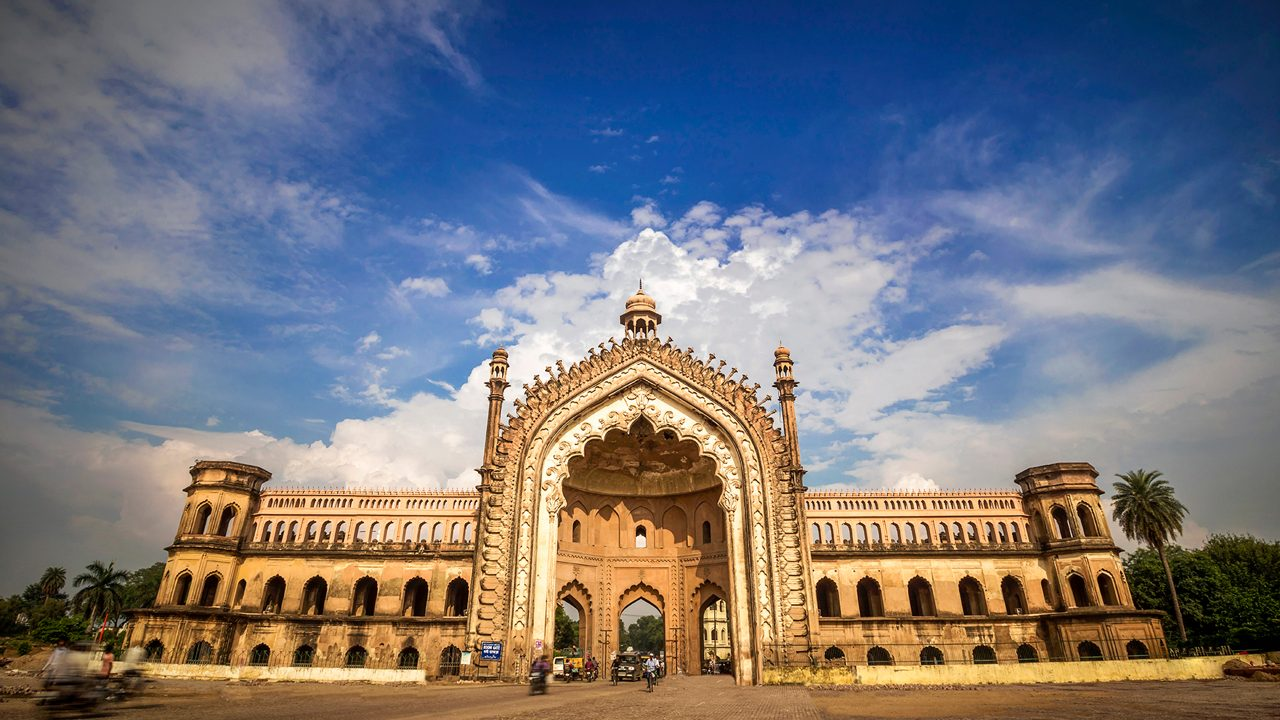
The heritage belt forms the foundation of Lucknow’s cinematic appeal. Locations such as Bara Imambara, Chota Imambara, Rumi Darwaza, and the surrounding precincts provide large-scale historical environments characterized by symmetry, depth, and intricate detailing. The Residency ruins, La Martinière’s colonial-Gothic architecture, Dilkusha Kothi, the Husainabad Clock Tower, the Gomti riverfront and the Ambedkar Memorial extend the range from Nawabi heritage through colonial to modern-monumental looks.
These sites are governed by layered regulatory systems, making compliance a central part of production planning. Access and execution are structured through the relevant film-permit and compliance processes, where different authorities impose specific requirements depending on the location.
For monuments under the Archaeological Survey of India, applications must follow the ASI’s monument-shooting permission process. This includes detailed documentation covering crew size, equipment specifications, shooting schedules, and preservation measures. Restrictions on lighting, rigging, and movement are common, and these constraints must be incorporated into both shot design and scheduling.
Despite these limitations, the heritage belt offers a level of authenticity that is difficult to replicate elsewhere. Productions that plan effectively can capture visually rich content within controlled environments, reducing reliance on artificial set construction while maintaining high production value.
Commercial and Contemporary Districts
Lucknow’s commercial zones, including Hazratganj and surrounding districts, provide a contrasting visual layer that complements the heritage environment. These areas combine colonial-era urban planning with active retail and civic life, creating a hybrid aesthetic that differs from other major Indian cities.
Filming in these districts is driven by operational timing rather than strict structural limitations. High footfall and continuous traffic activity require productions to schedule shoots during early morning or controlled time windows. This minimizes disruption and allows for cleaner visual capture.
Coordination with local authorities, particularly traffic police and municipal bodies, becomes critical in these environments. While permits are required, the primary challenge lies in managing real-world conditions during filming. Crowd control, movement restrictions, and timing precision all play a role in successful execution.
This duality—controlled heritage environments and dynamic commercial zones—defines Lucknow’s versatility. It enables productions to achieve multiple visual styles within a single city, provided that planning accounts for the operational differences between these clusters.

Line Producer and Film Fixer in Lucknow — What’s the Difference?
On a Lucknow shoot the two roles are distinct but complementary. A film fixer in Lucknow handles the local layer — securing permits, interfacing with police, ASI and municipal authorities, arranging site access, managing crowd control at heritage locations, and booking local crew and vendors. It is the on-the-ground function that makes a specific location and day work.
A line producer in Lucknow operates above that — owning the budget, the schedule, crew deployment and overall production execution, and folding the shoot into a wider North-India plan. On smaller ad or single-location shoots a production fixer in Lucknow is often enough; larger features and series engage both functions, usually through one production company. For recce-heavy projects, a location fixer in Lucknow can be brought in purely for scouting and access.
Permits and Compliance in Lucknow
Lucknow operates within a layered permission ecosystem where approvals are distributed across multiple authorities rather than consolidated into a single clearance system. This structure requires early planning, clear documentation, and parallel application handling. A delay in any one approval chain can disrupt the entire shooting schedule, which is why compliance in Lucknow is fundamentally a pre-production discipline rather than an on-ground adjustment.
Unlike high-volume production cities where processes are standardized, Lucknow’s approval pathways vary depending on location type, scale of production, and whether the shoot spans multiple districts within Uttar Pradesh. For this reason, understanding process flow—not just individual permits—is critical to execution stability.
UP Film Commission and State Access
The Uttar Pradesh Film Commission acts as a facilitation body that supports productions navigating state-level access. It is particularly effective for projects that involve multiple locations across Uttar Pradesh or require coordination between district administrations.
However, its role is often misunderstood. The commission does not replace individual permissions from police, civic bodies, or heritage authorities. Instead, it streamlines introductions and accelerates coordination where scale justifies intervention. For smaller or tightly scheduled shoots, direct engagement with local authorities may be faster and more efficient.
A working understanding of how film permissions actually work in india becomes essential in this context. Permissions in India are not linear—they are layered and often simultaneous. The decision to route through the commission versus handling approvals independently is a strategic one that depends on shoot complexity, timeline, and geographic spread.
For multi-city shoots within Uttar Pradesh, the commission becomes more valuable as it reduces duplication of effort across districts. For single-city shoots, experienced line producers often bypass this layer and engage directly with executing authorities to maintain tighter control over timelines.

Police, ASI and Civic Permissions
Operational permits in Lucknow fall into three primary categories: police approvals, heritage permissions, and civic clearances. Each operates independently and must be aligned before principal photography begins. A film fixer in Lucknow typically coordinates this local permission chain, interfaces with police and municipal authorities, and manages site-level access during the shoot.
Police NOCs are required for all public space filming, including streets, markets, and areas with crowd interaction. Applications typically include crew size, equipment details, shoot schedule, and traffic management plans where applicable. Any sequence involving vehicles, crowd control, or public disruption requires additional coordination with the traffic department.
Heritage locations—such as the Imambaras or Residency—fall under Archaeological Survey of India (ASI) or other governing bodies. These permissions require detailed submissions including script context, equipment footprint, and protection measures for the site. Approval timelines are longer and less flexible, making early application critical.
Civic permissions apply to municipal-controlled spaces, commercial districts, and infrastructure zones. These approvals often intersect with police permissions but are processed separately. Coordination between these bodies is not automatic and must be managed actively.
To maintain control across this fragmented system, productions rely on structured documentation frameworks such as the structured compliance checklist. This ensures that no approval layer is missed and that dependencies between permissions are clearly mapped before the shoot begins.
For operational reference and documentation alignment, the a structured compliance checklist provides a standardized checklist covering permits, documentation, and execution protocols across Indian jurisdictions.
In Lucknow, compliance failures are rarely due to complexity—they are usually the result of incomplete sequencing or missed dependencies. A structured, parallel approach to permissions ensures that the city remains efficient rather than unpredictable as a production environment.
Crew and Production Infrastructure
Lucknow’s production ecosystem is functional but structurally dependent on external support systems, particularly Delhi. The city can sustain mid-scale shoots with local resources, but larger productions require hybrid execution models that combine local workforce efficiency with imported technical expertise.
This dependency is not a limitation—it is an operational characteristic that must be planned into the production architecture from the outset. The effectiveness of a Lucknow shoot depends on how well this hybrid system is structured during pre-production.
Local Crew vs Delhi Dependency
Lucknow offers a stable base of local crew for foundational roles. Production assistants, drivers, local coordinators, and junior technicians across departments are readily available and cost-effective. These roles form the operational backbone of any shoot in the city.
However, higher-skill technical roles—camera teams, gaffers, key grips, and senior art department heads—are typically sourced from Delhi. This creates a dual-layer crew structure where local teams handle execution support while imported specialists control technical quality.
This model is formalized through production services in india, where crew composition is aligned with project scale and creative requirements. The balance between local hiring and external sourcing directly impacts both budget efficiency and execution speed.
An over-reliance on imported crew increases costs and logistical complexity. Conversely, over-dependence on local teams without adequate technical oversight risks compromising production quality. The line producer’s role is to calibrate this balance precisely based on the project’s demands.
Equipment and Logistics Movement
Equipment availability in Lucknow is limited to basic lighting, transport, and support gear. Most camera packages, advanced lighting setups, and grip equipment are transported from Delhi. This introduces a logistical layer that must be tightly managed.
Transport timelines, loading schedules, and vendor coordination become critical. Equipment typically moves by road, requiring advance dispatch planning to ensure arrival before technical setup begins. Any delay in transit directly impacts shooting schedules.
Efficient execution depends on systems outlined in robust on-ground coordination and logistics. These include contingency planning, backup vendor identification, and real-time tracking of equipment movement.
Lucknow’s proximity to Delhi allows for manageable logistics, but it does not eliminate risk. Same-day replacements are difficult, and emergency sourcing is limited. As a result, productions must build buffer time and redundancy into their schedules.
In this environment, logistics is not a backend function—it is a core determinant of whether the shoot runs on schedule or absorbs delays that negate cost advantages.

Budget and Incentive Structure
Lucknow presents a cost-efficient production environment, but these efficiencies are conditional. Savings are concentrated in specific categories and can be offset by poor planning, particularly in crew sourcing and logistics.
Understanding where the financial advantages lie—and where hidden costs emerge—is essential for building an accurate production budget.
UP Incentives and Qualification
Uttar Pradesh offers a structured incentive program designed to attract film and OTT productions. These incentives are tied to local expenditure and require strict documentation compliance.
Eligibility depends on meeting predefined criteria, including minimum spend thresholds, local hiring ratios, and submission of verified financial records. The application and approval process is managed through the state framework and must be integrated into production planning from the beginning.
A detailed breakdown of these structures is available in the film production incentives indian states comparison, where Uttar Pradesh is positioned within the broader national incentive landscape.
For productions benchmarking India against international markets, the wider international rebate benchmarks provides context on how UP’s offerings compare globally.
Incentives are not automatic cost reductions—they are recoveries that depend on compliance. Without proper documentation and tracking, productions risk losing eligibility entirely.
Cost Comparison vs Delhi
Lucknow’s primary cost advantage lies in three areas: location fees, accommodation, and local crew rates. These are consistently lower than Delhi, often by significant margins.
However, these savings are partially offset by the need to import equipment and senior crew. Travel, accommodation for external teams, and logistics coordination add overhead that must be factored into the budget.
When properly structured, productions typically achieve a 15–25% reduction in below-the-line costs compared to a Delhi-based shoot. This range depends on how effectively local resources are utilized and how efficiently logistics are managed.
Poor planning erodes these benefits quickly. Delays in equipment movement, inefficient crew structuring, or misaligned scheduling can eliminate cost advantages and introduce additional expenses.
Lucknow’s budget value is not automatic — the savings only materialise if crew movement and equipment transport are planned correctly. The financial outcome depends entirely on how well production architecture aligns with the city’s operational realities.

Multi-City Corridor Strategy: Delhi–Agra–Lucknow
Lucknow delivers maximum production value when positioned within a structured multi-city corridor rather than treated as a standalone destination. The Delhi–Agra–Lucknow route functions as a linear execution system where each city contributes a distinct visual layer while sharing logistical continuity. This structure reduces redundancy, improves scheduling efficiency, and allows productions to extract greater output from a fixed budget.
The corridor is not simply geographic—it is operational. Permits, crew movement, and equipment flow are planned as a continuous chain rather than isolated city-based actions. When executed correctly, this reduces idle time, minimizes reconfiguration, and creates a predictable production rhythm.
Corridor Efficiency and Routing
The primary advantage of the corridor lies in linear routing. Productions typically begin in Delhi, move to Agra, and conclude in Lucknow. This direction aligns with infrastructure flow, vendor availability, and permit sequencing. Equipment travels with the unit, eliminating the need for repeated dispatch cycles.
This approach is consistent with multi-city pipeline planning, where production design is built around movement efficiency rather than location isolation. Each transition is pre-planned so that crew readiness, location access, and equipment setup align with arrival times.
Routing decisions also influence cost control. Backtracking between cities increases fuel, accommodation, and time overhead. A forward-moving schedule ensures that each production day contributes directly to final output rather than logistical recovery.
Critically, corridor planning integrates permits across locations. Applications are staggered to match the shooting schedule, ensuring that approvals are active when the unit arrives. This reduces downtime and avoids administrative delays that can disrupt tightly scheduled shoots.
Execution Challenges and Control
Lucknow’s execution challenges are consistent and predictable. They do not arise from unpredictability but from structural constraints that must be addressed during pre-production. Effective line production in Lucknow depends on identifying these constraints early and building control mechanisms into the schedule, budget, and logistics plan.
Heritage Restrictions and Crowd Control
Heritage locations impose strict limitations on access, crew size, and equipment usage. These restrictions are not negotiable and must be incorporated into shot planning during recce. Attempting to expand scope on the shoot day typically results in denial or delays.
Old city environments introduce a different challenge—continuous crowd presence. Locations such as markets and heritage precincts require coordinated crowd management strategies, including police support and controlled shooting windows.
These factors align with principles outlined in structured location feasibility and risk assessment, where site constraints are evaluated before scheduling decisions are finalized. The objective is to ensure that creative requirements remain achievable within operational limits.
Early morning shoots are commonly used to reduce crowd pressure, but they do not eliminate the need for structured control. Planning must account for both predictable and residual crowd interaction.

Equipment Risk and Scheduling
Lucknow’s reliance on Delhi for equipment introduces a critical dependency. Transit delays, equipment failure, or vendor misalignment can impact entire shooting days. Unlike metro cities, immediate replacement options are limited.
To mitigate this, productions must build redundancy into their logistics systems. Backup equipment, contingency vendor contacts, and buffer time between setup and shooting are essential components of schedule design.
Scheduling must also reflect transit realities. Equipment should arrive before crew call times, allowing for testing and setup without compressing shooting windows. Any deviation from this sequence introduces cascading delays.
In this environment, control is achieved through preparation rather than reaction. When logistics, permissions, and scheduling are aligned before the shoot begins, Lucknow operates as an efficient production node. When they are not, the same factors become sources of delay and cost escalation.
