
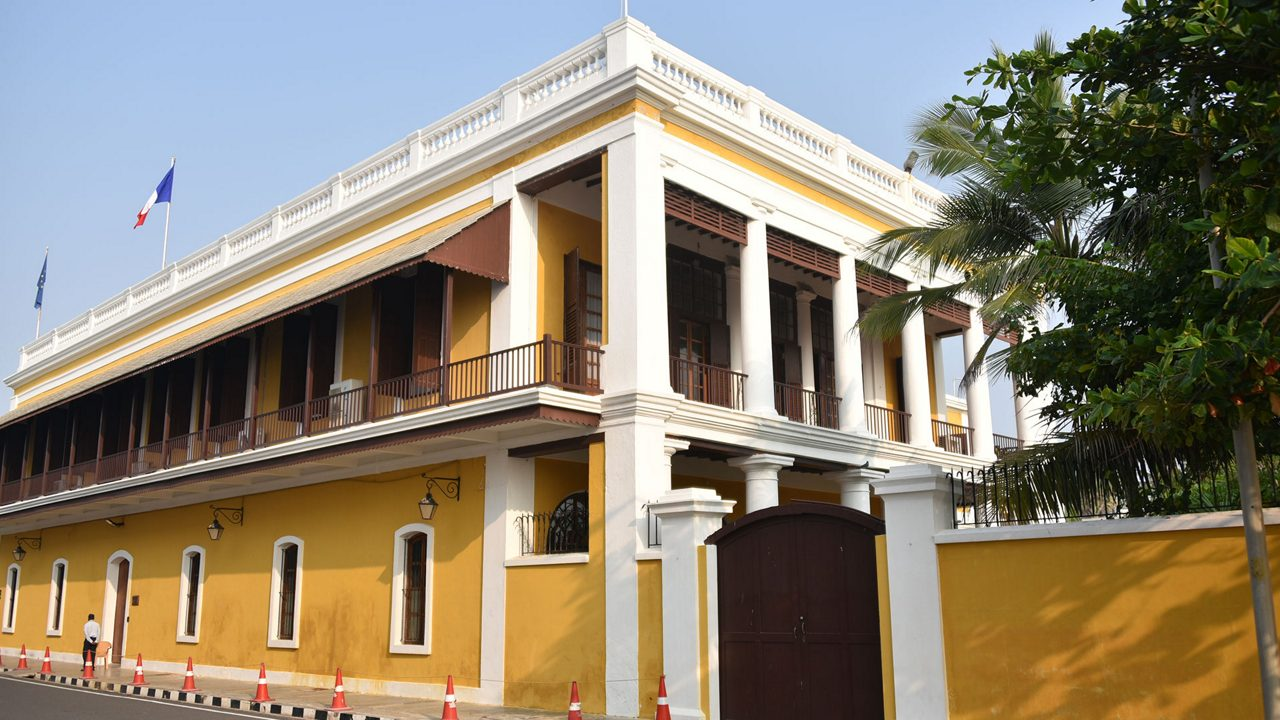
Puducherry is the Union Territory’s official name, while Pondicherry remains the widely used production and search term, and this page uses both as they are actually used on the ground. A line producer Pondicherry turns the town’s French-quarter and coastal locations into a permitted, costed shoot, working the local access and government permissions on the spot while drawing specialist crew and equipment down from Chennai. That split, local execution in Pondicherry backed by the Chennai supply base, is the practical model for larger and specialist shoots here.

Line Producer and Film Fixer in Pondicherry
The line producer and the fixer cover two parts of the same shoot. The line producer is the financial and logistical control: they cost and track the budget, hold the vendor and location contracts, arrange insurance, file the permissions and carry accountability for delivering the schedule. A line producer Puducherry engagement is what holds the government-location permits, the private-owner access and the Chennai supply run inside one accountable plan rather than a set of separate arrangements that meet only on the shooting day.
That control is what a producer is really buying. On a Pondicherry shoot the role runs the production office, sets the reporting the financier or studio expects, and manages cash flow across a schedule that mixes cheaper local days with more expensive Chennai inputs, while keeping the document trail that an international production, and any later audit, needs. It is the difference between a shoot that is coordinated and one that is merely arranged around a set of good-looking locations.
The film fixers in Pondicherry who work alongside the line producer are the access and coordination layer: owner and institutional contacts across the French and Tamil quarters, local crew, vehicle and small-equipment sourcing, police and municipal coordination, and the on-the-day problem-solving that keeps a heritage-street or beachfront location working. The roles are complementary, not alternatives. A single-day advertisement may take a scoped fixer engagement; a feature or series needs the full line producer, with the film fixers in Puducherry feeding location access into a schedule the line producer sequences, contracts and pays for.

Chennai as the Crew and Equipment Gateway
Pondicherry sits roughly 135 kilometres from Chennai airport, and the two work as one production corridor. Chennai is the specialist gateway: the studios, the high-end camera and lighting packages, the technocranes and specialist rigging, and the senior technical crew that a larger shoot draws on. Pondicherry supplies the local layer: fixers, location access and government-permission support, ground transport, unit accommodation and smaller suppliers. A line producer in Chennai base and a Pondicherry unit are commonly run as a single connected operation, with the specialist import identified in prep so it lands with the days that need it rather than being chased late.
The corridor runs in a single day each way, so a Pondicherry unit can pull a technocrane or a senior gaffer from Chennai for the days that need them and base the equipment in Pondicherry only for the scheduled days that require it. What stays local is everything that benefits from being on the ground: the fixers who maintain the current owner contacts and access information in White Town, the transport and accommodation, and the government-permission legwork. Sequencing that supply against the schedule is the core of what makes the two-city model economical rather than simply convenient.
The wider Union Territory also contains Karaikal, Mahe and Yanam, but these are geographically separate enclaves on different coasts, not nearby Pondicherry production locations, and they are planned as their own units if a brief ever needs them. For a Pondicherry shoot the relevant geography is the town, its immediate coastal corridor and the Chennai supply line, framed within the wider line producer in Tamil Nadu production region, which adjoins the Union Territory and connects it to Chennai.
Filming Locations: The Colonial Core
White Town and the French Quarter
White Town is the town’s defining look: mustard-and-white colonial villas, bougainvillea-draped walls, French street names and shuttered facades that photograph as a small European seaside town. It is also the most access-sensitive fabric in Pondicherry, because much of it is privately owned or run as boutique hotels and heritage properties, so a shoot here is built on owner agreements and neighbourhood liaison as much as on any government permit. The compactness is an advantage: a unit can hold several days of varied French-quarter cover within a short walk. The trade-off is that no two properties come on the same terms, so the schedule is assembled owner by owner rather than under a single permit.

The Promenade, Goubert Avenue and Rock Beach
The seafront along Goubert Avenue, the Promenade and Rock Beach is the town’s most recognisable public stretch, taking in the Gandhi statue, the old lighthouse and the war memorial. As public space it carries municipal and police coordination for any shoot with crew and equipment presence, and the pedestrian-only hours on the Promenade shape when a unit can work there. Dawn and the beach-plaza early hours are the prized windows, before foot traffic builds, and they are planned as fixed constraints rather than assumed. Vehicle access to the seafront and any structure on the beach itself add their own permissions on top of the standard public-space coordination.
The Tamil Quarter and Heritage Streets
West of the canal, the Tamil quarter offers a different and equally distinctive register: colour-washed Franco-Tamil houses with thinnai verandahs, temple streets and a denser, lived-in texture that reads as authentically South Indian rather than generically colonial. Access here leans even more on community liaison, because these are active residential streets. Landmarks such as the Sacred Heart of Jesus church and the town’s temples add institutional cover, each approached through its own custodian rather than a blanket town permit. The reward is a genuinely lived-in South Indian street texture that a set build cannot replicate, which is exactly why productions come for it rather than settling for a studio version.

Government, Institutional and Coastal Locations
Bharathi Park, Raj Nivas and Government Precincts
The government precinct around Bharathi Park, with the Aayi Mandapam monument at its centre and Raj Nivas, the Lieutenant Governor’s residence, on its northern edge, is the formal heart of the town. These are government-controlled locations, so filming here runs through the official permission route and its published fees, and the sensitive government buildings around the park carry their own conditions on access and equipment. A line producer confirms which specific precinct falls under which authority before the day is scheduled.
These precincts also carry the town’s civic and commemorative events, so the shooting calendar is checked against them, and security around the Lieutenant Governor’s residence and other sensitive buildings can constrain equipment, vehicle access and crowd staging on a given day. None of it is an obstacle to a well-planned shoot, but it is the kind of detail that decides whether a government-precinct day runs to time or loses hours at the barrier.

The Sri Aurobindo Ashram and the Botanical Garden
The Sri Aurobindo Ashram and its associated buildings are privately controlled institutions with their own rules on filming, and access is neither automatic nor covered by any government permit; it is sought directly from the institution and is often tightly restricted. The Botanical Garden, by contrast, is a government-managed site accessed through the official route. Grouping locations by their actual custodian is an important first step, because the permission route differs between government, private and institutional sites.
Chunnambar, Paradise Beach and the Backwaters
South of the town, Chunnambar and Paradise Beach add backwater and unspoilt-beach cover reached partly by boat, giving a schedule a natural-coast counterpoint to the colonial streets. Access involves the boat operators and the site management as well as the standard permissions, and the tidal and weather conditions govern the usable window. Together with the Promenade seafront, this coastal corridor is what lets a Pondicherry shoot hold both heritage-town and open-coast looks from one compact base. The boat legs and the tidal windows are built into the shooting order early, because a missed tide on a backwater day is not recoverable simply by staying later.

Auroville and Matrimandir: A Separate Permission Route
Auroville is frequently treated as part of Pondicherry, and operationally it belongs to the same Chennai-Pondicherry corridor, but it is not in the Union Territory: it lies in Villupuram district, Tamil Nadu, and it carries its own permission route entirely separate from the Puducherry government process. Filming or photography connected to Auroville is coordinated in advance through the Auroville Media Interface, and Matrimandir and any drone work are handled separately again, on their own terms and often with significant restriction.
For a production this means Auroville is planned as a distinct track from the first schedule draft, with its own lead time and its own approving body, and never folded into a Pondicherry town permit. The line producer keeps the Puducherry route separate from the Auroville Media Interface and Auroville Foundation process, adding any Tamil Nadu authority permissions required for the specific site or activity, because a clearance in one carries no weight in the others. Getting that separation right in prep is what keeps an Auroville sequence from stalling a town schedule that is otherwise cleared.
Permits and Government-Location Fees
For government-controlled locations, Puducherry publishes a defined permission route and fee schedule. The December 2024 Gazette lists government-location fees of ₹15,000 per day per location for cinema shooting and ₹10,000 per day per location for television serials, web series, advertisements, short films and documentaries, and a municipality or commune-panchayat jurisdiction may be treated as a single location for this structure. These are published government-location fees; they are not universal charges, and private, heritage or institutional properties set their own terms directly with the production.
The town’s published service standard lists movie-shooting permission through the Director-General of Police at thirty days. That is a published standard rather than a guaranteed turnaround, so it is confirmed for the specific brief and built into the prep calendar with margin rather than assumed at the minimum. Because a real schedule mixes government, private and institutional locations, the practical discipline is to file each route in parallel from the start of prep. Foreign productions may also require the relevant central permission through India Cine Hub, while local and site-specific permissions remain separate; the wider process is covered in our guide to filming permits in India.
In practice the fee schedule is only part of the picture. A government location carries the published per-day charge and the official permission; a private villa or boutique hotel in White Town sets its own rate and conditions directly; and an institution grants or refuses on its own terms regardless of any civic permit. A line producer prices all three correctly in the budget and files them in parallel, so the schedule is not held hostage to the slowest single approval or surprised by a location fee that was never a government matter in the first place.
The Incentive Position
No current general Puducherry cash rebate has been verified for ordinary incoming production. Targeted arts, tourism or sector schemes should not be treated as a production incentive unless the project receives written confirmation of eligibility. Eligible international projects are instead routed to the national incentive, covered in our India film incentives guidance, subject to its Indian-applicant and qualifying-expenditure rules.
Engaging the Pondicherry Production Team
An engagement here starts from a short brief: the locations or looks the production is chasing, the shoot window and rough schedule, the unit size and camera package, whether any Auroville access or foreign crew is involved, and the budget band. From those inputs the line producer’s first deliverable is a location-by-location plan that names who controls each site, government, private owner or institution, the route and cost against each, the Chennai supply run, and any Auroville track, with lead times attached so the schedule is permitted rather than merely intended.
Lead time is the variable that most often decides a Pondicherry schedule. The Director-General of Police route carries its published standard, a heritage owner may need an extended review and commercial negotiation, and an Auroville or institutional approval runs on its own calendar entirely, so the plan works backwards from the shoot dates to the earliest application each route demands. Built this way, a compact brief that looks simple on a location scout becomes a schedule that actually clears.
That map, more than the shoot itself, is where a Pondicherry schedule is made to hold together, because the town rewards identifying the correct authority, documentation and lead time for every location. Pondicherry local execution, backed by Chennai crew and equipment and with Auroville handled on its own route, is the proposition a line producer Pondicherry is engaged to deliver, and it is set up in prep rather than recovered on the day. Within the national picture the operation connects to a Line Producer India structure for any multi-state schedule.
