
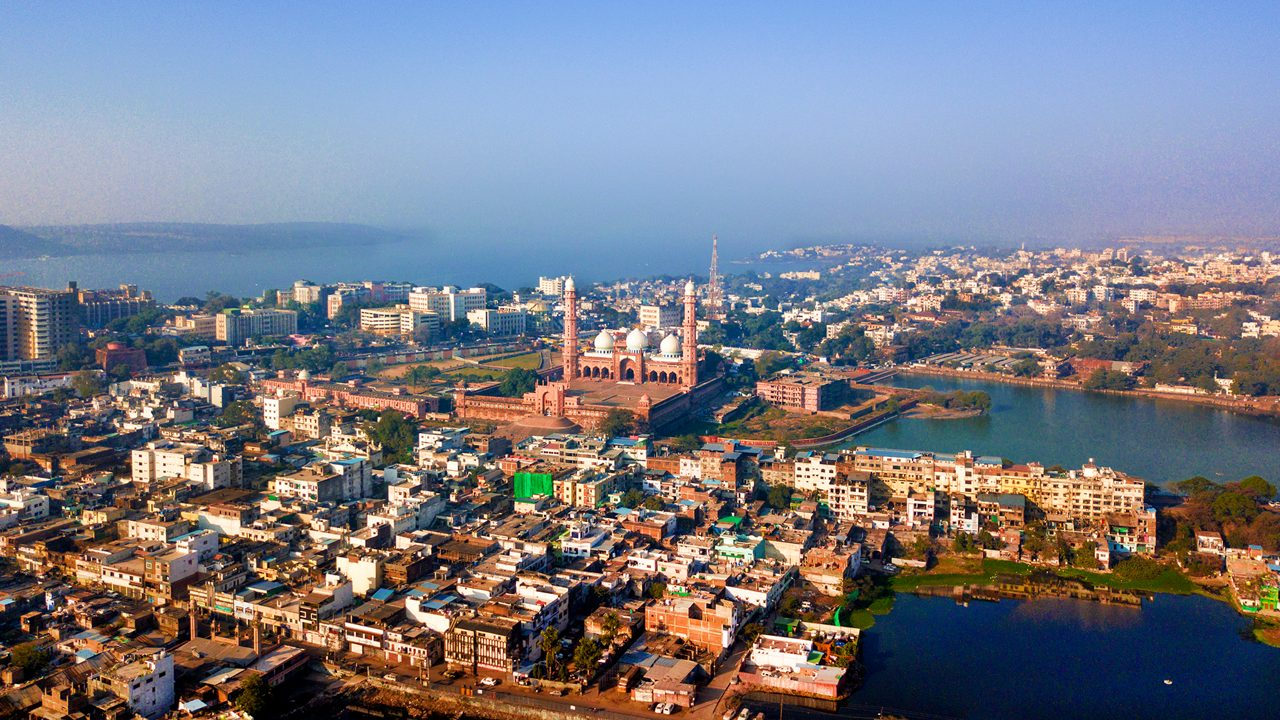
A line producer Bhopal team runs the shoot on the ground in Madhya Pradesh’s capital: budget and schedule, the Film Cell process and associated permits, local crew and kit, and the day-to-day logistics of a city built around two lakes and a dense heritage core. The role is end-to-end, covering recce, budget, scheduling, permits, crew, transport and wrap, for a feature, series or commercial that needs a full unit on the ground.
For a single location, documentary insert or compact commercial, a film fixer in Bhopal handles a narrower scope: access, permits, local crew and day-to-day coordination without carrying the complete production office. The search terms overlap, and the same local team may provide either service, but the responsibility changes with the brief: the fixer handles defined local tasks, while the line producer carries the full budget, schedule and production operation.
Bhopal earns its place on a schedule for three reasons. It is the administrative centre of Madhya Pradesh and the practical base for coordinating the state Film Cell, departmental permissions and city-level authorities. It holds a genuine spread of looks, from water to heritage and modern-institutional, within a short drive. And it sits at the centre of the state’s rail and road network, a practical base for a shoot that also touches Madhya Pradesh’s forts, forests and western towns.
What Bhopal Is, and Where It Leans
Bhopal is a state capital with an active but comparatively shallow production market, rather than a full-service film hub such as Mumbai. Its base is administration, education and heavy engineering (the seat of the Madhya Pradesh government, campuses such as MANIT and AIIMS Bhopal, and the BHEL industrial township), not production infrastructure. For a shoot that means the city supplies locations, clearances, a working base of general crew and a central position, but it does not hold the deep film supply chain a metro does: senior technical crew, high-end camera and lighting inventory, and finishing and post facilities are limited on the ground.
That is why Bhopal works as a hub rather than a self-contained production market. It sits in central India, with Nagpur to the south and Indore roughly four hours west. It draws on Mumbai for specialist crew, camera equipment and post-production; Delhi for cast and north-India talent; and Indore or Nagpur for additional vehicles, equipment and crew where availability permits. Larger schedules can coordinate the Mumbai component through our line producers in Mumbai network. A line producer plans around what Bhopal genuinely holds and imports the remainder from the nearest suitable market.

Filming Locations in Bhopal
The city divides broadly into three location families, and a multi-look schedule can combine them without long company moves. A line producer in Bhopal plans the day around that spread, since the looks change faster than the drive between them. The water frames come from the Upper Lake (Bada Talab, or Bhojtal) and the smaller Lower Lake, which give open-water horizons, boulevard edges and boat action in the middle of the city; the VIP Road causeway between them is a recognisable driving frame. Van Vihar adds a protected lake-edge forest and wildlife environment, subject to park approval, restricted crew movement and animal-welfare conditions; the Kerwa and Kaliasot dams on the outskirts give quieter water-and-greenery backdrops away from traffic.
Heritage and Old-City Frames
The heritage layer is one of Bhopal’s principal production draws. Gauhar Mahal and Sadar Manzil carry Indo-Islamic and colonial-era facades; Taj-ul-Masajid and Moti Masjid give mosque architecture at very different scales; Shaukat Mahal adds an unusual European-influenced frontage; and the lanes of the old city around Chowk hold period market texture. Charles Correa’s Bharat Bhavan and the Tribal Museum supply modernist and cultural-institution looks, so a single unit can move from nineteenth-century to contemporary within the same base.
Urban, Campus and Nearby Sites
For urban and institutional frames, the Old Vidhan Sabha has stood in for courts and government interiors, the MANIT and RGPV campuses give clean modern-India college and corporate settings, and New Market and the MP Nagar and DB City districts cover everyday commercial streets and mall interiors. Just outside the city, the Bhojeshwar temple at Bhojpur and the Bhimbetka rock shelters extend the range into ancient and archaeological frames: Bhojpur sits within an easy regional move, while Bhimbetka is normally planned as a longer half-day location block outside the city.
Season, Access and Interiors
Because the looks sit close together, a Bhopal day rarely loses hours to company moves; the real constraints are permits, lake wind that affects sync sound, and season. The most workable shooting window runs from October to March, when temperatures are moderate and rain disruption is limited; the July-to-September monsoon greens the landscape but carries schedule risk, and April to June is hot enough to restrict exterior work to cooler morning and late-afternoon periods.
The old-city heritage lanes are dense and lived-in, so crowd control and a tight footprint matter more than at a monument with its own compound, which is the reason local location coordination is necessary on those days.
Bhopal also offers workable interiors: heritage halls, institutional buildings and hotel interiors that double as sets, which cuts the need to build, though for controlled interior work many productions still bring a set-build crew from Mumbai. That mix of real locations and buildable interiors is part of why a heritage or period schedule pencils out here.

Permits and the Single-Window Film Cell
Madhya Pradesh routes permissions for state-government-controlled locations through its online Film Cell single-window system. A line producer in Bhopal maps each location to the Film Cell and any additional municipal, police, forest, heritage or custodial approval it requires. Public roads, lakefront areas, boats, parks, religious properties, museums and protected monuments do not necessarily share one issuing authority, so the controlling body for each proposed camera position and activity is confirmed before filing through the Film Cell or the relevant custodian.
The portal handles state-location applications for Indian and international productions. International films, web series and TV serials require filming permission from the Ministry of Information and Broadcasting, while international documentaries, AV commercials and music videos require permission from the Ministry of External Affairs.
Sequencing, Documents and Lead Times
The practical work is sequencing. Lakefront filming may require Film Cell facilitation together with municipal, traffic, custodial or water-activity permissions, depending on the exact camera position and activity, and those are filed early because they carry conditions on access, timing and crowd control. City shoots that hold traffic or use a public street bring in police and traffic coordination, arranged in advance. Aerial work over the lakes and old city runs under DGCA Digital Sky clearance, and heritage or religious sites add etiquette and access windows a fixer builds in.
Documents and Clearance Times
Each application carries a standard document set: a synopsis or relevant script pages, a shot and equipment list, shoot dates, crew and vehicle details, and, for many sites, an indemnity and a refundable security deposit. Where a selected location is protected by the Archaeological Survey of India, its separate application, tariff and restrictions apply in addition to the state process, and religious sites set the kind of scene that may be filmed at all.
The Film Cell states a 15-day clearance objective for a complete application covering locations and facilities controlled by state-government departments. That window does not automatically bind private owners, religious custodians, ASI sites, aviation authorities or other bodies outside the state-government permission envelope, so those are identified and filed early. Film fixers in Bhopal who understand the current civic and custodial filing routes help identify the correct authority, documentation, filing route and follow-up process for each site, though approvals still depend on a complete application and the conditions attached to each location.
Any state film incentive sits above all of this and is assessed at state-project level rather than per location, so a Bhopal budget carries it as a Madhya Pradesh line rather than a city one. Eligibility, caps and qualifying expenditure are assessed and administered across the full Madhya Pradesh schedule by a line producer Madhya Pradesh, and checked against the policy and notifications in force when the project registers.

Crew, Kit and Getting to Bhopal
Local Crew, Kit and Cost
Bhopal supports a working base of production coordinators, location staff, drivers, art-department labour and general lighting and grip crew. Compact commercials and documentary units can often be serviced locally, while larger units commonly import specialist camera packages, senior technical heads and substantial lighting orders.
Accommodation runs from heritage-hotel bases that double as period locations to business hotels near the airport and MP Nagar, keeping cast and crew close to both the old-city locations and the arrival point. A local production office and vendor base (vehicles, generators, catering, security and construction labour) can be assembled within the city for most of a mid-size shoot.
On cost, Bhopal generally carries lower local labour, transport and accommodation costs than Mumbai. Location costs vary by custodian, property type, closure requirement and production footprint. The offset is the travel and hire cost of crew and equipment imported for the shoot, so the relevant question is whether the local savings remain after imported crew, equipment, freight and travel are added. The Bhopal line-production team sizes that split at the budget stage, keeping as much local as the brief allows.
Access and the Feeder Cities
Connectivity is the city’s real advantage. Raja Bhoj Airport currently has nonstop connectivity to Delhi and Mumbai, subject to airline schedules, so cast, department heads and time-sensitive equipment reach Bhopal without an intermediate road transfer. Bhopal Junction is a major node on the Delhi–Chennai trunk route with fast services to both Delhi and Mumbai, which makes rail a genuine option for moving crew and non-urgent kit at a fraction of the air cost. National-highway links handle vehicles, generators and set-build materials.

Bhopal and Indore: a Two-City Plan Across the State
Madhya Pradesh schedules that combine central and western locations often use both Bhopal and Indore. Indore sits about a hundred and ninety kilometres west, three to four hours by road, and provides the stronger western Madhya Pradesh air and vendor base, a practical second base for schedules extending into western Madhya Pradesh. Pairing the two cities lets a production draw crew and kit from both and widens the location set, with the film fixers in Indore running that western base and the Mandu, Maheshwar and Omkareshwar circuit it opens up.
The two cities also anchor the state’s wider circuits. Satpura can be planned as a separate regional block from Bhopal; Kanha, Pench and Bandhavgarh require their own travel days, accommodation bases, forest-permission tracks and seasonal planning, and are treated as separate production legs rather than extensions of a city schedule. From Indore, the western heritage towns come into range, so a producer holding both cities can plan urban, heritage and forest as connected but distinct blocks rather than doubling back.
A two-city plan can create scheduling flexibility, but only where both legs are permitted, crewed and provisionally held in advance; otherwise a unit cannot simply switch cities when a window slips. Where that groundwork is done, the Bhopal production team coordinates with the Indore team, moving one core crew between the two rather than re-hiring in each.

Bhopal On Screen
Bhopal and its surrounding districts have hosted Hindi features, streaming projects and commercials across lakefront, campus, civic and rural locations. Neeraj Ghaywan’s Homebound, for example, filmed extensively around Bhopal and Sehore in 2024. Earlier productions have also used the city’s government buildings, campuses and heritage core, which is why many custodians already understand a unit’s requirements.
That track record matters practically. Previous filming means many custodians understand production requirements, although access, fees and conditions are still approved project by project, and the local crew has worked to feature and series standards. A film fixer in Bhopal who has worked those locations reduces avoidable delay by anticipating each custodian’s documentation, access windows and operating restrictions.
What Bhopal Suits, and What It Does Not
Bhopal is strongest for heritage and period work, lake and water frames, government-building and institutional interiors, and the texture of a mid-size, non-metro Indian city, the setting a script calls a state capital, a small town, or an older India. Across that range, film production services in Bhopal can deliver full local execution while importing the specialist crew and equipment the brief requires.
What Bhopal does not offer is a high-rise metropolitan skyline, a coastline, snow or high-altitude terrain. Those requirements belong to other production bases and should be assigned to separate schedule blocks. Being clear about that during the recce is part of the line producer’s job: when a required look does not exist in Bhopal, the unit should be placed elsewhere rather than forcing an unconvincing substitute. On a multi-state schedule, that allocation forms part of the wider coordination handled by line producers in India.

Budgeting and Booking the Bhopal Production Team
A Bhopal budget is built the way any city shoot is, from crew, kit and locations to permits, transport, accommodation and contingency, with any state film incentive applied at the Madhya Pradesh level rather than the city. Central and state eligibility are assessed separately, and combined recovery remains provisional until both treatments are confirmed. How the state and central positions compare is set out in our India film incentives guide and the India film rebates by state comparison.
Booked through one production-services company, crew, equipment, permits, transport and accommodation sit under one accountable budget and reporting structure rather than being contracted through unrelated local vendors.
Booking early matters in Bhopal because long-lead permits, seasonal hotel demand and imported crew and equipment all reward a locked schedule, so the productions that run smoothest in Bhopal are the ones that confirm dates and locations weeks ahead rather than arriving to negotiate on the ground.
Share the script or brief, proposed locations, dates and budget range, and the Bhopal team can map the permit route, the local-versus-imported crew split, the equipment plan and any Indore, Mumbai or Delhi feeder requirements before the schedule is locked.
