
Line production facilities in India sit across three primary hubs: Mumbai, the Delhi and NCR belt, and Hyderabad. Between them they hold the soundstages, backlots, camera and lighting inventories and post-production labs that international productions actually book. A facility is not the same as a location. A location gives a look. A facility gives controlled space, power, rigging and the crew base to shoot on schedule regardless of weather or daylight. India’s studio infrastructure has widened well beyond the Mumbai core, and a unit planning a feature, series or commercial can now assemble stages, gear and finishing under one coordinated calendar rather than stitching them together across borders.
This guide maps the studios, soundstages, equipment houses and crew infrastructure across those hubs, and how a line producer in India ties them into a single bookable plan. Reading facilities correctly, meaning who holds what capacity and where, is the first step in budgeting an India shoot around real availability rather than assumption. It is also where the country’s cash rebate is quietly won or left on the table, because the same facility spend that fills a schedule is what qualifies for recovery.
Why India Competes on Facilities, Not Just Locations
For a long time India sold itself to international productions on locations: the palaces, the deserts, the backwaters, the Himalaya. Those still matter, but the reason large shoots now commit to India is that the built infrastructure has caught up with the scenery. A country can offer a striking backdrop and still be unworkable if there is no stage to fall back on when it rains, no rental house holding the right camera, and no crew that can rig it. India no longer has that gap.
The shift has been driven by the domestic industry’s own scale. India makes more films a year than anywhere on earth, and the streaming boom has poured investment into stages, virtual-production volumes and post houses. That capacity was built for local demand, but it is fully available to international units, which means an incoming production inherits an ecosystem sized for one of the busiest film markets in the world rather than a boutique service industry built only for visitors.
India’s Facility Map: Mumbai, Delhi-NCR and Hyderabad
Three metros carry the weight. Mumbai is the deepest studio and crew market and the historic centre of the industry. Hyderabad holds the single largest studio campus in the world. The Delhi and NCR belt is scaling fastest, anchored by Noida and a major new film city under construction. Each hub has a different centre of gravity, and most large productions end up drawing on more than one, which is why the map matters before the booking. Read together, they are the line production facilities in India that international shoots actually draw on.

Mumbai: Film City, Yash Raj and the Studio Core
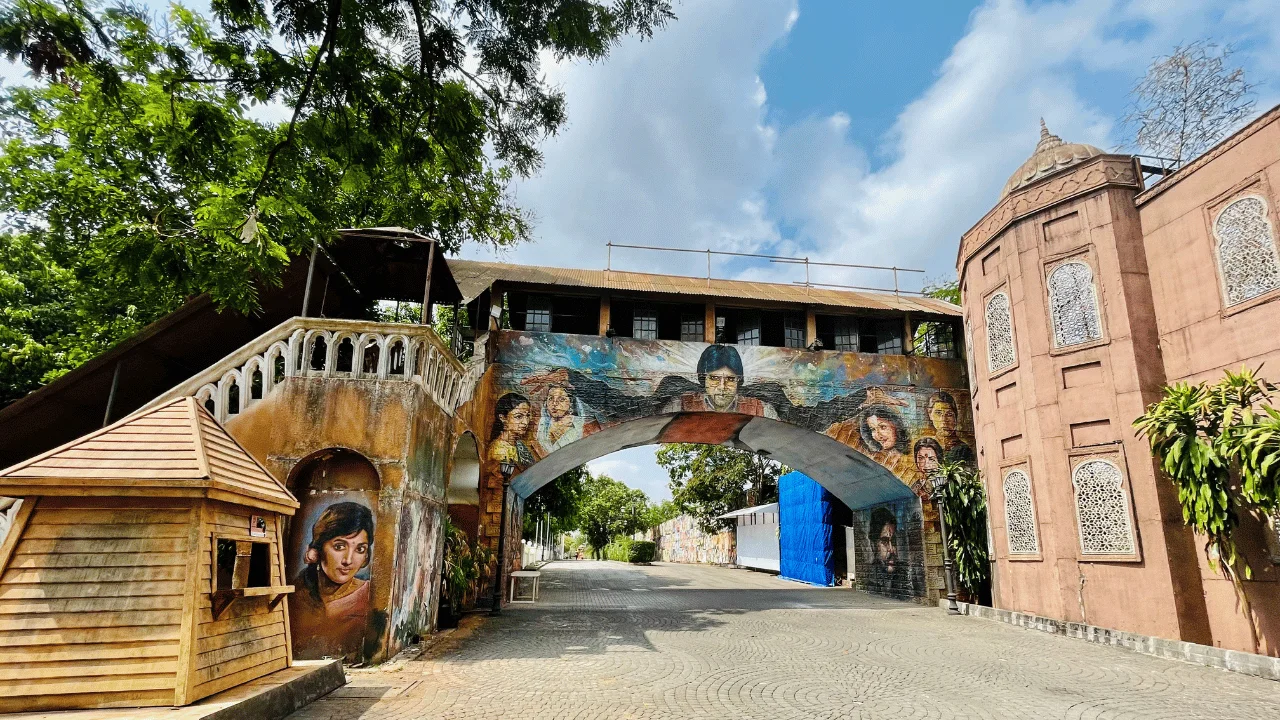
Film City in Goregaon, formally the Dadasaheb Phalke Chitranagari, is the anchor. It runs to roughly 520 acres with about 42 outdoor shooting zones and 16 sound stages, alongside permanent sets for temples, courts, villages and gardens plus man-made lakes and hills. Yash Raj Studios in Andheri sits at the premium end, with multi-floor stages, integrated post-production suites and India’s first in-sync recording stage, where dialogue is captured live on the take rather than dubbed later. Mehboob Studio in Bandra, Filmistan, Famous Studios and ND Studios out at Karjat fill in a dense studio grid that no other Indian city matches for concentration.
Mumbai’s real advantage is exactly that concentration. Stages, equipment houses, post facilities and the country’s deepest crew pool sit inside one metro, which keeps day rates competitive and cuts the travel and per-diem load that multi-city schedules carry. The city also runs an enormous advertising and streaming volume, so vendors are used to fast turnarounds and international standards. For most incoming features and series, Mumbai is still the default first stop before a shoot fans out to locations across the country.

Delhi-NCR: Noida Film City and the New YEIDA Hub
The established base is Noida Film City in Sector 16A, founded in 1988 by Sandeep Marwah. It spans about 100 acres, split roughly 75 outdoor and 25 indoor, with 16 studios, the Marwah Studios complex and the Asian Academy of Film and Television, and a working media population reported in the thousands. It has long been the northern centre for news, television and advertising production, with a crew base that turns over high volumes of commercial work and sits close to Delhi’s institutional and heritage locations.
The larger story is under construction nearby. The YEIDA International Film City in Sector 21 of Greater Noida is planned across roughly 1,000 acres and developed by a Bayview Bhutani consortium led by Boney Kapoor and Bhutani Infrastructure. Its phase one layout was cleared by YEIDA in June 2025 and construction has begun, with about 230 acres of studios and an 80-acre film institute in the first phase against an investment reported near 1,500 crore rupees. As it comes online later this decade, the NCR belt is the region most likely to shift India’s studio balance away from a single Mumbai centre and give northern shoots a full-scale campus of their own.

Hyderabad: Ramoji Film City, the World’s Largest
Ramoji Film City, opened in 1996 on about 1,666 acres, was recognised by Guinness World Records in 2005 as the world’s largest film studio complex. It holds roughly 47 sound stages and 50 studio floors, permanent sets that include a railway station, an airport, mansions and full streetscapes, and post-production labs covering editing, visual effects and dubbing. By its own account the campus can carry up to 20 international or 40 domestic productions at once across some 500 locations, with a standing pool of around 6,000 personnel available for hire. For scale, Universal Studios in Hollywood covers about 400 acres, so Ramoji is several times the size of a marquee Hollywood lot.
Ramoji’s draw is self-containment. Stages, standing sets, crew, accommodation and finishing all sit inside one gated campus, which suits long shooting blocks and productions that want to lock a controlled environment rather than move a unit across a city every few days. Hyderabad also carries the deep technical crew built by the Telugu industry, which routinely mounts some of India’s largest-scale productions. It is the clearest example of India competing on facility scale rather than on location appeal alone.

Soundstages and Virtual Production
Beyond raw floor count, what a soundstage delivers is control: sound isolation, rigging load, blackout for day-independent scheduling and the ability to light a set the same way at any hour. India’s stage inventory now runs from modest television floors to premium acoustically treated stages, and a production choosing between them is really choosing how much of the shoot it wants to make weather-proof and repeatable. Stage size, clear height, power supply and soundproofing are the specifications that decide whether a given floor can carry a build, and they vary widely across the hubs.
Stage Types and Specifications
Stages are not generic space. A large feature build needs clear height for rigging and a grid rated for heavy lighting, while a talk-format or product shoot can run on a far smaller floor. India’s inventory covers the full range, from compact television studios to stages big enough for standing architectural builds, and the specifications that actually decide a booking are usable floor area, clear height to the grid, power capacity, soundproofing and load-in access for trucks and cranes. Matching the build to the right class of stage, rather than booking on name alone, is what keeps a studio day efficient, and it is a judgement that depends on reading the technical sheet rather than the brochure.
The hubs differ in what they hold at the top end. Mumbai and Hyderabad carry the largest and best-equipped stages, while the NCR belt is strongest on mid-size floors geared to television, advertising and OTT. A production that needs a single very large build will find its options concentrated in two cities, whereas a multi-stage schedule of medium floors has more geographic choice. Knowing that distribution in advance avoids committing to a hub that cannot actually hold the biggest set on the list.
Virtual Production and LED Volumes
The top end of the market has moved into virtual production. LED volume stages comparable to the setups used on large streaming series are now operating in Mumbai, with facilities carrying immersive-audio and virtual-production capability alongside conventional floors. That capability changes the budgeting logic: a production that would once have travelled for a backdrop can increasingly build it in-volume and shoot it under controlled light, with the set extension rendered live behind the actors.
The trade-off is real and worth modelling. Volume time and content build carry their own cost, so it only pays where travel, permits and weather risk on a distant location would have cost more. Handling studio and soundstage procurement inside India lets a unit compare stage rental, rigging and virtual-production hours directly against the price of moving cast and crew, and decide the mix at budget stage rather than on the floor.

Camera, Grip and Lighting: Equipment Infrastructure
Facilities are only useful if the gear matches. India’s rental market is deep and current. Houses such as Accord Equips, established in 1997 with bases in Mumbai and Pune, Flamingo Films in Delhi for camera, lighting and grip, and app-based platforms like Camorent operating across several cities, stock current-generation packages: ARRI Alexa 35 and Mini LF bodies, RED and Sony Venice systems, and premium optics from Cooke, Zeiss and Angenieux, alongside dollies, jibs, technocranes and Steadicam rigs. Specialised kit such as drones, underwater housings and remote heads is available through dedicated vendors rather than freighted in.
Domestic Sourcing Versus a Carnet
For an international production the practical effect is that most premium camera and lighting packages can be sourced domestically rather than carried in under an ATA carnet. That trims both shipping cost and customs exposure, and it removes the risk of gear being held at the border while a schedule waits. A visiting director of photography can standardise on the same bodies and glass they would use anywhere, supported by local assistants and technicians who already know the kit, so the saving does not come at the cost of familiarity or reliability. Expendables, grip trucks and generators are equally available locally, which keeps the whole package on one invoice. The airport cargo and customs checklist for film equipment covers the paperwork either route needs.

Crew Infrastructure and Post-Production
The facility map only works because of the crew behind it. India carries deep benches of cinematographers, gaffers, sound recordists, art departments and production coordinators, concentrated in Mumbai and Hyderabad and increasingly across the NCR belt. Much of the senior crew works to international standards and in English, which is a large part of why studios and streamers place demanding shoots here with confidence. Local crew associations set rate cards and working norms, and a production that engages them through an experienced coordinator avoids the friction that catches first-time visitors.
Post-Production and Finishing Depth
Post-production is equally established. Editing, visual effects and dubbing run at scale through the Ramoji labs and a wide network of Mumbai and Hyderabad finishing houses, several of which deliver work for international features and series, which is a large part of why India’s film infrastructure now handles international-standard projects end to end. Crew depth is also the quiet reason India can absorb a large unit without importing most of its team. A production books the stage and the gear, but it is the standing crew base that determines whether a demanding schedule actually holds, and it is the hardest part of the infrastructure for a newer hub to replicate quickly.
Delivery is the other half. Indian post houses routinely master to international broadcast and streaming specifications, grade in dedicated DI theatres and mix in certified sound rooms, so a production can finish to a platform’s delivery standard without moving the material offshore. For a shoot that has already spent its stage and crew budget in India, keeping post in-country also keeps that spend inside the qualifying base for the rebate, which is one more reason finishing is worth planning as part of the facility package rather than treating it as a separate, later decision.
Access, Permits and Booking Lead Times
Booking a facility is more than reserving dates. Major studios and film cities run their own access, security and insurance requirements, and a production has to clear those alongside any civic filming permissions the shoot needs outside the gates. Lead times matter as much as rates: premium stages and volume time in the busy hubs are held well in advance, and popular campuses such as Ramoji or Film City can be committed months out during peak windows. Building the facility holds early, with fallback options against a moving schedule, is part of protecting the shoot rather than an afterthought.
Access also carries paperwork. Foreign productions typically work through a locally registered entity and the appropriate crew authorisations, and studios will want proof of insurance and, for some sets, method and safety documentation before a unit loads in. None of this is onerous when it is handled in prep by someone who books these floors regularly, but it is exactly the kind of detail that stalls a first-time production trying to arrange a stage from abroad, and it is one more reason facility access tends to run through a local coordinator.

How Facilities Tie to India’s Cash Rebate
Facility spend is not just a cost line, it is qualifying spend. Stage rental, equipment hire, local crew and post-production carried out inside the country all feed the base that India’s cash rebate is calculated against, so using domestic film production facilities in India deliberately raises the amount a production can recover rather than simply reducing its outlay. The India cash rebate reference sets out how the central incentive, its percentage and its caps work in practice.
The planning consequence is straightforward. A shoot that routes stages, gear and finishing through Indian facilities, instead of importing them, both lowers gross cost and lifts the qualifying base, and the two effects compound across a budget. Several states layer their own incentives and single-window clearances on top of the central scheme, so the choice of hub can affect the total recovery as well as the day rate. That is why facility choice and incentive strategy are best decided together at budget stage rather than after.
Common Mistakes Productions Make With Indian Facilities
The most common mistake is treating India as a location market and discovering the facility side late. Productions arrive with a detailed location list and no stage plan, then find that the weather cover, the build space or the volume time they assumed would be available is already booked, or sits in a different city from their locations. The facility map should be read at the same time as the location scout, not bolted on afterwards when the schedule is already fixed.
The second is underestimating how much the hub choice drives both cost and rebate. Picking a studio for its name, without checking crew availability, equipment depth and the state incentives attached to that region, can quietly raise the budget and shrink the recovery at the same time. The facilities themselves are world-class, but they reward a production that plans around real capacity and books through people who work these stages every week rather than once a year. A worked example of that discipline is documented in our multi-state India shoot case study.
Choosing the Right Hub for Your Shoot
The hubs are not interchangeable, and the right one depends on the shoot. Mumbai suits productions that need the deepest crew and vendor market, fast access to stages and post, and a base that can flex across genres from features to high-end commercials. Its cost of working is the highest of the three, but so is its capacity and speed. For a project built around studio work, coverage and turnaround, it remains the safest default.
Hyderabad makes sense when scale and self-containment matter more than proximity to the industry’s commercial centre: long schedules, large builds, and productions that want stages, sets, accommodation and post inside one campus. The NCR belt is the value and volume option for the north, strong on advertising and OTT, close to Delhi’s institutional locations, and set to grow sharply as the YEIDA campus opens. Many large productions split across two hubs, and sequencing that split well, the kind of Mumbai and Delhi logistics that decides whether a two-hub schedule holds, is where planning earns its keep.

Planning Facility Access with a Line Producer
Facilities do not book themselves in sequence. Stage availability, equipment holds, crew calendars, permits and post slots all have to be locked against one shooting plan, often across more than one hub, and that coordination is the line producer’s job. Running multi-city production pipelines in India means holding those vendor relationships across hubs, turning a facility wishlist into confirmed dates and rates, and keeping the schedule intact when one element moves at short notice.
For an incoming production the single accountable contact matters more than any one stage. It is what lets a unit compare the line production facilities in India across Mumbai, Hyderabad and the NCR belt on real availability and cost, route the qualifying spend correctly, and hold the whole plan together from prep through delivery. India’s facilities now rival the established hubs on capacity, from soundstages and LED volumes to equipment and crew. The remaining variable is coordination, and that is exactly what a line producer is there to supply. Our vendor evaluation checklist for selecting a line producer in India sets out what to check before committing.
