
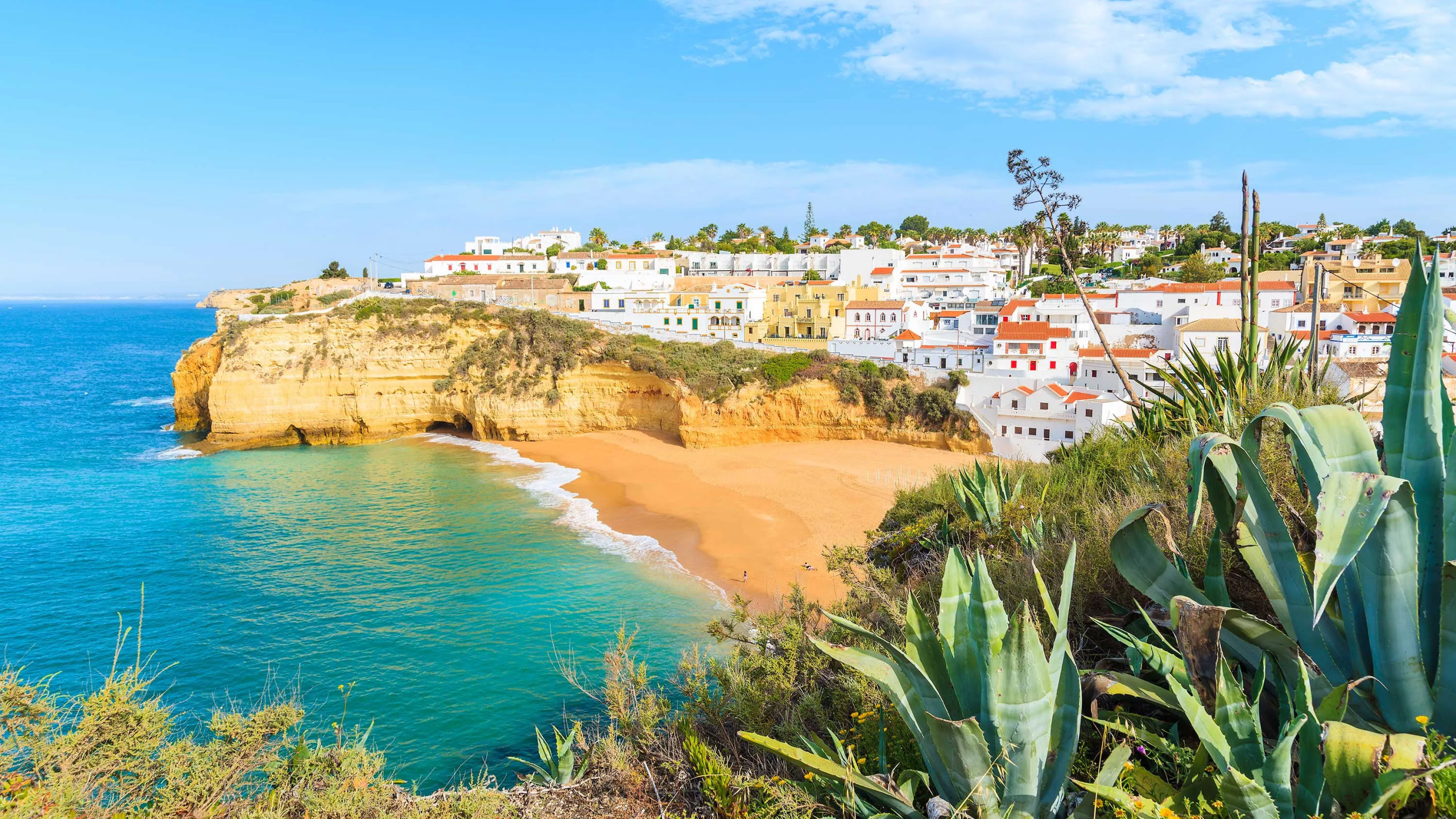
Our Line Producer Portugal desk coordinates crews, permits, equipment and countrywide logistics for international features, OTT series, documentaries and commercials across Lisbon, Porto, Alentejo and the Algarve. Film fixers in Portugal handle scouting, local access and field coordination, while the line producer stays accountable for the budget, schedule, contracts and national execution. Productions base in Lisbon or Porto and build regional legs from there, working through one accountable team from prep to wrap.
Why Portugal Works as a European Production Base
Portugal’s position within the European production corridor is grounded in geographic diversity and practical accessibility. Within a single production base, the Portugal line producer manages Atlantic coastlines, medieval city centres, cork-forest plains and a cliff-edged southern coastline: four visually distinct environments within a compact territory, most of them reachable from a Lisbon base in a few hours, though the far north and the Algarve are longer road moves. This concentration of location variety within a compact, politically stable territory is the first reason international productions route through Lisbon rather than assembling the same diversity by moving across multiple European countries.
The second reason is structural. Portugal operates within the EU compliance framework, participates in bilateral and multilateral co-production frameworks administered through ICA, including the European Convention on Cinematographic Co-production and Eurimages. This means productions structured through Portugal can access European co-production advantages (tax treaty benefits, territorial distribution rights, and broadcaster co-financing relationships) without the administrative complexity of multi-territory structure.
Primary Regions
Portugal’s four primary production regions each serve a distinct creative function. Porto and the northern Douro Valley provide riverside industrial heritage, granite architecture, and the dramatic terraced vine landscape that doubles for central European and South American environments. Lisbon operates as the principal base: production offices, crew infrastructure, equipment rental, and hotel accommodation concentrated in a city that offers Moorish, Pombaline, and contemporary architectural zones within walking distance of each other. Alentejo provides the uninterrupted plains, cork forests, and frontier light that substitutes cleanly for North Africa, the American Southwest, or generic European rural settings with minimal production logistics. The Algarve delivers Atlantic cliff formations, sea-access filming, and beach environments that serve both commercial and dramatic production formats.

Location Diversity From Porto to the Algarve
Porto’s Ribeira district is a UNESCO World Heritage zone, and municipal filming there is coordinated through Filmaporto, the city’s film commission; individual monuments, private properties, traffic changes and other controlled assets can each carry an additional approval on top of the municipal clearance. Movement restrictions inside the core zone are real; heavy equipment requires phased access and specific entry points. What Porto offers in return is an architectural texture that photographs distinctly European without looking generically French or Italian, which is why it is a regular choice for period and contemporary European narratives.
Sintra, accessible within forty minutes of Lisbon, provides palace architecture and forested terrain within and around the Sintra-Cascais protected landscape, where commercial filming may require ICNF authorisation in addition to municipal or property approval. Shoot windows inside the palace complexes managed by Parques de Sintra are allocated through a separate application process from the standard Lisbon municipal permit system. Coastal Cascais and Estoril add Atlantic cliff and resort environments within the same day’s reach.
Film Fixer Portugal: Local Access and Production Coordination
Film fixers in Portugal coordinate with Parques de Sintra, municipal film offices, landowners and marina or maritime authorities, keeping the correct application, access conditions and lead time aligned with the shooting plan. Local communication supports the process but does not replace the authority’s approval.
For productions entering Portugal through the Europe line producer and film production guide, Portugal functions as one of the most accessible Atlantic entry points, operationally mature, English-fluent at the production level, and connected to the continental crew and equipment network through established routes.

ICA Registration and Portugal’s Permit Framework
The Instituto do Cinema e do Audiovisual (ICA) is Portugal’s national film and audiovisual authority. It administers both the incentive programme and the production registration used to access it. Whether an ICA filing is required, and which one, depends on the production, the incentive track and the certification route rather than applying automatically to every shoot. ICA is not a location permit authority; it does not issue permits for individual locations, give a production general legal standing to film in Portugal, or endorse local permit applications. Entity registration, work registration, the incentive application, official co-production certification and shooting-visa documentation are separate processes, each applying in its own situation, and none of them replaces the municipal, heritage, private-property, maritime or protected-area approval a specific location needs.
The permit system for location-specific access is distributed across the relevant municipal or heritage authority for each location type. Understanding the difference between ICA’s role and the local permit authority’s role is one of the first things the line producer clarifies for incoming productions: they are parallel processes, not sequential ones, and both must be initiated early rather than completed after creative decisions are finalised.
When ICA Registration Applies
ICA entity registration, work registration, official co-production recognition, shooting-visa documentation and a SCRI.PT application are separate processes. An eligible applicant, which may be a line production company in Portugal, completes only the ICA and production filings relevant to the project. None of these filings grants location access or replaces municipal, heritage, maritime, protected-area or private-property permission.

Location-Specific Permits: Lisbon, Porto, Heritage Sites and Coastal Zones
Lisbon municipal filming permits are handled through the Câmara Municipal de Lisboa’s events and filming department. Street filming, public space access, traffic management, and crowd control coordination all route through the municipal system. As a production-planning allowance rather than a guaranteed authority timeline, standard Lisbon permits are typically scheduled around three to ten working days for uncomplicated urban locations. Heritage sites within Lisbon, in parts of Alfama, Belém and the Pombaline downtown, carry additional review with the responsible heritage authority, Património Cultural, I.P. or Museus e Monumentos de Portugal, E.P.E. depending on the site, and are handled structure by structure rather than under a single heritage approval.
Porto permits for the Ribeira and historic centre are submitted through Filmaporto and the Câmara Municipal do Porto, and individual monuments and controlled assets inside the UNESCO zone can each carry their own additional approval. Algarve coastal filming, particularly for sea-access sequences involving boats, underwater filming, or cliff-face proximity work, involves the maritime authority alongside the relevant municipal body. As a planning allowance rather than a guaranteed timeline, productions planning coastal sequences should build a minimum of around fifteen working days of permit lead time into their pre-production schedule regardless of how straightforward the shot list appears.

Incentive Planning Within a Portugal Production Budget
Portugal provides production support through SCRI.PT for qualifying film and audiovisual projects, with separate routes for medium-budget and large productions. Eligibility depends on the applicant structure, qualifying Portuguese expenditure, cultural assessment and available programme funding. Rates, thresholds, regional treatment, payment schedules and the full claim process are maintained in our Portugal film incentives guide.
Crew, Equipment and Line Production in Portugal
Film production services in Portugal are concentrated in Lisbon, with a secondary base in Porto that covers northern productions. The Lisbon crew market is the largest in the country and has developed through decades of international co-productions, advertising film production for the European market, and a steady flow of streaming platform original productions since 2015. The result is a crew base that is experienced in international working methods, English-fluent at the HOD level, and accustomed to the pace and communication standards of UK, American, and German production companies.
The practical consequence for a Portugal film fixer managing an incoming international shoot is that crew conversations happen at professional speed. Department heads understand prep timelines, shooting ratios, and post-production delivery standards. The discussion is not about explaining how an international shoot works; it is about fitting the specific requirements of the incoming production into the available crew pool with the right lead time.
Portuguese Crew Base: Departments, Language and International Experience
The strongest departments in the Portuguese crew market are cinematography, art direction, and production design. Portuguese DPs trained through the national film school system and through co-production experience with French and Brazilian productions bring a sophisticated visual language to international work. The art department (set designers, prop masters, location art directors) has been consistently developed through the advertising production sector, where Portugal has been a preferred European location for European and American campaigns for over twenty years.
Sound departments are well-equipped for drama and commercial production. VFX supervision and on-set data management have grown substantially through the streaming platform productions that have used Lisbon as a base. Below-the-line crew (grips, gaffers, standby props, costume, makeup) is available in sufficient depth for single-unit drama productions and mid-scale commercial shoots. Multi-unit or very large-scale productions may need to supplement with crew from Spain or the UK, which established European crewing arrangements accommodate without significant friction.
Equipment, Facilities and the Production Fixer Network
Lisbon has established camera, lighting and grip suppliers stocking current-generation cinema systems (ARRI, RED, Sony Venice) alongside standard and specialist grip equipment, with Porto covering lighter packages and larger orders routed from Lisbon when required. Equipment already in EU free circulation moves to Portugal without a fresh import declaration at an internal EU border, subject to the applicable transport, insurance and tax documentation. Equipment arriving from the United Kingdom, the United States or another non-EU origin requires an ATA Carnet or another customs-approved temporary-admission procedure coordinated with the production’s customs broker. ICA registration does not itself create a customs exemption.
Film fixers in Portugal with an established vendor network provide access to suppliers who do not maintain English-language public presences: production vehicles, specialist transport, marine logistics for coastal shoots, Alentejo-based agricultural vehicle hire for rural sequences, and heritage property access through private owner relationships that are not listed through public channels. This network is the practical layer that separates productions that encounter Portugal as a straightforward territory from those that spend pre-production chasing vendors through channels that do not connect reliably.

Filming Across Portugal’s Key Locations
Portugal’s location profile rewards productions that approach each region with a clear understanding of what it offers on the ground, not just visually. The four primary regions (Lisbon and its surrounds, Porto and the Douro, Alentejo, and the Algarve) function under distinct permit frameworks, carry different infrastructure profiles, and present different logistical demands. A Portugal line producer managing a multi-location shoot treats each region as a separate operational context connected by a shared production base rather than as interchangeable settings within a single continuous shoot.
The practical starting point for any Portugal production is Lisbon. The capital concentrates the majority of the country’s production infrastructure: crew, equipment rental, post-production facilities, production offices, international hotels, and the ICA registration office. Even productions that will spend most of their shooting days in Alentejo or the Algarve typically base themselves in Lisbon for logistics and use the regions as shooting days reached by road. Porto-centric productions maintain their own base in the north, with Lisbon supplying specialist equipment and crew that the Porto market cannot provide at scale.
Lisbon and Sintra: Urban, Heritage and Atlantic Surrounds
Lisbon’s filming environment is genuinely diverse within a compact geography. The Alfama district offers Moorish-origin architecture, steep lanes, and tilework that photographs as generically Southern European while remaining specifically Portuguese. Belém provides riverside monumentality (the Jerónimos Monastery, the Tower of Belém, the Tagus waterfront) all requiring coordination with the responsible heritage authority for any shot that involves the protected structures themselves rather than the surrounding public space. The Parque das Nações zone on the eastern waterfront offers contemporary architecture and open public space with straightforward municipal permit access.
Sintra is a patchwork of managers rather than one authority. Parques de Sintra administers the properties in its own portfolio, such as the Pena Palace and the Moorish Castle; Quinta da Regaleira is run separately and is not part of the Parques de Sintra route; and the surrounding protected natural areas follow their own process. Productions that assume Sintra access matches a standard Lisbon street permit run into delays, so for complex heritage access we plan on a four-to-six-week allowance as our own scheduling buffer rather than a published authority minimum.
Porto, Alentejo and the Algarve: Northern, Plains and Coastal Production
Porto’s Ribeira riverside district delivers a visual texture that is consistently used for period European narratives and contemporary drama equally. The double-deck Dom Luís I Bridge, the iron-framed architecture of the railway stations, and the terraced wine lodges of Vila Nova de Gaia across the river create a distinct northern Portuguese industrial atmosphere. The Douro Valley extending east from Porto provides terraced vineyard landscape, river sequences, and small-scale heritage towns accessible for filming with straightforward local authority coordination.
Alentejo is the region that most surprises productions encountering it for the first time. The plains extend across central Portugal with a spatial scale and quality of light that substitutes cleanly for North Africa, the American Great Plains, or generic arid European settings. The absence of tourism pressure across most of the region means access can be comparatively straightforward on privately controlled rural locations, while heritage towns such as Évora, an inscribed UNESCO World Heritage site, and Mértola, which sits on Portugal’s UNESCO tentative list, follow their own approvals. A film fixer in Portugal with Alentejo relationships can access private agricultural estates, abandoned rural infrastructure, and frontier landscapes that do not appear in any public location database.
Algarve’s coastal cliff formations
The Algarve’s primary filming assets are its coastal cliff formations, particularly the formations around Ponta da Piedade near Lagos and the Benagil sea cave system. Productions planning cliff-edge filming or sea-access sequences involving boats require marine authority coordination alongside the relevant municipal permit. Underwater and near-cliff work carries additional safety documentation requirements. The Algarve’s infrastructure (hotels, transport, catering) is well-developed through the tourism sector, which benefits productions operating in the region during the spring and autumn shoulder seasons when crew logistics are manageable. Summer months bring tourist volume that complicates location control in the most visually distinctive zones.

How Portugal Connects Into the European Production Corridor
Portugal’s position at the Atlantic edge of continental Europe creates a specific role within the European production corridor that is distinct from its neighbours. Where Spain, France, and Germany function as production hubs with large domestic industries that absorb significant international production volume, Portugal operates as a specialist territory (accessible, incentive-competitive, and visually distinctive) that international productions choose for specific creative and financial reasons rather than defaulting to. Against the Mediterranean majors that same specialist logic sets Portugal beside a line producer Italy base: Italy brings the studio scale and the period cityscapes, while Portugal answers with Atlantic-and-island range. Where Portugal fits within that wider regional map is set out in our Europe as a strategic line-production region guide (PDF).
For a cost-led European leg the comparison often shifts east. A production comparing studio-led Eastern European options would look at a line producer Romania setup or the long-running studio base behind film fixers in Bulgaria, both commonly considered on cost-sensitive briefs. Portugal’s own case rests less on price than on its Atlantic and island geography, its Iberian access, Portuguese-language production and incentive eligibility where a project qualifies, so the decision comes down to the look the film needs and where the spend has to sit.
This shapes how the Portugal line producer approaches multi-territory work. Portugal often serves as the production-service territory for a defined block of the schedule, with the cameras and qualifying spend placed there while the wider production is structured across the participating countries. Whether Portugal is also the administrative centre depends on the project and its financing rather than a fixed rule, and the ICA route is set up to fit whichever role it plays.
Portugal as the Atlantic Entry Point for European Co-Productions
Portugal’s bilateral co-production treaties cover many of the territories from which international productions approaching it originate, including France, Germany, Italy, Spain and Portuguese-speaking partners such as Brazil, with the European Convention on Cinematographic Co-production extending that reach to countries such as the UK. Official co-production recognition may provide national treatment under the applicable Portuguese and partner-territory frameworks, subject to each programme’s eligibility, financing and public-aid rules. The Eurimages fund, to which Portugal contributes as a Council of Europe member, provides an additional financing layer for productions with European co-producers from Eurimages member states.
The Portugal-Brazil connection is operationally significant beyond its co-production treaty status. Portuguese-language productions originating in Brazil often use Portugal as a European base: the shared language can reduce the crew communication friction that other European territories present for Brazilian productions, and the incentive can help the financial structure where the project qualifies. A local fixer managing a Brazil-originated production operates within a workflow that is more linguistically integrated than most European territories can offer.
Managing a Portugal Leg Within a European Shoot
When a production extends from Portugal into Spain, France, or the UK within a single shooting schedule, the line-producer function transitions from territory-specific management to corridor coordination. Equipment moving within the EU customs union crosses borders without carnets; a carnet or temporary-import procedure applies only when equipment enters from outside the EU, and that documentation should anticipate customs audit. Crew contracts must reflect the employment law of the territory where the crew member is working, which changes as the production crosses borders. Insurance coverage must be validated for each territory’s regulatory requirements rather than assumed to transfer automatically.
The European production corridor functions efficiently when these transitions are managed as planned operational sequences rather than improvised border crossings. Productions that treat Portugal as the first chapter of a European shoot (building the logistics structure in Lisbon, completing any applicable ICA, co-production or incentive filings, and then extending north or east from that operational base) find the corridor more navigable than productions that attempt to coordinate the full European scope from a production office in a different continent.
Conclusion
Portugal works best when the Lisbon or Porto base, regional locations, local approvals, crew and equipment are planned within one production schedule. A line producer in Portugal holds the budget, contracts and delivery line, while local film fixers manage scouting, access and field coordination across each region.
For an initial production plan, provide the script or treatment, proposed dates, location brief, crew size, equipment list and any coastal, heritage, aerial or island requirements.
