

On a film shoot, payroll is rarely a single clean run. A production hires local crew, foreign technicians, day players, and loan-out companies, often across more than one country, each paid on different terms and taxed under different rules. In India that already means TDS under Section 192, provident fund, and ESI on the domestic payroll, before any foreign layer is added. Film production payroll reconciliation is the discipline of making all of that tie out: matching what was worked to what was paid, what was paid to what was budgeted, and what was reported to what each tax authority expects. Done well it is invisible; done badly it surfaces as a blown cost report, a rejected incentive claim, or a tax bill nobody planned for. This guide sets out how the standard process works, from a single timecard through to the wrap true-up, and where it gets genuinely hard once a production crosses a border. It sits inside the wider global execution architecture for film production, but payroll is the part with the least room for improvisation.
What Payroll Reconciliation Actually Is
Payroll runs the same loop on every pay cycle. A crew member submits a timecard; the hours become gross pay once overtime, meal penalties, and night premiums are applied; employer costs, the fringes and statutory burden, are added on top; tax and contributions are withheld to reach net; and the whole amount is posted to a cost code so it lands in the right budget line. Reconciliation is the check that each of those steps agrees with the one before it and with what was planned.
The same check runs at more than one level. There is the individual reconciliation, the crew member’s pay against their deal memo; the departmental one, a department’s payroll against its budget line; and the production one, total labour spend against what the financing assumed. A number that will not reconcile is either an error or an exposure, and the point of running the process continuously is to find out which while it is still cheap to fix. This is the heart of film payroll reconciliation, and it is mechanical only until people and money start crossing borders.
In practice the loop runs on a cadence rather than in one pass. Timecards and payroll are reconciled every cycle, usually weekly, and a daily hot-cost estimate keeps the production’s view of labour spend current between full runs, so the figure in the cost report is never more than a day or two behind what actually happened on the floor. That rhythm is what turns reconciliation from a monthly audit into a running control.
The Payroll Service Company as the Backbone
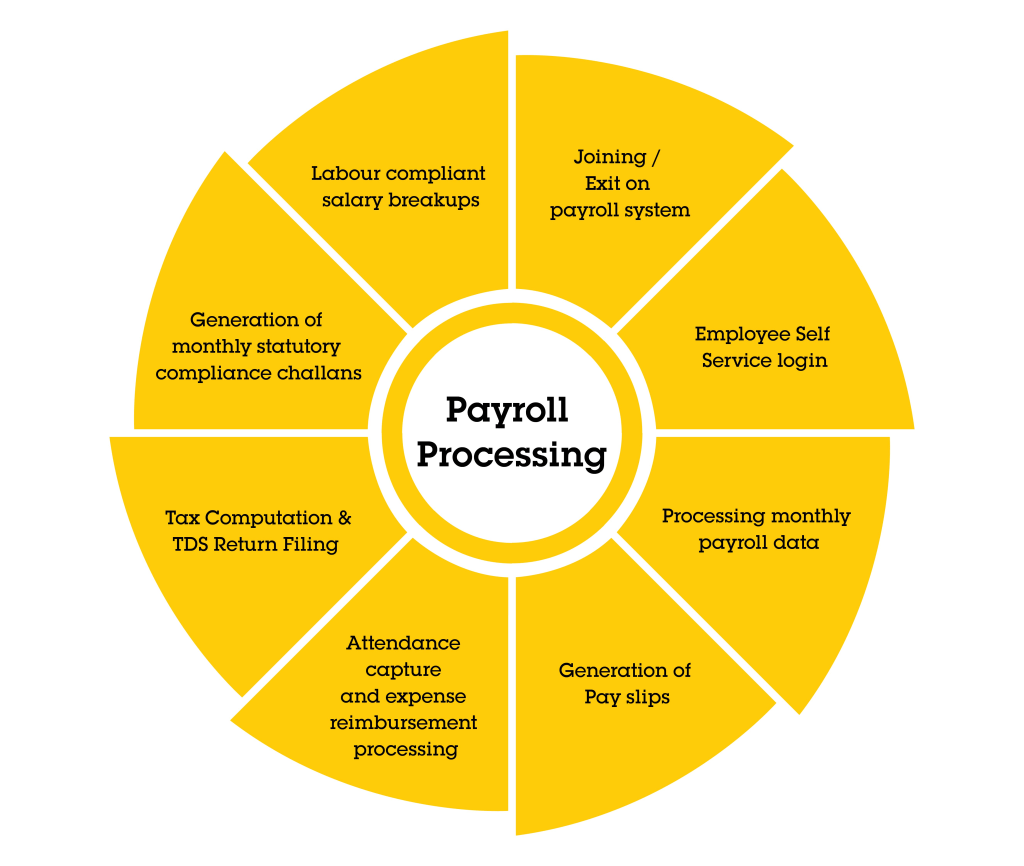
The industry standard is not to run payroll in-house but through a payroll service company, the paymaster. Internationally these are firms like Entertainment Partners, Cast & Crew, and Wrapbook; in India, specialist production-payroll providers play the same role. They calculate the overtime and penalties, apply the statutory pieces, handle withholding and filings, and in many structures act as the employer of record, so the production carries the labour without carrying every employment liability directly.
For reconciliation, their real value is a single data spine. Digital timecards flow into the payroll engine and straight onto cost codes, so a figure is entered once and can be traced from the set to the cost report without being re-keyed. In India that spine also has to carry TDS on salaries under Section 192, provident fund and ESI contributions where they apply, and the provider’s service fee, all coded consistently. That integration is what makes daily reconciliation realistic instead of a month-end reconstruction from paper.
How Crew Are Engaged, and What a Fringe Is
Before anything reconciles, each crew member has to be engaged on clear terms, and how they are engaged changes how they are paid and taxed. Most crew work on a deal memo that fixes the rate, the working week, overtime rules, and any kit or box rentals. Some are engaged as employees through the paymaster, who withholds tax and contributions at source; others invoice through a loan-out or personal company and are paid gross, which shifts the compliance burden onto their own filings. Foreign crew add a third pattern again. Getting this classification right at onboarding is the cheapest reconciliation there is, because fixing a misclassified engagement after payment is slow and often costs tax.
The other half of the number most people underestimate is the fringe, or burden: the employer costs that sit on top of gross pay. Provident fund and ESI contributions in India, holiday and leave accrual, the payroll provider’s handling fee, and any workers’ cover all load onto the base rate, and on many productions the fringe runs a meaningful fraction above gross. A budget that reconciles against gross pay but forgets the burden will be wrong in the same direction on every line, so the reconciliation always works from the fully loaded cost, not the headline rate.

Why Multi-Territory Payroll Gets Hard
Within a single country, payroll is mostly a matter of doing the mechanics correctly. The difficulty begins when crew and money cross borders, because now two or more tax systems can have a claim on the same person or the same company, and the reconciliation has to satisfy all of them at once without paying anyone twice or reporting anything late.
Residency and the 183-Day Line
Start with the simplest question: which country has the right to tax a crew member’s income. Under most tax treaties, following the OECD model, a host country can tax employment income earned within its borders once the person’s presence passes a threshold, commonly 183 days, though treaties measure that window differently: some over a calendar year, some over a rolling twelve months, some over a fiscal year. Reading the right version for each territory is part of foreign-production compliance, set out in the guidance on foreign film production compliance.
For a line producer that threshold is a scheduling input, not just a tax footnote. A technician who tips over it in a given country changes what must be withheld and reported there, which means the payroll and the shooting calendar have to be read together. A day added late in one territory can quietly move someone across the line and rewrite their tax position, and the reconciliation is where that shows up.
There is also the question of who actually bears the extra tax. Senior crew are often hired on net deals, where the production guarantees a take-home figure and absorbs the tax itself, or on tax-equalisation terms that keep the person no better or worse off for having worked abroad. Either way the production, not the individual, carries the host-country liability, so a mis-read residency threshold lands straight on the production’s own books, which is exactly why it belongs in the reconciliation and not just in someone’s personal return.
Shadow Payroll for Crew Who Cross the Threshold
When someone stays long enough to owe tax in the host country but is still paid from home, the standard answer is a shadow payroll. The person remains on the home payroll and their bank account does not change, while a parallel run in the host country reports the same income locally and meets the host withholding and social-security obligations. It is, in effect, a second set of books whose only job is to make the host country whole. Getting that shadow run to agree with the real one, usually in a different currency, is one of the more demanding reconciliation tasks on an international shoot. Social security is handled separately again: where a treaty allows it, a certificate of coverage, an A1 or its equivalent, keeps a crew member in their home social-security system and exempts the production from paying host-country contributions on the same wages, which avoids a double charge that would otherwise never reconcile.

Permanent Establishment Risk
Above the individual sits a larger exposure. If a production’s people and activity in a foreign country go far enough, they can create a permanent establishment, which pulls the company itself into host-country corporate tax rather than just payroll tax. That is a materially bigger bill, and it is triggered by the pattern of work, not by a single form.
Payroll data is often where a permanent establishment first becomes visible, because it records how many people did how much work, for how long, and where. Keeping that record clean and reconciled is therefore part of managing the risk, not merely reporting after the fact, and a production that can show exactly what happened is in a far stronger position if the question is ever asked.
Reconciling Across Currencies
Multi-territory payroll is also multi-currency, and the exchange rate is a reconciliation problem in its own right. The production has to fix a single conversion method and apply it consistently, whether that is a spot rate on the pay date, a contracted rate, or a period average, because mixing methods is exactly how two individually correct numbers stop matching. This is the same exposure described in currency volatility in film routing systems, seen from the payroll side of the ledger.
The discipline that contains it is a single reporting spine. Every payroll stream, in every currency, rolls up into one consolidated view in the production’s reporting currency, with the conversion shown on the face of the report rather than buried inside it. Contract terms have to line up with that spine as well, which is why payment triggers and currency clauses belong in the same conversation as the deal itself, an alignment set out in cross-border contract symmetry.

Keeping the Payroll Auditable
Reconciliation is only as good as the trail behind it. Every timecard, rate, fringe, conversion, and payment should trace back to a cost code and a supporting document, so a financier, a completion bond, or a tax authority can follow any number to its source without a reconstruction. That is the same standard set out in the finance and audit guidance for Indian film production, applied specifically to labour.
Variance, Insurance, and the Bond Review
The working mechanism is variance detection. The reconciled numbers are compared against the budget and against the prior run, and anything that moves without a reason is flagged while it is still small, with a defined path for who investigates and who signs off before a discrepancy hardens into a dispute. That is the payroll expression of the wider international production audit discipline.
Payroll also feeds the statutory and insurance picture, since workers’ cover, provident-fund and ESI contributions, and any claims all read from the same numbers. Keeping it reconciled therefore protects more than the cost report: an under-reported headcount or a missed contribution shows up first in the payroll data, and a clean reconciliation is what keeps the statutory filings and the insurance schedule agreeing with what actually happened on the floor, as the guidance on film production insurance for Indian line producers sets out.
The practical way to hold that line is a fixed set of checks run every cycle, so nothing statutory is left to memory or to the wrap. Our India Filming Compliance Checklist is a downloadable document that lays out the points to confirm before a payroll run is signed off.

Where Payroll Fails to Reconcile
Most reconciliation breaks happen in a handful of predictable places, and knowing them is half the discipline. Timecards approved late or out of sequence throw the cost report out until they catch up. A day split across two account codes gets loaded to one, so two departments disagree about the same shift. A conversion done on the wrong method, or on the wrong date, quietly separates the payroll from the budget. Meal penalties and night premiums get missed at entry and reappear as a correction weeks later.
The cross-border cases add their own failures: a shadow-payroll run that does not match the home run after conversion, a residency threshold crossed without anyone updating the withholding, or a fringe that exists in one territory and not another. None of these are exotic; they are the ordinary friction of paying a lot of people across several systems. Catching them early is why the reconciliation runs every cycle rather than once at the end.
The checks that catch all of this run on a fixed list every cycle, not from memory:
- Timecards approved and in sequence
- Gross, fringes, and net agree with each deal memo
- Every line posted to the right cost code
- Conversion done on the agreed method and date
- Shadow-payroll balances matching the home run
- Statutory withholding and contributions filed on time
The Wrap True-Up
The reconciliation is closed at wrap. End-of-production payroll cleanup trues up every open item: final timecards, held fringes, retroactive rate changes, and any shadow-payroll balances, so that the last cost report matches the last payroll run rather than approximating it. It is the point where every loose thread from a long, multi-territory shoot is either resolved or explained. Our Majapahit Production Cost Breakdown is a downloadable document showing a worked cost report of the kind those reconciled payroll figures ultimately feed into.
It is also where incentive documentation is finalised, because a rebate claim on labour spend stands or falls on payroll that reconciles cleanly to what was reported to each authority. A production that has reconciled all along closes its accounts in days; one that left it for the end spends weeks rebuilding a trail it should have kept. The difference is entirely in the discipline, not the difficulty.
A few items deliberately stay open past wrap. Retroactive rate adjustments, late vendor-style invoices from loan-outs, and, on some productions, residual or use-based payments can land after the unit has stood down, so the reconciliation leaves a clean, documented tail rather than being forced shut. The test of a good process is that reopening the books months later to settle one of these is a lookup, not an investigation.

Why the Reconciliation Holds a Production Together
Reconciling film payroll across borders is unglamorous, and it is also where a production is most exposed, because it sits at the intersection of people, money, and three or four sets of rules at once. The productions that treat it as a continuous discipline, one data spine, a consistent conversion method, a clean audit trail, and a real wrap true-up, are the ones whose final numbers can actually be trusted. Done properly it is not paperwork; it is what lets a financier, a bond, and a tax authority all believe the same cost report.
There is quiet leverage in it, too. A production that can produce a clean, reconciled payroll on request is trusted with bigger budgets, bonded more easily, and cleared through incentive audits faster, because the people who underwrite film know that labour is where the numbers usually hide. Reconciliation is how you take that hiding place away.
