
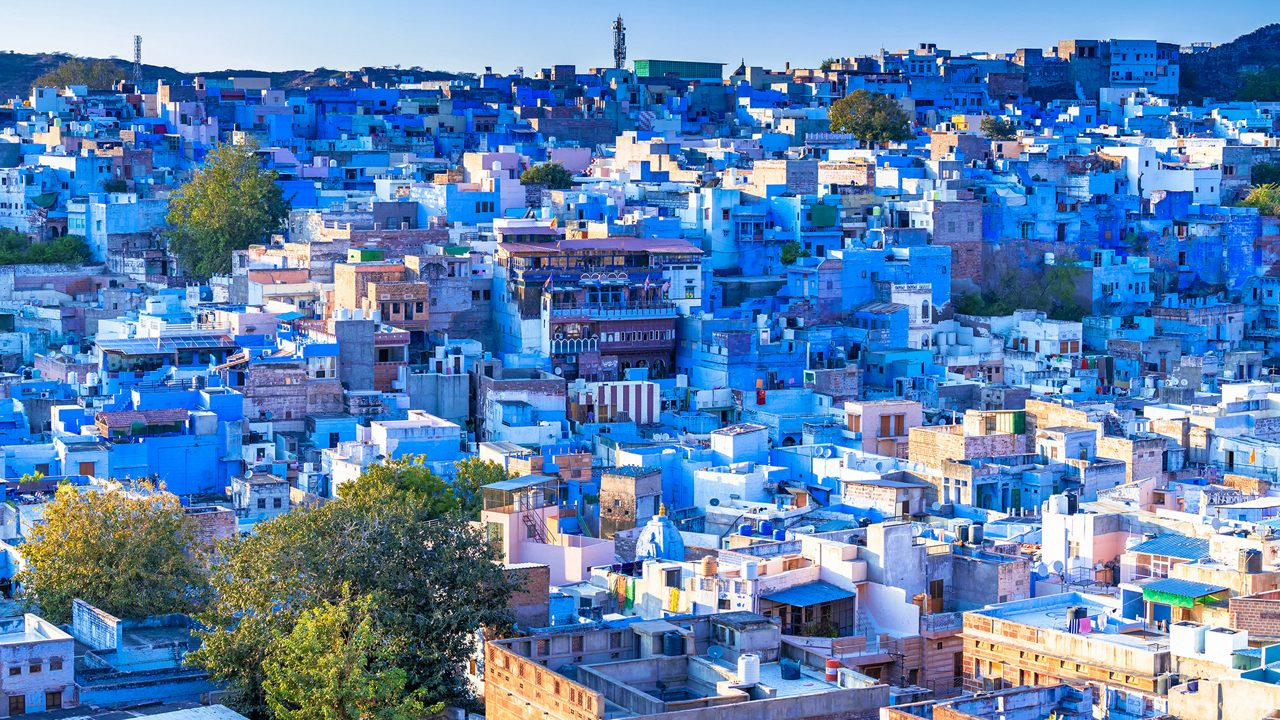
Jodhpur is one of Rajasthan’s most cinematically versatile locations. Mehrangarh Fort, the Blue City lanes, Umaid Bhawan Palace, and the Thar Desert edge combine to give productions a range that few Indian cities match. A line producer Jodhpur team coordinates every element of that environment (permits, crew, equipment, vendor contracts and daily logistics) so creative teams can focus on the shoot. Below we cover what the ground team handles, how permits and budgets are structured, and how to engage the right production partner for a Jodhpur shoot. For schedules extending beyond Jodhpur, see our statewide Rajasthan production guide for Jaipur, Udaipur and Jaisalmer routing. Jodhpur is well connected by air within the western desert circuit, with scheduled services from Delhi and Mumbai (confirmed against the current airline timetable) that make it a practical crew base for shoots routing into Jaisalmer or the deeper Thar.
Jodhpur has hosted Bollywood blockbusters, international features, high-end commercials, and documentary units over the past two decades. The city’s production infrastructure has matured steadily, with trained crew, well-networked fixers and established permit workflows now in place for both domestic and international teams. The heritage sites are regulated but accessible to productions that engage the right ground team early.
What distinguishes a Jodhpur production from a general Rajasthan field operation is the concentration of visual assets within a tight geographic radius. Fort, Blue City lanes, palace interiors and desert-edge locations sit close enough to be scheduled from a single base without the company moves a dispersed Rajasthan route demands, subject to the access windows and travel times confirmed during the recce. That compactness is what makes the city efficient for budget-conscious productions that cannot afford to spread across multiple base camps. The line producer’s pre-production work, documented filings and confirmed schedule are what make consecutive location days achievable rather than aspirationally planned.
Line Producer Jodhpur: Fort, Blue City and Desert Logistics
Jodhpur’s visual character is specific enough to be iconic and broad enough to serve multiple production genres. Heritage architecture, urban colour, and open desert sit within an hour of each other, making it efficient to hold multiple location days without moving a large unit far. That operational compactness is one reason production companies return: the logistics overhead stays lower than dispersed, multi-city Rajasthan shoots. Line production in Jodhpur is organised around that compactness, and a film fixer Jodhpur coordinates location access and daily field logistics across the fort, Blue City and desert edge. The city rewards pre-production investment: a production team that arrives with permits in hand, a confirmed crew list, and a clear schedule operates at a pace and cost level that an unprepared unit simply cannot match.

Mehrangarh Fort, Umaid Bhawan and the Blue City
Mehrangarh Fort is Jodhpur’s signature filming location. Rising 125 metres above the city on a sheer sandstone outcrop, the fort delivers visual scale without CGI augmentation. Its battlements, courtyards, cannon platforms, and rampart views have been used for period features, action sequences, and brand campaigns across Hindi, regional, and international productions. Filming is arranged through the Mehrangarh Museum Trust, which administers the fort, with structured access slots allocated around daily visitor operations; the line producer coordinates these with the fort management office and, where the footprint requires, the relevant state or municipal authorities. Shoots typically happen in early morning or evening slots to minimise conflict with tourist access; the line producer accounts for this in the daily shooting schedule.
Umaid Bhawan Palace: Private Estate Permit Process
Umaid Bhawan Palace operates on a different permit model. As a privately managed property with an active hotel wing and a museum section, access is negotiated directly with palace administration rather than through a government permit system. The interiors (carved sandstone corridors, Art Deco ballrooms, trophy rooms and formal gardens) suit high-end commercial and fashion work. Exterior aerial views of the dome and wings are separately permitted. Early booking and a clear shot-list submission matter here; last-minute requests are rarely accommodated. The production team manages all advance liaison with the palace events and operations office.
Notable productions have used Jodhpur’s locations for decades. The battlements of Mehrangarh appeared in international theatrical features seeking fortress-scale environments on a production budget. The palace interiors have been used for luxury brand films targeting premium markets. The blue lanes have featured in automotive commercials, music videos, and documentary series distributed across streaming platforms. Each of these productions worked through a local line producer and fixer team, and there is no shortcut to accessing these spaces at shoot-grade reliability.
The Blue City, the dense residential quarter spreading below the fort, is Jodhpur’s most distinctive street environment. Indigo-washed walls produce a colour palette unlike anywhere else in India, and the narrow lanes create natural framing that is difficult to replicate on set. Street-level shoots require crowd management, neighbour coordination, and police liaison for road closures. The local fixer network is essential here: interior courtyards and rooftops are filmed under resident and property-owner consent and location agreements, with police coordination for road closures. An experienced Jodhpur fixer brings documented filing experience across these residential locations and manages the consent and liaison layer under the line producer’s schedule.

The Thar Edge: Dunes, Seasonality and Stand-In Range
Jodhpur’s desert edge extends toward Osian and Khimsar, whose dune-and-scrub environments work well for music videos, car commercials, and feature sequences requiring sand, space, and sky. These desert-edge locations sit within logistical reach of the city, and shoot timing and any control of public movement are agreed with the relevant site operators and authorities. The large-scale Sam and Khuri dune systems are served from Jaisalmer, not Jodhpur; the line producer Jaisalmer desk covers those dunes. Logistics include generator rigs, vehicle convoys for cast and crew, and catering setups that the production team manages from base camp. For multi-day desert shoots, the LP pre-positions fuel, water, and communication equipment.
October to February, and Shooting Through the Monsoon
Seasonal planning determines the shoot schedule and directly affects the below-the-line budget. October to February is the primary window: stable light, mild temperatures and reliable weather make exterior-heavy production efficient. March to May is workable for interiors, pre-dawn sequences, and overnight shoots. June to September brings monsoon conditions that can be used creatively (green-tinged desert, dramatic cloud formations and wet sandstone textures) but require full weather contingency planning and specialist electrical safety protocols. The line producer builds weather buffer days into all Jodhpur schedules rather than relying on forecasts alone.
On stand-in value: Jodhpur’s desert edges convincingly double for general arid-region settings, and the heritage tier stands in for fortified and historical architecture. The fort’s scale is usable for fantasy and period productions where CGI budget would otherwise carry the environment, which has made the city attractive to international co-productions seeking cost-efficient locations. Producers exploring Rajasthan as a broader location strategy can assess multi-city potential across the wider state corridor.
Line Producer and Fixer: Who Does What in Jodhpur
A line producer in Jodhpur takes end-to-end responsibility for the production operation. The role covers pre-production planning, on-ground execution, vendor management, daily scheduling, and post-production handover. Where Jodhpur differs from larger metros is in the depth of the fixer layer: local production professionals who bridge between the formal production structure and the city’s administrative, cultural, and geographic realities. Without that layer, even a well-resourced production runs into delays that a competent local team would have avoided.

How the Line Producer and Fixer Split the Work
The line producer structures the shoot: breaking the script into a production schedule, costing each shooting day, hiring department heads, managing vendor contracts, and controlling the overall budget against actuals. They are the financial and operational controller on set. In Jodhpur, that scope extends further than in studio-city productions because location dependencies (weather contingencies, permit timing, heritage site access windows and crowd dynamics) are harder to shortcut and can cascade quickly if not managed in advance.
Film Fixers and Location Execution
Film fixers in Jodhpur work as the ground-level execution layer. A fixer is typically a local professional with working knowledge of the permit offices, hotel and catering vendors, transport operators and equipment suppliers, and documented experience filing for the city’s heritage and public locations. When a fort courtyard needs to be arranged for a shoot window, a rooftop in the blue quarter needs a resident agreement, or a police liaison needs a follow-up filing at short notice, the fixer handles it directly under the line producer’s schedule and budget. That documented local experience is what an experienced Jodhpur team brings to a production.
The line producer and fixer roles are distinct but tightly integrated. The LP sets the parameters (timeline, budget ceiling, shot priority) and the fixer executes within them. For straightforward commercial shoots of one to three days, a single experienced film fixer in Jodhpur may cover both roles effectively. For feature-scale productions, the two functions run in parallel: the LP managing the full budget envelope and department coordination, one or more location fixers managing site-specific logistics and community access.
Equipment: Local Kit and Jaipur–Delhi Specialist Supply
Equipment is sourced through a hybrid supply chain. Standard kit (tripods, basic lighting rigs, camera support, reflectors and generator sets) comes from Jodhpur-based vendors. Specialist equipment (high-end cinema cameras, remote heads, underwater or aerial rigs, DIT workstations) is routed from Jaipur or Delhi, with logistics timing factored into the pre-production schedule. The line producer maintains backup vendor contacts for all critical equipment categories; a single-source dependency on specialist kit is a production risk the LP’s vendor list is designed to eliminate.
For infrastructure beyond Jodhpur’s own base, the hub choice matters. Line producer Jaipur is the primary equipment, talent and coordination hub for Rajasthan shoots and runs the cross-city logistics model. For large sequences, specialist packages such as heavy gensets and vanity vans may route from Jaipur, Delhi or Mumbai once the equipment manifest is confirmed, drawing big-rig infrastructure and specialist crew from a line producer Delhi or line producer Mumbai base and moving it in.
Crew Sourcing and the Jodhpur Talent Network
Jodhpur has a trained local crew base developed over two decades of film activity. Camera assistants, grips, art department hands, costume and prop coordinators, make-up artists, and production assistants are available locally, and the line producer draws from this network first, supplementing with Jaipur or Mumbai specialists where specific department heads or technical skill sets are required. Local crew typically have experience on both Bollywood and commercial formats; the LP vets each department’s crew list against the production’s specific requirements. This local bench is the backbone of the film production services Jodhpur units rely on.
Accommodation, catering, and transport for crew are managed centrally. Jodhpur’s hotel and guesthouse capacity covers mid-to-large production units; the LP or production manager negotiates block room rates and meal plans in advance, with flexible release clauses to handle schedule changes. Unit catering is either contracted to a local operations provider or managed through a production kitchen, depending on location remoteness and unit size. For desert and exterior locations, the LP pre-positions mobile catering, shade structures, and rest facilities as part of the logistics plan.
Housing and Moving a Unit Across Fort, City and Desert
Daily call sheet management is a line producer responsibility that matters more in location-heavy shoots than on studio productions. In Jodhpur, where crew may be deployed across the fort, the city lanes, and the desert in the same production week, accurate daily call sheets (with precise call times, location access windows, transport arrangements and contingency contact chains) are the operational mechanism that keeps multi-location shoots functional. The LP or their production coordinator issues these the evening before each shoot day, with the fixer confirming ground readiness by the stated time.

The Permit Stack: Fort, Palace and Police Clearances
Production in Jodhpur is permit-intensive by design: the city’s most filmable assets are also its most regulated. Mehrangarh Fort is administered by the Mehrangarh Museum Trust and is recorded on Rajasthan’s state-protected monuments list; Umaid Bhawan is privately controlled; Blue City street shoots require police coordination and neighbour agreements. Handling these in parallel calls for a team that knows each approval process and files accurately and early. Arriving without confirmed permits and working reactively adds cost, delay, and avoidable friction with the property and heritage authorities.
The Rajasthan permissions guide covers current permit procedures and location controls across the state’s key production zones, a useful reference for pre-production planning in Jodhpur and the wider Rajasthan corridor.

Mehrangarh: Trust Approval and State Heritage Controls
Filming at Mehrangarh is arranged through the Mehrangarh Museum Trust, which administers the fort as a museum property; the fort sits on Rajasthan’s state-protected monuments list rather than the central ASI list. An application sets out the shot list, crew manifest, equipment inventory, production insurance and the applicable fees or deposit, and is submitted well in advance because the Trust manages filming alongside daily visitor operations. Lead times and access conditions are confirmed with the Trust for the specific dates and footprint rather than assumed. Where a schedule extends into centrally protected sites elsewhere, that filming is arranged through the applicable ASI process on its own timeline.
Rajasthan Tourism’s Film Facilitation Cell coordinates state-level filing across additional state-managed heritage properties and public spaces, working across the relevant departments while each individual site approval remains with its competent authority. The line producer files through this office for shoots covering several heritage sites within a single schedule. Fees are structured by property category, access tier, and shooting duration; the LP works the confirmed figures into the below-the-line budget.
Blue City Street and Police Permissions
Police permissions for street and public-space shoots are processed through the local district office. Blue City lane shoots typically require a static crowd-management detail and road closure coordination with the municipal authority. These permits are location-specific and date-specific, so a schedule or footprint change may require amendment, reconfirmation or a fresh approval depending on the authority, which is why accurate pre-production planning matters. Film fixers in Jodhpur manage the police liaison layer directly, submitting the filings and flagging any objections before they become shoot-day problems.
Checking Eligibility Under Rajasthan’s Film-Tourism Policy
Rajasthan’s film-tourism policy offers incentive support to qualifying formats such as feature films, web or OTT series, television serials and documentaries; advertisement films and videos are excluded. Eligibility is assessed at the format level rather than assumed for all production spend, so the line producer confirms whether the project qualifies before building any incentive assumption into the budget. Where a production qualifies, the accounting system captures the required documentation from day one. The full eligibility criteria and application process are set out in the Rajasthan film incentives producer handbook.
What a Jodhpur Budget Actually Carries
A Jodhpur production budget follows the standard above-the-line and below-the-line split, with the below-the-line envelope carrying the bulk of location-specific costs: crew fees, equipment rental, accommodation, catering, transport and location access fees, alongside pre-production planning and wrap close-out. The proportion each phase carries is set by the individual production’s scale, schedule and location mix rather than a fixed template.
Heritage Location Fees and Permit Cost Variables
Heritage location fees are a distinct line item and vary by property, access tier, shooting duration, and time slot. Once confirmed for the specific dates, the line producer books them as fixed costs rather than contingency estimates. Equipment is the most variable line; the production team works with multiple vendors so that alternatives are available when a primary supplier is unavailable or delayed.
Real-time budget tracking is standard practice on all Jodhpur productions. The line producer or a dedicated production accountant monitors actuals against the approved budget daily, flagging variances before they compound. The most common cost overrun drivers in Jodhpur: extended permit negotiations, weather-related schedule delays, overtime at heritage sites where access windows are fixed, and last-minute specialist equipment sourcing. A disciplined line producer surfaces these risks in the pre-production risk log and presents mitigation options before they materialise as unmanageable overruns on shoot day.
Contingency in Jodhpur budgets is set against the risks confirmed for the individual schedule: permit delays requiring schedule re-sequencing, weather-forced postponements of exterior days, and equipment sourcing gaps when Jaipur or Delhi vendors are unavailable. The percentage is drawn from those documented risks rather than applied as a universal allowance, and the line producer presents the risk items with mitigation costs so the producer can see what the contingency is buying.

Jodhpur Production Experience
Global Producers managed the Jodhpur leg of Titik Nol at Mehrangarh Fort within a wider Rajasthan schedule that also covered Jaipur, Udaipur, Pushkar, Ajmer and the Jaisalmer desert before continuing to Delhi. The Jodhpur days centred on Mehrangarh and the surrounding heritage locations. The project was directed by Herwin Novianto, with Denny Sumargo and Daniella Sya among the cast.


Hiring and Briefing a Jodhpur Line Producer
Start the engagement before you lock a shoot date. The most common error domestic and international productions make in Jodhpur is treating the line producer hire as a late-stage logistics step. By the time shoot dates are confirmed, location decisions are made, and a rough schedule exists, the line producer should already be in place, because their input shapes all three of those decisions. A line producer brought on after locations are locked inherits decisions they would have made differently.
What to Include in Your Line Producer Briefing Package
The briefing package a line producer needs to begin work: a script or treatment (even a rough one), a proposed shoot window, a location reference list or initial scouting targets, a crew tier level (local-only, mixed, or international-heavy), and a target budget range. With these inputs, the production team prepares a detailed budget breakdown, a permit timeline, and a location-by-location feasibility assessment on a turnaround confirmed against the brief and shoot window.
Vetting a line producer in Jodhpur follows the same criteria as any production market: check the project list for comparable-scale shoots, speak to directors or producers from recent productions, verify the permit track record, references and filing history, and confirm that their crew network covers your department requirements. A line producer who has filed for Mehrangarh and Umaid Bhawan repeatedly will bring a more extensive documented filing record than one who has only worked the desert edge.

Jodhpur functions within the wider Rajasthan production network. For multi-city Rajasthan shoots that combine Jodhpur with Jaisalmer, Udaipur or Jaipur, the line producer coordinates across city-based fixer teams from a central operations point. Where the plan turns from Jodhpur’s forts and desert to the lake city, a line producer in Udaipur takes over the trust-controlled palace and water logistics that the Blue City schedule never touches.
In the first week after hire, the line producer’s focus is on parallel path initiation: submitting the Mehrangarh Museum Trust and property applications along with the relevant state or municipal filings at the earliest stage (because their processing time is often the longest lead-time item on the schedule, with ASI filing added only where a separate centrally protected location forms part of the schedule), confirming location availability with the fort and palace administrations, beginning crew outreach across priority departments, and producing a first-draft budget breakdown for the producer’s approval. These four tracks run simultaneously, and delay in any one creates downstream compression in the schedule.
Productions new to Jodhpur frequently ask how the city compares operationally to Jaipur, the state capital. Jaipur offers a larger crew pool, better equipment availability, and direct international flight connections: it is the coordination centre for multi-city Rajasthan shoots. Jodhpur offers locations that Jaipur does not: the desert-city interface, the fort scale, and the Blue City character. The two cities are complementary rather than competing; a Rajasthan feature production will often use both, with the line producer managing logistics across the corridor.
The standard engagement model: the line producer is contracted at pre-production start on a daily or weekly rate, transitions to a shoot-day rate during production, and wraps with a post-production close-out phase covering final vendor settlements, permit return documentation, and budget actuals reporting. For short commercial shoots in Jodhpur of one to three days, a project-fee model is also common. Whichever structure applies, the line producer’s scope (and the ceiling of their budget authority) should be agreed in writing before pre-production begins.
