

The importance of understanding customs for film equipment
The movement of film equipment across international borders is one of the most complex logistical tasks in global production management. Productions that depend on multi-country shoots, tight schedules, and high-value gear must navigate layers of customs regulations, airport protocols, carnet documentation, and security standards that differ significantly across jurisdictions. Airport & Cargo Customs for Film Equipment becomes the backbone of friction-free mobility for cameras, lighting rigs, drones, audio systems, VFX capture units, and fragile accessories essential to modern filmmaking. When this workflow is executed precisely, crews save days of downtime, eliminate unnecessary storage fees, and prevent costly equipment holds that can derail an entire production calendar. When mishandled, however, even a single case of misdeclared gear can result in penalties, impoundment, and multi-day shoot cancellations
Global rules, ATA carnet & import options
Cross-border production logistics turn on documentation accuracy — serial numbers, HS codes and carnet page endorsements determine whether gear clears in hours or in days. This section covers the three foundational mechanisms (ATA Carnet, temporary import permits and bonded warehouses), the insurance layer that underpins every international equipment move, and the common failure points that trigger holds. Productions that structure customs strategy before departure consistently avoid the equipment seizures and demurrage fees that cascade into missed shoot days and unplanned overtime.

Cross-border cost exposure — why customs planning protects productions
Producers face high stakes when moving film gear across borders. Mishandled customs for film equipment india can trigger delays, fines, or seizures. Imagine your crew stuck at an airport. Equipment held up means missed shoot days. Each day lost costs thousands in crew time and rescheduling. Moreover, customs errors risk damaging sensitive items like cameras or lenses during inspections. Plan ahead to avoid these pitfalls. First, understand global frameworks. They set the baseline for temporary imports. Without them, you pay full duties on gear meant for short-term use.
ATA carnets simplify this. They act as passports for equipment. Use them to bypass taxes in over 80 countries. However, not every nation accepts them. Know when to switch to alternatives like temporary import permits. Proper planning cuts risks by 50%. It saves time at airports. Plus, it protects your budget from unexpected fees. Always factor in transit insurance. It covers liabilities during moves. In short, strong customs strategy keeps productions on track. It lets you focus on creativity, not bureaucracy.
Next, consider the ripple effects. Delays cascade into overtime costs for crews. They disrupt location bookings. In worst cases, they force script changes. Yet, smart producers turn this into an advantage. They build buffers into schedules. They partner with experienced freight forwarders. These experts handle manifests and declarations. As a result, you clear customs faster. You reduce hold times at cargo terminals. Ultimately, thorough planning boosts efficiency. It minimizes liabilities. It ensures gear arrives intact and ready. For more on airport processes worldwide, check our guide on airport filming around the world. Now, let’s dive into the pathways that make this possible.

Common cross-border pathways for film equipment
Film gear moves under strict international rules. You have options like ATA carnet, temporary import permit, or bonded warehouse. Each suits different scenarios. Start with basics. Global conventions govern temporary imports. The ATA Convention and Istanbul Convention set standards. They allow duty-free entry for professional equipment. This includes cameras, lights, and sound gear. However, rules vary by country. Always check eligibility.
ATA carnet shines for multi-country shoots. It covers temporary import film gear for up to one year. You avoid duties and taxes. Issuing bodies like chambers of commerce handle applications. Pros: Simplifies customs. One document for multiple entries. Cons: Not accepted everywhere. Fees apply based on gear value. Use it for tours across carnet countries.
Temporary import permits work when carnets don’t. Apply directly to customs. Provide invoices and descriptions. Post a bond or guarantee. Pros: Flexible for non-carnet nations. Often cheaper for single entries. Cons: More paperwork. Longer processing times. Bonded warehouse film gear offers storage solutions. Hold items duty-free until use or re-export. Pros: Defers payments. Secure storage at airports. Cons: Extra handling fees. Time limits apply.
Choose based on itinerary. For Europe hops, carnet wins. For isolated spots, permits suffice. Always document serial numbers — mismatches between the carnet and physical inventory are the single most common cause of holds at customs. The airport filming around the world covers territory-by-territory airport protocols and cargo workflows across all major production hubs.

ATA carnet explained — how it works and when to use it
ATA carnet streamlines temporary imports. It acts as an international customs document. You get duty-free entry for gear. The acronym stands for Admission Temporaire/Temporary Admission. Eligible items include professional equipment like film cameras and lenses. Over 80 countries accept it, including the EU and India.
How it works: Apply through issuing associations. In the US, USCIB handles it. Provide gear lists with values and serials. Pay fees—basic around $250 plus 0.5–1% of value. Validity lasts one year. At borders, customs stamps vouchers. On exit, they validate re-export. Fail to re-export? Face penalties up to full duties.
When to use it: Ideal for multi-stop productions. Think festival circuits or tours. It covers exhibitions, samples, and equipment. Skip it for consumables like film stock. Not for sales items. Pros: Cuts paperwork. Speeds clearance. One carnet for multiple trips. Cons: Upfront costs. Not for all countries—check lists.
For film, list everything. Include backups. Renew if needed. Always carry originals. Digital versions don’t suffice. In practice, it saves hours at airports. Producers swear by it for efficiency. If your shoot spans carnet nations, get one early—processing takes 1–2 weeks.

Alternative mechanisms — carnets not available or not ideal
Carnets aren’t always feasible. Turn to alternatives like temporary import permits or bonded warehouses. First, temporary import permits allow duty-free entry for specific periods. Apply to local customs. Submit invoices, descriptions, and bonds. In Vietnam, get approvals from the Ministry of Culture. Lead times: 3–30 days. Pros: Works in non-carnet countries. Tailored to project length. Cons: More bureaucracy. Refundable deposits tie up cash.
Bonded warehouse film gear provides storage options. Hold items in secure zones without duties. Pay only on release or re-export. In Dubai free zones, this defers costs. Pros: Flexible for multi-leg shoots. Secure against theft. Cons: Storage fees add up—$100–500/month. Access limited to bonded areas.
In Jordan, RFC facilitates customs without carnets. Use diplomatic letters for waivers. Processing: 1–2 weeks. For Portugal, EU rules allow intra-Schengen moves without carnets, but entry requires one. Check prohibitions—drones often need extra approvals.
Choose based on itinerary. Short stays? Permits. Storage needs? Warehouses. Always insure against holds. These options keep gear flowing. They complement carnets for global flexibility.
Insurance & liabilities when moving film gear internationally
Equipment insurance for international film production requires three distinct coverage layers that work together but are typically written as separate policies. The foundational layer is an inland marine or equipment floater policy, which covers the physical assets against theft, accidental damage and loss in transit. For international productions, this policy must carry a worldwide extension — standard domestic policies exclude international transit events. Air cargo liability under the Warsaw Convention is capped at approximately USD 9.07 per pound of cargo, a limit that falls dramatically short of the declared value of professional cinema equipment; supplementary declared-value coverage bridges this gap and should be purchased for every shipment above $50,000 in equipment value.
Transit delay and customs hold coverage
The second layer is transit delay and customs hold coverage. When equipment is detained at a port due to documentation issues, the resulting storage fees, demurrage charges and crew standby costs can exceed the cost of the original customs error many times over. Transit delay policies reimburse documented losses — storage charges, rescheduled crew costs, location rebooking fees — up to the policy limit when the delay is caused by a covered peril (typically customs holds, carrier failure or port congestion). Claims must be filed promptly; most transit policies carry a 30-day reporting window from the date the delay is first documented. Photograph equipment condition at the origin packing stage and at the point of customs inspection — photographic documentation is required for damage claims.
Third-party liability coverage protects against damage to property or persons during equipment moves — relevant when gear is transported through public airport terminals or when a customs inspection results in damaged cases during physical examination. Productions working across multiple countries should verify that their broker’s policy carries global validity and does not exclude specific jurisdictions; some policies exclude named territories in the MENA region or restrict coverage for politically sensitive locations. The most reliable brokers for international production equipment insurance specialise in the entertainment industry and maintain loss-adjustment relationships with customs authorities in major production territories.

India-specific customs for film equipment — workflow & airport SOP
India classifies professional film equipment as temporary imports — duty-free entry is available under ATA Carnets (applied through FICCI or the Indian Chamber of Commerce) or Temporary Import Bonds posted at the port of entry. The Carnet is the preferred mechanism for productions already using one across multiple territories; the bond route (5–10% of declared equipment value, refundable on re-export) is used when a Carnet is unavailable or the equipment list was finalised too late to process one. Lead times for Indian customs documentation run 7–30 days depending on the port, the broker’s relationship with the customs office and whether the gear list is clean and complete on first submission.
Every customs filing for India requires a full commercial invoice or proforma invoice, complete with declared values, serial numbers and Harmonized System (HS) codes for each item — cameras fall under HS 9007, lenses under 9002, and audio equipment under 8518. The DGFT (Directorate General of Foreign Trade) governs import policy and the CBIC (Central Board of Indirect Taxes and Customs) administers clearance. Productions that pre-file documentation through the e-Sanchit portal before arrival consistently report faster green-channel routing. Demurrage at Indian cargo terminals runs $50–200 per day — the cost of a documentation error compounds quickly against the daily cost of an idle crew.
For airport-specific processes, see our airport filming India.
Why India Requires a Specialized Approach for Airport & Cargo Customs for Film Equipment
India is now one of the most active film production territories in the world, attracting foreign projects to Mumbai’s urban environments, Delhi’s heritage sites, Rajasthan’s deserts, Kerala’s backwaters and Ladakh’s high-altitude landscapes. Yet the country’s customs system for film equipment remains highly procedural, with interpretation varying by airport.
Foreign equipment entering India typically does so under Temporary Import Bonds, Carnets or Equipment Facilitation Letters issued through registered Indian line producers. While the ATA Carnet is accepted in India, its implementation demands perfect alignment between physical cargo and carnet pages. Customs officers inspect cases thoroughly, and any mismatch can lead to delays. Indian airports also impose strict rules for batteries, drones, specialized lenses and communication equipment.
Documentation workflow, HS codes and DGCA compliance
Productions seeking efficient clearance in India generally rely on established line producers, freight forwarders and customs brokers who pre-coordinate case lists, create harmonized system (HS) codes for all gear, and submit documentation days in advance. These workflows reflect international best practices, but India’s additional documentation layers require a heightened level of detail. Productions planning multi-territory shoots that combine India execution with European or MENA incentive frameworks will find the worldwide film rebates a practical reference for structuring qualifying spend across jurisdictions.
Drone operations at Indian airports require separate clearance through the Directorate General of Civil Aviation (DGCA). Productions using drones must obtain NPNT (No Permission, No Takeoff) compliance and file pre-approved flight paths before any shoot day. Restricted airspace around airports, military zones and heritage sites adds a further layer to the import declaration — drone units and related radio-control equipment must be listed separately on the carnet with manufacturer-issued frequency documentation. Productions planning aerial work in India should consult our drone filming Indian cities before finalising import documentation.

Step-by-step India workflow (pre-shipment to release)
Pre-shipment preparation begins at T-60 (sixty days before the first required date in India). The gear manifest — make, model, serial number, declared value and HS code for every item — forms the foundation of every document that follows. Freight forwarders use this to prepare the air waybill (AWB) and shipping manifests; customs brokers use it to pre-file on the e-Sanchit portal; the FICCI or ICC team uses it to issue the ATA Carnet if that route is taken. Every item, including backup units and accessories, should be on the manifest — items that appear in the cargo hold but not in the documentation are the most common trigger for red-channel routing and physical inspection on arrival.
Origin-port dispatch and India customs clearance
At the port of origin, the freight forwarder seals cases with tamper-evident locks, attaches shipping labels referencing the AWB number, and coordinates the ATA Carnet departure endorsement with origin-country customs before the shipment departs. Productions using air freight to Mumbai, Delhi or Chennai should confirm that the cargo is routed to the international freight terminal at each airport — domestic and international cargo are handled separately, and misdirected cargo requires additional paperwork to redirect.
On arrival in India, the customs broker presents the pre-filed documentation package to the customs assessment officer. Low-risk shipments route through the green channel and clear without physical inspection, typically within 24–48 hours of landing. Red-channel cases — usually triggered by documentation gaps, high-value items or flagged HS codes — require a physical examination of the cargo against the manifest. If clearance cannot be completed on the day of arrival, bonded warehouse storage defers duty liability while the documentation is resolved. Once released, local freight forwarders transport the gear to the set under a local transit receipt; this transit document is held until re-export, when it is surrendered along with the carnet re-export endorsement or bond release claim. Build 3–5 buffer days into any India schedule for first-time entries at a new port.

ATA carnet process for India (how it’s used there)
India is one of approximately 80 countries that accept the ATA Carnet, but its implementation carries conditions that distinguish it from standard procedure elsewhere. Applications are processed through FICCI (Federation of Indian Chambers of Commerce and Industry) or the Indian Chamber of Commerce. Base application fees start at approximately ₹1,000, with an additional levy of 0.5% of total declared equipment value. While the standard Carnet is valid for 12 months, Indian customs applies a six-month limit on temporary import of professional film equipment — productions planning multi-leg shoots or returning to India within the same Carnet period need to plan re-entry scheduling accordingly.
Application process and arrival endorsement
The application requires a detailed manifest: make, model, serial number and declared value for every item, submitted through the issuing chamber’s online portal. Processing runs 3–7 working days. At the port of origin, the Carnet receives a departure endorsement from origin-country customs before the shipment departs — this endorsement is a required precondition for valid Indian customs acceptance on arrival. On arrival at the Indian port, the Carnet is presented at the dedicated customs desk; officers verify the physical inventory against the Carnet vouchers and endorse each page. No duties apply when documentation and physical inventory align. The Carnet covers multiple entries and re-entries within its validity period, making it the most efficient mechanism for productions shooting across India with gear transiting in and out.
Re-export obligations and penalty exposure
Re-export is the closing obligation that productions most frequently mishandle. The re-export endorsement from Indian customs — applied to the correct Carnet voucher at the port of exit — is required before the issuing chamber will close the file without penalty. Missing this endorsement, even when the gear physically left the country, results in full duty liability on the entire declared equipment value. Productions extending beyond the six-month window should apply for Carnet renewal before expiry; renewal requires issuing chamber approval and processing time, and cannot be done at the airport on departure day. Always carry original Carnet documents on travel days — photocopies and digital scans are not accepted at the Indian customs desk.

Common friction points in India and how to avoid them
Serial number mismatches are the single most common cause of equipment holds at Indian customs. They occur when the physical item (camera body, lens, audio unit) carries a serial number that differs from what appears on the Carnet or import bond — whether through transcription error, a last-minute equipment swap, or a rental house substituting a unit without updating the paperwork. The fix is a full physical-to-document cross-check at the freight forwarder’s staging facility before the shipment departs the origin country, not at the Indian terminal after arrival. Any undocumented item discovered in the cargo — even low-value accessories and cables — can trigger a hold on the entire case it was packed in, not just the individual item.
Restricted categories, HS codes and operational timing
Restricted and prohibited equipment categories in India include certain radio-frequency transmission devices, high-power batteries above specified watt-hour thresholds, encrypted communication units and drone systems without pre-clearance documentation. HS code misclassification — listing a professional cinema lens under a consumer camera code, for example — routinely flags for examination because the duty rate differential is significant. Productions should verify current restricted-items lists with their customs broker at least 30 days before shipment, since the applicable rules can change between productions. Specialised VFX rigs, RF transmission systems and high-output lighting units are the categories most often caught by unfamiliar brokers.
Operational delays compound the documentation risks. Indian customs processing slows during major festival periods — Diwali, Holi and Eid — and cargo terminal congestion is a regular occurrence at Mumbai and Delhi during peak festival weeks. Port strikes, while infrequent, are difficult to predict. Building 3–5 buffer days into any India schedule for first-time entries is not conservative; it reflects the realistic variance in clearance timelines across different ports and seasons. Line producers with established customs broker relationships in India consistently report faster green-channel routing because pre-existing relationships with customs officers accelerate the assessment process.
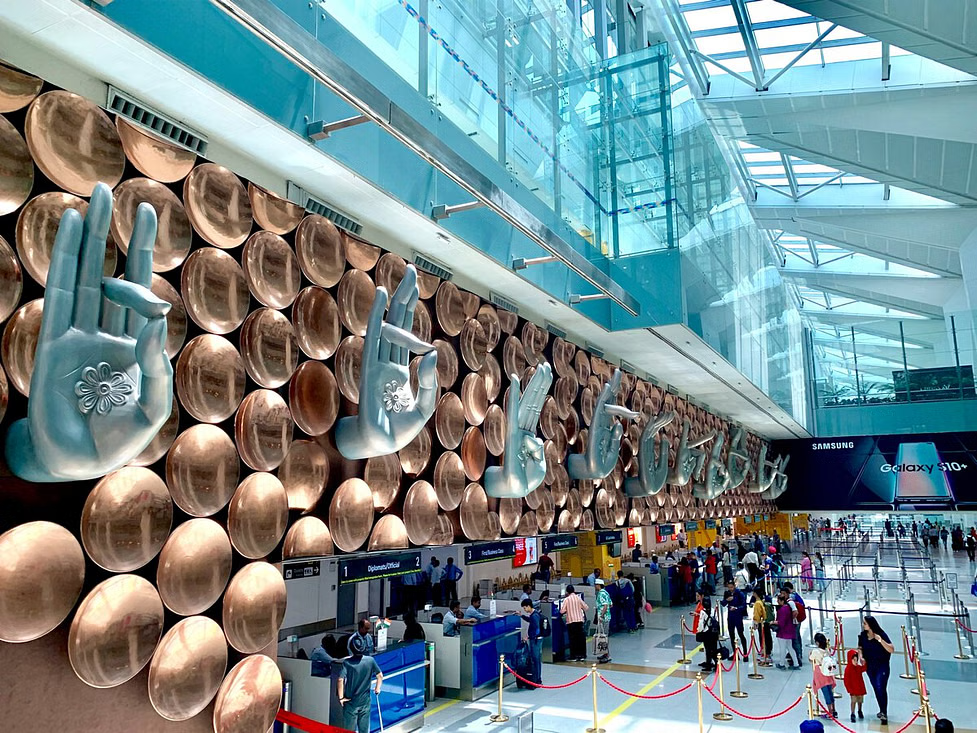
Airports & hubs: who’s best for film shipments in India?
Mumbai Chhatrapati Shivaji Maharaj International Airport (BOM) handles the majority of international production cargo entering India, primarily through the Sahar Air Cargo Complex adjacent to Terminal 2. Specialist freight forwarders with film-industry experience are embedded in the complex and maintain working relationships with the customs assessment officers who handle professional equipment. ATA Carnet clearances at BOM typically complete in 24–48 hours for clean documentation; bond-route clearances run 2–4 days. Mumbai’s proximity to the western India film industry — studios in Andheri, the MDRK locations corridor, and the primary base for most Indian line producers — makes it the default entry point for productions shooting anywhere in the country.
Delhi Indira Gandhi International Airport (DEL) is the primary gateway for North India and Rajasthan shoots. The IGI Air Cargo terminal processes high volumes and has established customs channels for professional equipment declarations. Productions arriving into Delhi benefit from the proximity of the capital’s fixer and logistics network, which can mobilise ground transport quickly once clearance is confirmed. Chennai (MAA) serves South India — Hyderabad, Bengaluru, Kerala and Tamil Nadu shoots — with lower terminal congestion than Mumbai and efficient ATA Carnet processing at the Air Cargo Complex. Bengaluru (BLR) suits productions based at Innovative Film City or those requiring access to the tech-infrastructure corridor. Kolkata (CCU) provides the most direct routing for productions moving equipment into North East India, Bhutan corridor shoots or Bangladesh co-productions.
Practical SOP checklist for Line Producers
The four-phase timeline below reflects the documentation sequence used by established Indian line producers for international equipment imports. T-60 is the latest viable starting point for ATA Carnet applications; T-30 is the deadline for customs pre-filings via e-Sanchit; T-7 is when all AWB numbers and transit documents must be confirmed with the broker before the cargo departs the origin country.
| Phase | Tasks | Key Contacts | Contingency |
|---|---|---|---|
| Pre-Shipment | Inventory gear, serials; prepare invoices, packing lists. | Freight forwarder | Add 10% buffer value. |
| Origin | File manifests; secure seals. | Broker | Track AWB. |
| Arrival | Submit e-declarations; pay bonds. | Customs broker | Plan for inspections. |
| Release | Handle fees; transport to set. | Local fixer | Bonded storage if delayed. |
Productions with smaller equipment lists can compress the T-60 timeline to T-30 if using the bond route rather than a Carnet, but the T-7 document confirmation window is non-negotiable at any scale — last-minute filing changes at Indian ports of entry reliably trigger red-channel routing.
International nuances, case studies, templates & checklist
No two territories handle temporary equipment imports identically. The global frameworks — carnet, temporary permit, bonded warehouse — apply across jurisdictions, but their implementation varies in ways that matter operationally. Jordan’s RFC facilitation system runs on diplomatic letters rather than standard carnets; the Royal Film Commission acts as a direct intermediary with customs and the military for drone approvals. Vietnam’s Ministry of Culture approval runs on a 90-day lead time — the longest in Southeast Asia. Dubai’s free zones function as duty-deferral layers between production legs, useful for gear transiting between MENA and Asia. Each territory below has one or two operational details that, if missed, cause holds; the following section documents them by hub.

Jordan — RFC facilitation and cargo workflow at QAIA
Jordan operates the most film-friendly customs facilitation system in the MENA region. The Royal Film Commission (RFC) acts as a direct liaison between productions and the Department of Customs — a relationship that removes the carnet requirement entirely for accredited productions. Equipment enters under an RFC facilitation letter, which the commission issues after reviewing the production’s gear manifest. Processing at Queen Alia International Airport (QAIA) typically runs 3–5 working days for full clearances; expedited review is available for returning productions or those with prior RFC relationships.
A refundable deposit of 1,000 JOD (approximately USD 1,400) covers the full equipment list and is released upon re-export confirmation. Drone units require a separate military permit — the RFC coordinates this, but productions must submit drone make, model and serial details at least two weeks before import. High-value or specialised items (long lenses, RF transmission units, VFX rigs) benefit from detailed descriptions in the RFC manifest: vague entries are the most common cause of holds at QAIA cargo. For full operational detail, see our filming Jordan airport.
Vietnam, Schengen and UAE — operational customs notes
Vietnam. No ATA Carnet acceptance. Productions must apply for temporary import permits through the Ministry of Culture, Sports and Tourism — a process with a 60–90 day lead time that catches first-time Vietnam productions off guard. Permits cover specific equipment lists, and any item added after approval requires a supplementary filing. Batteries exceeding certain watt-hour ratings and radio-frequency transmission equipment face import restrictions; customs brokers in Ho Chi Minh City and Hanoi maintain current restricted-items lists. Refundable bonds run 10–20% of equipment value and are held until re-export is confirmed with documentary proof.
Schengen zone and UAE free zone operations
Schengen / EU. ATA Carnets are the standard mechanism for equipment entering the Schengen zone from outside the EU. Once inside, equipment moves freely between member states without further customs stops. The critical operational detail: endorsements must be completed at the first Schengen entry point and the last exit point. Productions moving across Portugal, Spain and France should confirm with their freight forwarder which border crossing carries the endorsement obligation — errors at this stage result in carnet validity disputes that affect the full equipment list. Within Portugal specifically, production equipment cleared at Lisbon or Porto airports benefits from efficient Schengen-standard processing, with typical ATA clearance in 24–48 hours.
UAE / Dubai. Dubai’s free zone infrastructure makes it one of the most useful staging hubs for productions moving between MENA and South or Southeast Asia. Equipment can be held duty-free within the Jebel Ali or Dubai Airport Free Zone between production legs, deferring import duties until the gear clears into UAE customs territory proper. Processing runs 1–3 working days. Productions using Dubai as a transit hub for India or Jordan shoots should note that equipment removed from the free zone for filming in UAE proper requires a temporary admission bond, while re-exports to other territories exit through the freight forwarder’s standard documentation channel.

Case studies & real-world examples
The most consistent clearance failures on international productions are not caused by wrong paperwork — they are caused by late paperwork. Airlines require advance notification of film cargo before the flight is booked, not after. The equipment manifest — a serialised list of every item, its HS code, country of manufacture, declared value, and case weight — must be submitted to the airline cargo division at the time of booking. This is not a formality. Airlines that receive an undocumented or under-documented consignment at the freight desk will offload it. The crew arrives on location. The gear does not.
Cargo fees must be negotiated before the booking is confirmed, not at check-in or on arrival. Productions that treat cargo as a variable to be settled later consistently overpay — spot rates at international freight desks for film equipment run 30–60% above pre-negotiated contract rates on the same route. The line producer or production manager must engage the airline cargo desk directly, present the full equipment manifest, and agree the rate in writing before any freight is loaded. This applies to both international airline cargo and domestic feeder legs within India.
For India arrivals, the Indian Mission — the embassy or high commission in the country of origin — must be informed before the production departs. The notification package sent to the Mission should include: the complete equipment list with serial numbers and declared values; crew details and passport copies for all personnel travelling with equipment; the producer’s name and Indian contact number; the equipment owner’s name and relationship to the production (owner, rental house, broadcaster); and the name and licence number of the clearing agent in India who will handle customs release at the point of entry. Productions that provide this package to the Mission at least 10 days before departure receive a cooperation letter that the clearing agent can present at customs — this letter does not guarantee duty exemption but materially accelerates the queue and reduces the probability of a full inspection hold.
The clearing agent relationship is not interchangeable. India’s film equipment customs environment at IGIA Delhi, CSIA Mumbai, and Kempegowda Bengaluru has specific officers and processing windows that experienced film clearing agents navigate by relationship, not just by documentation. A general freight forwarder unfamiliar with film equipment classifications will misfile HS codes — broadcast-grade cameras attract different duty treatment than commercial video equipment, and the distinction is consistently challenged at Indian customs. Productions entering India for the first time should use a clearing agent with documented film production experience at the specific entry airport, not a general logistics provider.
Cost & timeline estimation table
| Mechanism | Preparation Lead Time | Typical Cost Range | Best For |
|---|---|---|---|
| ATA Carnet (India via FICCI) | 7–14 days after full documentation submitted | ₹3,000–₹12,000 fee + security deposit ~40% of equipment value (refundable) | Multi-country shoots, re-entry productions, equipment value above $50,000 |
| ATA Carnet (USA via USCIB) | 5–10 business days | $325–$500 processing fee + security deposit | US-originated productions entering India, Jordan, EU territories |
| Temporary Import Permit — India | 15–30 days via customs broker | Refundable bond 100–150% of equipment value; broker fees ₹15,000–₹40,000 | Short-duration shoots, equipment below ATA Carnet threshold |
| RFC Facilitation Letter — Jordan | 5–10 working days after gear manifest submission to RFC | No fee for accredited productions; refundable deposit 500–1,500 JOD at QAIA | Jordan-based shoots; replaces ATA Carnet requirement entirely |
| Bonded Warehouse | 1–3 days on arrival | Storage: $15–$40/cubic metre/day depending on airport | Multi-leg shoots where equipment must be stored between locations |
| Vietnam Temporary Import Permit | 60–90 days via Ministry of Culture | Refundable bond 10–20% of equipment value | Vietnam-only; no ATA Carnet accepted |
Lead times run from the date a complete, accurate documentation package is submitted — not from the date the production decides to begin the process. Productions that start customs planning after the shoot schedule is locked routinely miss these windows. The equipment manifest, crew list, producer contact details, equipment owner details, and clearing agent appointment should all be in place before any airline booking is confirmed.
Final checklist & recommended next steps for line producers
Sixty days before departure: compile the full serialised equipment manifest with HS codes, declared values, country of manufacture, and case weights for every item. Identify the clearing agent at the entry airport and confirm their experience with film production customs at that specific facility. Appoint the airline cargo contact and negotiate freight rates in writing against the manifest — do not book cargo at spot rates.
Forty-five days before departure: submit ATA Carnet application to the guaranteeing body in the country of origin (FICCI in India, USCIB in the USA, London Chamber of Commerce in the UK). For India arrivals, send the Mission notification package — equipment list, crew passport details, producer contact, equipment owner details, and clearing agent name and licence — to the Indian Mission in the originating country. For Jordan shoots, submit the gear manifest to the RFC for facilitation letter processing.
Fourteen days before departure: confirm the Carnet is issued and correct — verify every serial number against the manifest, as discrepancies at customs cause holds that no diplomatic relationship can resolve quickly. Confirm cargo booking with the airline in writing. Ensure the clearing agent has copies of all documents before the production leaves the origin country.
On departure: cargo must travel on the same flight as at least one credentialed crew member wherever the airline permits this arrangement. Unaccompanied film equipment consignments attract higher inspection rates at most major hubs. The crew member travelling with cargo should carry physical copies of the Carnet, the equipment manifest, and the clearing agent’s contact details.
On arrival: the clearing agent takes custody of documentation at the freight terminal. Do not attempt to negotiate directly with customs officers — the clearing agent relationship exists precisely to manage this interface. If an inspection hold is issued, escalate through the clearing agent to the line producer, not through the crew. Re-export obligations under the ATA Carnet must be fulfilled at the same airport of entry; partial re-export through a different port requires supplementary Carnet documentation filed before departure from the original entry point.
Productions managing complex multi-territory equipment logistics can download the Film Equipment Customs Checklist — Master Document for a field-ready reference covering ATA Carnet documentation, HS code classification, and clearance SOPs across all major production hubs.
