
A line producer Madhya Pradesh shoot runs across a state that sits at the geographic centre of India, combining heritage forts, UNESCO temples, river gorges, tiger reserves, a hill station and several working city bases. The role is end-to-end: budget and schedule, the state’s single-window film permissions, the incentive claim, local crew and the coordination of a unit that moves between location blocks on one routing. It is one node in the national planning that line producers in India run across states.
For a single location, a documentary insert or a compact commercial, a film fixer in Madhya Pradesh covers a narrower scope: access, permits and a local crew for a defined brief. The same team scales between the two, but the responsibility changes with the job, the fixer handling defined local tasks while the line producer carries the full budget, schedule and production operation.

What a Madhya Pradesh Shoot Runs On
Madhya Pradesh built a structured film-production framework around its 2025 Film Tourism Policy: a single-window facilitation cell, a defined subsidy band, and a location portfolio that runs from UNESCO monuments to national parks. For a producer, that central position is a practical advantage, because a single schedule can group several visual registers around regional hubs rather than travelling to a different state for each, though the hubs themselves sit apart and are planned as separate blocks.
What the state does not yet hold is a deep standing crew base of its own. Local production support, junior crew, vehicles, extras and general services are available in the cities, but specialist technical departments and camera and lighting packages travel in, most often coordinated with our line producers in Mumbai. Sizing that local-versus-imported split is one of the larger swings in a Madhya Pradesh budget, and it is a decision a line producer makes early, because lead times on heads of department and specialist kit shape the schedule as much as the locations do.
A Documented Facilitation Record
Madhya Pradesh also carries a documented facilitation record: it received the Most Film Friendly State award at the 68th National Film Awards. The current operating framework is separate and newer, established under the Madhya Pradesh Film Tourism Policy 2025 and administered through the Film Facilitation Cell, and it is that 2025 framework, not the earlier award, that a line producer budgets around. The 2025 framework provides a central state application route for state-government-controlled locations, while ASI, forest, railway, aviation and privately controlled sites retain their separate approval requirements.
The result is a state that suits scheduled, multi-location work: features, series and documentaries that want variety, a controlled budget and a clear permit route, rather than a single-city shoot that could sit anywhere. The rest of this guide covers the incentive, the permit system, the locations and the two city bases, and how a line producer routes them into one plan.
The 2025 Film Incentive: Caps, Formats and Claiming
Madhya Pradesh’s incentive is a cash subsidy calculated on eligible, Madhya Pradesh-attributable expenditure, capped by format and project size. The 2025 policy runs a ladder from short films at the entry point up to a high ceiling for the largest international projects, with additional bonuses for regional-language content and for local manpower. Because the rates, caps and eligibility thresholds are set by the current policy and its notifications, they are confirmed against the position in force when a project registers rather than modelled from an older summary. The Madhya Pradesh subsidy sits alongside the other state schemes in our India film rebates by state comparison.
| Format | Maximum subsidy (2025 policy) |
|---|---|
| Short films | up to ₹15 lakh |
| Documentaries | up to ₹40 lakh |
| TV shows | up to ₹1 crore |
| Web series | up to ₹1.5 crore |
| Feature films | up to ₹2 crore |
| International productions | up to ₹10 crore |
Source: Madhya Pradesh Film Tourism Policy 2025, rules and regulations.
For an international film, series, original show or documentary, the Madhya Pradesh Film Tourism Policy 2025 provides up to 10% of eligible expenditure incurred in Madhya Pradesh, capped at ₹10 crore. The project requires Government of India approval, at least ten shooting days in the state and international release. This international route is separate from the percentage and cap formulas available to qualifying domestic productions.
The Madhya Pradesh grant and the national India Cine Hub incentive have separate applications, eligible-cost rules and approval processes. Any combined recovery should remain provisional until both authorities confirm the proposed treatment.
What decides whether the subsidy is worth budgeting is operational rather than the headline cap: the schedule has to clear the state’s minimum shooting-day share and local-spend conditions, and the subsidy is assessed from the completed project, release evidence and audited expenditure records, so MP-attributable spend records kept from day one sit with the line producer in prep. The detailed slabs, eligibility thresholds and claim documentation, and how the central India film incentives scheme applies alongside the state grant, are covered on their owner pages rather than reproduced here.

Permits, Clearances and the Single-Window Film Cell
Madhya Pradesh routes permissions for state-government-controlled locations through its online Film Facilitation Cell single-window portal, where a production files applications, downloads the common forms and fee schedules, and tracks progress. That portal handles state-location applications for Indian and international productions; foreign productions must also attach the applicable central filming permission. A foreign or international production also needs a central clearance: international films, web series and TV serials require filming permission from the Ministry of Information and Broadcasting, while international documentaries, AV commercials and music videos require permission from the Ministry of External Affairs. The wider multi-agency picture is set out in our guide to film permission in India.
A film fixer in Madhya Pradesh maps each location to its controlling authority before the shoot, because the headline sites do not share one issuing body. The UNESCO temple groups at Khajuraho, the Buddhist stupas at Sanchi and the prehistoric rock shelters at Bhimbetka fall under the Archaeological Survey of India, which sets conservation limits on rigging, lighting and crew size and works to its own timeline. Mandu, Orchha and Gwalior contain monuments, palaces and living-heritage areas under different ASI, state, municipal, religious and private custodians, so each selected location needs a site-specific authority check, and the tiger reserves run under the Forest Department and the National Tiger Conservation Authority.
The Film Cell works to a defined clearance objective for a complete application covering state-controlled locations, but that window does not automatically bind ASI sites, forest authorities, private owners or religious custodians, so those are identified and filed early. Film fixers in Madhya Pradesh who work these desks routinely know which application goes where, what a monument will and will not allow, and how far ahead to file, which reduces the risk of delay caused by filing through the wrong authority or submitting an incomplete application.
Documents, Fees and Lead Times
Each application carries a standard pack: a synopsis or the relevant script pages, a shot and equipment list, shoot dates, and crew and vehicle details, with monuments and reserves adding their own tariffs and conditions on rigging, lighting, drones and crowd size. Fees and lead times vary by site and by the size of the unit, so a realistic plan lodges the long-lead ASI, forest and trust applications first and treats the routine state items as shorter-lead work, with the permit map built at the recce rather than the week before the shoot.
Filming Locations Across Madhya Pradesh
The state’s locations divide into four broad families, and a multi-look schedule can combine them on a single routing: living forts and heritage towns, the UNESCO monument groups, river gorges and hill country, and the tiger reserves. Each carries its own custodian and its own filming conditions, which a line producer maps at the recce.
The practical value of that range is that a single Madhya Pradesh base can deliver a fort day, a river day, a temple day and a forest block on one routing, which is the main reason a varied script schedules here rather than splitting across several states.

Forts and Heritage Towns
Mandu’s hilltop ruins, the Jahaz Mahal, Hindola Mahal and the Rani Roopmati pavilion, form an Afghan-era period set that is most striking when the monsoon greens the plateau; ASI clearances apply and the plateau winds call for stabilised rigs. Maheshwar brings the Ahilya Fort terraces, the long Narmada ghats and the town’s Maheshwari handloom workshops, with water shots needing boat-safety protocols and ghat and fort access requiring approval from the relevant municipal, custodial, religious or private authority. Gwalior Fort, one of the largest hill forts in the country, gives citadel scale with the Man Mandir Palace facade and the Jai Vilas Palace interiors, and Orchha’s Bundela palaces and Betwa-side chhatris form a compact, easily staged heritage cluster.
UNESCO World Heritage Sites
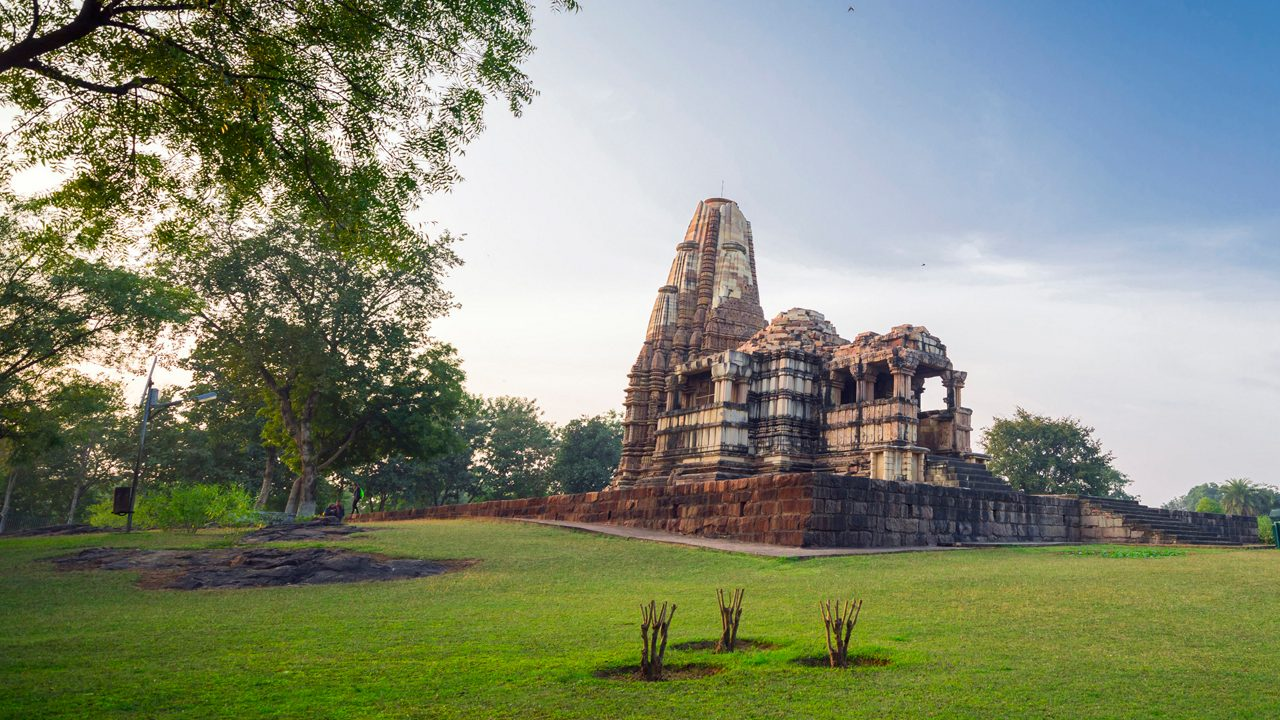
Three groups carry World Heritage status. Khajuraho’s Nagara temples give axial temple and heritage arcs with little need for built sets; Sanchi’s Buddhist toranas and stupas suit contemplative and scholarship scenes; and the painted rock shelters at Bhimbetka open anthropology and prehistory beats under stringent ASI rules. All three sit under the Archaeological Survey, so they are planned around its conservation limits and application timeline rather than assumed available on the day.
Gorges, Falls and Hill Country
At Bhedaghat near Jabalpur, the Marble Rocks gorge and the Dhuandhar falls on the Narmada give a dramatic natural set with boat access through the canyon; higher seasonal flow changes the scale of the falls but can restrict safe access and boat operations, and the gorge supports boat-based and elevated landscape coverage subject to water conditions, access restrictions and equipment approval. Pachmarhi, the state’s only hill station, adds Satpura forests, caves and waterfalls and a cool-climate green register the rest of the state cannot offer, workable from a single base. Both extend the range of a state schedule beyond its forts and temples.

Kanha and the Tiger Reserves
The tiger reserves are a category of their own, and a genuine point of difference for the state. Kanha, Bandhavgarh, Pench and Satpura are administered by the state Forest Department and individual reserve authorities under applicable wildlife and NTCA rules, and commercial filming there is tightly controlled: access to core and buffer areas is controlled separately, and commercial filming may be restricted to specified zones, routes and time windows, with departmental escorts and ecological conditions on vehicles, lighting, drones and crew movement. Film fixers familiar with the forest circuit identify the applicable authority, the permitted zone, the seasonal window and the documentation required, and build the escort, safety and ecological conditions into the schedule rather than discovering them on the day.

Bhopal and Indore: The Two City Bases
Most Madhya Pradesh schedules run from one of two city bases, and each has its own local production and vendor base and its own page of detail. Bhopal, the state capital, anchors central Madhya Pradesh: it is the administrative centre for the single-window Film Cell, and it holds the twin lakes, Van Vihar and a heritage core from Gauhar Mahal to Taj-ul-Masajid. For a city shoot there, the locations, permit route and crew sit with the line producer in Bhopal, who runs that base.
Indore, the commercial capital, anchors the west, with Rajwada and Lal Bagh heritage, contemporary city frames and direct air access, and it is the gateway to the Mandu, Maheshwar and Omkareshwar circuit. For a shoot based there, the locations, permits and crew sit with the line producer in Indore, who anchors that base. Bhopal sits about three to four hours east of Indore, so a production combining central and western Madhya Pradesh often runs both, drawing crew and kit from each.
Running both cities is a scheduling decision as much as a creative one. Crew and kit can be split across the two bases, joined by a half-day road move, so a production that has permitted and provisionally held both legs keeps some flexibility when a window slips in one. Where only one base is needed, the schedule sits with that city’s team; where the shoot spans the state, the two coordinate a single itinerary rather than re-sourcing in each place.

Basing and Routing a State Shoot
Madhya Pradesh’s value is realised in the routing. The central corridor lets a unit group looks by hub and make the move between hubs once, rather than shuttling back and forth, so a carefully selected fortnight can combine several registers by grouping locations around regional hubs, though forest and eastern-state blocks need separate travel and accommodation planning. From an Indore base a schedule cycles the Mandu ruins, the Maheshwar ghats and the Omkareshwar river frames; from Bhopal it pairs the city lakes with Sanchi and Bhimbetka; and from Jabalpur it reaches the Bhedaghat gorge with urban access nearby. Grouping the looks by hub reduces repeated company moves and backtracking and concentrates more expenditure inside Madhya Pradesh. That can increase the MP-attributable cost base presented for assessment, but only expenditure accepted under the policy counts towards the subsidy.
The crew plan runs the other way, from Mumbai in. Because the state does not carry a deep technical base, heads of department and specialist camera and lighting packages are confirmed and dispatched on a schedule, usually coordinated with a Mumbai crew team, while the cities supply the local production layer. A Madhya Pradesh shoot is therefore built backwards from crew and equipment availability as much as from the locations, and the split between local and imported is set at the budget stage.
Season shapes both the look and the logistics. The monsoon greens the Malwa plateau and drives the Narmada falls at Bhedaghat at their most dramatic, but it slows road moves across the corridor; the October-to-March window is the most workable for stable weather and clear access, while the deep summer is hard on outdoor units in the plains. A line producer sequences the hubs and the season together so the schedule holds its dates.

Madhya Pradesh or Rajasthan
The state Madhya Pradesh is most often weighed against is Rajasthan, the long-standing benchmark for heritage filming. Both now run a 2025 film-tourism policy, a single-window cell and a subsidy paid against eligible spend, so the choice comes down to the location brief and the terms that apply to it rather than a single winner. Rajasthan is the stronger answer where a schedule depends on desert, palace and large-fort imagery, and a line producer in Rajasthan works the forts and dunes of Jaisalmer, Jaipur, Udaipur and Jodhpur that have long been the default for period epics.
Where Madhya Pradesh Wins
Madhya Pradesh answers a different brief. Alongside heritage it adds river gorges, central-Indian heritage towns, forest environments, and Buddhist and prehistoric sites, so one schedule can move across several registers rather than the palace-and-desert register alone; and it holds the tiger reserves and deep-forest country the desert-and-fort belt cannot. Its subsidy slabs start at short-film and documentary level and run up to a high ceiling for the largest international projects, which keeps it open to indies and mid-budget work as well as major productions. The trade is maturity, since the specialist crew and equipment travel in and the ecosystem, though growing, is newer than Rajasthan’s.
For a line producer the decision is less about which state is better in the abstract and more about matching the location brief and the terms to the right one, and often about sequencing both into a single multi-state plan. The financial comparison itself turns on the applicable format, the minimum shooting share, qualifying expenditure, location charges and how much specialist crew and equipment has to travel into each state, so it is worked case by case rather than assumed.
Booking a Madhya Pradesh Shoot
Handled with the corridor in mind, Madhya Pradesh delivers distinctive footage on a controlled budget across features, series and documentaries. Share the script or brief, the proposed locations, the shoot window and the budget band, and a line producer Madhya Pradesh team can map the incentive eligibility, the permit route across the Film Cell and the ASI and forest authorities, the local-versus-imported crew split, and whether the schedule bases in Bhopal, Indore or both before the plan is locked.
