

A line producer Ajmer team and film fixers in Ajmer coordinate permits, crew, heritage access and location logistics across Ajmer, Pushkar and central Rajasthan. Line production in Ajmer connects the district-level work to the statewide Rajasthan schedule.
Ajmer and Pushkar as Filming Environments in Central Rajasthan
Ajmer and Pushkar occupy a distinctive place within Rajasthan’s filming landscape. Located close to Jaipur yet visually very different from the state’s larger cities, the region offers filmmakers a blend of historic architecture, religious landmarks, and desert-adjacent terrain. Productions frequently use Ajmer and Pushkar when they require authentic cultural environments that cannot easily be replicated through studio sets or constructed locations. Ajmer sits within the line producer Rajasthan production corridor — permit coordination for multi-location shoots routes through Jaipur as the state clearance hub before district-specific Dargah Committee and ASI approvals are processed.
The appeal of these towns lies in their layered visual character. Ajmer presents dense historic neighbourhoods, Sufi shrines, narrow markets, and Mughal-era structures that communicate the atmosphere of older North Indian cities. Just a short distance away, Pushkar offers an entirely different environment with its temple-lined lake, whitewashed ghats, and surrounding desert hills. Together they create a compact filming region where multiple narrative settings can be captured within a relatively small geographic radius.
For productions scheduling Rajasthan-wide shoots, the Ajmer–Pushkar corridor fills a specific slot in the production calendar — it provides the religious and cultural visual register that Jaipur’s palaces and Jodhpur’s fort cannot, and its proximity to Jaipur means it can be incorporated without requiring a separate base camp.

Line Production Ajmer: Central Rajasthan Base
Rajasthan functions as a regional production hub because it combines visual diversity with a well-established ecosystem of film professionals. The state supports productions ranging from advertising films and documentaries to international features requiring large-scale desert landscapes or historical settings. Structured production coordination across the state is typically managed through line producer Rajasthan services that coordinate logistics across multiple filming locations, help productions move between cities, and maintain continuity in scheduling, budgeting, and crew management.
Within the Rajasthan production network, Ajmer operates as a second-tier base — directly connected to Jaipur by four-lane highway, with its own hotel infrastructure capable of accommodating mid-sized production units, and a local crew pool that has grown from repeated engagement on both domestic and international shoots. Equipment brought from Jaipur reaches Ajmer within three hours by road. The city’s position between Jaipur and Jodhpur on the main national highway corridor means it can serve as a practical midpoint base for multi-city scheduling.
Ajmer’s Role Within the Rajasthan Production Network
When productions focus specifically on the Ajmer–Pushkar region, execution is typically managed through a line producer Ajmer team that combine local fixer knowledge with structured production oversight. These services source location permissions, coordinate with heritage site administrators, manage local crew contracts, and handle district-level police coordination — functions that require specific institutional familiarity with how the Ajmer and Pushkar permit systems operate, which differ in several respects from the Jaipur or Jodhpur permit infrastructure.
Heritage and Religious Landscapes Used in Film Shoots
Ajmer’s primary filming locations fall into three categories: the Dargah Khwaja Sahib complex and its surrounding lanes, the Taragarh Fort on the hillside above the city, and the Anna Sagar Lake with its marble pavilions. Each presents a distinct visual register and a distinct access regime. The Dargah is among the most filmed locations in the city but requires careful coordination with the Dargah Committee, which administers access and has specific protocols around camera placement, crew conduct, and shooting hours. The narrow lanes leading to the shrine compound have been used in multiple Bollywood productions and several international documentaries for their organic crowd texture and built environment.
Taragarh Fort provides elevated vantage points over the city and the surrounding landscape. The fort’s partially ruined state makes it flexible for period and contemporary production alike. Access requires coordination with the Archaeological Survey of India, which administers the site, and lead times for permits run four to six weeks for standard commercial production.
Pushkar and the Anna Sagar — Distinct Visual Registers
Pushkar offers one of the few intact sacred lake environments accessible to film production in north India. The ghats that ring Pushkar Lake, the Brahma Temple precinct, and the open ground used for the annual camel fair have all appeared across feature films, advertising productions, and documentary content. Filming within the immediate sacred perimeter of the lake requires negotiated access with the local temple administration and is subject to restrictions on certain content types. The Anna Sagar Lake in Ajmer, with its Daulat Bagh gardens and marble Baradari pavilions built by Shah Jahan, provides a more formally administered filming environment that allows greater camera freedom within designated areas.
Why Ajmer and Pushkar Attract International Productions
International productions are drawn to Ajmer and Pushkar for reasons that go beyond visual aesthetics. The region’s religious and cultural density is difficult to find elsewhere at this geographic concentration — within a 15-kilometre radius, a production can access one of the most significant Sufi shrines in South Asia, a sacred Hindu pilgrimage lake, a Mughal lakeside garden, and a medieval hillfort. This concentration reduces travel between setups and allows a tight shooting schedule to capture dramatically different environments.
The familiarity of the region within the international film community — built on decades of documentary production at the Pushkar Camel Fair and feature shoots around the Dargah — means that fixers and production coordinators with direct experience of these environments are available and can be engaged through established networks. International productions also benefit from Ajmer’s road connectivity to Jaipur airport, which simplifies the logistics of bringing in international crew and equipment.
Crowd logistics in both Ajmer and Pushkar require careful planning. Both towns attract large volumes of pilgrims year-round, and filming schedules must account for religious event calendars — the Urs festival at Dargah Khwaja Sahib and the Pushkar Camel Fair both bring significant crowd volumes that affect location access and filming feasibility in their respective peak periods.

Permits and Government Coordination for Filming in Ajmer
Film productions operating in Ajmer encounter a permit environment that runs on three parallel tracks: the Archaeological Survey of India for centrally protected monuments, the Dargah Committee for shrine-adjacent locations, and the Rajasthan state system via and district administration for public spaces, roads, and non-protected heritage areas. These three tracks operate independently and require separate applications — conflating them is the most common pre-production error on first-time Ajmer shoots.
The Line Producer Rajasthan Guide covers permit procedures across all major Rajasthan production zones, including ASI compliance for Dargah and heritage monument access relevant to Ajmer-based shoots.
Local administrative coordination adds a fourth layer. Police permission for road closures, crowd management near pilgrimage areas, and unit movement in the old city lanes must be obtained from the Ajmer district police separately from monument permits. Productions that assume a single window covers all Ajmer filming requirements consistently experience permit delays that affect the shooting schedule.

Heritage Monument and Archaeological Permissions
Taragarh Fort and Adhai Din ka Jhonpra are under Archaeological Survey of India administration. ASI permits for commercial production require an application to the regional office that covers the specific location, a detailed equipment list, crew count, intended usage, and the production entity’s registration details. Lead time for standard commercial production access runs four to six weeks. Night shoots, large crew contingents above a site-specific threshold, or requests involving equipment installation require additional approval layers and extend the timeline to eight weeks or more.
The Dargah Khwaja Sahib is administered by the Dargah Committee, a statutory body that operates independently from the state tourism or ASI systems. Camera access within the inner precincts requires a separate application to the Committee, with specific restrictions on shooting angles near the main shrine, crew gender composition in restricted areas, and the type of content being produced. Documentary and news access follows a different protocol from commercial feature film production. Productions that have not worked at the Dargah previously should engage a local coordinator with existing Committee relationships — the application process benefits significantly from institutional familiarity.
Application Process and Lead Times for Ajmer Filming Permits
For state-administered monuments and public filming in Ajmer city, the state commits to granting shooting permission within fifteen days of a complete application. An application missing an annexure does not start that clock. District administration coordination for police permissions typically runs 10 to 15 days but should be submitted in parallel with the monument applications, not after them. The practical minimum pre-production window for an Ajmer shoot involving both ASI locations and Dargah access is six weeks from permit initiation to cleared access — eight weeks if night shoots or large-format productions are involved. Productions with tighter timelines must either accept location substitutes or carry the risk of permit delays into the shooting schedule.
Police, Municipal and Local Administrative Coordination
Filming in the old city lanes around the Dargah and in the Pushkar market areas requires coordination with the local police at district level and, in some locations, with municipal authorities managing the public right-of-way. Road closures for equipment vehicles in the narrow access streets near the Dargah are subject to approval from the Traffic Police branch of the Ajmer district force. Applications citing only the standard filming permit without the specific traffic coordination component are regularly returned incomplete.
The Pushkar local body administers additional filming restrictions around the lake perimeter. Certain camera positions on the ghats require authorization from the local Municipal Council separately from the state filming permission. For productions shooting during festival periods, crowd management requires coordination with both the police and the District Collector’s office, as large-scale events bring temporary administrative structures that affect normal permit channels.
Crew movement with equipment through Ajmer’s densely occupied old city lanes also requires planning around daily pedestrian and pilgrim traffic patterns. The most effective approach for productions new to the environment is to engage a production coordinator with direct Ajmer district experience who can navigate the informal expectations of local administration alongside the formal permit process.

Production Logistics and Multi-City Scheduling
Film productions operating in Ajmer must plan logistics carefully because most Rajasthan shoots rarely remain confined to a single city. Production units typically move between multiple filming environments — Jaipur, Pushkar, Jodhpur, and surrounding desert and rural settings — during the same schedule. Ajmer functions as a practical operational base within central Rajasthan because it sits within driving distance of several major filming environments: Jaipur is 135 kilometres north-east, Pushkar is 11 kilometres west, and Jodhpur is roughly 200 kilometres to the west. This allows production teams to establish a local logistics hub while accessing nearby heritage towns, desert landscapes, and rural settings.
Logistics planning for Ajmer-based shoots begins during pre-production with route planning, accommodation selection, and equipment transport scheduling. Most productions base their primary crew accommodation in Jaipur and run a forward unit into Ajmer, rather than establishing a full base in Ajmer itself — the hotel infrastructure in Jaipur is deeper, and Jaipur airport provides the international and domestic connectivity that Ajmer lacks. The choice to base entirely in Ajmer makes sense only for productions whose schedule is concentrated in the Ajmer–Pushkar corridor for more than a week.
Equipment Transport and Crew Mobility
Equipment for Ajmer shoots is typically sourced from Jaipur or Mumbai and transported by road. The Jaipur–Ajmer national highway is four-lane and well-maintained, with transit times of approximately three hours for production vehicles. Large format equipment — cranes, generators, and heavy lighting rigs — can be transported on this route without significant restrictions, though oversized load permits are required for equipment above standard vehicle dimensions.
Crew mobility within Ajmer requires a different approach from larger Rajasthan cities. The old city areas and Dargah surrounds are not accessible to full-size production vehicles, and equipment must be transferred to smaller vehicles or hand-carried through the narrow lanes for interior-zone setups. Productions scheduling shoots inside the Dargah complex or in the old city markets must plan for this transfer layer in the call sheet, which adds approximately 30 to 45 minutes per setup compared to road-accessible locations.
Pushkar presents a similar access constraint around the lake ghats. Vehicle access to the immediate ghat areas is restricted, and equipment movements require hand-carry or small electric vehicles that the Pushkar Municipal Council permits on the ghat approaches. Productions scheduling tight multi-location days between Ajmer and Pushkar should factor these access delays into their scheduling calculations rather than treating them as contingency.
Coordinating Multi-City Rajasthan Production Schedules
When Ajmer and Pushkar are incorporated into a broader Rajasthan production schedule that includes Jaipur, Jodhpur, or Jaisalmer, sequencing decisions significantly affect both cost and permit timing. The standard approach is to base the production in Jaipur and sequence Ajmer–Pushkar as a 3-to-5-day block, either at the beginning of the Rajasthan leg before moving south and west, or at the end as a closing unit.
Multi-city permit applications are more efficiently managed when filed simultaneously from the Jaipur base rather than sequentially from each city. A line producer coordinating across the full Rajasthan schedule can initiate the ASI and Dargah applications for Ajmer while Jaipur city permissions are being processed, ensuring that permit timelines run in parallel rather than in series. Productions that initiate city permits sequentially — waiting for Jaipur to clear before filing Ajmer — typically extend the overall pre-production period by three to four weeks unnecessarily.
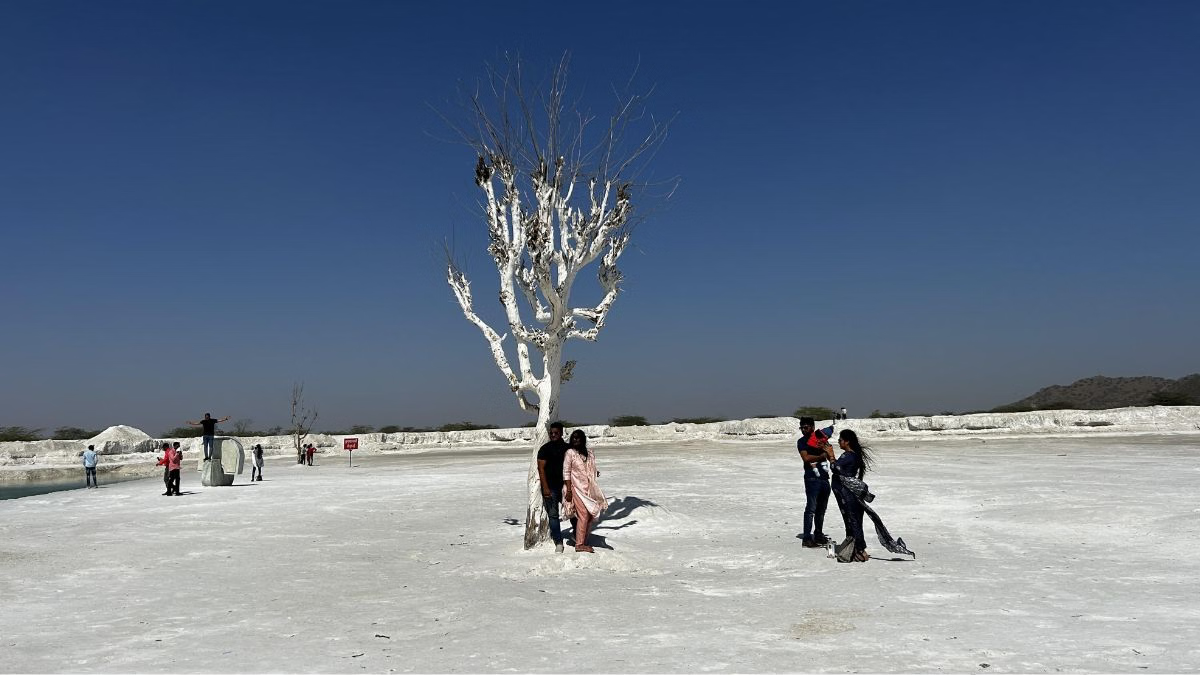
Kishangarh, located 27 kilometres from Ajmer, has grown as an additional location in the central Rajasthan circuit. The marble processing industry there has created an unusual visual landscape — vast marble yards, dust-covered processing areas, and heavy machinery — that has been used in advertising and commercial production as an industrial texture environment. Productions including Kishangarh in their schedule can treat it as a half-day addition to the Ajmer leg without requiring a separate accommodation base.
The shoot calendar for Ajmer and Pushkar follows a clear seasonal pattern. October through February is the primary window — temperatures are manageable, light quality is consistent, and access to both the Dargah and Pushkar lake is not disrupted by monsoon-related closures. March through May temperatures rise sharply, and June through September monsoon conditions affect road access to the Taragarh Fort hillside and limit outdoor production. Productions considering the Pushkar Camel Fair period in November should note that location access in the Pushkar ground area becomes highly restricted during the fair itself, and filming during the event requires a separate accreditation process managed through the district administration, distinct from the standard production permit.

Film Fixers and Line Producers in Ajmer
Productions shooting in Ajmer typically enter through one of two models: a full line producer engagement covering the entire Rajasthan production, with the Ajmer leg managed as part of a wider schedule; or a fixer-led engagement where a local production coordinator handles Ajmer and Pushkar specifically, plugging into a broader production structure managed from Jaipur or Mumbai. The choice between these models depends on the scale of the shoot, the number of locations in Ajmer, and whether the production has its own in-house unit manager for the Rajasthan leg. Film fixers in Ajmer operate primarily in the second model — providing the ground-level access, local contacts, and location knowledge that outside production companies cannot replicate without local presence.

Operational Role of Local Fixers in Ajmer
A film fixer Ajmer brief, and the wider film-fixer team in Ajmer, provides services that fall into three operational layers. The first is access — using established relationships with the Dargah Committee, the local ASI office, district police, and the Pushkar Municipal Council to facilitate permits and location access that a production company approaching these institutions cold would struggle to obtain within a normal pre-production timeline. The second layer is logistics intelligence — knowledge of which old-city lanes can accommodate a production vehicle, which ghat approaches in Pushkar allow equipment movement on which days, and how pilgrim traffic patterns affect specific filming windows at the Dargah. The third is crew sourcing — access to the local production talent pool of camera assistants, art department hands, drivers, and crowd coordinators who have worked on previous productions in the city.
For documentary and international news productions, a film fixer in Ajmer becomes even more central. The Dargah complex and Pushkar lake during pilgrimage seasons attract significant documentary interest from international broadcasters. In these contexts, the fixer manages not just logistics but cultural protocol — advising crews on appropriate behaviour in sacred environments, mediating any misunderstandings with religious authorities, and ensuring the production does not create access problems for future shoots in the location.
What Local Fixers Handle on Location in Ajmer
On-location fixer responsibilities in Ajmer typically include: coordination of the police escort required for large productions moving through old-city areas; communication with the Dargah administration on shoot days when access protocols need real-time interpretation; sourcing of local crowd coordinators who can manage pilgrimage-area filming without disrupting religious activity; and management of the small-vehicle equipment transfer system required for non-road-accessible zones. Productions that attempt to manage these on-location functions without a fixer embedded in the local institutional network consistently experience delays and access refusals that could have been avoided.
When Productions Scale to Full Line Production Services
When a production’s Ajmer–Pushkar schedule extends to five days or more, or involves multiple simultaneous units, the coordination requirement typically exceeds what a single fixer can manage and calls for structured line production services. A full line producer engagement for the Ajmer leg covers advance logistics planning, consolidated permit filing across all three administrative tracks, unit accommodation and transport management, budget control against the local spend, and post-production documentation for any incentive applications that include Ajmer-based QCOP spend.
Scaling from Fixer Support to Full Line Production
The transition point from fixer engagement to full line production is typically reached when the shoot involves more than one simultaneous camera unit, when international crew numbers exceed ten, or when the production schedule includes both Ajmer and Pushkar on the same day. At this scale, the coordination load across permits, logistics, and crew management requires dedicated production oversight rather than a single fixer managing all tracks simultaneously.
Productions that have engaged line producer services for larger Rajasthan shoots — Jaipur, Jodhpur, Jaisalmer — and are adding Ajmer as a supplementary leg typically find that the same line production company can extend coordination to cover the central Rajasthan locations without requiring a separate engagement. This continuity in production management benefits QCOP documentation for incentive purposes, as a single vendor maintains the spend records across the full Rajasthan production period. The Ajmer district’s position within the broader Rajasthan incentive framework means that qualifying spend in Ajmer counts toward the same QCOP base as spend elsewhere in the state — a factor that productions budgeting against the state incentive should factor into their Ajmer allocation decisions.
