
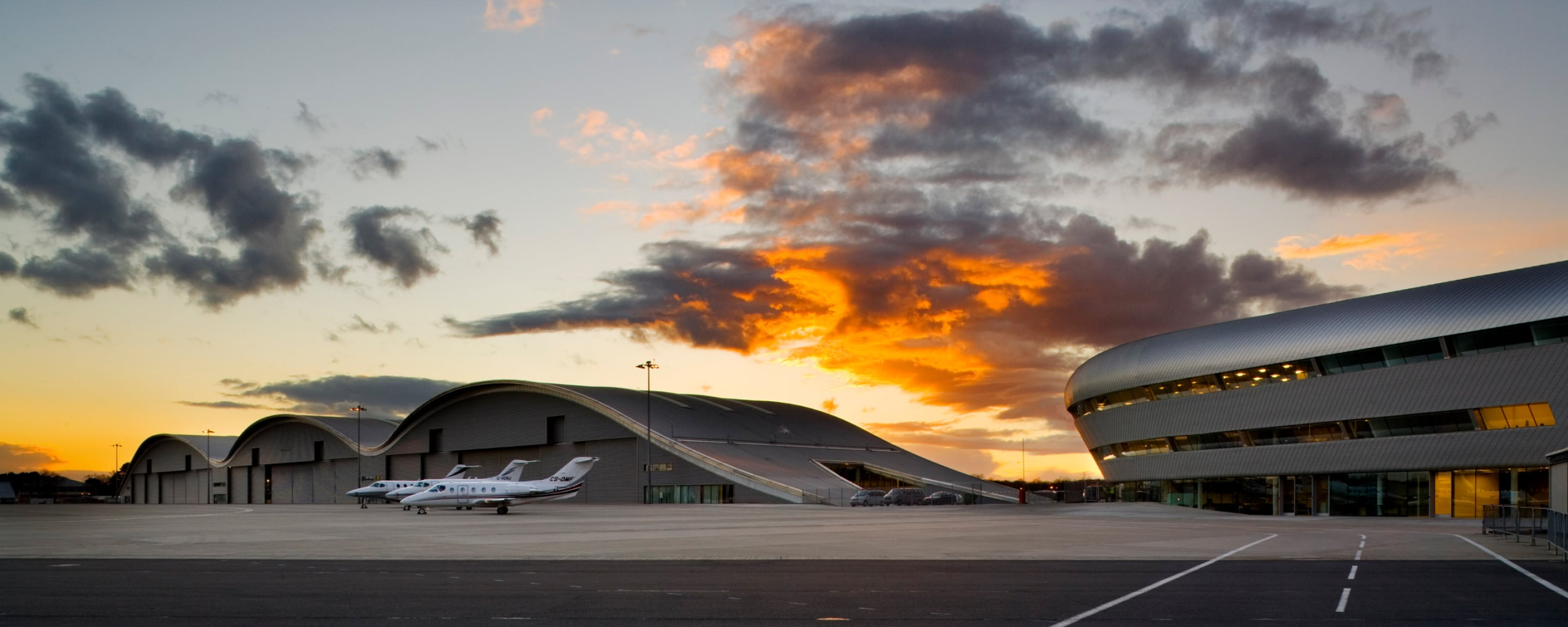
Airport filming in India sits at the intersection of three overlapping regulatory systems, the airport operator’s site control, the Bureau of Civil Aviation Security’s access governance, and the Directorate General of Civil Aviation’s photography permissions framework. Whether the sequence is a commercial interior shoot in Delhi’s T3 terminal, an airside apron production at Mumbai’s CSMIA, or a drone aerial pass approaching a metropolitan airport boundary, each requires separate applications from separate authorities running on parallel timelines. Productions that approach airport filming in India as a single-permit task consistently hit last-minute clearance blocks that no production relationship can resolve once pre-production time has run out.
The regulatory complexity behind airport filming in India reflects the country’s fast-evolving civil aviation landscape. India’s DGCA administers one of the world’s most digitally governed drone and aerial photography frameworks, built around the Drone Rules 2021 and the DigitalSky NPNT platform. AAI-operated and private-concession airports each impose their own commercial filming conditions independently. BCAS runs a parallel security clearance structure for every crew member and vehicle that crosses the security threshold. The three authorities do not communicate with each other on a production’s behalf, the line producer manages all tracks simultaneously from the first day of pre-production.
Airport Filming in India, The Three-Authority Framework
Airport filming in India covers a broader range of operational categories than productions typically plan for at the brief stage. Ground photography inside terminal buildings and check-in halls. Airside sequences on aprons, gate bridges, and aircraft stands. Aerial drone passes over or near airport perimeters. Air cargo terminal logistics for international equipment import and re-export. Each category falls under a different combination of the three authorities, with its own application portal, lead time, and document set. This guide maps each of those pathways in detail, with specific reference to the DGCA eGCA portal for ground photography, the DigitalSky platform for aerial operations, and what Delhi IGI, Mumbai CSMIA, and other major Indian airports require, and sits alongside the broader film permits and compliance services framework that governs all commercial production permissions in India.
The single most common planning error international productions make when scheduling airport sequences in India is applying to the airport operator alone and assuming everything else follows. It does not. A separate BCAS security clearance process runs concurrently for crew and vehicles. DGCA photography permissions are required before any camera rolls on airport premises. All three tracks must close before a shoot date is confirmed, and none of them can be accelerated by the others once the application process has begun.
Airport Operator, Location Permission and Site Conditions
The airport operator issues the primary filming permission and defines what a production can do, where, and when. At AAI-operated secondary and state airports, across the 137-plus airports in the AAI network, applications go through the regional AAI office. At private concession holders, including Delhi International Airport Limited (DIAL), Mumbai International Airport Limited (MIAL), Hyderabad’s GMR-operated RGIA, and Bengaluru’s BIAL, applications go to the commercial team of the relevant operator. There is no shared national rate card; conditions, fees, escort requirements, and approved zones are set station by station.
DIAL maintains a published photo and video shooting programme. RGIA indicates that permit applications should be submitted approximately ten days before the shoot date for standard landside requests, though airside work involves longer lead times. Operators typically require a script synopsis, crew and equipment manifest, and a signed indemnity letter before confirming a slot. A site survey before slot confirmation is standard for any sequence involving airside access.
BCAS, Airport Entry Passes for Crew and Vehicles
The Bureau of Civil Aviation Security administers the Airport Entry Pass (AEP) and Temporary AEP (TAEP) system under the AEP Guidelines 2022 published by the Ministry of Civil Aviation. Every crew member who crosses the security threshold into a controlled zone requires a TAEP, including actors, camera operators, sound recordists, lighting assistants, and any production co-ordinator who steps past the security screening point. Vehicles operating airside require a Vehicle Entry Permit (VEP). Any driver operating a vehicle in airside areas must hold an Airside Driver Permit (ADP). These are issued after background screening and vehicle inspection. The BCAS eSahaj portal handles security pass applications. Production managers should begin the TAEP process immediately after the operator confirms a shoot slot, TAEP processing time for larger crew sizes runs three to four weeks and cannot be compressed at the last stage.
DGCA, Ground Photography Permissions and the eGCA Portal
The Directorate General of Civil Aviation regulates commercial ground photography at airports through its eGCA online portal at dgca.gov.in. Applications are filed under the Ground Photography category in the permissions section. The portal requires the applicant to specify the airport, the nature of the photography activity, the intended dates, and the purpose, commercial filming is a distinct category from media or documentary work in the application form. India Cine Hub, the Government of India’s official filmmaking portal, confirms that airport and aerial filming applications should be submitted at least two months before the planned shoot date. The Nodal Officer for filming-related applications at DGCA is the Joint Director General (Operations) at DGCA headquarters, Aurobindo Marg, New Delhi. Productions should treat the eGCA submission as a priority parallel to the operator application, not a step that follows once operator permission is secured.

Airside vs Landside, What the Distinction Means for Production
The boundary between landside and airside access has direct consequences for how many permits are required, how long the process takes, and how much the shoot will cost. Productions that fail to define which zones they actually need at the brief stage often discover late in pre-production that their desired sequences require the more complex airside compliance pathway.
Landside, Terminal Interiors, Check-in Halls and Public Concourses
Landside covers everything from the entrance forecourt through the check-in hall to the security screening boundary. These are areas accessible to the general travelling public. Filming here requires the operator’s permission and compliance with crowd-flow and operational constraints, but does not typically require BCAS TAEPs for crew who remain on the public side of the security threshold. That said, costs are still significant. A four-hour commercial shoot inside Indira Gandhi International Airport, Delhi has been cited in industry reporting at around ₹10 lakh for a standard window, with premium terminal interior sequences reaching ₹15 lakh to ₹30 lakh depending on footprint, timing, and whether exclusive zone access is required. Operators do not publish granular rate cards; all figures are operator-quoted and project-specific. Landside sequences at major metros should be budgeted conservatively until the operator provides a formal quotation.
Airside, Apron, Gates, Stands and Service Roads
Airside covers every controlled movement area, runways, taxiways, aprons, aircraft stands, gate bridges, and service corridors. Access here requires all three compliance layers to be active simultaneously: operator permission with specific airside authorisation, BCAS TAEP and VEP/ADP credentials for every crew member and vehicle, and DGCA ground photography clearance. CISF escort is standard for airside shoots, and crew cannot move between airside zones independently. Production managers planning airside sequences should budget for CISF escort staffing time as a direct cost alongside the operator’s filming fee, this is non-negotiable at any Indian airport. Unauthorised airside filming is explicitly listed in the AAI penalty schedule as a chargeable offence under the Airports Authority of India Act. Given the layered compliance involved, airside shoots are rarely viable with less than six to eight weeks of dedicated pre-production time from brief to confirmed shoot date.

Aerial Filming, Drones and Civil Aviation Compliance Near Airports
Drones and aerial platforms face an entirely separate compliance layer near Indian airports. The Drone Rules 2021, and the Civil Drone Bill 2025 released for public consultation in September 2025 as the successor framework, designate airport perimeters as yellow or red airspace zones on the national DigitalSky map. Red zones are no-fly without central government authorisation. Yellow zones require prior digital permission through the DigitalSky platform before any flight is attempted. The airspace map is dynamic and must be checked immediately before every flight, not just at the planning stage weeks earlier.
DigitalSky Platform, NPNT and Airspace Zone Classification
The DigitalSky platform at digitalsky.dgca.gov.in is the operational system for drone permission management in India. It enforces the No Permission, No Takeoff (NPNT) principle, a drone without a valid digital clearance will not receive an unlock authorisation from the platform. Near airports, virtually all practical operating zones fall within yellow or red classification. In yellow zones, the DigitalSky application specifies the exact GPS coordinates, altitude ceiling, date, and operating time window; approval or rejection comes through the platform. Maximum permitted altitude in approved zones is 120 metres (approximately 400 feet) above ground level, with visual line of sight (VLOS) required throughout the flight. Night flying requires a separate DGCA special permission that is not routinely granted for commercial productions and should never be assumed available at the planning stage.
UIN Registration, Remote Pilot Licence and Insurance Requirements
All drones above 250 grams must be registered on DigitalSky with a Unique Identification Number (UIN). The Drone Rules 2021 define five categories by weight: Nano (under 250g), Micro (250g–2kg), Small (2kg–25kg), Medium (25kg–150kg), and Large (above 150kg). Cinema drones carrying payload cameras almost always fall into the Small or Medium category. Operators of drones above 250 grams must hold a Remote Pilot Licence (RPL) issued by DGCA. Third-party liability insurance is mandatory for all drones operating in civil airspace, the Drone Rules 2021 specify a minimum ₹1 crore cover for commercial operations. Equipment manifests for drone payloads, including gimbal-mounted cinema cameras, must be included in the DigitalSky application. For aerial work within the airport boundary, DGCA aerial photography permissions through the eGCA portal must be obtained in parallel with the DigitalSky permission-to-fly.
Drone Filming in Indian Cities, Related Compliance Resources
Drone operations near airports represent one segment of India’s broader urban drone filming compliance landscape. Many productions that begin with airport aerial work extend their drone schedule into adjacent city areas, where different airspace classifications, local police permissions, and city-specific risk zones apply. The full operational framework for urban airspace in India, including city-by-city restricted zones, NPNT compliance workflow, and how to structure a commercial drone shoot across multiple Indian locations, is covered in the dedicated guide to drone filming in Indian cities. For the detailed DGCA regulatory process, from DigitalSky account creation through UIN registration, RPL documentation, and final permission-to-fly, the complete procedural guide is at drone film permission in India.

Airport Filming in India, Delhi, Mumbai and Major Production Centres
The three-authority framework above applies across all Indian airports. At the station level, each airport has its own process, commercial team, cost structure, and practical constraints. What follows covers the major metro airports where most international commercial and feature productions are concentrated, along with the document and lead-time requirements that cut across all stations.
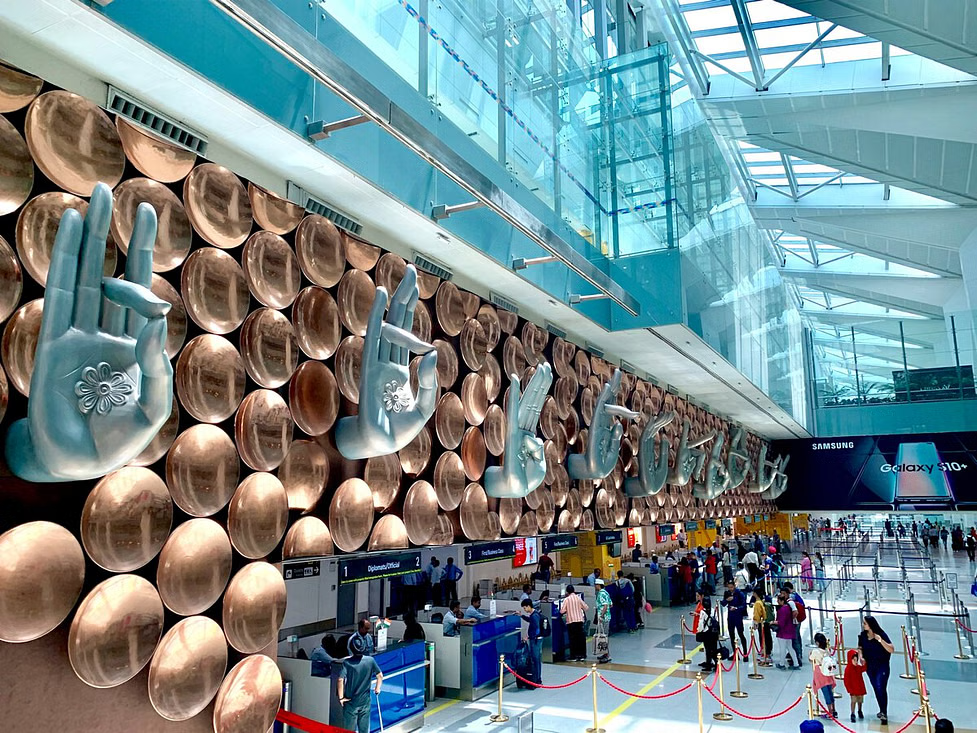
Indira Gandhi International Airport (IGI), Delhi
DIAL, the private operator of IGI, maintains a formal photo and video shoot programme. Applications go to the DIAL commercial team with a script, crew list, equipment manifest, and schedule. All DGCA eGCA and BCAS applications run in parallel from the same pre-production start date. For a line producer Delhi-based production, IGI is among the most complex and expensive airport locations in India. Industry reporting places landside commercial shoots between ₹8 lakh and ₹10 lakh for a standard four-to-six-hour window, with terminal interior sequences at ₹15 lakh to ₹30 lakh for larger footprint productions requiring multiple zones or extended access. These are media-reported benchmarks, DIAL does not publish a rate schedule and productions should treat operator quotation as the definitive cost input. DIAL commercial liaison should be contacted at the pre-production planning stage, not when the location contract is already drafted.

Chhatrapati Shivaji Maharaj International Airport (CSMIA), Mumbai
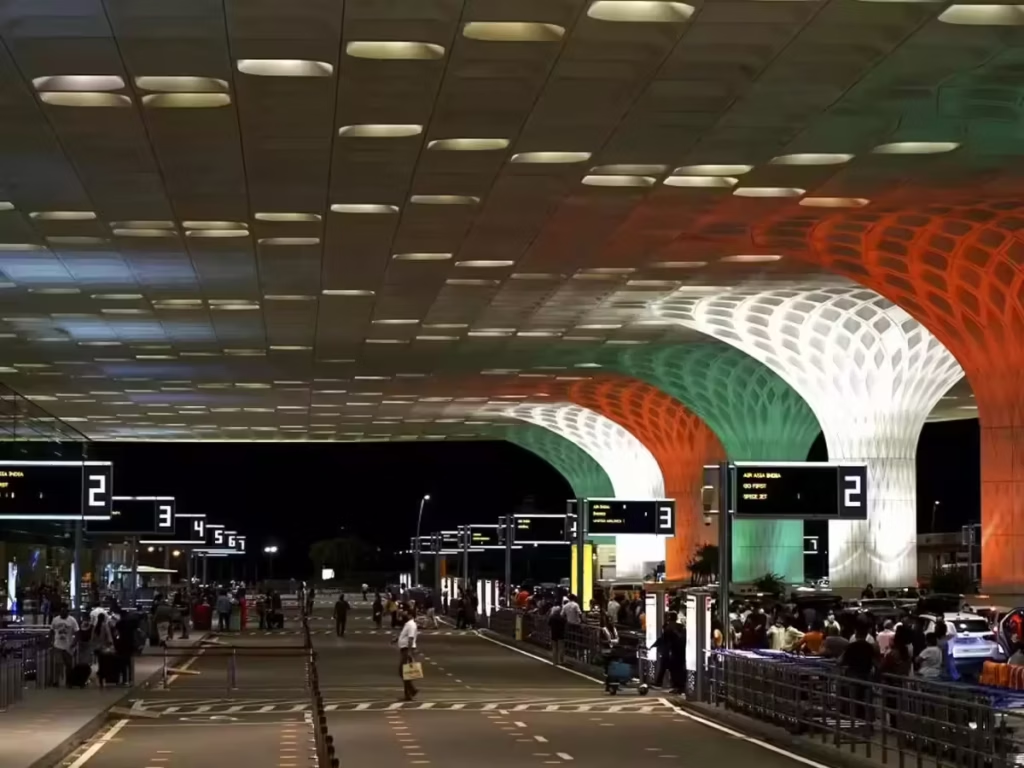
CSMIA is operated by MIAL, now under Adani Airports. Filming applications go to the MIAL commercial team; the process mirrors the national framework with operator permission, BCAS TAEPs, and DGCA eGCA ground photography clearance running in parallel. CSMIA does not publish a filming tariff. Cost structures typically comprise a location licence fee, security escort staffing, operational supervision charges, and overtime or weekend uplifts. Productions requiring private jet terminal or cargo apron access should plan separate access applications, as those zones involve different operational departments within the airport and carry additional constraints. For the broader Mumbai compliance environment, including BMC, police and fire NOC requirements that stack onto airport permits when sequences involve road approaches or adjacent locations, the dedicated guide to filming permissions in Mumbai covers the multi-agency process in full.
Other Airports, Hyderabad, Chennai, Bengaluru and Regional Stations
Hyderabad’s Rajiv Gandhi International Airport (RGIA), operated by GMR, indicates advance notice of approximately ten days for standard landside applications. Airside and security-access work requires considerably more lead time and should be budgeted at the full two-month minimum. Chennai International Airport, operated by AAI, handles filming through the AAI regional office; productions requiring air freight terminal sequences should co-ordinate directly with the cargo complex. Bengaluru’s Kempegowda International Airport (BIAL) has a commercial filming programme similar in structure to DIAL and MIAL.
For any production moving equipment into or out of Indian airports, whether for location shoots or carnet-controlled imports, the Airport Cargo and Customs Master Checklist covers ATA Carnet preparation, temporary import procedures, re-export compliance, and hub-specific customs protocols for Mumbai, Delhi, Chennai and other major cargo gateways. These logistics processes run in parallel with filming permits and must be initiated no later than six weeks before the first equipment movement.
India’s Civil Aviation Filming Regulatory Landscape
The regulatory architecture governing airport filming in India has evolved significantly since 2021. Understanding where the rules come from, how they are enforced digitally, and what the current review cycle means for productions planning ahead is part of responsible pre-production, not optional background reading. For any production that films at, above, or logistically through an Indian airport, the regulatory layer is the production layer.
DGCA’s Drone Rules 2021 and the Civil Drone Bill 2025
The Drone Rules 2021 replaced the Unmanned Aircraft System Rules of the same year and introduced India’s first fully digital permission framework for unmanned aerial operations. The rules established the five weight categories (Nano, Micro, Small, Medium, Large), the DigitalSky platform as the single point of permission management, and the NPNT (No Permission, No Takeoff) enforcement mechanism built into drone firmware. For commercial productions, this meant that any aerial filming unit operating above 250 grams required a registered drone, a licensed remote pilot, and a digital permission-to-fly before the first frame could be captured.
In September 2025, the Ministry of Civil Aviation released the Civil Drone Bill 2025 for public consultation, signalling a further evolution of the framework. The Bill proposes consolidating drone regulation under a single statute, introducing a tiered certification pathway for commercial operators, and strengthening NPNT compliance through updated firmware standards. For productions planning shoots in 2026 and beyond, the transition period between the 2021 Rules and the 2025 Bill means that compliance workflows should be verified against the current operative rules at the time of pre-production, not assumed stable from a prior shoot cycle. DGCA’s EGCA portal and DigitalSky platform remain the operative systems until the Bill receives legislative assent.

Why India’s Airport Filming Framework Is Stricter Than Most
India operates one of the most digitally enforced civil aviation filming frameworks of any major film production destination. The combination of NPNT-based drone control, BCAS-administered security access credentials, and DGCA’s EGCA portal for ground photography creates a three-layer digital trail for every airport filming activity. Most comparable jurisdictions, the UK, UAE, Australia, require operator permission and aviation authority clearance for airport filming, but India’s NPNT architecture goes a step further by making physical compliance (drone unlock) conditional on digital permission status. A drone that has not received a valid DigitalSky clearance will not fly, regardless of what the production believes its permissions to be.
For line producers managing international co-productions or advertising campaigns that involve Indian airport sequences, this framework means there is no workaround for incomplete applications. Every track must close independently. The India Filming Compliance Checklist covers the full documentation protocol for productions operating across permit categories, including airport sequences, location shoots, and equipment imports, and is a useful cross-reference during pre-production planning. Download the India Filming Compliance Checklist here.
Pre-Production Planning for Airport Filming in India
Successful airport sequences in India come down to pre-production discipline. The permit architecture is fixed, three authorities, three parallel tracks, non-negotiable lead times. What a line producer controls is the quality and completeness of the application file, the sequence in which tracks are opened, and whether the production calendar has absorbed the real time these processes require. The sections below cover the full document set and the lead time logic that governs every Indian airport shoot.
Document Set for Airport Filming in India, What All Three Authorities Require
Assembling the complete document set is the production manager’s critical-path responsibility for any airport sequence in India. From the airport operator: filming or photography permit, slot and time allocation, location plan approval, escort arrangement confirmation, fee payment receipt, and a signed indemnity letter from the production company. BCAS: TAEP approvals for all crew entering controlled zones, VEP for production vehicles, ADP for airside drivers, and equipment screening clearance documentation.
From DGCA: the eGCA ground photography permission certificate is mandatory; where aerial or drone work is involved, DigitalSky permission-to-fly and UIN and RPL documentation for the named remote pilot must accompany all other submissions. A full equipment manifest covering camera body serial numbers, lens details, lighting and grip inventories, and any drone or gimbal payloads should be filed with all three authorities from the outset, inconsistencies between manifests cause delays at the gate even when all permits are in hand.

Lead Times and Why Two Months Is the Minimum
India Cine Hub, the Government of India’s official filmmaking portal, explicitly states that airport and aerial filming applications must be submitted at least two months before the intended shoot date. In practice, BCAS TAEP processing for larger crew sizes runs three to four weeks. The eGCA ground photography permit carries no published service level agreement, and production managers report turnaround times ranging from three weeks to six weeks depending on application completeness and current DGCA workload. Operator permission typically closes fastest at two to four weeks, but operators will not confirm availability until they see that DGCA and BCAS tracks are already active. Drone and aerial applications through DigitalSky add a further variable for any production combining ground and aerial work at the same location.
The only way to hold an airport shoot date is to build the full compliance framework into your production calendar from the first day of pre-production and manage all three authorities in parallel. Airport filming in India demands more advance planning than virtually any other domestic location category, the combination of aviation security requirements, aviation safety regulations, and operator commercial process makes it structurally incompatible with late-stage location confirmations. Productions that have successfully delivered airport sequences in India consistently credit line producer-led pre-production with two months of runway as the single factor that separated confirmed shoot dates from collapsed plans.
