
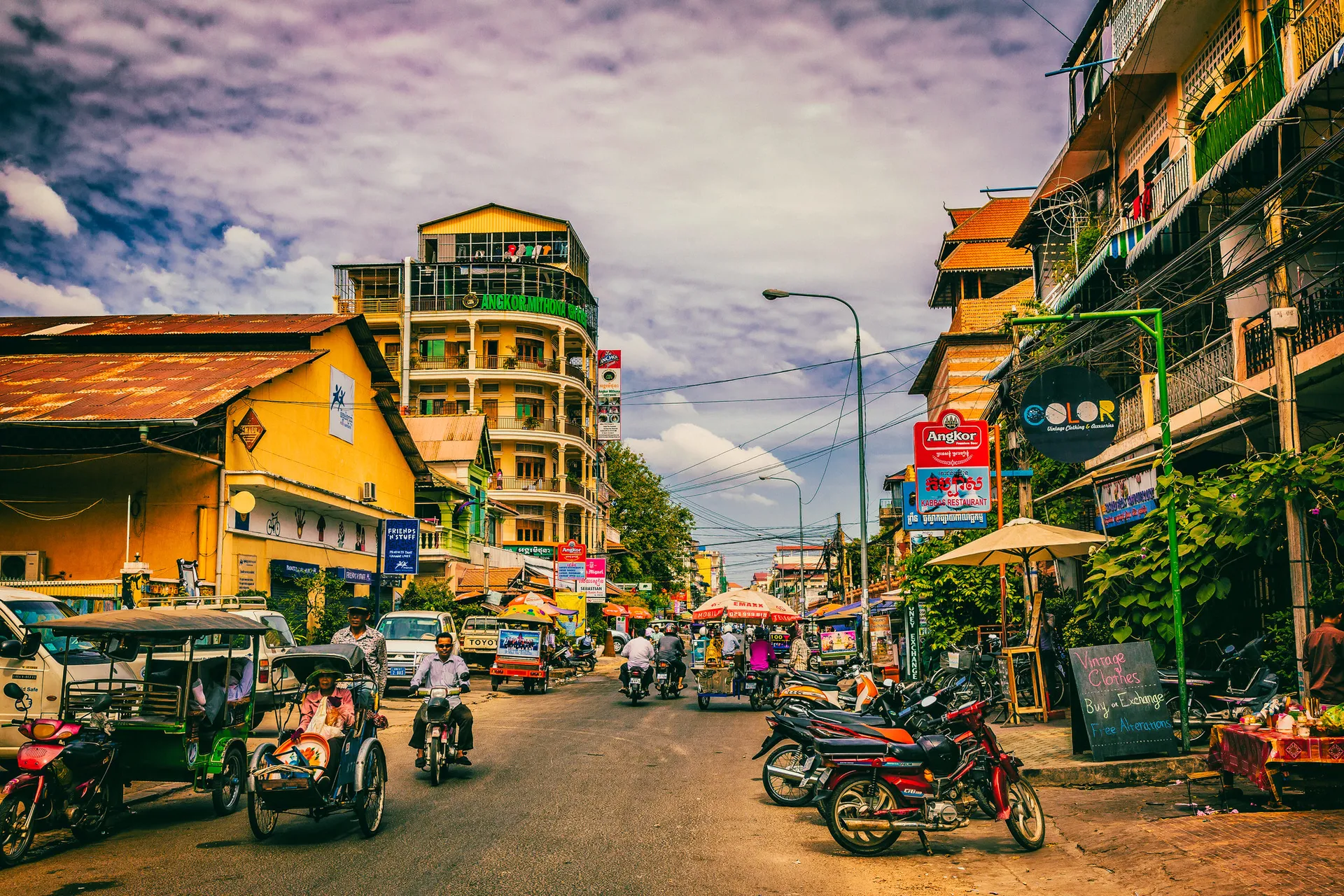
A line producer Cambodia gives an international production access to some of Southeast Asia’s most distinctive locations — the temples of Angkor, colonial Phnom Penh, the Bokor plateau and the southern islands — at a cost base well below Thailand or Vietnam, with equipment moving in and out duty-free. Working with a film fixer in Cambodia, the line producer secures the permits, builds the crew and controls the budget so a shoot in an emerging production market runs to plan. Film production services in Cambodia, at their best, mean exactly that access to the temples, the colonial cities and the islands, together with the compliance to use them cleanly.
Cambodia is not a big-incentive jurisdiction like Italy or Abu Dhabi; its advantage is low cost, striking locations and a duty exemption on production equipment. The role of a line producer Cambodia is to turn those advantages into a delivered shoot — clearing the Ministry of Culture and APSARA permits, importing kit cleanly, and structuring the budget so the low base cost is not eroded by the friction of an unfamiliar market.

What a Line Producer in Cambodia Does
The line producer is the single point of accountability for executing a shoot in Cambodia. That means the recce and location plan, the permit applications, the crew and vendor build, the shooting schedule, the equipment import, and the on-set cost control from pre-production through wrap. In a market where local infrastructure is thinner than Thailand’s and paperwork can move slowly, that accountability is what keeps a foreign production on schedule rather than stalled at a checkpoint or a permit office.
A film fixer in Cambodia adds the local access layer: the relationships with the Ministry of Culture and Fine Arts, the APSARA Authority that governs the Angkor Archaeological Park, provincial authorities, and the vetted local crew and vendors. Where the line producer owns the budget and plan, the fixer opens the doors and solves the daily problems — the two operate as one unit so an incoming feature, series, commercial or documentary shoots on time.

Filming Permits and Local Support in Cambodia
Filming permits in Cambodia run principally through the Ministry of Culture and Fine Arts, which issues the central authorisation for foreign productions, with provincial and municipal permissions layered on for specific locations. Shooting at Angkor — Angkor Wat, Ta Prohm and the wider complex — requires a separate permit and fee structure from the APSARA Authority, which manages the protected site and sets conditions on access, crew size and equipment. A line producer maps these tracks against the schedule so the iconic locations are locked on realistic dates.
Angkor and Heritage-Site Conditions
The Angkor permit comes with conditions that a production must plan around: limits on crew size and equipment in sensitive temple areas, restrictions on where and when large units can work around visitor access, and fees that scale with the scope of the shoot. The APSARA Authority protects the site actively, so a realistic plan respects those conditions rather than assuming full access — and an experienced line producer knows which shots are achievable within them and which need an alternative.
The fixer handles the on-ground process: preparing the script and shot breakdown for the authorities, coordinating with heritage and provincial officials, arranging any required government liaison or police presence, and managing the fees and conditions that come with sensitive sites. Lead times matter — heritage and government locations need more notice than street or private ones — so the permit calendar is built early rather than assumed.
Provincial and Location Permits
Beyond the central authorisation, individual locations bring their own permissions — provincial authorities, municipal offices in Phnom Penh, private landowners and, for drone or restricted work, additional clearance. The fixer assembles these in parallel with the shooting schedule, and the line producer sequences the shoot so no single pending permit holds up the plan.

Filming Costs and Rates in Cambodia
Cambodia’s financial case is built on cost, not a headline rebate. Crew, location and service costs sit well below Thailand and Vietnam, so a given budget buys more shooting days, and the country grants an exemption on import and export duties for production equipment, which removes a cost that other markets absorb into the budget. For productions bringing significant kit, that duty exemption and the low base cost together make Cambodia one of the region’s most cost-efficient shoots.
Preferred Local Rates on Transport, Hotels and Flights
A large part of Cambodia’s cost advantage is realised through the line producer’s and fixer’s local relationships. Ground transport, hotels, domestic flights and the airlines and operators that move crew and equipment are all booked at preferred, negotiated rates rather than rack prices — rates built up across many productions and not published. Because transport and accommodation make up a substantial share of any location budget, those preferred rates are a material saving on exactly the lines where an unfamiliar production would otherwise overpay. A local unit also knows which operators, hotels and charter services are reliable at production scale, so the saving does not come at the cost of the schedule.
Building the Budget on Real Savings
The discipline is to build the budget on the savings that are real and reliable — the low base cost, the duty exemption, and the preferred transport, hotel and flight rates — rather than on an uncertain rebate. A line producer models those savings against the shoot before locations are locked, so the headline cost advantage of filming in Cambodia survives contact with the schedule and turns into a genuinely lower net figure.
How Cambodia Compares on Cost
Within Southeast Asia, Cambodia typically sits at the lowest end of the base-cost range — below both Thailand and Vietnam on crew, location and service rates. Thailand offers deeper crews, full studios and a codified cash rebate, and Vietnam a broader crew base, but both carry higher day rates. Cambodia’s trade is clear: the lowest input costs and a duty exemption, against thinner local infrastructure. For a production whose budget is tight and whose locations are the draw, that trade often favours Cambodia, especially when the shoot is paired with a neighbouring market for the incentive and the crew depth.
What Cambodia does not yet offer is a fixed, published cash rebate or tax credit of the kind Thailand and much of Europe run. References to a Cambodian film rebate exist, but the rate, cap and application process are not clearly defined, so an honest budget treats the duty exemption and low cost as the reliable savings and does not bank an uncertain rebate. Where a production needs a codified incentive alongside Cambodia’s locations, the common structure is to pair a Cambodia leg with a line producer Thailand shoot that carries Thailand’s cash rebate.

Locations Across Cambodia
Cambodia’s locations are its headline draw. Siem Reap and the Angkor Archaeological Park offer the temples that made the country a global filming name — Ta Prohm and Angkor Wat anchored Tomb Raider, and the wider complex has hosted features and documentaries drawn to its scale and texture. Angelina Jolie’s First They Killed My Father filmed across the country, from the capital to the provinces.
Siem Reap and the Angkor Temples
Siem Reap is the base for Angkor work, with the airport, hotels and local crew concentrated there. The temples range from the restored grandeur of Angkor Wat to the root-tangled ruins of Ta Prohm, and the wider park offers dawn-to-dusk options that a fixer schedules around the site’s visitor rhythm and the APSARA conditions.
Beyond Angkor, Phnom Penh supplies a working Southeast Asian capital with French-colonial architecture, riverside boulevards and dense urban texture; the Bokor plateau and its abandoned hill station bring an eerie, atmospheric highland look; and the southern coast — Sihanoukville, Koh Rong and the Koh Kong mangroves and islands — offers tropical beach and jungle environments. Battambang and the rural provinces add colonial towns and agricultural landscapes within a manageable travel radius.
Phnom Penh and the Capital
Phnom Penh gives a working capital: the riverfront, French-colonial buildings, markets, the Royal Palace precinct and dense street life, alongside contemporary districts. It is also the logistics hub for a Cambodia shoot, with the deepest local crew and vendor base and the main point of entry for imported equipment.
The Coast, Islands and Provinces
The southern coast and islands — Sihanoukville, Koh Rong and the Koh Kong mangroves — supply tropical beach and jungle, while Bokor’s plateau and abandoned hill station bring an atmospheric highland look, and Battambang and the provinces add colonial towns and rural landscapes. A line producer plans travel between these and the Angkor and capital bases as one logistics picture.

Crew, Equipment and Logistics
Cambodia’s local crew base is smaller and less deep than Thailand’s, so a line producer typically builds a hybrid unit: a core of experienced Cambodian crew and fixers supplemented, where the format demands, by heads of department and specialist technicians brought in from Bangkok or the wider region. High-end camera, lighting and grip packages are frequently imported — cleanly, under the duty exemption or on carnet — rather than sourced entirely locally, and the line producer plans that equipment routing so kit clears customs without holding the schedule.
Importing Crew and Equipment
For larger formats, the line producer manages the import of both crew and kit: regional heads of department and specialist units from Bangkok or beyond on the appropriate visas, and camera, lighting and grip packages cleared under the duty exemption or on carnet. Getting that import routing right — the entry point, the timing, the paperwork — is what keeps Cambodia’s cost advantage from being eaten by customs delays.
The local production team — coordinators, production assistants, location and transport crew, and the fixers who hold the government and site relationships — is where Cambodia’s value is delivered day to day. A line producer builds that team, sets the reporting and cost-control discipline it works to, and manages the interface between the local unit and any visiting core team, so an international production runs on Cambodian cost with international-standard control.
Equipment Availability
Basic camera, lighting and grip is available in Phnom Penh and Siem Reap, but high-end packages are typically imported — most often from Bangkok, a short hop away. A production planning ARRI or RED bodies, Sony Venice, large lighting and grip packages, generators or professional drone units should budget for regional import under the duty exemption or on carnet rather than assume full local availability. Experienced drone and specialist operators are similarly drawn from the regional pool. Knowing exactly what is reliably available locally versus what must come from Bangkok is part of what a line producer prices into the budget from the start.
Logistics are part of the service: transport between Phnom Penh, Siem Reap and the coast, accommodation blocks, and the movement of crew and equipment across a country where road infrastructure varies. Planning that logistics picture as one plan — rather than improvising it leg by leg — is where an experienced Cambodia line producer protects both the schedule and the cost.
Airports and Travel Times
Cambodia has three main entry airports — Phnom Penh, the new Siem Reap–Angkor International serving the temples, and Sihanoukville on the coast — which lets a production fly crew and equipment close to the location rather than driving the length of the country. Phnom Penh to Siem Reap is a short domestic flight or a five-to-six-hour drive; the southern coast around Sihanoukville, Kampot and Bokor is roughly three to five hours from the capital on the newer expressways; and Koh Kong sits about four to five hours to the west. A line producer plans the basing and routing around these so travel days are minimised.


Cambodia in the Southeast Asia Production Network
Most productions do not shoot Cambodia in isolation. Its natural pairing is with the region’s more developed markets: a Cambodia leg for Angkor and distinctive locations combined with a line producer Thailand base for crew depth, studios and the cash rebate, or a line producer Vietnam leg for a broader Southeast Asian look. Run through one coordinated unit, a multi-country shoot keeps a single line of accountability across the region.
That regional model is how Cambodia’s locations become bankable for a larger production: the country supplies the look, the neighbouring market supplies the incentive and the infrastructure, and the whole engagement can run through our film production services unit as one plan rather than a set of unconnected local vendors.

Why Film in Cambodia
Cambodia offers a rare combination: world-recognised locations in Angkor, a working capital and a tropical coast, a cost base among the lowest in the region, and a duty exemption that removes the equipment-import cost other markets carry. What it needs to work for an international production is a local line producer and film fixer who know the Ministry of Culture and APSARA processes, can build a crew to the format, and can route equipment and logistics cleanly through an emerging market.
Planning a feature, series, documentary or commercial in Cambodia? A location and permit plan, a realistic budget built on the country’s genuine cost advantages, and — where a codified incentive is needed — a regional pairing with Thailand are the starting point for a shoot that delivers on Cambodia’s promise.
Best Productions for Cambodia
| Format | Suitability in Cambodia |
|---|---|
| Feature films | Excellent — locations and cost, hybrid crew |
| Television series | Good — plan crew depth via the region |
| Commercials & branded content | Excellent — fast, cost-efficient |
| Documentary & factual | Excellent — lean, mobile units |
| Travel & lifestyle series | Excellent — iconic locations |
| High-end studio production | Moderate — hybrid / regional approach recommended |

Line Producer Cambodia: Frequently Asked Questions
Does Cambodia offer a film tax rebate or incentive?
Cambodia does not run a fixed, published cash rebate or tax credit. Its financial advantages are a very low cost base and an exemption on import and export duties for production equipment. Productions needing a codified incentive alongside Cambodia’s locations often pair the shoot with Thailand’s cash rebate.
Do I need a permit to film at Angkor Wat?
Yes. Filming in the Angkor Archaeological Park, including Angkor Wat and Ta Prohm, requires a permit and fee from the APSARA Authority, in addition to the central authorisation from the Ministry of Culture and Fine Arts. A line producer arranges both with the required lead time.
How much does it cost to film in Cambodia?
Cambodia is one of Southeast Asia’s lowest-cost shoots — crew, location and service costs sit below Thailand and Vietnam — and the equipment duty exemption lowers costs further. The real figure depends on how much crew and kit is imported versus sourced locally, which a line producer plans in the budget.
Do I need a local line producer to film in Cambodia?
For a shoot of any scale, yes. A local line producer clears the Ministry of Culture and APSARA permits, builds the crew, manages equipment import and holds the budget — the accountability that keeps a foreign production on schedule in an emerging market.
Where can you film in Cambodia?
Siem Reap and the Angkor temples, Phnom Penh’s colonial capital, the Bokor plateau, and the southern coast and islands — Sihanoukville, Koh Rong and Koh Kong — plus Battambang and the rural provinces.
Can Cambodia be combined with Thailand or Vietnam for one shoot?
Yes, and it commonly is. Cambodia supplies the distinctive locations while a Thailand base adds crew depth, studios and the cash rebate; run through one unit, the multi-country shoot keeps a single line of accountability.
Can a line producer secure preferred rates on hotels and transport in Cambodia?
Yes — that is one of the main cost levers. A local line producer and fixer book ground transport, hotels, domestic flights and operator services at preferred, negotiated rates built up across productions, a material saving on the transport and accommodation lines of a location budget.
What equipment is available locally in Cambodia?
Basic camera, lighting and grip is available locally, but high-end packages are usually imported — cleanly, under the duty exemption or on carnet — often from Bangkok. A line producer plans the mix of local and imported kit to balance cost, reliability and customs timing.
Is Cambodia cheaper than Thailand for filming?
Generally yes on base costs — crew, location and service rates in Cambodia sit below Thailand’s, and the equipment duty exemption lowers costs further. Thailand offers deeper infrastructure and a codified cash rebate, so many productions use Cambodia for its lower input costs and distinctive locations and pair it with a Thailand leg for the rebate and studios.
Can drones be flown for filming in Cambodia?
Yes, with permission. Drone filming needs clearance from the relevant authorities and, at heritage sites, from APSARA, with restrictions around Angkor and sensitive or crowded areas. Experienced drone operators are usually brought in from the region, and a line producer arranges the permits and airspace clearance in advance.
How long do Cambodia filming permits take?
Standard permits typically clear in a couple of weeks, but Angkor and other heritage or government locations need more lead time given the APSARA conditions and fees. A line producer files them early in pre-production so location-lock dates are realistic.
