
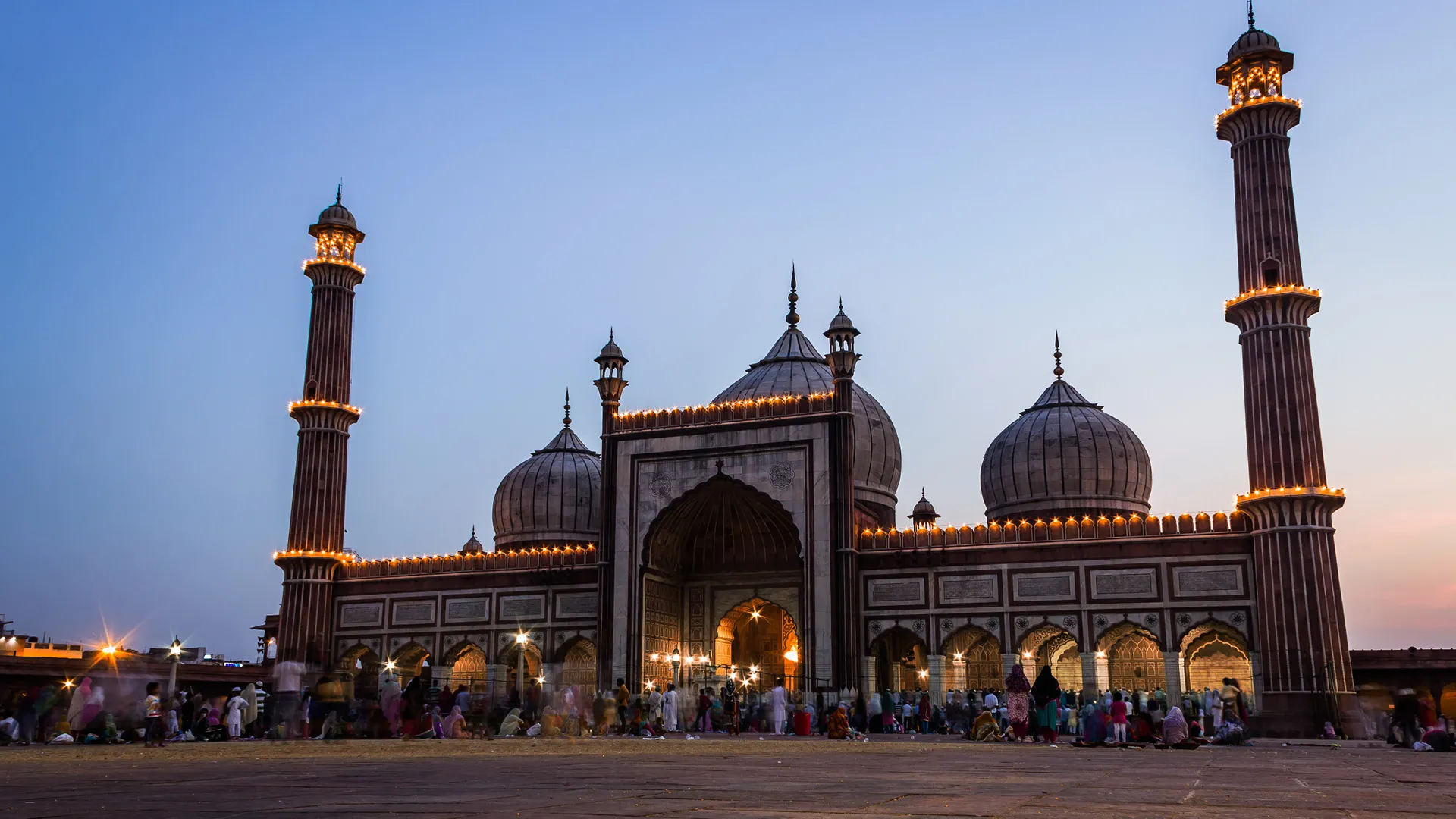
Running a complex film shoot across Mumbai and Delhi is, before it is anything creative, a logistics problem. Every frame in a big Indian city sits inside hard constraints — the distance between units, crowd density, traffic, power, weather and which authority holds jurisdiction over the location — and in a metro those constraints compound fast, so a small operational error early in the day becomes a lost afternoon by the end of it. This guide is about how the two cities actually differ as production environments, what that means for the line producer who has to deliver in both, and how complex multi-city shoots are planned and executed rather than improvised.
Mumbai and Delhi are the two poles of Indian production. They look different on camera and they behave completely differently on the ground, and a production that copies one city’s playbook in the other gets caught out. The cities-as-profiles view sits on our multi-city line production overview; this page is the operational layer — the logistics, permits and crew movement that make a complex shoot in either city work.

Urban Filmmaking Is a Logistics Discipline
Large-city filmmaking is a logistics discipline wearing a creative costume. The visible output is the frame; the thing that actually determines whether the frame gets shot is the infrastructure around it — how far the unit has to move, how dense the crowd is, whether power and parking are available, how the traffic behaves at the hour of the shot, and which police or civic body controls the space. Because delays in a metropolitan region do not add but multiply, the productions that succeed are the ones that model these variables in advance rather than hoping for flexibility on the day. The line producer’s core job on a complex shoot is to remove that variance: to build a plan detailed enough that the difficult day has already been rehearsed on paper.
In practice that plan is concrete. It maps each location to its controlling authority and permit, sequences the shooting order around clearances and traffic windows rather than convenience, models unit moves and travel times at the actual hour they will happen, and identifies the fallback for every location and every approval that could slip. It also names who owns each problem on the day — the fixer for local access, the production manager for the unit, the line producer for the budget and the call. The cost of skipping this is not abstract: a permit that arrives a day late, a move that runs into rush hour, or a location that is double-booked can each cost a full day, and on a tightly budgeted shoot a lost day is rarely recoverable.
Mumbai vs Delhi: Two Different Logistics Problems
Both cities present complex filming conditions, but their operational profiles are opposites, which is why the strategy has to be built city by city rather than templated. Mumbai is a density-and-speed problem; Delhi is a structure-and-clearance problem.
That distinction is not a slogan; it changes where the planning effort goes. In Mumbai the scarce resource is time and movement, so the plan optimises routing, basing and the order of the day. In Delhi the scarce resource is permission, so the plan optimises the clearance path and lead times. A line producer who internalises which problem each city poses allocates the prep accordingly — and a production that does not tends to under-prepare exactly the part of the shoot that will hurt it.

Mumbai: Density, Speed and the Traffic Tax
Mumbai is India’s commercial production capital, and that concentration is its advantage: the largest pool of studios, suppliers, post facilities, casting and technical crew sits within the city, so turnaround is fast and a unit can be assembled and scaled quickly. The cost of that density is movement. Extreme traffic, limited parking, tight loading zones and packed locations mean that the time between setups, not the setups themselves, is where Mumbai schedules are won or lost. The city rewards precision — productions that invest in detailed advance modelling of routes, call times and unit moves consistently outperform those that arrive expecting to improvise. A Mumbai line producer plans the day around the traffic and the moves, then fits the creative into the windows that leaves.
The texture of the city compounds this. Mumbai’s working locations are spread from the studios and suburbs of the north to the heritage streets and sea-facing stretches of the south, and the gap between them is measured in hours at the wrong time of day, not kilometres. Public and street shooting brings in civic and police coordination, building societies and markets have their own gatekeepers, and the monsoon imposes a hard seasonal constraint on exteriors. A line producer who runs Mumbai regularly bases the unit to minimise the worst moves, batches locations by area and time, and keeps the studio fallback live for the days the city or the weather refuses to cooperate — so the schedule bends without breaking.


Delhi and NCR: Bureaucracy, Heritage Governance and Visual Range
Delhi works the opposite way. Where Mumbai’s filmmaking culture is woven into the city’s rhythm, Delhi runs through layered administrative structures and heritage governance, and it is a more regulated environment to shoot in. Its compensation is range: imperial-era monuments, formal institutional zones, modern corporate corridors in Gurgaon and Noida, industrial districts and informal settlements all sit within an hour of each other, which gives a production extraordinary location-substitution flexibility. The catch is that this range is gated by permits and jurisdictions, so urban sequencing in Delhi has to follow the clearance structure rather than the map. A Delhi line producer plans the permit path first and the shooting order second, because in this city the binding constraint is approval, not access.
The NCR scale adds to this. Gurgaon and Noida extend the city into corporate and modern environments that read as contemporary Asia, but they bring their own private-estate and authority permissions; central Delhi layers heritage, security and diplomatic-zone clearances on top; and government, monument and high-security locations each run on their own lead times that cannot be compressed at the last minute. A Delhi line producer therefore starts the schedule from the clearances — identifying which locations carry the longest or most uncertain approvals and locking those first — and treats the city’s extraordinary visual range as something that is unlocked by paperwork rather than simply available.
Production Geometry: the Mumbai Corridor vs the NCR Triangle
The two cities also have different production geometry, and it drives where a unit bases. Mumbai’s working locations string along a narrow, congested corridor from the southern tip to the northern suburbs, so units base to minimise a small number of punishing moves and accept that any cross-city hop is expensive in time. The Delhi–NCR triangle of central Delhi, Gurgaon and Noida is more dispersed but better linked by expressway, so clustering a day’s work within one node — a Gurgaon corporate day, a central-Delhi heritage day — and basing near it usually beats criss-crossing the triangle. Reading that geometry correctly is what decides where the unit stays and how the days are grouped.

Complex Execution in Practice: Three Case Studies
The difference between the two cities, and the value of planning over improvisation, is clearest in real execution. Three shoots illustrate the range of what a complex Mumbai–Delhi production has to manage.
A European Commercial in Gurgaon
A European lifestyle commercial needed a futuristic corporate look and used Gurgaon’s glass skyline as the backdrop, doubling for an Asian metropolitan business district. The creative ambition — clean, scaled architectural frames — collided with the reality of a live commercial district, so the execution turned on control: timed road management and foot-traffic suppression to clear the frame, tight scheduling around the building owners’ and authorities’ windows, and a unit move plan that kept an international crew productive in an unfamiliar environment. The lesson is that a stand-in location only works if the logistics behind the illusion are engineered as carefully as the shot.
For an international crew the logistics layer was as important as the control. Equipment had to clear and move to an unfamiliar location, local crew had to integrate with the visiting team at the visiting team’s pace, and the whole day had to be costed and run against an agency budget that left little room for an over-run. That is the recurring shape of corporate-stand-in work in the NCR: the frame is achievable, but only if the road management, the building access, the crew integration and the schedule are planned as one operation rather than solved on the morning of the shoot.
A Documentary in Chandni Chowk
Chandni Chowk — one of the oldest continuously operating commercial streets in Asia — is among the most sensitive filming environments in India. The roads are narrow, pedestrian density is extreme and commerce never stops, so control cannot be blunt; it has to be surgical, working with the life of the street rather than trying to shut it down. A documentary shoot here depends on local coordination, a light and mobile unit, careful crowd handling that keeps both the production and the public safe, and a schedule that reads the rhythm of the market. It is the clearest example of a location where a heavy, feature-style footprint simply fails and an experienced fixer-led approach succeeds.
The control problem here is human, not technical. Filming has to coexist with thousands of people going about their day, with shopkeepers, handcarts and traffic that will not and should not stop for a camera, so the production works in small, mobile pods, secures the specific frames it needs with local agreement, and keeps a light enough footprint that it never becomes a safety or public-order problem. A line producer staffs this kind of shoot for agility — strong local coordination, a compact crew, clear safety management — and schedules it around the rhythm of the market rather than imposing a film unit’s rhythm on the street.

Government-Permit Filming at India Gate
Filming at India Gate is one of Delhi’s most regulation-heavy tasks, because the zone carries national-heritage status, security sensitivity and ceremonial significance at once. Approvals have to align precisely with procedure, which means creative ambition has to be reconciled with administrative feasibility from the first plan, not negotiated on the day. For an international tourism film, the line producer’s work is largely upstream — securing the right clearances in the right order, scheduling around security and ceremonial constraints, and keeping the on-ground footprint within what the permissions allow — so that the shoot day itself is uneventful. At sites like this, the permit plan is the production plan.
The execution risk at such sites is almost entirely upstream. If the clearances are complete and correctly sequenced, the shoot day is calm; if they are not, the unit is simply turned away, and there is no on-the-day workaround for a missing government permission. So the line producer front-loads the effort — lodging applications early, confirming the conditions attached to each, and aligning the shooting plan to security and ceremonial schedules — and treats the on-ground shoot as the easy part. Heritage and high-security filming rewards patience and procedure far more than improvisation.

Coordinating a Multi-City Shoot
When a single production runs across both cities, the logistics stop being two separate problems and become one integrated one. The line producer is then coordinating not just within each city but the movement and continuity between them.
Two separately managed city units, each optimising for itself, make decisions that conflict at the seams — a move scheduled into the wrong window, a crew booked twice, a clearance assumed by both and arranged by neither. One producer holding both cities sequences them as a single timeline, so the production flows from one to the other instead of restarting at each.
Crew and Equipment Movement
Moving a production between Mumbai and Delhi is a planned operation, not a booking. Crew, camera, lighting and grip packages have to be routed by air or road on a timeline that aligns with the shooting order in each city, with continuity of key crew across the move and contingency for the things that delay freight and people. The decision of what travels with the unit and what is sourced fresh in each city is itself a cost-and-time lever — both Mumbai and Delhi have deep local crew and rental, so a smart plan re-crews locally where it can and moves only what genuinely has to travel. Getting that split right is the difference between a smooth multi-city schedule and one that loses days to transit.
Continuity is the other half of the problem. Key creative and department heads usually travel with the production to hold the look and the working method consistent across cities, while the broader crew is re-sourced locally; the line producer manages that hand-over so the second city does not start from zero. Accommodation, per diems, unit transport and the timing of the move all have to be budgeted alongside the freight, and a buffer built in for the reality that flights, road transport and equipment clearances do not always run to plan. Treated as a single routed operation, the Mumbai–Delhi move is routine; treated as an afterthought, it is where multi-city budgets quietly overrun.
Air Freight, Road Freight and Equipment Transfer
The most under-planned part of a Mumbai–Delhi production is the physical movement of equipment, and it rewards real expertise. The first decision is air versus road. Air freight or excess-baggage cargo moves a package between the cities in hours but carries cost, weight limits and handling risk; road transport is cheaper and skips airport handling but takes a day or more and exposes the kit to the journey. In practice, camera, lens and grip packages tend to fly with or just ahead of the unit, while bulkier lighting and rigging often go by road on a staggered schedule so the gear lands before the crew. Lithium batteries are their own constraint — air-cargo rules limit how they travel, so battery logistics are planned separately rather than assumed onto a passenger flight.
Same-day transfers are possible but fragile: a production that needs a package in Delhi the morning after a Mumbai wrap builds in a buffer, or duplicates the item locally, rather than betting the schedule on one flight. The line producer plans this freight chain — what flies, what drives, what is re-rented in each city, and when each has to leave — with the same rigour as the shooting schedule.
Budget and Contingency Across a Complex Shoot
The distinctive budgeting risk on a Mumbai–Delhi shoot is that the two cities push on each other: a clearance that slips in Delhi or a weather day in Mumbai does not just cost that day, it compresses the window in the other city and the freight and crew moves booked around it. So the contingency cannot be held city by city; it has to be managed across the whole production as one timeline, with the move dates and the most uncertain clearances treated as the load-bearing points where a slip propagates. That cross-city interaction — not the individual permit or weather day — is what makes complex-shoot budgeting different from a single-city one.
The Line Producer Across Two Cities
Holding a complex Mumbai–Delhi shoot together is, in the end, a single accountable role. The line producer carries the budget across both cities, runs the permit path in Mumbai and the clearance structure in Delhi, supervises the local fixer and crew layers in each, manages the movement between them, and keeps the schedule and the contingency intact when one city’s constraints push on the other. City-specific execution sits on our line producer in Mumbai and line producer in Delhi pages; what this page describes is the discipline that connects them — treating a multi-city Indian shoot as one engineered operation rather than a set of separate bookings. That, more than any single location, is what makes a complex production deliver on schedule and on budget.
