

For an international production, line production Turkey combines budget control, permit sequencing, Turkish crew, equipment and multi-city logistics within one operating plan. Global Producers coordinates international productions through a line producer Turkey desk and film fixers in Turkey working across Istanbul, Cappadocia, Antalya and the Aegean. The line producer holds the budget, schedule, vendor plan and reporting line, while the fixers coordinate national and local permit applications, locations, Turkish crew, equipment and daily execution.
Exchange-rate movements affect a Turkey budget and need to be budgeted rather than assumed. A production working in USD or EUR converts crew, equipment and location costs at the rate in force, which changes over a schedule. The practical discipline is to fix quotes with validity dates, lock key vendor rates early and hold a currency contingency, so a favourable rate is captured rather than assumed to hold across a long schedule.
This guide covers what a line producer Turkey engagement actually involves, and what film fixers in Turkey handle on the ground: which territories work for which briefs, how permits move through the Directorate General of Cinema and the relevant location authorities, how crew and equipment are sourced, what the incentive structure looks like in practice, and what to check before committing to a line producer or fixer here.

Filming Environments and Stand-In Range
Turkey’s location range is the primary reason repeat productions return. The country is not a single visual environment but a compressed collection of distinct territories, each with its own permit structure, crew base, and production rhythm. Understanding the range before committing to a Turkey engagement is how you avoid costly re-scouting mid-prep. Productions that arrive with a single visual reference and discover mid-scout that their brief requires three separate permit authorities across two regions are productions that could have structured their schedule correctly from week one of pre-production, had they engaged a line producer with Turkey territory knowledge at the outset.
The stand-in range is equally significant for productions planning multi-territory shoots. Istanbul’s Historic Peninsula doubles for the broader Eastern Mediterranean and historic Arab cities. Cappadocia proxies Mars, Central Asia, and ancient civilisations within the same shoot week. The Aegean coast carries the visual DNA of Greece, Southern Italy, and the Eastern Mediterranean without the cross-border logistics. Anatolia’s steppe and highland terrain covers Central Asian and historical briefs that would otherwise require travel to territories with heavier operational complexity. This compressed versatility is what keeps Turkey on the shortlist for productions that need multiple visual registers within a tight budget and schedule. For a location-by-location breakdown of these environments, see the filming locations in Turkey scouting guide.
Istanbul: European Quarter, Asian Side, and the Bosphorus
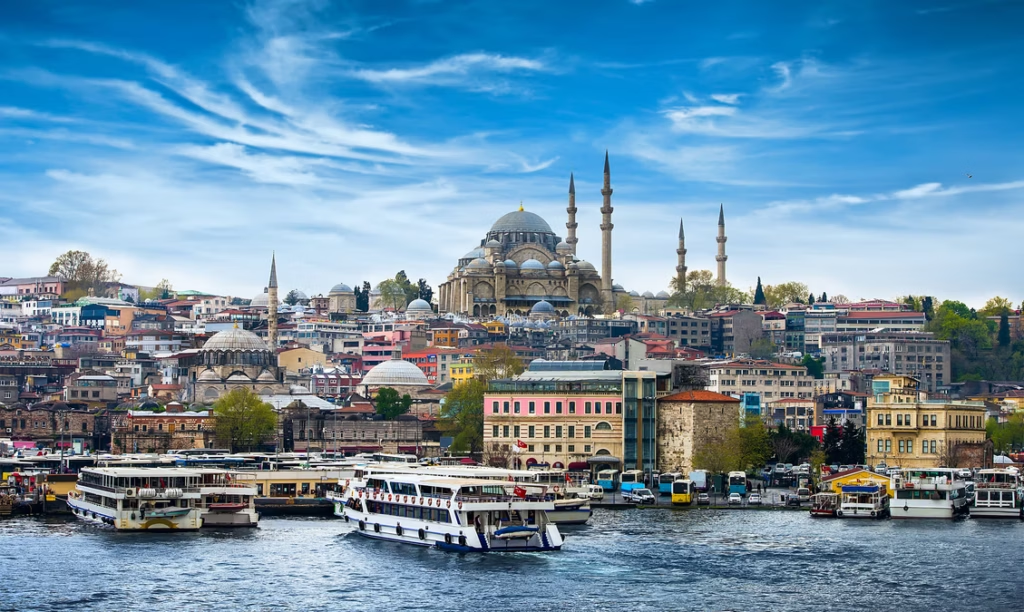
Istanbul operates across two continents and three distinct visual registers. The Historic Peninsula (Sultanahmet, the Grand Bazaar, Hagia Sophia, Topkapi Palace) carries the Ottoman and Byzantine visual language used in period productions and action sequences requiring layered architecture. Galata, Beyoğlu, and the backstreets of Karaköy deliver a grittier urban European feel that doubles effectively for Eastern Europe, the Balkans, or the broader Mediterranean. The Asian side (Kadıköy, Üsküdar, Moda) offers a quieter, less touristed visual register suited to character-driven sequences requiring Istanbul without the monument density.
The Bosphorus Strait is a category of its own. Shooting on or alongside the waterway requires coordination between the city’s Film Shooting Coordination Commission, the Turkish Coast Guard, and Istanbul Metropolitan Municipality depending on vessel size and proximity to bridges. Lead times for Bosphorus sequences depend on the setup and are confirmed per project; major bridge or vessel sequences can require additional SHGM (Directorate General of Civil Aviation) clearance if aerial coverage is part of the brief.

Cappadocia and the Anatolian Interior
Cappadocia’s fairy chimneys and volcanic valleys have hosted productions requiring otherworldly terrain, and multiple OTT originals have used the region for sci-fi and fantasy briefs. Permits for ground-level Cappadocia shoots move through the Nevşehir Governorate with Ministry of Culture overlay for heritage-classified formations. Hot air balloon coverage, which is frequently requested as establishing aerial, requires SHGM coordination and must be planned around the commercial balloon flight window (sunrise hours), a constraint that experienced line producers build into call sheets as standard.
Central Anatolia beyond Cappadocia (the steppe landscapes of Konya, the salt flats of Tuz Gölü, the highland terrain toward Erzurum) works for desolate, wide-horizon briefs. These interiors are significantly cheaper to access than Istanbul and carry fewer permit layers, but the crew and equipment logistics require careful pre-planning given the distance from Istanbul’s rental infrastructure. A line producer Turkey brief covering Anatolian locations will typically position base camp in Ankara or Kayseri for central supply.

Aegean and Mediterranean Coast
The Aegean coast (Çeşme, Bodrum, Kuşadası, the ruins at Ephesus) delivers classical Mediterranean visuals: turquoise water, white architecture, ancient stone. Ephesus, managed by the Ministry of Culture as a UNESCO heritage site, requires direct ministry approval, with lead times and any on-site heritage monitor confirmed per location. Coastal shoots outside heritage zones move considerably faster through local municipality permits, with lead times confirmed per project rather than fixed.
The Mediterranean stretch toward Antalya expands the palette further, limestone cliffs, dense forest, ancient harbour towns. Pamukkale’s white travertine terraces are Ministry of Culture territory requiring the same heritage overlay as Ephesus. Productions using these sites plan the permit track as a parallel workflow during pre-production, not a sequential step after location lock.

Line Production Turkey: Crew, Permits and Multi-City Execution
A line producer Turkey engagement covers the full execution layer, from location scouting and permit coordination through to crew hiring, vendor management, on-set oversight, and post-production wrap. The line producer is the single point of accountability between the international production company and the Turkish production infrastructure. Where a production needs the ground layer rather than the full desk, film fixers in Turkey deliver the same local knowledge on a narrower brief; a film fixer in Turkey coordinates location access, permit applications, local crew and equipment within an agreed field-support brief, without taking responsibility for the full production budget.
Productions that skip this layer and try to manage Turkish logistics directly from abroad can run into permit delays, budget overruns and vendor disputes that an experienced in-country operator is placed to anticipate and work through earlier. The same crews, permit desks and vendor networks that carry a film shoot also underpin event management in Turkey, where large-format launches, conferences and destination weddings in Istanbul, Ankara and Antalya draw on the identical on-ground logistics discipline.
The Turkish production service industry is mature and internationally experienced. Istanbul has been hosting major international productions for over three decades, and the institutional infrastructure around international filming (the Film Shooting Coordination Commission, Directorate General of Cinema permit procedures, established vendor networks) reflects that depth. What an international production company without Turkey experience typically underestimates is the institutional complexity, not the creative capacity. The logistical and permit coordination demands of a multi-location Turkey shoot require a line producer who knows the system well enough to navigate it on schedule, not someone learning it in real time on your production’s budget.
Film Fixer in Turkey: Location Access and Permit Coordination
A film fixer in Turkey coordinates location recce, site-owner discussions, application documents, local crew calls, vehicles and shoot-day access within the agreed scope. The fixer checks which authorities and property owners need to be involved and tracks outstanding permissions. Approval remains with the relevant authority; the line producer retains the agreed budget, schedule and production-control responsibilities.
For Istanbul public locations (streets, squares, waterfront and civic landmarks), access runs through the city’s Film Shooting Coordination Commission framework and the relevant municipality, transport body or property owner. Lead times depend on the location, the activity and the authorities involved, and should be confirmed rather than assumed from a single published window. Heritage sites within the Historic Peninsula require separate Directorate General of Cinema and Ministry approval on their own route; the city framework does not expedite Ministry approvals.
Fixers who have completed these applications before know the documentation each authority expects and prepare submissions that reduce avoidable omissions and track each one to a decision. A production without local support faces the full process cold, and may discover during prep that the permit window it assumed is unavailable because of prior bookings or seasonal restrictions at busy heritage locations.
Crew, Equipment, and Production Vendors
Istanbul carries a professional crew ecosystem built on decades of international production activity. Camera, lighting, grip, and sound departments sourced locally are technically competent for international specifications. Senior Turkish HODs with international credits are available, having worked on European, US and Middle Eastern productions with an understanding of international workflow standards. Equipment rental infrastructure is concentrated in Istanbul, with secondary rental capacity in Ankara and Izmir for productions working in those regions.
For productions based significantly outside Istanbul (Cappadocia-heavy schedules, Anatolian interior briefs) the line producer plans equipment trucking from Istanbul as the baseline, with local grip and transport supplemented from Kayseri or Nevşehir. Specialist equipment for aerial, underwater, or high-speed applications is sourced through Istanbul with advance booking; last-minute sourcing of specialist gear outside Istanbul is high-risk. The line producer locks all vendor agreements before the production travels, not after arrival in region.
Permits, Compliance, and Production Logistics
Turkey’s permit structure operates through several parallel tracks: the Directorate General of Cinema national permit; the relevant provincial, municipal, public-institution or property-owner approval; any separate heritage or protected-site consent; and SHGM approval for aerial work. These tracks remain independent and must be sequenced together from pre-production.
Each track has its own authority, timeline and documentation. A production that holds the national permit and a heritage approval but has not applied for the public locations around that site can find itself with site access and no street access, so the tracks are opened together from the start.

Ministry of Culture Permits and Heritage Filming
Many UNESCO and nationally heritage-classified sites (Hagia Sophia, Topkapi Palace, the Blue Mosque interior, Ephesus, Pamukkale, Göbekli Tepe, and Cappadocia’s classified formations) are permitted through the Ministry of Culture and Tourism, but the exact authority, access conditions and any on-site monitoring depend on the particular site. Applications require a production brief, script extracts or treatment, location plan, equipment list, insurance certificates, and production company registration documents. Ministry review timelines vary by site and season and are confirmed per application; peak summer season (June–August) and major heritage locations in tourist season can extend them. Productions that plan around Ministry permit timelines, submitting applications in the first week of pre-production, avoid the most common Turkey scheduling failure: locked shoot dates without confirmed heritage access.
Some protected-site approvals may require an on-site authority representative or heritage monitor. Whether one is required, who appoints that person and what conditions apply must be confirmed with the authority controlling the location. Crew departments should be briefed on all monitoring, lighting and rigging restrictions before shoot day.
National Permit, Location Approvals and Aerial Tracks
Foreign producers filming commercially in Turkey apply to the Ministry of Culture and Tourism’s Directorate General of Cinema for the national filming permit. Applications must be filed at least ten working days before filming, and the production must engage at least one Turkish citizen as a host, who must be present during filming, and engaging a company established in Turkey does not remove this requirement. The national permit does not replace permissions from the authority controlling the location: Istanbul public-space filming follows the city’s current Film Shooting Coordination Commission framework and the requirements of the relevant municipality, transport body, public institution or property owner, while museums, archaeological sites, active religious buildings, protected landscapes and other controlled locations retain their own approval routes.
Aerial work, drone operations and balloon filming require the applicable SHGM and airspace approvals, and these tracks should be opened alongside the filming and location applications rather than treated as one combined permit. Productions shooting outside Istanbul (Ankara, Izmir, Antalya, Konya) coordinate directly with the relevant Büyükşehir (Metropolitan Municipality) or Valilik (Governorate) depending on whether the location is municipally or state-managed. Published and first-hand planning allowances can guide the schedule, but final lead times must be confirmed against the specific locations, activity and authorities involved rather than assumed from a single published window. The line producer establishes the correct administrative contact for each location in the recce stage, not on arrival.
Multi-City Logistics and Shoot Scheduling
The Istanbul–Cappadocia–Aegean triangle is the most common multi-location Turkey configuration. Istanbul is the production base: crew accommodation, production office, equipment depot, and casting are all managed from Istanbul. Cappadocia is normally reached by air through Kayseri or Nevşehir, with equipment routed by road where required. İzmir and Antalya are served by domestic flights from Istanbul; final journey times and equipment movements should be confirmed against the live schedule during prep.
For film production services involving tight multi-city schedules, the line producer sequences the shoot to minimise company moves, typically anchoring Istanbul at the start and end of the schedule with regional moves in the middle, when the production is at full operational tempo and the move logistics are better absorbed. The sequence depends on the locations, crew and equipment availability, permissions and transport, and is set once those are known.
Budget, Incentives, and Hiring a Line Producer in Turkey
Turkey’s costs are compared against other locations by quotation for the same crew specification, equipment package and schedule rather than by rate card. Heritage-site and civic-location fees should be budgeted against current published schedules where available, while private-property charges and ancillary services remain project-specific. Equipment rental in Istanbul is quoted per package, with multi-day rate cards available for longer production weeks. The full day-rate, equipment and vehicle breakdown is set out on our cost of filming in Turkey page.
Catering, transport and accommodation for a crew based in Istanbul are quoted for the dates and standard required and included in the Turkey leg budget alongside crew, equipment and location costs. Turkey’s Foreign Film Production Support can reduce the net cost where a project qualifies.
Turkey’s Foreign Film Production Support
Turkey operates a Foreign Film Production Support programme rather than an automatic tax rebate. Support may not exceed 30 percent of expenditure in Turkey accepted by the Ministry. Applications are made by an eligible Turkish co-producer or production-services company, and the project must pass the programme’s 50-point qualification test and current minimum-spend requirements.
The published categories cover feature films, documentaries and series, and commercials and advertising productions fall outside the published categories. Current thresholds, eligible expenditure and the application and payment process are maintained on our Turkey film rebates and incentives page. An experienced line producer builds the supporting documentation into production administration from day one, so a qualifying project does not leave eligible support value on the table.
For MENA corridor planning that places Turkey within a wider regional strategy, see line producer Middle East.
Evaluating a Line Producer in Turkey Before Commitment
The selection criteria for a line producer Turkey engagement follow the same logic as any international territory, but Turkey’s specific permit structure and multi-institutional coordination requirements create some evaluation points that are Turkey-specific. A line producer who has not personally navigated a Directorate General of Cinema national permit, a municipal multi-location approval, and an SHGM aerial clearance in a single production is not carrying the full operational range that a complex Turkey brief requires.
Our Istanbul office also supports Turkish film remakes for producers evaluating Turkish-origin films and screenplays for adaptation in India, the US and UK.

Verification Criteria Before Commitment
Ask for three recent Turkey credits with references from the international production company (not the Turkish service company) who engaged them. Confirm they have filed city and municipal location permits and handled Ministry of Culture heritage permits within the past 18 months. Verify they have documented experience completing SHGM applications for aerial work if your brief includes drone or balloon coverage. Where incentive administration is handled by a third-party consultant rather than in-house, the service contract should clearly identify who controls eligibility assessment, documentation and audit responsibility for the support claim.
A Turkey film fixer can support the line producer with local application experience, crew coordination and vendor information. Any deputy role, spending authority or additional management responsibility is agreed for the project. The strongest Turkey engagements pair an internationally experienced line producer with a senior Turkish fixer carrying substantial Istanbul and regional production experience. That combination covers both the international production company’s reporting requirements and the deep local operational knowledge that Turkish permit structures, vendor networks, and on-ground logistics can demand from productions working here at scale. Whether a production books film production services in Turkey or line production services in Turkey, the requirement is the same: local knowledge held by one accountable team.
Send the shoot window, location shortlist and production format for an initial Turkey plan covering permits, crew, equipment, schedule and budget.
